
Disclosure: WebFin is reader-supported. If you buy hosting through links on this page, we may earn a commission at no extra cost to you. Commissions vary between providers and our ratings do not — here’s our full disclosure.
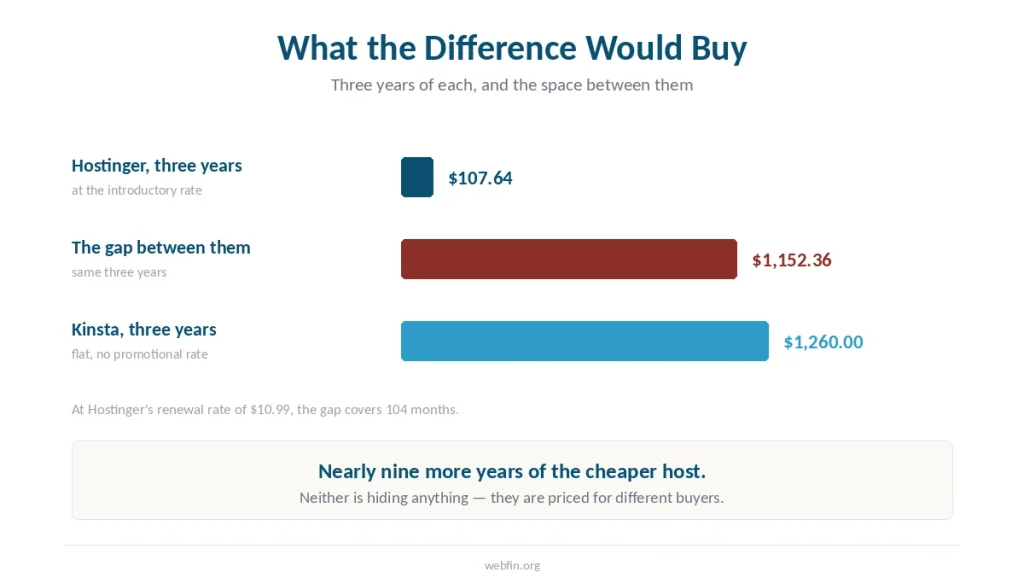
Over three years Hostinger costs $107.64 and Kinsta costs $1,260.00. The difference between them would pay for nearly nine more years of Hostinger at its own renewal rate.
If you are asking which of these two to buy, the answer is almost certainly Hostinger. Not because Kinsta is bad — it is excellent — but because the question itself suggests Kinsta was not built for you.
The Short Answer
Hostinger, 4.2 against 4.1, and by a margin the scores understate. For a personal site, a blog, a portfolio or a small business, twelve times the price buys capability that will sit unused.
Kinsta if you run client sites for a living, your visitors are in North America or Europe, and the dashboard and monitoring replace tools you would otherwise pay for separately.
Head to Head
| Hostinger Premium | Kinsta Starter | |
|---|---|---|
| Advertised | $2.99/mo | $35/mo |
| Renews at | $10.99/mo | $35/mo, unchanged |
| Three-year total | $107.64 | $1,260.00 |
| The gap | — | $1,152.36 |
| Origin TTFB | sub-480 ms | 525 ms |
| Edge-cached TTFB | not published | 25–42 ms |
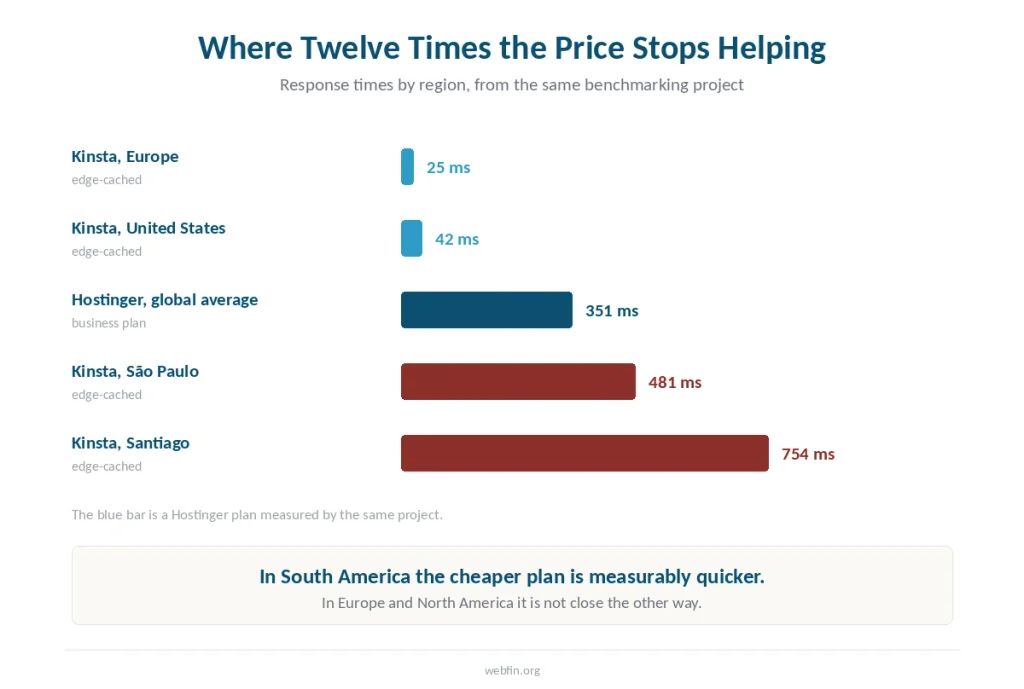
| Latin America | 351 ms global average | 481–754 ms |
| CDN | Add-on | Cloudflare Enterprise, included |
| Email hosting | Included | Not offered |
| Phone support | No | No |
| Our score | 4.2 | 4.1 |
The Price Gap Is the Story
Twelve times. That is the ratio at twelve months, at thirty-six months and at any point inside Hostinger’s promotional term.
Even past it, however, the arithmetic stays uncomfortable. Hostinger renews at $10.99; Kinsta charges $35 and always has. The ongoing difference is $24.01 a month, which over five years produces totals of $275.40 against $2,100.00.
⚠️ Neither host runs a promotional trap. Hostinger’s introductory rate expires after 48 months and is disclosed; Kinsta has no introductory rate at all. This is one of the few comparisons on this site where nobody is hiding a renewal — the full field is here.
Speed, and the Argument Nobody Frames Correctly
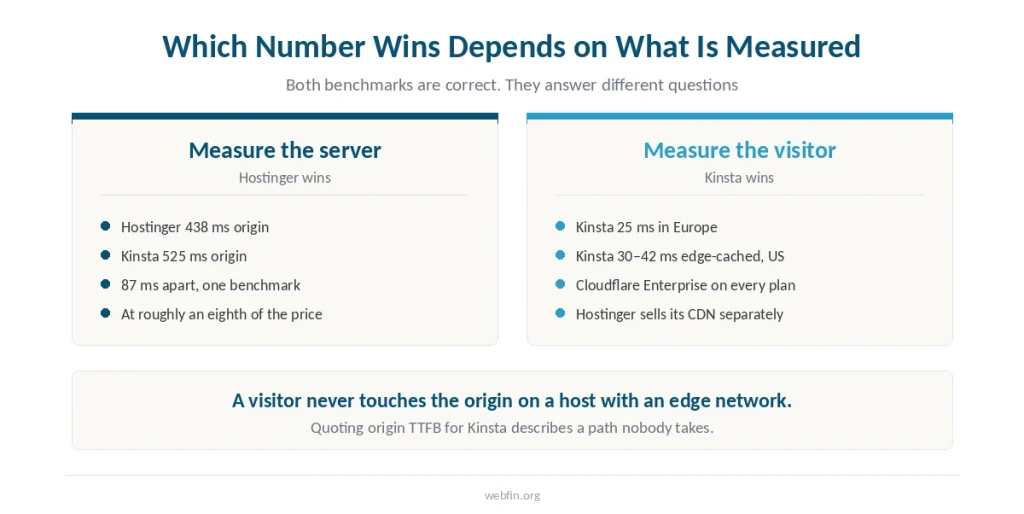
A long-running benchmark reaches a blunt conclusion about Kinsta: the premium outpaces the performance. It records Kinsta at 525 ms origin TTFB and Hostinger’s business plan 87 ms faster at 438 ms, for roughly an eighth of the price.
That comparison is technically correct and practically misleading, and it is worth understanding why before either host uses it in marketing.
Origin TTFB measures how fast the server answers when nothing is cached. Kinsta includes Cloudflare Enterprise on every plan, so a visitor almost never reaches the origin. Measured at the edge, Kinsta records 25 ms in Europe and around 30–42 ms in the United States — figures Hostinger does not match anywhere, because its CDN is an add-on rather than a default.
So the honest version is this. Compare the servers and Hostinger wins. Compare what a visitor experiences and Kinsta wins, provided the visitor is somewhere the network reaches.
⚠️ We introduced this distinction in our Kinsta review and it qualifies every speed figure on this site, ours included.
Where the Premium Stops Working
Geography, and in fact it is not a small exception.
The same benchmark that scores Kinsta well recorded 481 ms in São Paulo and 754 ms in Santiago, and concluded the CDN is not mitigating distance effectively for Brazil, Chile and Mexico. Hostinger’s business plan records a 351 ms global average in the same project.
In Latin America, the plan costing twelve times more is measurably slower. Not marginally — by a factor of two at Santiago.
For a North American or European audience, of course, this does not arise. For anyone else, it is the single most important line in this comparison.
Uptime
Both are strong, and in short the difference sits inside the noise.
Kinsta records 99.98% over an eight-month window and 100% across a separate project monitoring twenty live sites. Hostinger records 99.93% to 100% across seven projects, with downtime falling from 1,228 minutes in 2021 to 33 in 2025. Figures like these need a window beside them, which how to read an uptime report explains.
⚠️ The benchmark attributes one Kinsta dip in 2025 partly to a Cloudflare outage rather than to Kinsta. Building on someone else’s edge network means inheriting their bad days, which is a real consideration at this price.
What the Money Actually Buys
Setting price aside for a paragraph, though, Kinsta’s inclusions are genuinely substantial.
Cloudflare Enterprise on every plan, not sold as an upgrade. Application performance monitoring built into the dashboard, which is normally a paid third-party tool. Isolated containers, so a neighbor’s compromise cannot reach your site. Staging, automatic backups and free malware removal.
Hostinger’s list is shorter and cheaper. Email hosting included, WHOIS privacy included, a free domain on annual plans, LiteSpeed caching at the server level.
⚠️ Kinsta does not offer email hosting at all, which for a small business means another vendor and another bill. Hostinger includes it.
Support and Ownership
Neither has a phone line. Both run chat and tickets around the clock; Hostinger opens with an AI assistant that transfers you on request.
⚠️ Nobody publishes controlled measurement of support response times for any host, and for Kinsta we could not find even the consistent third-party description that exists for others. We scored that criterion conservatively in its review and we are not inflating it here.
Both are privately held, and both have a wrinkle. Hostinger states that a private equity firm holds around 30%. Kinsta’s funding history is reported two ways — some databases describe it as bootstrapped, others record a single round with one institutional investor — and we found no first-party statement resolving it.
Neither belongs to a portfolio that would put two names on your shortlist, which is more than can be said for much of this category.
Winners by Category
Three-year cost: Hostinger, by $1,152.
Origin speed: Hostinger, by 87 ms in one benchmark.
Edge-cached speed: Kinsta, comfortably.
Latin America: Hostinger, by a factor of two.
Included tooling: Kinsta, by a wide margin.
Email: Hostinger, by offering it.
Uptime: a draw.
Support: a draw, and neither is well documented.
Pricing honesty: a draw — neither hides a renewal.
When to Choose Kinsta Instead
You host client sites. The dashboard, the monitoring and the container isolation are built for people managing many WordPress installs, and they save real money against buying those tools separately.
Your traffic is North American or European and performance is revenue. Twenty-five milliseconds at the edge is not a rounding error on a store.
You already pay for APM, a CDN and staging. Add those up before comparing the sticker prices, and the gap narrows considerably.
Outside those, this is not a close decision, and we would rather say so than write a paragraph pretending both options suit everyone.
How We Research
Every figure comes from the two underlying reviews, where each is attributed to a named project with its window and — critically here — whether it measured origin or edge. Prices come from each company’s own pages. We run no tests of our own.
Our criteria are on our About page. The long version for the cheaper host is in our Hostinger review.
Frequently Asked Questions
Hostinger, by $1,152.36 over three years — $107.64 against $1,260.00. Besides, the ratio holds at twelve months too. Once Hostinger’s introductory term expires the monthly difference is $24.01.
For an agency running client sites, often yes: Kinsta includes Cloudflare Enterprise, performance monitoring and container isolation rather than selling them separately. For a personal site or small business, that capability goes unused.
It depends what is measured. One benchmark records Hostinger 87 ms faster on origin response. Measured at the edge with the CDN active, Kinsta records 25 to 42 ms, which Hostinger does not match because its CDN is an add-on.
No. Kinsta does not offer mailboxes, so email requires a separate provider and a separate bill. Hostinger includes email hosting in the plan price along with WHOIS privacy and a free domain on annual plans.
Neither. Both run chat and tickets around the clock. Hostinger opens with an AI assistant that transfers you to a person on request, usually within about two minutes.
The Verdict
Hostinger, 4.2 against 4.1, and for most readers this is not close.
Twelve times the price is not a premium. Instead, it is a different category of purchase. The difference alone would fund nearly nine more years of Hostinger at its renewal rate.
Kinsta is not overpriced for its buyer. An agency running twenty client sites gets tooling, isolation and an edge network that would cost more assembled separately. It is overpriced for everyone else, and the storefront does not draw that line, so we will: if you are comparing these two on price, you have already answered the question. Our page on Kinsta for Drupal covers where to get an edge network without leaving Drupal.