
Disclosure: WebFin is reader-supported. If you buy hosting through links on this page, we may earn a commission at no extra cost to you. Commissions vary between providers and our ratings do not — here’s our full disclosure.
WebFin runs on Hostinger. We pay for the plan ourselves, we bought it before this site existed, and we have received no discount or other consideration from them. It does not change how they are scored, and it does not change the section below where we say what we do not like.
Hostinger is the cheapest way to get a competent WordPress host, and the published test data broadly agrees. What that data also shows, once you line up seven testing projects side by side, is something none of them says out loud.
The uptime figure depends mostly on how long the tester watched. Thirty-day tests report 100%. Ninety-day tests report 99.94%. Six-month tests report 99.93%. That is not seven disagreements about Hostinger. It is one fact about testing windows, and it is the most useful thing in the whole dataset.
Is Hostinger Good in 2026?
Yes, for the money. LiteSpeed servers and NVMe storage produce TTFB between 180 and 420 milliseconds depending on where you are measured from, uptime sits between 99.93% and 100%, and the entry plan renews at $10.99 a month. The catch is the term: the advertised rate needs four years paid upfront. Our comparison of Hostinger against GreenGeeks prices the two side by side.
At a Glance
What works
- Independently measured TTFB well under the 600 ms Google treats as acceptable
- Long-term monitoring shows downtime falling year over year, not drifting
- hPanel is built in-house and is genuinely easier than cPanel for a first site
- Live chat answers in around two minutes across several independent accounts
- Renewal multiplier is among the lowest on shared hosting
What does not
- The advertised price requires a 48-month prepayment
- No phone support at any tier
- Support routes through an AI assistant before a human
- Resource limits are not published anywhere — you see your quota after buying
Speed
Every figure here comes from a named testing project, with its method and its date. We run no tests of our own.
Cybernews monitored Hostinger for over two weeks in June 2026 using Grafana k6 and recorded a TTFB of 707 milliseconds, down from 1.208 seconds in December 2025, with a Speed Index of 1.43 seconds and average server response of 246 milliseconds.
Hostingstep has accumulated more than 564,000 tests since 2021 using Pingdom from nineteen North American locations at sixty-second intervals. It reports sub-480 ms TTFB from those North American probes and ranks Hostinger Business fifth of thirty-four WordPress hosts tested in 2026. The same project ranks Hostinger Premium twenty-eighth of the same thirty-four, because Premium ships without a content network: global TTFB comes to 223 ms on Business against 495 ms on Premium.
TechRadar ran ten weeks of monitoring and recorded a Largest Contentful Paint of 0.607 seconds, second fastest of fifteen hosts.
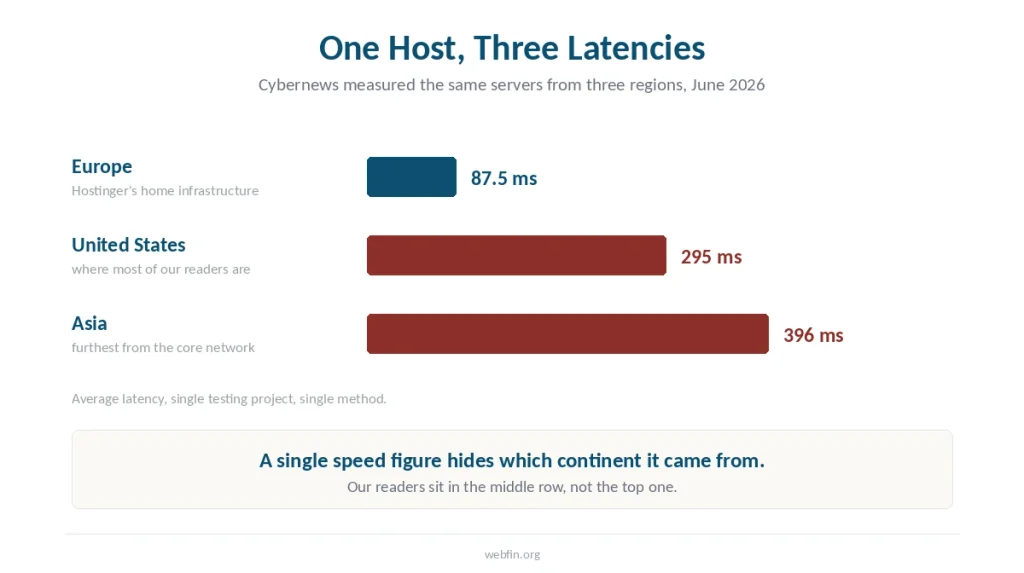
⚠️ Location changes the answer more than the plan does. Cybernews measured average latency of 87.5 ms in Europe, 295 ms in the United States and 396 ms in Asia. MetaWingz recorded 420 ms TTFB from a US-East probe against 180 ms from Europe. Hostinger is a Lithuanian company with European infrastructure at its core, and the flattering numbers tend to come from European probes.
Uptime
Here is the pattern worth understanding before reading any hosting review, ours included.
| Tester | Window | Result |
|---|---|---|
| HostAdvice | 30 days, 8,640 checks | 100%, zero incidents |
| Website Planet | 1 month, hourly | 100% |
| Cybernews | 2+ weeks | 100% |
| TechRadar | 10 weeks | 100% |
| MetaWingz | 90 days, 1-minute intervals | 99.94%, four incidents |
| HostPro Reviews | 6 months | 99.93%, about 2.6 hours down |
| Hostingstep | since 2021, continuous | 99.99%, 33 minutes down in 2025 |
The short windows are not wrong. They are short. A host with 33 minutes of downtime across a year will show 100% in almost any thirty-day sample, because thirty days is not long enough to contain the incident.
So a review advertising “100% uptime in our testing” is telling you the test lasted a month. It is not telling you the host never goes down.
What the long data does show is direction. Hostingstep’s dataset records total downtime falling from 1,228 minutes in 2021 to 75 in 2024 and 33 in 2025, with outages down from twenty-three to eleven. Whatever changed in the infrastructure between 2023 and 2024 worked.
Support
Live chat and email, twenty-four hours, in more than ten languages. No phone support at any tier, which is the single most common complaint and a real one if you prefer talking to typing.
Chat opens with an AI assistant called Kodee. Typing “human” or “agent” transfers you. Independent accounts consistently report waits under two minutes to reach a person; one thirty-day test recorded about 45 minutes for an emailed ticket, which is fast for the category.
⚠️ Response times here come from published reviews rather than a controlled study. Nobody publishes support benchmarking with the rigor that uptime gets, so treat this criterion as the softest of the five.
Price and Renewal
The Premium plan advertises at $2.99 a month and renews at $10.99 — a multiplier of 3.7, which is modest for shared hosting. Compared against the field, only Bluehost’s longest term comes lower; Bluehost belongs to Newfold Digital.
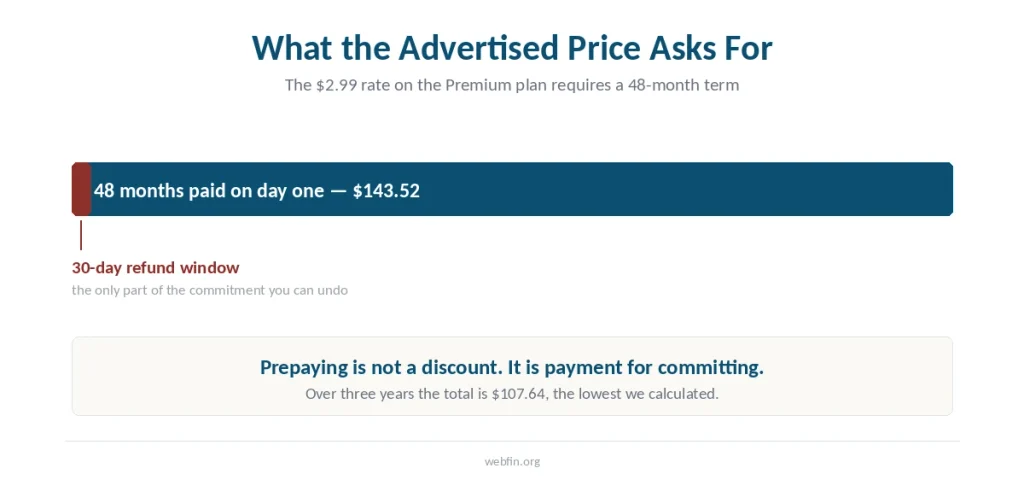
The catch is the term. That $2.99 requires a 48-month commitment, $143.52 paid on day one. Over three years that works out to $107.64, the cheapest total in our comparison — but you are committed for a fourth year you have already paid for, and the refund window is thirty days regardless.
A free domain comes with annual plans and WHOIS privacy is included rather than sold, which is not true everywhere. Migrations are free and unlimited as well.
⚠️ The resource limits are not published. Hostinger’s own inode article explains what inodes are and how to reduce them, but gives no number and tells you to check your dashboard — which opens after payment. We wrote about that separately, and it is the clearest thing Hostinger does worse than Bluehost, which prints its figures even when they contradict each other.
Ease of Use
hPanel is Hostinger’s own control panel, not cPanel, and that is a deliberate choice rather than a cost saving. It is lighter, the WordPress install is genuinely one screen, and a first-time buyer will find it easier than the industry standard. For a first site, the best hosting for beginners weighs it against four alternatives.
The trade-off arrives if you ever migrate. cPanel knowledge transfers between hosts; hPanel knowledge does not, and neither do cPanel-based tutorials, which is most of them.
Who Owns It
Hostinger is privately held and states its own ownership plainly. Its FAQ says ConHostinger, a private equity company, controls around 30% of the stakes, with the remainder private. Headquarters in Vilnius, offices in Kaunas and Yogyakarta.
The company was founded in Kaunas in 2004 as Hosting Media and renamed in 2011. Hosting24 and Niagahoster are subsidiaries. Reported revenue was €275.4 million in 2025 with more than a thousand employees.
⚠️ Several reviews still describe Hostinger as employee-owned. That is out of date, and the company’s own FAQ contradicts it. Unlike most hosts, Hostinger owns its infrastructure rather than reselling, and hPanel, the site builder and the CDN are built in house.
Hostinger also appears on the WordPress.org recommended hosts page, alongside Pressable and Bluehost — what that listing actually means is worth reading before treating it as an endorsement.
What We Don’t Love
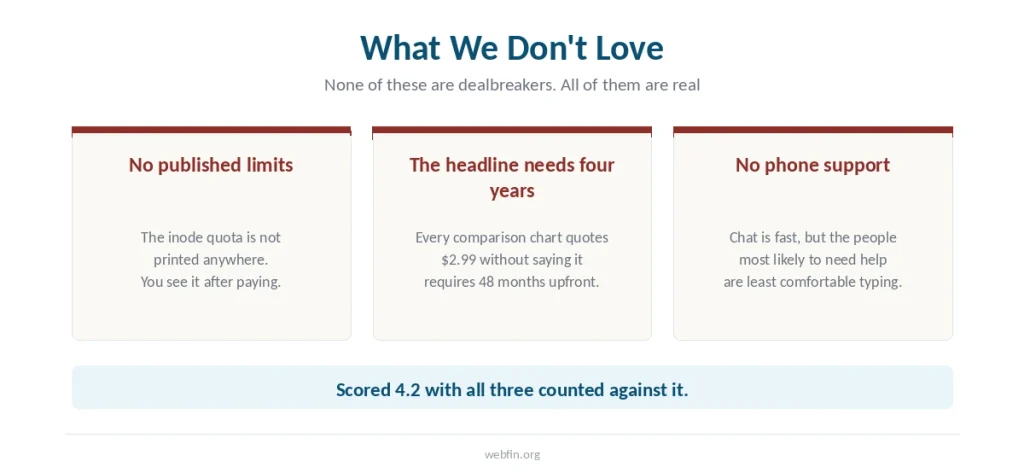
No published resource limits. You cannot know your inode quota before paying. Bluehost publishes three contradictory figures; Hostinger publishes none, and it is not obvious which is worse.
The 48-month price is the headline price. Every comparison chart in this category quotes $2.99 without stating that it requires four years upfront, and Hostinger’s storefront does not go out of its way to correct them.
No phone support. For a host aimed at first-time site owners, the absence of a voice channel is a real gap. Chat is fast, but the people most likely to need help are the ones least comfortable typing a technical problem.
How We Research
We do not run speed or uptime tests. Every performance figure above is attributed to a named testing project with its window and method stated, because a number without a window is not evidence. Ownership and pricing come from Hostinger’s own pages, read on 31 August 2026. Where reviews disagree with the company’s own statements, we say which is which.
Our five criteria and how they are weighted are published on our About page, along with the reasons a provider outside our top five can score higher than one inside it.
Frequently Asked Questions
Yes, for a budget host. LiteSpeed servers with built-in caching remove the need for a separate caching plugin, and independent monitoring puts TTFB comfortably under Google’s 600 ms threshold. Hostingstep ranks Hostinger Business fifth of thirty-four WordPress hosts tested in 2026, and Hostinger Premium twenty-eighth. The difference is the content network, which Premium omits.
Independent results range from 99.93% to 100%, and the difference is mostly test length rather than performance. The longest continuous dataset records 33 minutes of downtime across 2025, down from 1,228 minutes in 2021.
It is privately held. The company’s own FAQ states that ConHostinger, a private equity firm, controls around 30% of its stakes. It was founded in Kaunas, Lithuania in 2004 as Hosting Media and renamed Hostinger in 2011.
No. Support is live chat and email only, available around the clock in more than ten languages. Chat begins with an AI assistant; typing “human” or “agent” transfers you to a person, usually within about two minutes.
The Premium plan renews at $10.99 a month. The advertised $2.99 rate applies to the first term only and requires a 48-month commitment, which means $143.52 paid on day one.
Hostinger
Summary
Fast, cheap and honest about most things — except what you have to commit to in order to get the advertised price.
The Verdict
Hostinger earns 4.2, and the number is held down by one thing: what you have to commit to in order to get the advertised price. The hosting itself is better than its price suggests.
Choose it if you want the lowest realistic three-year cost, your audience is European, and paying four years upfront does not frighten you. Our page on Hostinger for Joomla covers the simplest of the platform cases.
Skip it if you need phone support — one registrar answers it in more countries than most, you want to know your resource limits before paying, or your traffic is mostly American — in which case the TTFB advantage narrows considerably. We put it head to head with SiteGround on exactly those points.
Consider instead: Cloudways if you would rather pay a flat rate and never think about renewal, or SiteGround if you want phone support and every resource limit published up front.