
Disclosure: WebFin is reader-supported. If you buy hosting through links on this page, we may earn a commission at no extra cost to you. Commissions vary between providers and our ratings do not — here’s our full disclosure.
Do you need a dedicated server? For most websites, no. It gives you a whole physical machine with no neighbors. That matters when you need guaranteed hardware, strict isolation or software that will not run on virtual machines. For a busy site that is simply slow, however, a larger VPS or a cloud plan usually solves the problem for less.
This guide sets out what a dedicated server adds, the signs that you have outgrown the alternatives and what to check before you rent one.
What a Dedicated Server Gives You
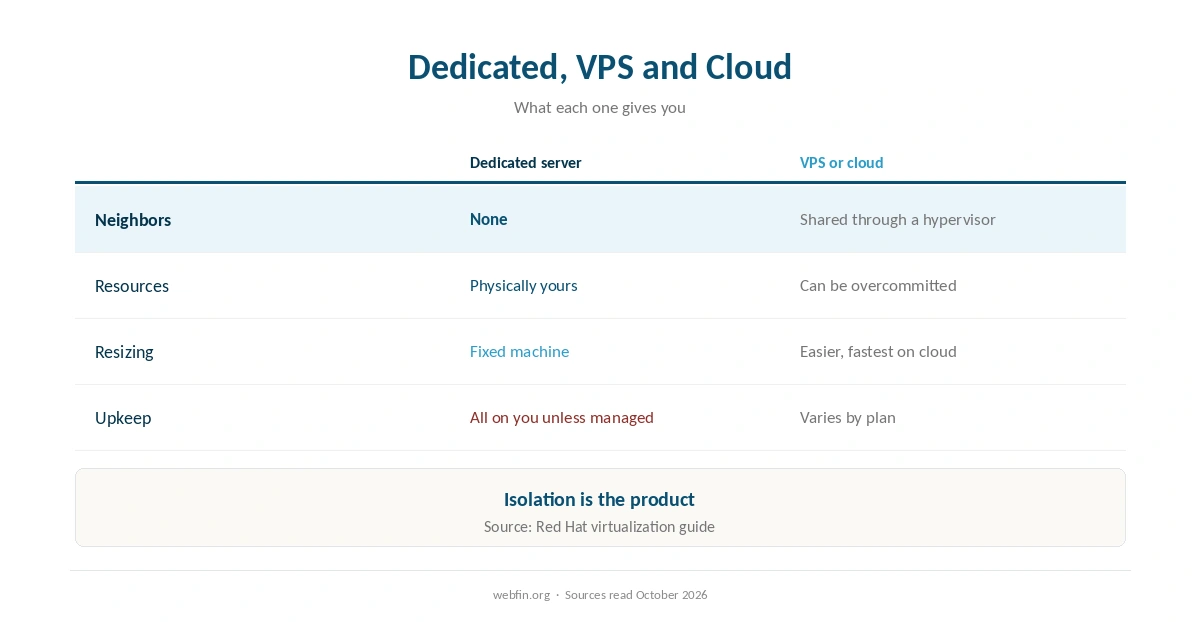
On a VPS, a hypervisor shares one machine between several customers. Red Hat’s documentation even notes that the hypervisor can overcommit processors and memory, promising more than the machine physically has. A dedicated server removes that layer of sharing: the processors, memory and disks are yours alone.
That brings three real gains. First, performance does not depend on neighbors. Second, you can choose the operating system and even the hardware. Third, isolation is physical rather than virtual, which some compliance rules require.
Do You Need a Dedicated Server or a Bigger VPS?
A whole machine and a large VPS often look similar on paper. The difference is what happens under load: on a VPS, a busy neighbor can slow you down, while on a machine of your own the capacity stays yours.
Even so, a well-run VPS host rarely overcommits enough to hurt a normal site. Our guide to VPS hosting explains what “dedicated resources” on a VPS really mean, and our shared vs VPS guide covers the step before.
Dedicated Servers Against Cloud Hosting
Cloud hosting answers a different problem. It lets you resize quickly and pay for use, which suits a load that rises and falls. A rented machine, by contrast, is fixed: you pay for it whether it is busy or idle.
Our dedicated vs cloud guide weighs the two directly, and our guide to cloud hosting explains what the cloud label should mean.
Five Signs You May Need One
First, your VPS is maxed out even after caching and database fixes. Second, measured response times swing with no change on your side, which can point at neighbors. Third, a compliance rule requires physical isolation.
Fourth, your software needs hardware a virtual machine cannot offer, such as a specific processor or very large memory. Fifth, your load is steady and high. In that case, a whole machine can cost less than cloud capacity by the hour.

Try These Fixes First
Most slow sites have a cause that a bigger machine will not fix. Before renting a dedicated server, test from a nearby location with the tools in our guide to website speed test tools.
Then check whether the host is limiting you, as our guide on checking whether your host is throttling you explains. A traffic spike, meanwhile, is a job for caching, which our guide on handling a traffic spike covers.
Managed or Unmanaged Dedicated
A machine of your own comes with more work than any other kind of hosting. Updates, security, monitoring and backups all fall to you unless the host manages the machine.
That is why a managed dedicated plan is the usual choice for a business without a systems administrator. Our guide to managed hosting explains what the host takes on, and our managed vs unmanaged guide weighs the trade.
What to Check Before Renting One
Read three things on the plan page: the hardware you actually get, who handles the operating system and how backups work. Hardware can be older than the price suggests, so ask for the processor model and drive type.
Backups matter more than usual, because a hardware failure takes the whole machine. Our guide to website backup services covers the off-site copy you should keep regardless.
Who Needs a Dedicated Server
Large stores with steady, heavy traffic, software platforms with strict compliance rules and teams running specialist software are the natural customers. Our guides to high-traffic hosting and hosting for SaaS startups cover those cases.
Everyone else will usually do better on a VPS or a cloud plan, and can move up later. Our guide on moving from shared hosting to a VPS covers that first step.

How We Research
We run no tests. The description of hypervisor overcommitting comes from Red Hat’s virtualization guide, and Liquid Web’s plan structure comes from our TablePress tables, checked against its plan pages in September 2026.
We hold no verified prices for dedicated servers in our tables, so we do not print any. The criteria behind our scores are on our about page, and our Liquid Web review covers one dedicated host in depth.
Dedicated Server FAQ
Usually not. A larger VPS or a cloud plan solves most busy-site problems for less, unless you need physical isolation or special hardware.
A VPS shares one machine through a hypervisor, which can overcommit resources; a dedicated server gives you the whole machine.
When your load is steady and high, so paying for a whole machine costs less than paying for cloud capacity by use.
If nobody on the team runs servers, yes. Updates, security and backups are otherwise all yours.
The actual hardware, who manages the operating system and how backups work, including an off-site copy.
The Verdict
A dedicated server is the right answer to a narrow set of problems: physical isolation, special hardware or steady, heavy load. For those, nothing else fits as well.
For most sites, though, the problem is caching, the database or distance. Fix those first, then move to a bigger VPS or a cloud plan before you rent a whole machine.