
Disclosure: WebFin is reader-supported. If you buy hosting through links on this page, we may earn a commission at no extra cost to you. Commissions vary between providers and our ratings do not — here’s our full disclosure.
“Managed” has no standard definition in hosting, which is why two plans at the same price can mean different things. One host patches the operating system and answers at three in the morning. Another installs a panel and calls it managed. So the useful move is to stop reading the adjective and ask for the list, and our tables show how rarely any of it is committed in writing.
Managed vs Unmanaged: The Short Answer
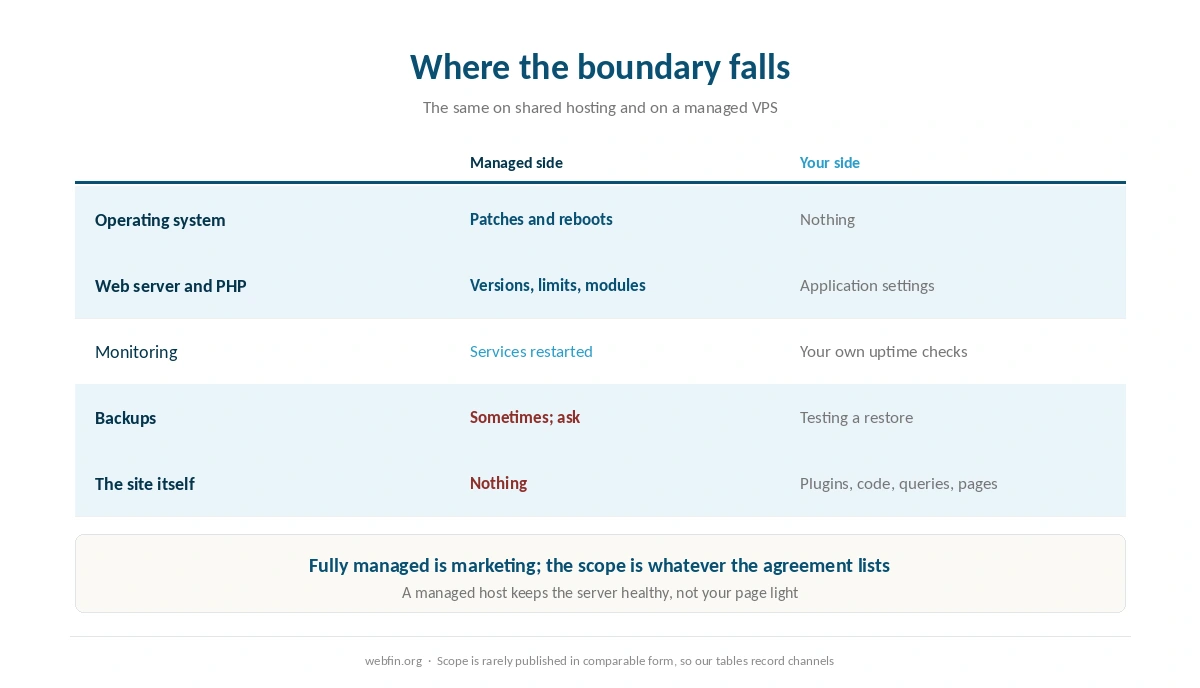
Managed normally covers the server: operating system patches, the web server, the panel, monitoring and stack support. It stops at your application. Plugins, code, database tuning and email deliverability stay yours. Unmanaged is cheaper and hands you all of it. Ask for the boundary in writing, because most rows in our tables record support channels rather than commitments.
What Managed Usually Includes
Operating system patches. The part that matters most and the part nobody notices until it is missing.
Web server and PHP configuration. Versions, limits, modules.
A panel or dashboard. So that routine work does not need a shell.
Monitoring and restarts. Someone notices when a service stops, which on an unmanaged server is you, as our guide to fixing a website that is down assumes.
Backups, sometimes. This is the item most often assumed and least often specified.
What Managed Almost Never Includes
Your application. A plugin conflict, a bad theme edit or a fatal error in your own code is yours, which our guide to fixing a 500 error works through.
Database tuning. Indexes and slow queries belong to whoever wrote them, and our guide to fixing a slow database covers them.
Email deliverability. Records, reputation and spam folders, even where the host provides mailboxes.
Performance of your site. A managed host keeps the server healthy. It does not make a heavy page light.
⚠️ If a page says “fully managed”, that phrase is marketing rather than scope. The scope is whatever the agreement lists, which our guide to reading a hosting agreement covers.
What Our Tables Actually Record
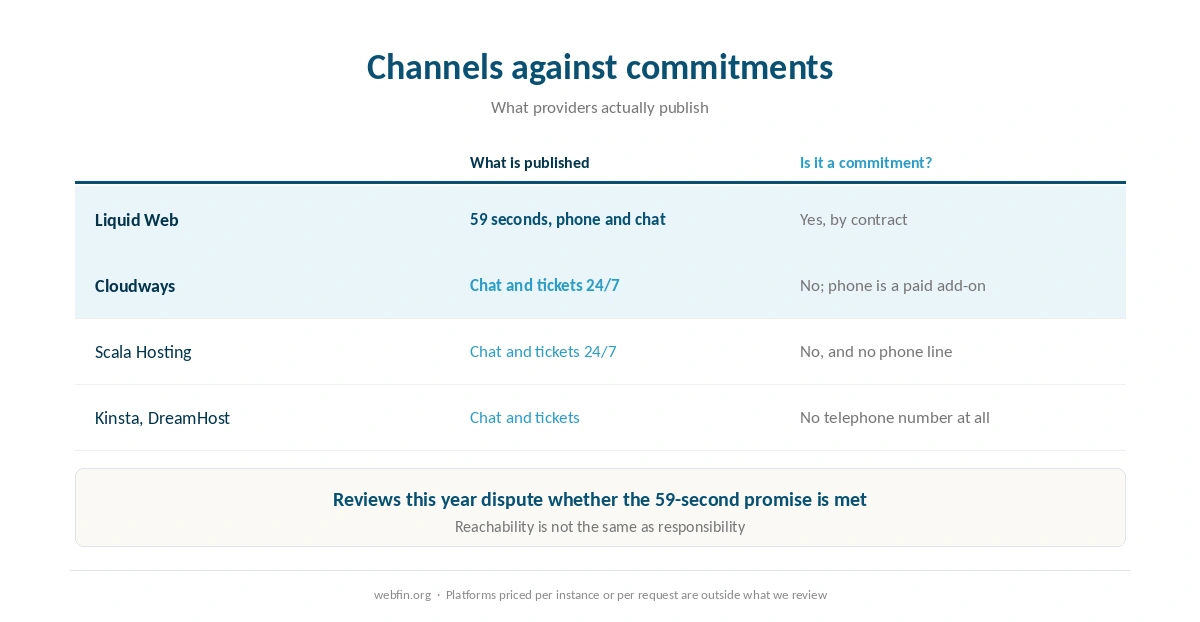
Support channels, not scope, because scope is rarely published in a comparable form. Liquid Web commits to 59 seconds on phone and chat as a contractual service commitment, and to 100% network uptime backed by credits. Reviews this year dispute whether the response promise is met.
Everyone else publishes channels rather than commitments. Cloudways offers chat and tickets around the clock with phone as a paid add-on, and Scala Hosting offers chat and tickets with no phone line. Kinsta and DreamHost publish no telephone number at all.
Those are facts about reachability rather than about who fixes what.
| Host | Channel and response | Source and date |
|---|---|---|
| Liquid Web | Phone and chat, 59 seconds by contract | Published service commitment, 2026 |
| InMotion | Phone, chat and tickets, 24/7 from US staff | Several 2026 reviews; no timed measurement |
| HostGator | Phone, chat and tickets, 24/7 | Published channels, 2026 |
| GoDaddy | Phone in more countries than most, 24/7 | Published channels, 2026 |
| IONOS | Phone plus a named consultant per account | Company statement; one review disputes it |
| SiteGround | Phone, chat and tickets, 24/7 | Several 2026 reviews; no timed measurement |
| Rocket.net | Chat under a minute; phone from Business tier | Published accounts, 2026 |
| Hostwinds | Chat and tickets, 24/7 in house; 4.9 of 5 | Aggregate of 400+ business reviews, 2026 |
| ChemiCloud | Chat and tickets, 24/7; praised in every source | 2026 reviews; no timed measurement |
| Scala Hosting | Chat and tickets, 24/7 | 2026 reviews; no timed measurement |
| Hostinger | Chat and email, AI assistant first, no phone | Published channels, 2026 |
| Namecheap | Chat and tickets, 24/7, no phone | Published channels, 2026 |
| A2 Hosting | Disputed: one review lists 24/7 phone, customers say removed | Two 2026 sources in conflict |
| GreenGeeks | Chat and tickets 24/7; phone not around the clock | Published channels, 2026 |
| WP Engine | Chat and tickets 24/7; phone on higher tiers | Published channels, 2026 |
| InterServer | Chat, phone and tickets, 24/7 | Published channels, 2026 |
| DreamHost | Chat, email and tickets; no telephone line | Published channels, 2026 |
| Kinsta | Chat and tickets 24/7; no telephone line | Published channels, 2026 |
| Cloudways | Chat and tickets 24/7; phone on paid add-on | Published channels, 2026 |
| Bluehost | Phone and chat, 24/7 | Published channels, 2026 |
The Hours, Honestly
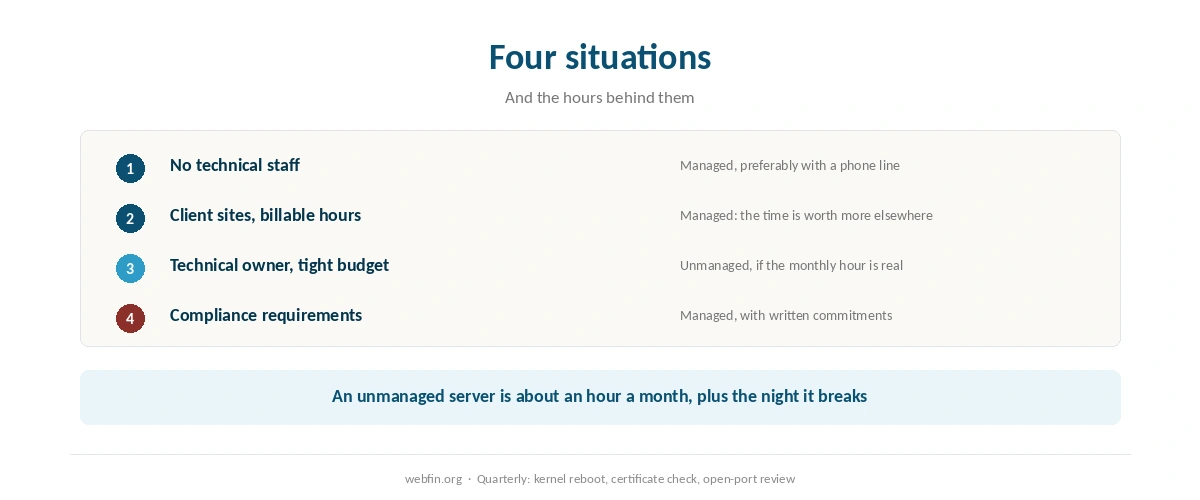
Monthly, on an unmanaged server. Package updates, a look at the logs, a check that backups ran, and a glance at disk and memory. Call it an hour when nothing is wrong.
Quarterly. A reboot into a new kernel, a certificate check, a review of what is listening on which port.
Occasionally. A major version upgrade of the operating system, which is an evening with a rollback plan.
Unpredictably. The night something breaks. That is the hour you are actually buying when you pay for managed.
Four Questions to Ask Before Buying
Who patches the operating system, and on what schedule? If the answer is vague, it is you.
Are backups included, and have you tested a restore? The second half is the real question, which our guide to setting up automatic backups covers.
Who renews certificates? On a managed plan this should be automatic, and our page on SSL certificates explains why renewal is the failure that matters.
What happens at three in the morning? Which channel, what response time, and whether it is written down.
Where the Money Difference Goes
A managed server costs more than a bare instance because the price includes labour. Cloudways starts at $14.00 a month for a managed server, and Scala prices a managed VPS per unit at $36.00 a year per processor core. Liquid Web starts at $33.00 a month on annual billing with dedicated resources.
We do not price bare cloud instances. Platforms sold per instance or per request are outside what we review, as our list of hosting for SaaS startups says plainly. The comparison to make is between managed plans, or between a managed plan and your own time.
Four Situations
A small business with no technical staff. Managed, and preferably one with a phone line.
A developer running client sites. Managed, because the hours are billable elsewhere, which our list of hosting for agencies covers.
A technical owner on a budget. Unmanaged, if the monthly hour is genuinely available, and our list of hosting for developers covers the tooling.
Anything with compliance requirements. Managed with written commitments, because a promise you can quote is the point.
The Middle Ground Nobody Names
Most plans we price are partly managed. A shared account is fully managed at the server level and unmanaged at the application level, which is why nobody fixes your plugin. A managed VPS is the same arrangement with more room and root access.
That is worth saying because the phrase “managed hosting” is often used as though it were a product category rather than a boundary. Our page on shared against VPS hosting covers the same boundary from the resource side. Our page on VPS against cloud hosting covers it from the billing side.
How We Research
We run no tests. Support channels and commitments come from the providers’ own pages and from reviews published this year, read on 20 September 2026, and sit in our tables. The Liquid Web service commitment is from its published terms, and the dispute over whether it is met comes from reviews published this year.
Scope of management is rarely published in comparable form, so our tables record channels rather than scope, and we say so rather than inferring. Platforms priced per instance or per request are outside what we review. The criteria behind our scores are on our about page.
Managed vs Unmanaged FAQ
The server: operating system patches, web server and PHP configuration, a panel, monitoring and stack support. Backups are the item most often assumed and least often specified, so ask.
Your application. Plugin conflicts, your own code, database tuning and email deliverability stay with you, and a managed host will not make a heavy page light.
About an hour a month when nothing is wrong: updates, logs, a backup check, disk and memory. Plus a quarterly reboot and certificate check, and an unpredictable evening when something breaks.
Liquid Web publishes one: 59 seconds on phone and chat as a service commitment, with 100% network uptime backed by credits. Reviews this year dispute whether the response promise is met, and other rows in our tables record channels instead.
At the server level, yes, and not at the application level. That is why nobody fixes your plugin. A managed VPS is the same boundary with more room and root access.
The Verdict
Ignore the adjective and ask for the boundary. Managed means somebody else patches the server and answers when a service stops; it does not mean somebody else owns your plugins, your queries or your page weight.
Take the managed version unless the monthly hour is genuinely somebody’s job, and get the response expectations in writing if a contract depends on them. In our tables, one provider commits to a number and the rest publish channels. Our page on what web hosting costs prices the managed options across three years.