
Disclosure: WebFin is reader-supported. If you buy hosting through links on this page, we may earn a commission at no extra cost to you. Commissions vary between providers and our ratings do not — here’s our full disclosure.
A word on scope before the picks. For many software products the right answer is a cloud platform we do not review, priced per request and built around containers. This guide covers the hosts we actually price, which means managed servers and VPS plans with root access. They suit a specific and common case: a small team running one application, wanting a predictable bill, a server they control and someone to call when it breaks.
Best Hosting for SaaS Startups: The Short Answer
Cloudways when the product is a PHP application and the traffic is unpredictable, because servers resize by the hour from $14.00 a month. Scala Hosting’s VPS when you want to buy resources by the unit, at $36.00 a year per processor core and $12.00 per gigabyte of memory. Liquid Web when requirements are contractual, for root, dedicated resources, a 59-second support commitment and 100% network uptime backed by credits.
Why Shared Hosting Is the Wrong Shape
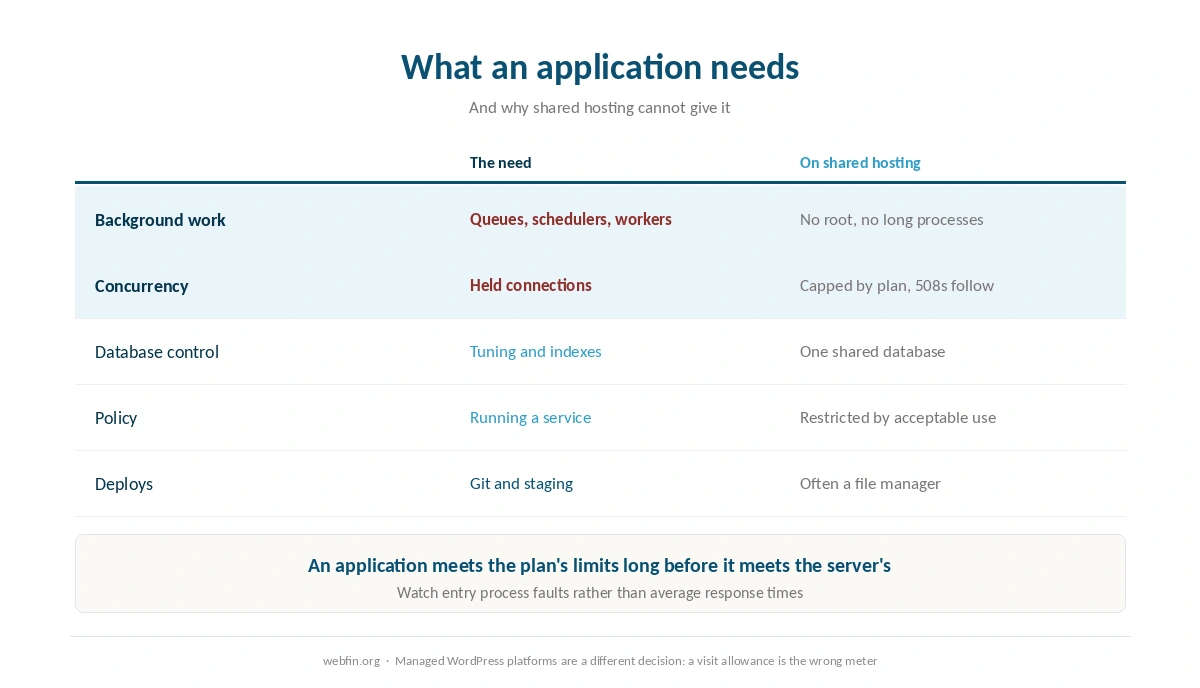
No root, no background workers. A queue, a scheduler or a long-running process needs control a shared account does not give.
Resource limits by design. Shared plans cap concurrent processes, and an application that holds connections meets those limits early. Our guide to checking whether your host is throttling you shows where the faults appear.
Policy, not just performance. Acceptable use policies restrict running services and distributing files, which our piece on what unlimited hosting means covers.
One database, shared everything. You cannot tune what you do not control, and tuning is most of the work once a product has users.
| Host | Channel and response | Source and date |
|---|---|---|
| Liquid Web | Phone and chat, 59 seconds by contract | Published service commitment, 2026 |
| InMotion | Phone, chat and tickets, 24/7 from US staff | Several 2026 reviews; no timed measurement |
| HostGator | Phone, chat and tickets, 24/7 | Published channels, 2026 |
| GoDaddy | Phone in more countries than most, 24/7 | Published channels, 2026 |
| IONOS | Phone plus a named consultant per account | Company statement; one review disputes it |
| SiteGround | Phone, chat and tickets, 24/7 | Several 2026 reviews; no timed measurement |
| Rocket.net | Chat under a minute; phone from Business tier | Published accounts, 2026 |
| Hostwinds | Chat and tickets, 24/7 in house; 4.9 of 5 | Aggregate of 400+ business reviews, 2026 |
| ChemiCloud | Chat and tickets, 24/7; praised in every source | 2026 reviews; no timed measurement |
| Scala Hosting | Chat and tickets, 24/7 | 2026 reviews; no timed measurement |
| Hostinger | Chat and email, AI assistant first, no phone | Published channels, 2026 |
| Namecheap | Chat and tickets, 24/7, no phone | Published channels, 2026 |
| A2 Hosting | Disputed: one review lists 24/7 phone, customers say removed | Two 2026 sources in conflict |
| GreenGeeks | Chat and tickets 24/7; phone not around the clock | Published channels, 2026 |
| WP Engine | Chat and tickets 24/7; phone on higher tiers | Published channels, 2026 |
| InterServer | Chat, phone and tickets, 24/7 | Published channels, 2026 |
| DreamHost | Chat, email and tickets; no telephone line | Published channels, 2026 |
| Kinsta | Chat and tickets 24/7; no telephone line | Published channels, 2026 |
| Cloudways | Chat and tickets 24/7; phone on paid add-on | Published channels, 2026 |
| Bluehost | Phone and chat, 24/7 | Published channels, 2026 |
Cloudways: Capacity That Follows Usage
Cloudways runs a managed server on the cloud you choose, from $14.00 a month with no promotional term, and bills by the hour. For a startup that shape pays twice. You can resize for a launch and shrink afterward, and a staging server costs only the runs.
It held uptime between 99.996% and 99.999% across five plans in the benchmark project we cite, and imposes no visit caps. SSH, Git deployment, staging and PHP version selection ship on every tier.
Weaknesses. It is built around PHP applications, so a product written in something else belongs elsewhere. Its weakest published load result was 288 ms with a 1.7% error rate on the Vultr High Frequency plan, email is not included, and phone support costs extra. Our Cloudways review covers each cloud.
Scala Hosting: Buy Resources by the Unit
Scala prices a VPS per unit: $36.00 a year for a processor core and $12.00 a year for a gigabyte of memory, adjustable at any time. For a product whose load is known rather than spiky, that is the cheapest honest way to size a server. Its shared plan also served the benchmark load test at 48 ms without an error.
Its own panel includes daily backups, staging and cloning, and it refunds the unused part of a term pro-rated after the first 30 days, which is unusual.
Weaknesses. No phone line. SPanel is proprietary, so leaving means moving the application rather than exporting an account. Its ownership is not documented in anything we read. Our Scala Hosting review covers the VPS line.
Liquid Web: When the Requirements Are Contractual
Liquid Web sells managed VPS from $33.00 a month on annual billing, with dedicated resources on every managed tier and root access. Its service promise commits to a 59-second response on phone and chat and 100% network uptime backed by credits, which is rare in writing.
Those commitments are the reason to pay more. They matter for a product with compliance rules, for an enterprise customer asking about isolation, or for a team that wants a number to call at three in the morning.
Weaknesses. No benchmark project we cite measures its servers, and reviews this year dispute the 59-second promise. Its monthly pricing is reported as $36.00 renewing to $72.00, which we record as disputed. Our Liquid Web review covers the tiers.
What to Get Right Before Users Arrive
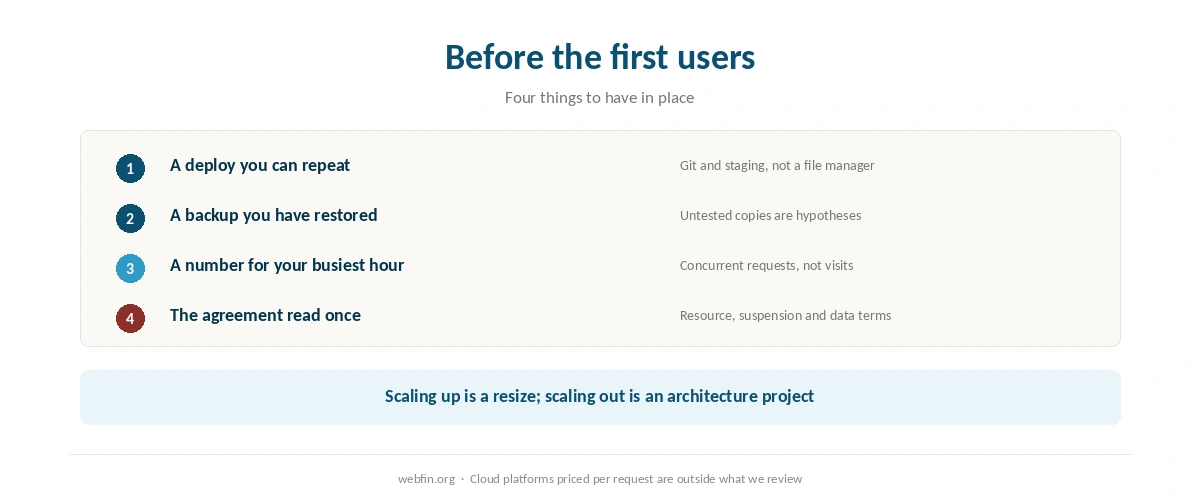
A deploy you can repeat. Git deployment and a staging environment, not a file manager. Our guide to setting up a staging site covers the copy, and our list of hosting for developers records which hosts include the tooling.
Backups you have restored. A database copy nobody has restored is a hypothesis, and our guide to setting up automatic backups covers the schedules.
A number for your busiest hour. Concurrent requests, not monthly visits. Our guide to handling a traffic spike covers testing against it.
The agreement read once. Resource clauses, suspension terms and what happens to your data on cancellation, which our guide to reading a hosting agreement covers.
Billing Shapes, and Which Suits a Startup
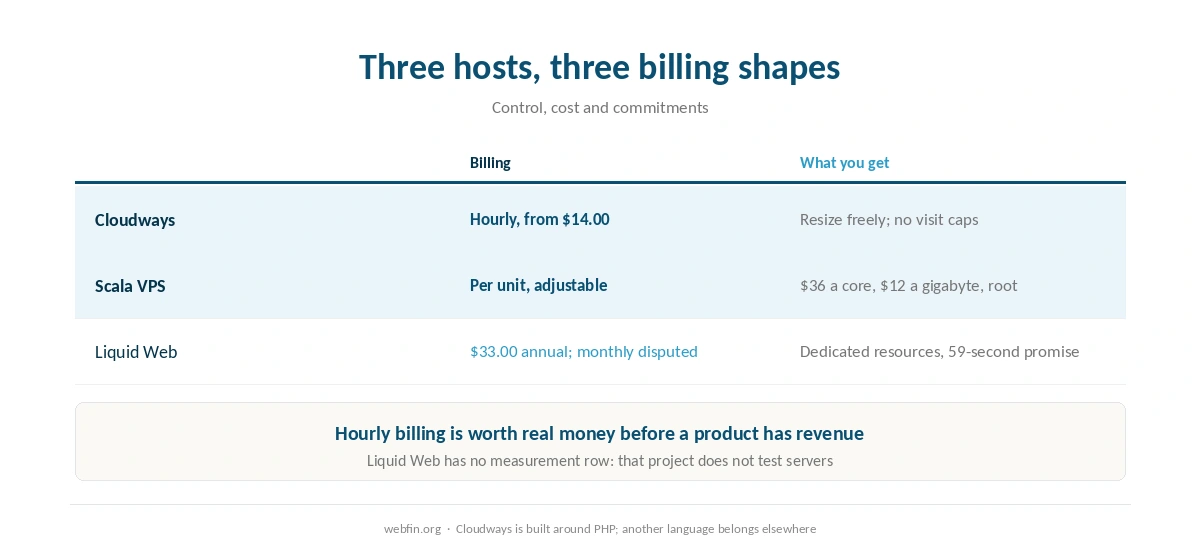
Hourly. Cloudways. Capacity follows usage, and an experiment that fails costs the hours it ran.
Per unit. Scala’s VPS. Cores and memory bought separately, adjusted when the product changes.
Monthly or annual. Liquid Web. Predictable, and cheaper annually, with the monthly figure disputed in our sources.
For a product with no revenue yet, hourly billing is worth real money. Our guide to choosing between annual and three-year terms works through the same trade for longer commitments.
What These Hosts Are Not
None of them is a platform-as-a-service. There is no request-based pricing, no automatic horizontal scaling and no managed container runtime in the plans we price. Scaling here means a bigger server, or several servers you arrange yourself.
Managed WordPress platforms are also outside this decision, whatever their benchmarks say. Kinsta hosts WordPress only, and a visit allowance is the wrong meter for an application. Our list of hosting for high traffic separates the two cases.
One habit is worth adopting early: write down which server does what, where the database lives and where the backups go. A product with two servers and no notes is one only a single person can operate. That person will take a holiday eventually.
Four Products, Four Answers
A PHP application with unpredictable traffic. Cloudways, for hourly billing and no visit caps.
A steady product with known load. Scala’s VPS, sized by core and gigabyte.
An application with compliance requirements. Liquid Web, for dedicated resources, root and written commitments.
Anything needing containers or request pricing. A cloud platform we do not review, and this is the honest answer rather than a sale.
Scaling, When It Happens
The first move is vertical: a bigger server. On Cloudways that is a resize billed by the hour, and on Scala it is more cores and memory at the published unit prices. Either takes minutes rather than a migration.
The second move is harder. Several servers behind a balancer means session storage, shared file storage and a database that lives apart from the application. None of that is automatic on the plans we price. That is the point where many teams move to a platform instead, and our guide to moving from shared to VPS covers the step before it.
How We Research
We run no tests. Load and uptime figures come from Hostingstep’s 2026 benchmarks, each with its window, and Liquid Web has no measurement row because that project does not test servers. Prices, resource units, support commitments and refund terms come from the providers’ own pages, read on 20 September 2026, and sit in our tables.
Cloud platforms priced per request, container runtimes and managed Kubernetes are outside what we review, and we say so rather than rank them from marketing pages. The criteria behind our scores are on our about page.
SaaS Hosting FAQ
Briefly, and badly. Shared plans give no root, cap concurrent processes and restrict running services in their acceptable use policies. A product with users needs a server you control.
Cloudways, because it bills by the hour and imposes no visit caps: resize for a launch and shrink afterward. Scala’s VPS is the alternative when load is known, priced at $36.00 a year per core and $12.00 per gigabyte.
Liquid Web is the one of these three with dedicated resources on every managed tier and root access. It also commits in writing to a 59-second support response and 100% network uptime backed by credits.
No. There is no request-based pricing, automatic horizontal scaling or managed container runtime in the plans we price. If your product needs those, the answer is a platform we do not review.
No. Kinsta and similar platforms host WordPress only, and a monthly visit allowance is the wrong meter for an application whose cost follows requests and background work.
The Verdict
If your product is a PHP application, Cloudways is the sensible start. You get a server you can resize by the hour, with Git and staging included, and no allowance to exceed. Scala’s VPS is cheaper once the load is known, because you buy cores and memory rather than a tier.
Liquid Web earns its price when the requirements come from a contract rather than a benchmark. And if the answer is containers, request pricing and automatic scaling, it is a cloud platform rather than any host on this page. Our page on what web hosting costs prices the options we do cover across three years.