
Disclosure: WebFin is reader-supported. If you buy hosting through links on this page, we may earn a commission at no extra cost to you. Commissions vary between providers and our ratings do not — here’s our full disclosure.
Bluehost is the host most beginners are sent to, and the reasons are better than the internet suggests. It has the highest hardware score of the shared hosts we have benchmarked, the gentlest renewal increase, and phone support around the clock.
It also sells a long list of paid extras that renew separately, publishes its resource limits in three contradictory versions, and belongs to a company that will probably appear twice on your shortlist without saying so.
Is Bluehost Good in 2026?
For a first WordPress site, yes. Independent monitoring puts origin TTFB around 500 ms and uptime at 99.95–99.97%, with European nodes performing far better than American ones. The Starter plan renews at $9.99 a month on a 36-month term, roughly double the introductory rate — but the extras renew separately. Against GoDaddy specifically, see Bluehost vs GoDaddy.
At a Glance
What works
- WPBench score of 9.6, the highest of the hosts we have benchmarked
- Renewal roughly doubles rather than sextupling
- Phone support around the clock, alongside chat
- Cached global delivery around 224 ms via CDN
- European nodes measured at 52–53 ms
What does not
- Origin TTFB has drifted from 408 ms in 2023 to around 500 ms
- Resource limits are published in three versions that disagree
- Add-ons renew separately and fall outside the refund
- Newfold owns several brands that compete with it on price comparisons
Speed
Every figure below comes from a named project with its window stated. We run no tests of our own.
Hostingstep has monitored Bluehost since 2021 and ran 349,920 tests between 1 October 2025 and 31 May 2026. That window recorded 501 ms average origin TTFB, 99.97% uptime, 224 ms cached global TTFB, and a WPBench hardware score of 9.6 out of 10 — the highest of the three shared hosts we have reviewed.
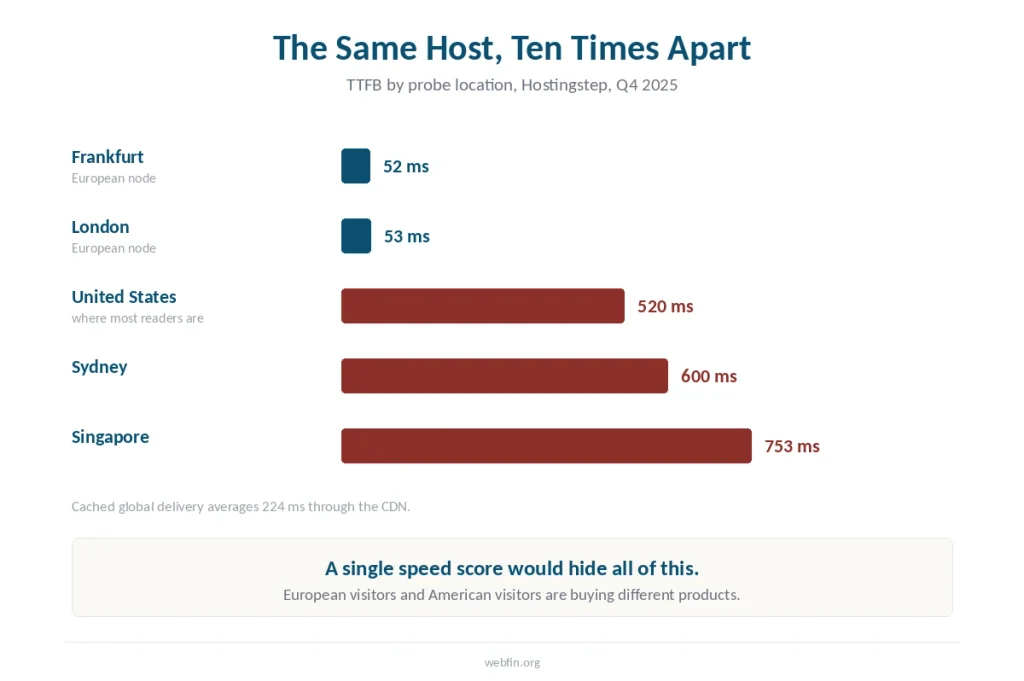
The regional spread is the story. The same project measured 52 ms in Frankfurt and 53 ms in London against roughly 520 ms in the United States, 600 ms in Sydney and 753 ms in Singapore. That is a tenfold difference between the best and worst location on one host.
Origin response has drifted the wrong way over time: 408 ms in 2023, 532 ms in 2025, 501 ms across the recent window. Hostingstep describes the trend as flattened rather than reversed, and attributes the mixed figure to Bluehost running old and new infrastructure simultaneously during its Oracle Cloud migration.
⚠️ The same project contradicts itself on load handling. Its Bluehost review reports 41 ms with a 0% error rate; its benchmark page states that Bluehost’s security settings block the load test and the result cannot be verified. We show both rather than picking one.
Uptime
Solid, and the pattern is the one we now expect.
Cybernews recorded 100% across 30 days. Gizmodo recorded 99.96% across three months. Hostingstep’s Q4 2025 quarter recorded 99.95% across 14 incidents totalling 134 minutes, and its eight-month window to May 2026 recorded 99.97%.
Short windows find nothing; long windows find the incidents. That is a fact about monitoring rather than about Bluehost, and it applies to every uptime claim you will read, including ours.
Support
Chat and phone, around the clock, which not every host at this price offers. Bluehost has run a voice line for years and it is the practical difference between this host and a chat-only competitor when something breaks at an awkward hour.
⚠️ The recurring complaint in published reviews is the content of the answer rather than the speed of it: several report that performance questions are met with an upgrade suggestion. We could not find controlled measurement of response times for any host, so treat this criterion as the softest of the five.
Price and Renewal
The renewal is the gentlest we have measured, and it deserves saying plainly given how this site usually talks about renewals.
The Starter plan renews at $9.99 a month on a 36-month term, $11.99 on 12 months, and $15.99 month to month. Business renews at $13.99, $15.99 and $20.99 on the same three terms. Against SiteGround’s six-fold jump, roughly doubling is restrained — the full comparison is here.
Buy the 36-month term and the renewal never arrives inside a three-year window at all: 36 months at the introductory rate, and the total lands second-lowest of everything we have calculated.
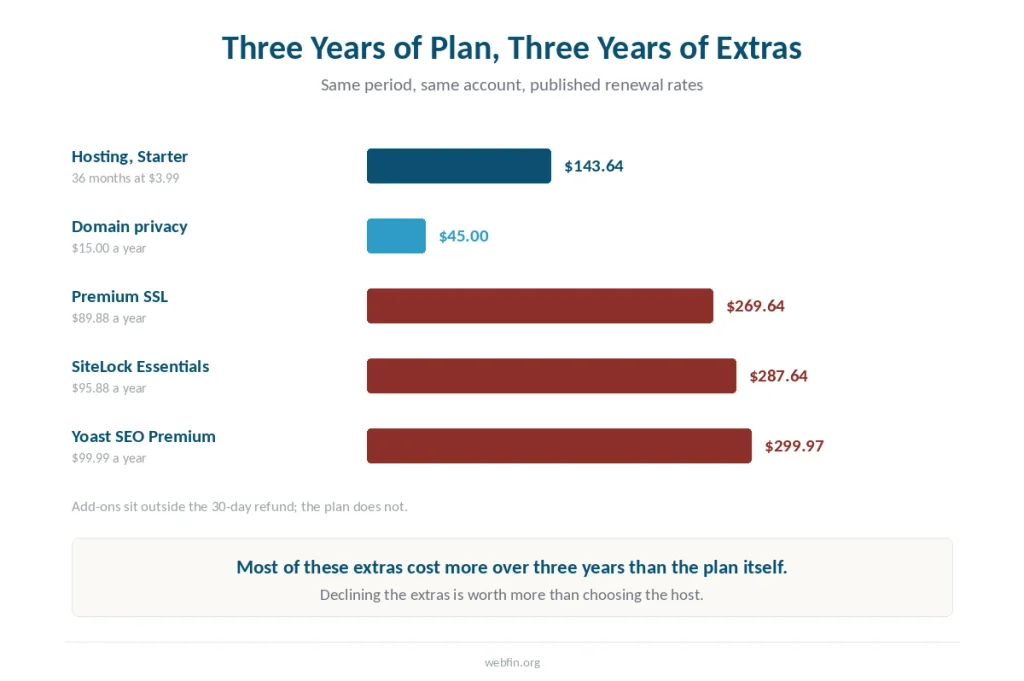
Then the extras arrive. SiteLock Essentials renews at $95.88 a year, premium SSL at $89.88, domain privacy at $15, and Yoast SEO Premium at $99.99 — sold through Bluehost by the company that owns both. The 30-day refund covers hosting only; add-ons, domains and professional services are excluded, and cancelling early deducts $15.99 for the free domain. We priced the whole list separately.
So the plan is cheap and the invoice is not. Whether that matters depends entirely on whether you say no at checkout.
The Limits Are Published Three Times
This is where Bluehost is worse than either competitor, and it is not close.
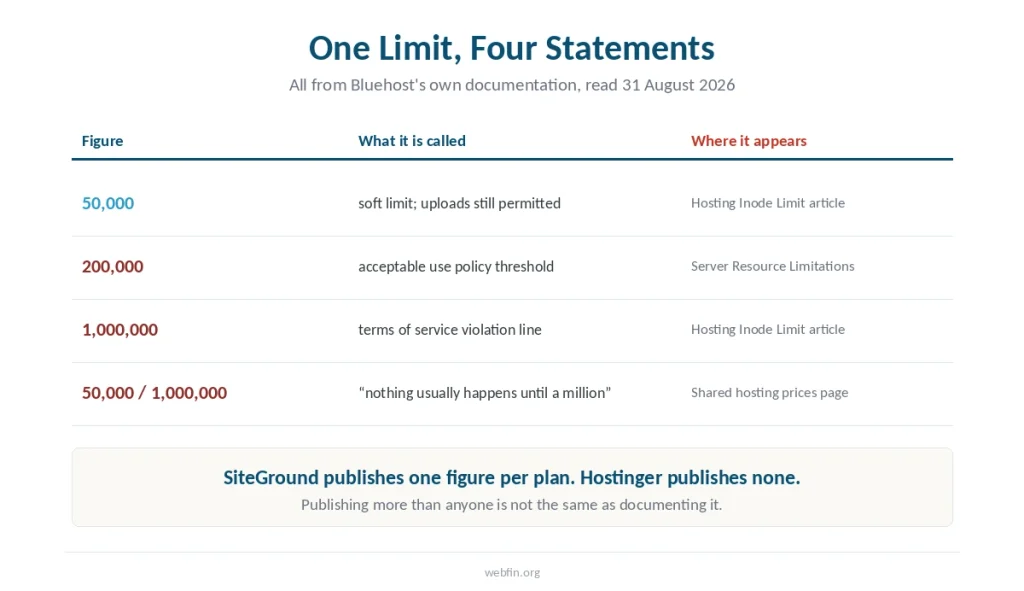
The article titled Hosting Inode Limit, updated 6 July 2026, contains three different figures in one document: 50,000 as a soft limit, 200,000 as the acceptable-use threshold, and 1,000,000 as the terms-of-service violation line. A second article states a maximum of 200,000. The shared hosting pricing page adds a fourth phrasing: the cap is 50,000, but nothing usually happens until a million.
Databases are capped at 5,000 tables or 10 GB in total, 5 GB for any single one. Those figures appear nowhere near a pricing page.
Compare the alternatives. SiteGround publishes every ceiling per plan on one page. Hostinger publishes none and points at a dashboard behind payment. Bluehost publishes more than anyone and agrees with itself least — we wrote about all three.
Ease of Use
The account area is genuinely built for a first site, and the WordPress install is close to automatic. More tutorials on the internet assume Bluehost than assume any other host, which matters more than it should when you are stuck at eleven at night.
The cost is the upsell path. Add-ons are offered at checkout, in the dashboard, and in the emails afterwards, and several of them are the most expensive line on the eventual bill.
Who Owns It
Bluehost belongs to Newfold Digital, formed in 2021 from Endurance Web Presence and Web.com Group, and backed by Clearlake Capital and Siris Capital.
Newfold’s own boilerplate also names HostGator, Network Solutions, Register.com, Crazy Domains, Web.com, Yoast and YITH. So a shortlist of three “competing” hosts can contain one company twice, and the Yoast upsell inside the Bluehost dashboard is the same owner selling you a second product. We traced the paper trail separately.
Bluehost has appeared on the WordPress.org recommended hosts page since 2005. That page states some listed hosts return part of your fee, and the outbound link to Bluehost carries an affiliate parameter.
⚠️ The infrastructure is genuinely changing. Newfold announced the Oracle Cloud migration in November 2025, with roughly a million customers moved and 4–5× median response improvements claimed in its own release. Completion is expected during 2026, which is why current benchmarks mix old and new.
What We Don’t Love
Documentation that contradicts itself. Four statements of the inode policy across three pages is worse than publishing nothing, because it looks like an answer.
The add-on catalogue. Most of the extras cost more per year than the hosting, renew on their own schedule, and sit outside the refund window.
Origin speed drifting the wrong way since 2023, even allowing for the migration.
How We Research
Pricing, resource limits and refund terms come from Bluehost’s own help pages, read on 31 August 2026, with the update date of each page stated. Performance figures are attributed to named testing projects with their windows. Where one project contradicts itself, both statements appear.
We run no tests of any kind. Our five criteria are on our About page.
Frequently Asked Questions
Yes, and that is its clearest strength. The account area is built for a first site, WordPress installs in a few clicks, and more tutorials assume Bluehost than any other host. Phone support around the clock helps when something breaks late.
The Starter plan renews at $9.99 a month on a 36-month term, $11.99 on 12 months and $15.99 month to month. Business renews at $13.99, $15.99 and $20.99 on the same terms. Add-ons renew separately.
Depends where your visitors are. Independent monitoring recorded 52 ms in Frankfurt and 53 ms in London against roughly 520 ms in the United States. Cached global delivery averages around 224 ms through the CDN. Origin response has drifted from 408 ms in 2023 to about 500 ms.
Newfold Digital, backed by Clearlake Capital and Siris Capital. Newfold also owns HostGator, Network Solutions, Register.com, Crazy Domains, Web.com, Yoast and YITH, so two names on a hosting shortlist can belong to one company.
Depends which page you read. Bluehost’s own documentation states 50,000 as a soft limit, 200,000 as the acceptable-use threshold and 1,000,000 as the terms-of-service line, with a fourth phrasing on the pricing page.
Bluehost
Summary
The best hardware and the gentlest renewal of the three, sold alongside the longest list of paid extras.
The Verdict
Bluehost earns 4.0, and it is the most improved of the three we have reviewed — better hardware than either, a renewal that merely doubles, and infrastructure being rebuilt underneath it.
Choose it if you are launching your first WordPress site, your audience is European, and you are disciplined about declining extras. Our page on Bluehost for Joomla covers the pairing that needs nothing confirmed first.
Skip it if you want documentation you can trust, or you are assembling a shortlist and would rather not have one company on it twice. We put it head to head with Hostinger, where the two finish $36 apart.
Consider instead: Hostinger for a lower three-year total and better global delivery, SiteGround if you want every limit published in one place, or Cloudways if you would rather buy a server than a catalog.