
Disclosure: WebFin is reader-supported. If you buy hosting through links on this page, we may earn a commission at no extra cost to you. Commissions vary between providers and our ratings do not — here’s our full disclosure.
We have now read the resource documentation of three shared hosts, and SiteGround is the one that gets it right. Every limit it enforces is published, broken out per plan, on a single page, with no figure contradicting another.
That page was last updated in October 2021. Which is the SiteGround experience in one sentence: unusually honest, unusually good at the parts that need people, and priced in a way that makes the honesty expensive.
Is SiteGround Worth It in 2026?
For support and reliability, yes. For raw delivery speed, increasingly not: independent long-term monitoring puts its origin TTFB at 632 ms in 2025, up from 403 ms in 2022, and ranks it 22nd of 34 hosts. The StartUp plan renews at $17.99 a month after an advertised $2.99, the steepest increase we have measured.
At a Glance
What works
- Every resource limit published, per plan, in one place
- Phone support, with the number published on the company’s own site
- 90% first-contact resolution reported by independent review
- Second-highest hardware allocation of 34 hosts benchmarked
- Handles concurrent load with zero errors under stress testing
What does not
- Origin TTFB has degraded 57% since 2022
- Global TTFB is the highest among 29 hosts benchmarked
- Six-fold renewal increase, the largest in our comparison
- 10,000 CPU seconds a day on the entry plan, and the ceiling is real
Speed
Every figure below comes from a named project with its window stated. We run no tests of our own.
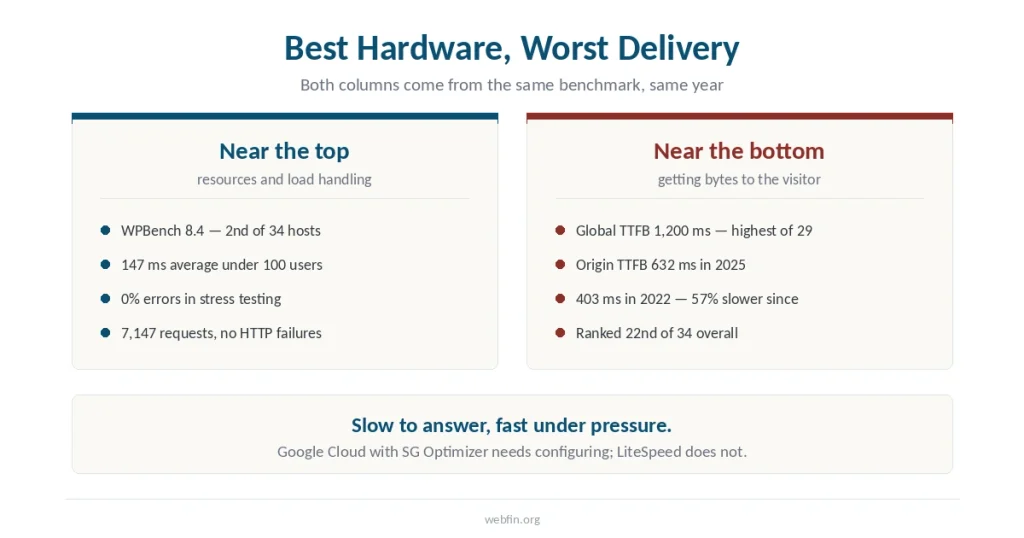
Hostingstep has monitored SiteGround since 2020 across more than 561,000 individual tests. Its 2026 benchmark records 632 ms origin TTFB, against 403 ms in 2022 — a 57% degradation over three years. Global TTFB stands at 1,200 ms, the highest among the 29 WordPress hosts it tested. SiteGround ranks 22nd of 34, in the below-average tier. Against Namecheap specifically, see SiteGround vs Namecheap.
And yet the hardware is excellent. The same benchmark gives SiteGround a WPBench score of 8.4, second highest of the 34, with top marks for CPU, memory and database performance.
The contradiction resolves under load. Hostingstep’s Loader.io test, ramping to 100 concurrent users, produced a 147 ms average response with a 0% error rate. A Cybernews stress test recorded 7,147 requests with zero HTTP failures and a 95th-percentile response of 197 ms. Our comparison of SiteGround against A2 Hosting prices the two side by side.
So SiteGround is slow to answer and fast under pressure. That is a real profile, not a contradiction in the data: Google Cloud with SG Optimizer needs configuring, where a LiteSpeed host is quick out of the box.
⚠️ TTFB figures for SiteGround range from 40 ms to 1,200 ms across published tests, depending on probe location and method. That spread is wider than the gap between most hosts, which is why we give the source and window for each.
Uptime
Consistently strong, and here the short and long windows agree for once.
Cybernews recorded 100% across a two-month window. Hostingstep’s twelve-month tracking across 22 global locations measured 99.99%, about 52 minutes of downtime over 13 incidents. Its full-year 2025 figure is 99.96% with 193 minutes down.
⚠️ Those last two come from the same project and do not match. Different windows and different rollups produce different rounding, and we would rather show both than pick the tidier one.
Either way, uptime is not where SiteGround costs you anything.
Support
The best in shared hosting, and it is not close.
SiteGround publishes a phone number, which Hostinger does not. Live chat and tickets run around the clock, and Cybernews’ 2026 review reports a 90% first-contact resolution rate with a 4.9/5 Trustpilot score across thousands of reviews.
There is no AI gate to argue with before reaching a person, which is the difference we noted with Hostinger.
If you are the kind of site owner who wants someone to call at two in the morning, this criterion alone may decide it.
Price and Renewal
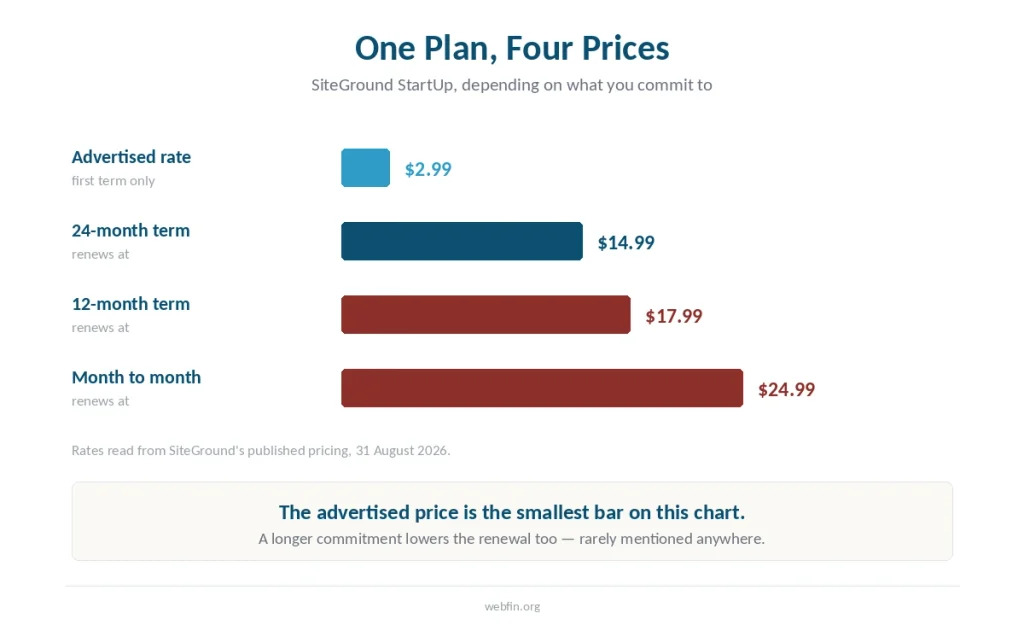
The StartUp plan advertises at $2.99 and renews at $17.99 a month on the annual term — a six-fold increase, the steepest we have measured. GrowBig runs $4.99 to $29.99, GoGeek $7.99 to $44.99. Against InterServer specifically, see SiteGround vs InterServer.
A longer commitment softens it: the 24-month term renews at $14.99, the monthly at $24.99. Most comparisons quote one figure and miss that entirely.
Over three years the annual path costs $467.64. That is within about a dollar a month of managed cloud hosting that never increases at all, which is an uncomfortable place for a budget shared plan to land.
What you get for it is email hosting included at no extra charge, daily backups, and the support above. Whether that is worth six times the entry price is the actual question, and it depends entirely on how often you need the support.
The Limits Are Published, and They Bind
This is where SiteGround is straightforwardly better than its competitors, and where its worst reputation comes from.
Everything is on one page, per plan:
| Limit | StartUp | GrowBig | GoGeek |
|---|---|---|---|
| CPU seconds per day | 10,000 | 20,000 | 40,000 |
| CPU seconds per month | 300,000 | 600,000 | 800,000 |
| Inodes | 200,000 | 400,000 | 600,000 |
RAM is capped at 768 MB per process, databases at 1,000 MB, and cron jobs must sit at least 30 minutes apart.
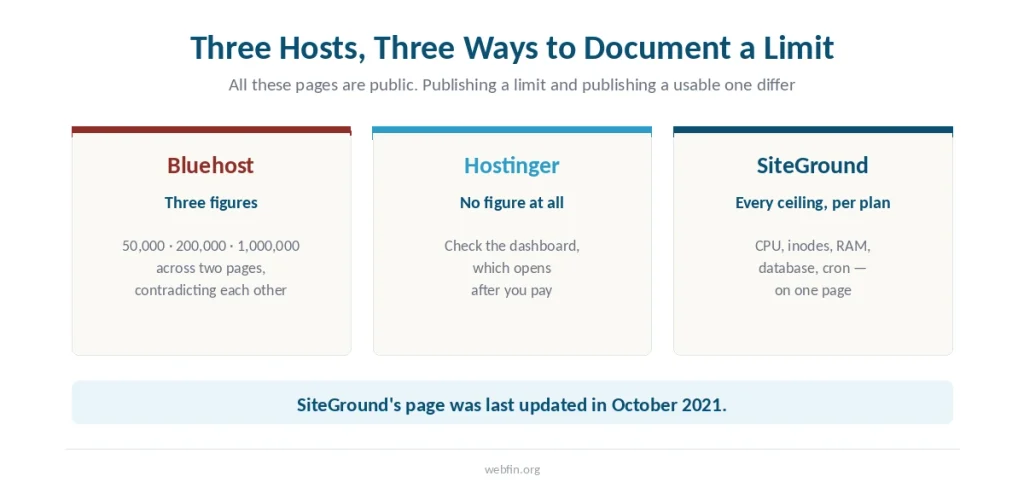
Compare that to what else we have read. Bluehost, a Newfold Digital brand, publishes three different inode figures across two pages and contradicts itself within a single article. Hostinger publishes no number at all and tells you to check a dashboard that opens after payment. We wrote about both. SiteGround publishes the lot, per plan, and does not hedge.
⚠️ The page was last updated on 12 October 2021. Nearly five years for a document describing limits that get enforced daily. Published and current are not the same thing.
And the CPU ceiling is the real one. Exceed it and SiteGround limits the account, returning errors until usage falls or you upgrade. Published accounts describe traffic spikes — including bot traffic — triggering limits on the entry plan, followed by a recommendation to move to Cloud hosting. Ten thousand CPU seconds a day is generous for a brochure site and thin for anything with a plugin stack.
Ease of Use
Site Tools is SiteGround’s own panel, replacing cPanel since 2020. It is clean and well organised, and like hPanel it means your knowledge does not travel if you leave.
SG Optimizer is where performance actually lives, and it needs configuring. That is the trade behind the TTFB numbers: more control, more setup, and worse defaults than a host that caches at the server level automatically.
Who Owns It
SiteGround Hosting Ltd. is independent, and in this category that is worth stating.
Founded on 22 March 2004 in Sofia by a group of university friends including Ivo Tzenov. Headquarters still in Sofia, with offices in Plovdiv, Stara Zagora and Madrid. More than 600 employees, over three million domains hosted. The current chief executive, Tenko Nikolov, started at the company as a technical support agent in 2004.
No private equity holding, no parent group, no sister brands competing with it on your shortlist. Infrastructure runs on Google Cloud since 2020.
⚠️ SiteGround was dropped from the WordPress.org recommended hosts page in 2023, with no public reason given. It had been listed for years. What that listing means is worth reading before treating the removal as a verdict.
What We Don’t Love
The renewal. Six times the advertised price is the largest multiplier we have measured, and the storefront leans on the $2.99 figure heavily. Our comparison of SiteGround against DreamHost prices the two side by side.
The speed trend. A 57% TTFB degradation across three years, in one continuous dataset, is not noise. Something is getting slower.
The CPU ceiling on StartUp. Ten thousand seconds a day is a real constraint, published honestly, and it is the single most common reason people leave.
How We Research
Resource limits, plan pricing and company details come from SiteGround’s own pages, read on 31 August 2026, and we say when each was last updated. Performance figures are attributed to named testing projects with their windows stated. Where two figures from the same project disagree, both are shown.
We do not run tests of any kind. Our five criteria are published on our About page.
Frequently Asked Questions
It depends on which criterion decides for you. Support is the best in shared hosting, with a phone line and a 90% first-contact resolution rate. Delivery speed has degraded 57% since 2022 in continuous monitoring, and the renewal is six times the advertised rate.
Google Cloud infrastructure, email hosting included at no charge, daily backups, and a support team large enough to answer the phone. The StartUp plan renews at $17.99 a month against $2.99 advertised, which is the steepest increase we have measured.
Published per plan: 10,000 CPU seconds a day on StartUp, 20,000 on GrowBig, 40,000 on GoGeek. Exceed them and the account is limited until usage falls. Inode limits run 200,000 to 600,000 and databases are capped at 1,000 MB.
SiteGround Hosting Ltd., an independent Bulgarian company founded in Sofia in 2004 by university friends. It has no parent group and no private equity holding, which distinguishes it from most competitors at this price point.
No reason was published. SiteGround was dropped from the recommended hosts page in 2023 after years of being listed. The page describes its own selection process as arbitrary, so removal is not evidence of a problem with the host.
SiteGround
Summary
Publishes everything it enforces and answers faster than anyone — then charges six times the entry price to renew.
The Verdict
SiteGround earns 3.9, and the score is a tug of war. Support scores full marks and price scores worst in our set.
Choose it if support matters more than speed, you want a phone number, and you would rather know your limits than guess them. Our page on SiteGround for Joomla covers where requirements stop being the question.
Skip it if you are buying on price, your traffic is global, or your site has the kind of plugin stack that eats CPU seconds. We put it head to head with Bluehost, where the term decides more than the host.
Consider instead: Hostinger for roughly a third of the three-year cost and better global delivery, Cloudways if flat pricing matters more than a support line, or Kinsta if edge delivery is worth five times the bill.