
Disclosure: WebFin is reader-supported. If you buy hosting through links on this page, we may earn a commission at no extra cost to you. Commissions vary between providers and our ratings do not — here’s our full disclosure.
The renewal price is the number the hosting industry prints smallest, and the one that decides what you actually pay. A plan advertised at $2.99 a month can renew at $17.99 — the same plan, the same server, six times the price. Our page on domain renewal prices covers how to compare the structure rather than the headline.
But the comparison everyone runs is wrong in a specific way. Reviews quote one renewal figure per plan. Most plans have three, because the renewal depends on the term you commit to, and the difference between them is larger than the gap between some hosts.
What Is a Hosting Renewal Price?
It is what the plan costs once the introductory term ends, and it applies for as long as you stay. At one host we could not find it published at all. Introductory rates are for new customers on the first term only. On shared hosting the renewal typically runs two to six times the advertised price, depending on the host and the term. At one host it also exceeds the regular price the discount is calculated from.
The Renewal Prices, With Their Terms
| Host and plan | Intro → Renewal | Multiplier |
|---|---|---|
| IONOS Plus | $1.00 → $14.00 | 14.0× over 12 months |
| SiteGround StartUp | $2.99 → $17.99 | 6.0× over 12 months |
| SiteGround GrowBig | $4.99 → $29.99 | 6.0× over 12 months |
| SiteGround GoGeek | $7.99 → $44.99 | 5.6× over 12 months |
| ChemiCloud Starter | $2.49 → not published | Renewal shown at checkout only |
| Scala Hosting Mini | $2.95 → $11.95 | 4.1× over 12 months |
| DreamHost Launch, annual | $2.89 → $10.99 | 3.8× over 12 months |
| Hostinger Premium | $2.99 → $10.99 | 3.7× over 48 months |
| Bluehost Starter | $3.99 → $11.99 | 3.0× over 12 months |
| A2 Hosting Turbo Boost | $6.99 → $20.99 | 3.0× over 12 months |
| HostGator Hatchling | $3.75 → $10.99 | 2.9× over 36 months |
| GoDaddy Economy | $5.99 → $15.32 | 2.6× over 36 months |
| Bluehost Starter | $3.99 → $9.99 | 2.5× over 36 months |
| Namecheap Stellar | $1.98 → $4.88 | 2.5× over 12 or 24 months |
| Namecheap Stellar Plus | $2.98 → $6.88 | 2.3× over 12 or 24 months |
| Namecheap Stellar Business | $4.98 → $9.88 | 2.0× over 12 or 24 months |
| DreamHost Launch, 4-year | $2.89 → $7.99 | 2.8× over 48 months |
| DreamHost, eligible US nonprofits | One shared plan free for the account's life | 501(c)(3) or (c)(19); help article, checked 10 Jun 2026 by a nonprofit directory |
| Bluehost Business | $6.99 → $13.99 | 2.0× over 36 months |
| Bluehost Starter, second reading | $1.99 → $8.99 | Hostingstep, July 2026; conflicts with Bluehost's help page |
| Hostwinds Basic | $4.54 → $6.99 | 1.5× over 12 months |
| WP Engine Startup | $27.00 → $35.00 | 1.3× over 12 months |
| Rocket.net Starter | $25.00 → $30.00 | 1.2× over 12 months |
| InterServer Standard | $2.50 flat | 1.0×, price lock |
| Cloudways, from | $14.00 flat | no promotional term |
| Kinsta Starter | $35.00 flat | no promotional term |
| Liquid Web managed VPS, annual billing | $33.00, no promotional term | No increase described on annual billing |
| Liquid Web managed VPS, monthly billing | $36.00 → $72.00 reported | 2.0× over one month; one pricing guide, disputed |
| GreenGeeks Lite | $2.95 → $13.95 | 4.7× after one term; renewal was $12.95 before 2026 |
| ChemiCloud Starter, third-party figures | $9.95, $11.95 or $12.95 quoted | Sources disagree; 4.0× to 5.2× over 36 months |
| SiteGround StartUp, by term | $2.99 → $14.99, $17.99 or $24.99 | 5.0× over 24 months, 6.0× over 12, 8.4× month to month |
| ChemiCloud Kickstart, reseller | $8.99 → $29.95 | Term not stated in the source we read |
| InterServer reseller | $19.95, price locked | No increase described in sources |
| GreenGeeks reseller | $19.95 with WHMCS included | Promotional rate; renewal not published |
| Hostwinds white-label reseller | $10.00 with WHMCS included | Plain reseller plan excludes WHMCS |
| InMotion Core, 36-month term | $3.19 → $10.99 | 3.4× over 36 months; TechRadar, 2026 |
| InMotion Launch, 36-month term | $4.99 → $13.99 | 2.8× over 36 months; TechRadar and plan cards, 2026 |
| InMotion Core, by term | Renews at $10.99, $11.99 or $14.49 | Longest term lowest; one review, May 2026 |
A multiplier without a term is meaningless, which is why the table carries both. The steepest we have found runs to fourteen. SiteGround calculates from 12 months, Bluehost from 36, Hostinger from 48. Comparing 6.0× against 2.5× as though they measure the same thing is the most common error in this category, and we have made it ourselves in an earlier draft.
One Plan, Three Renewal Prices
Here is the detail that survives almost no comparison article.
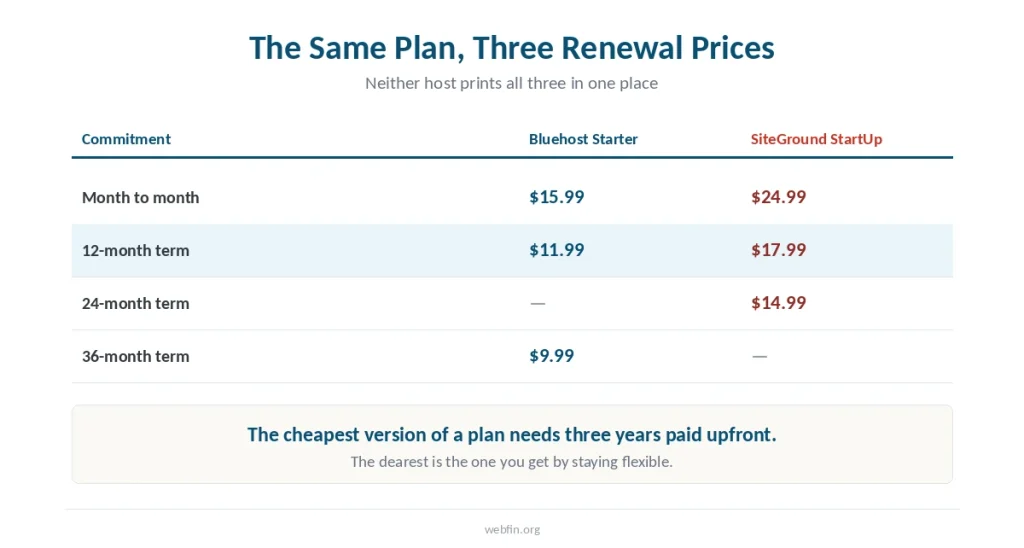
Bluehost’s Starter plan renews at $9.99 a month on a 36-month term, $11.99 on 12 months, and $15.99 month to month. SiteGround’s StartUp renews at $14.99 on a 24-month term, $17.99 on 12 months, and $24.99 month to month.
So “the renewal price” is not a property of the plan. It is a property of the plan and the commitment together, and the spread between the cheapest and dearest version of the same plan runs to 60 percent at Bluehost and 67 percent at SiteGround.
The practical consequence runs against intuition. A long commitment discounts twice: once during the promotional term, and again at every renewal afterwards. The cost of that is flexibility, and two or three years is a long time to be right about a host.
The Cheapest Signup Is the Dearest Renewal
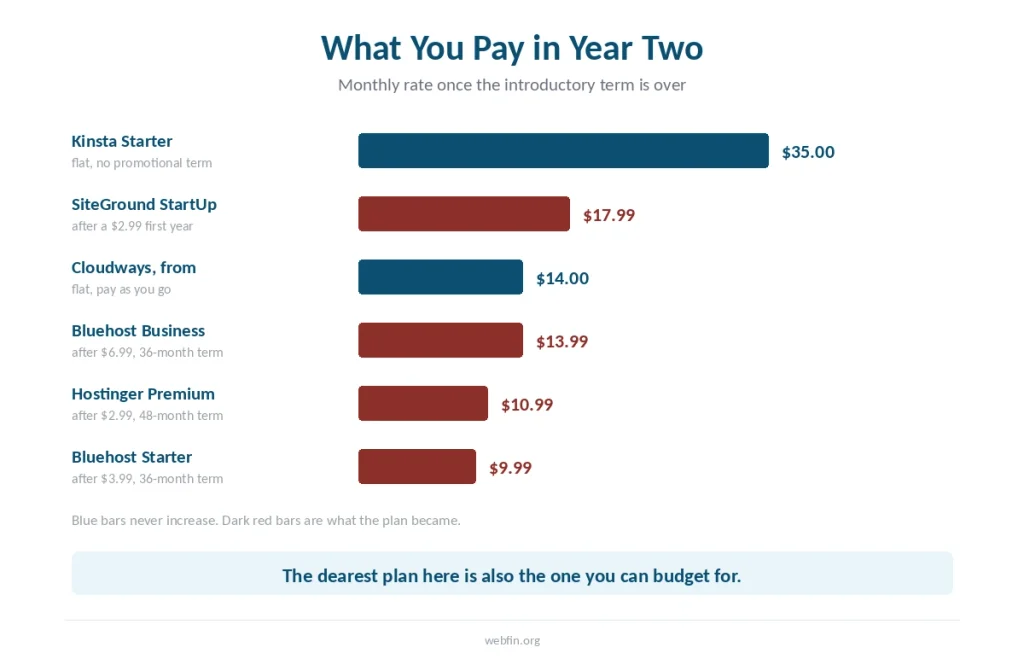
Rank hosts by advertised price and SiteGround looks mid-table. Rank them by what you pay in year two and the order inverts.
SiteGround’s entry plan renews at $17.99 a month on the annual term. That is more than Cloudways charges for managed cloud hosting, which starts at $14 a month and does not increase. The host with the steepest multiplier is also the one whose entry price looks most attractive on the storefront, and those two facts are the same fact.
Hostinger and Bluehost land lower — $10.99 and $9.99 respectively — but both reach those figures by asking for four years and three years upfront.
Two of the Five Have No Multiplier at All
This is worth saying plainly, because it reframes the whole category.
Cloudways bills pay-as-you-go, by the hour and settled monthly, with no contract. Kinsta bills a flat tier, from $35 a month at Starter level. Neither runs a promotional first term, so neither has a renewal increase to disclose. What you pay in month one is what you pay in year three.
They are not cheaper. Kinsta’s entry tier costs more than any shared plan on this page, at renewal or otherwise. They are simply priced in a way that can be planned, and for a business that matters more than the headline.
⚠️ Cloudways’ own pricing page gives $14 a month as the entry figure. Third-party write-ups quote $7 and $11 for the same tier, which reflects promotional codes rather than list price. We use the figure from the vendor.
What the Renewal Price Does Not Include
The multiplier covers hosting. It does not cover the domain from year two, the add-ons that renew on their own schedule, or the charges that sit outside the refund policy — we priced those separately.
Nor does it cover the resource ceilings that decide whether the plan works at all, which are published in help articles rather than on pricing pages.
How to Pay Less Without Guessing
Price the term you will actually keep. The 36-month renewal only helps if you stay 36 months. If you might move, the monthly rate is the honest comparison, and it is the largest of the three.
Set a calendar reminder for the renewal date, not the purchase date. The increase arrives silently and auto-renewal is on by default at every host here.
Check whether a longer term also lowers the renewal. At SiteGround it does. Most articles never mention it because they quote a single figure per plan.
Compare year two, not year one — or year four, where one host puts its increase. Every host wins year one. Only some of them are still competitive in year two, and that is the year you find out.
And consider whether you need the promotional structure at all, or whether a longer contract solves it. Flat-rate hosting costs more at the start and less to plan. For a site that will exist in three years, that trade is worth pricing.
How We Research
The Bluehost figures were read from that company’s own renewal pricing table on 31 August 2026. SiteGround and Hostinger renewal rates come from multiple independent write-ups that agree with each other and with our own check of the vendor pages in August; where they disagreed, we say so below rather than picking one. Cloudways’ entry price comes from its own pricing page.
We run no tests of our own. Our method and the criteria behind every score are on our About page.
Frequently Asked Questions
It is what a plan costs once the introductory term ends. Promotional rates apply to new customers on the first term only, and every host on this page states that in its terms. On shared hosting the renewal usually runs two to six times the advertised rate.
Of the five compared here, SiteGround. Its StartUp plan advertises at $2.99 a month and renews at $17.99 on the annual term, a six-fold increase. Its GrowBig plan follows the same pattern, from $4.99 to $29.99.
At some hosts, yes, and it is rarely mentioned. SiteGround’s StartUp renews at $14.99 a month on a 24-month term against $17.99 on an annual one. Bluehost’s Starter renews at $9.99 on 36 months against $11.99 on 12.
Only by choosing a host that does not use promotional pricing. Cloudways bills pay-as-you-go and Kinsta bills flat tiers, so neither has an increase to disclose. Both cost more at the start than a promotional shared plan.
The introductory rate is a customer acquisition cost, and moving a site is inconvenient enough that most people stay. Nothing about the service changes at renewal. The economics assume you will not move, and usually the economics are right.
The Verdict
The renewal is the price. The promotion is the discount. Reversing those two in your head is what the storefront is designed to encourage. Our page on negotiating a renewal discount covers the ten-minute conversation worth having.
Ask which term the renewal applies to before quoting it. A plan with one advertised price can have three renewal prices, and the cheapest requires paying three years in advance.
And notice that the steepest multiplier belongs to the cheapest signup. SiteGround at $2.99 renews at $17.99, above what managed cloud hosting costs elsewhere. That is not a coincidence in the pricing; it is the pricing.