
Disclosure: WebFin is reader-supported. If you buy hosting through links on this page, we may earn a commission at no extra cost to you. Commissions vary between providers and our ratings do not — here’s our full disclosure.
Over three years Cloudways costs $396 more than Hostinger. That number is real and it is also misleading, because almost all of it is the promotional term.
Once Hostinger’s introductory rate expires, the two plans are $3.01 a month apart. What that three dollars buys is a server nobody else is sharing, and what it costs you is email hosting and a certain amount of comfort.
The Short Answer
Hostinger for most sites, because $3 a month is real money when the cheaper option is genuinely adequate. Cloudways once you have outgrown shared hosting — when a resource ceiling has bitten you, when you need staging and SSH, or when you would rather pay a flat rate forever than track a renewal date.
Head to Head
| Hostinger Premium | Cloudways | |
|---|---|---|
| Model | Shared hosting account | Managed cloud server |
| Advertised | $2.99/mo | From $14/mo |
| Renews at | $10.99/mo | $14/mo, unchanged |
| Three-year total | $107.64 | $504.00 |
| Steady-state gap | — | $3.01/mo |
| Contract | 48 months for the offer | None, billed hourly |
| Email hosting | Included | About $1 per mailbox |
| Resource ceilings | Not published | None — dedicated |
| Uptime measured | 99.93–100% | 99.996–99.999% |
| Owner | Private, ~30% PE-held | DigitalOcean |
| Our score | 4.2 | 4.1 |
Where the $396 Actually Comes From
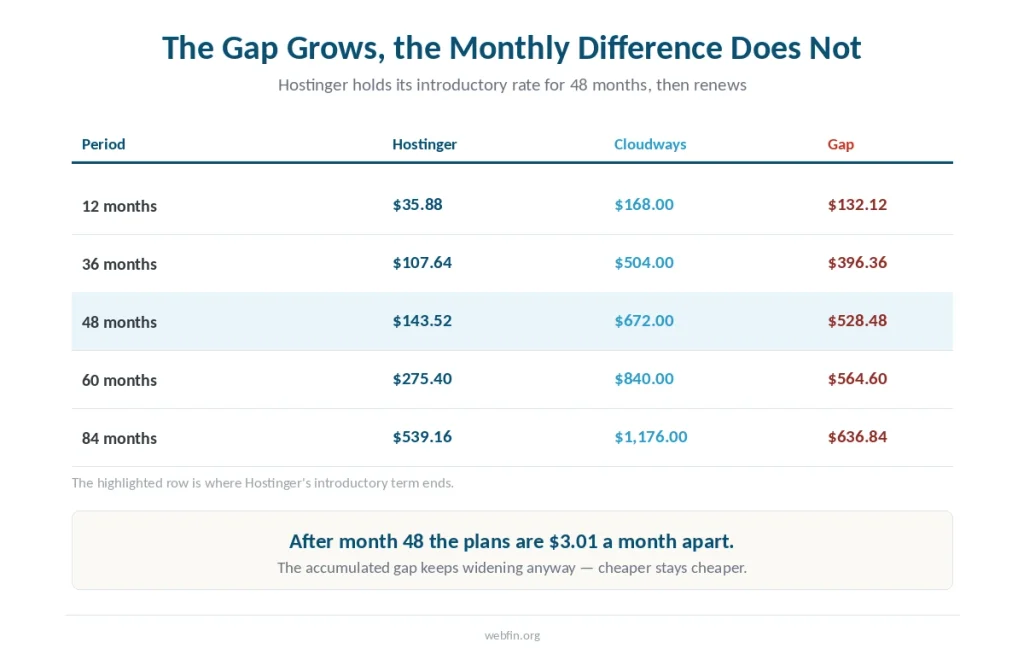
Hostinger’s introductory rate runs for 48 months. A three-year window therefore sits entirely inside it, at $2.99 a month — $107.64 total. Cloudways charges $14 from the first day and never changes it: $504.00.
That is the $396, and it is almost entirely a promotional artifact.
Look past month 48 and the picture flattens. Hostinger renews at $10.99. Cloudways stays at $14. The ongoing difference is $3.01 a month, or $36.12 a year — which is less than a single Bluehost add-on and roughly the price of two coffees.
⚠️ The gap does not close, though. Over five years the totals are $275.40 against $840.00; over seven, $539.16 against $1,176.00. Cheaper stays cheaper. The point is that the monthly difference is small while the accumulated one is not — the full arithmetic for every host is here.
They Are Not the Same Product
This is the part price comparisons skip.
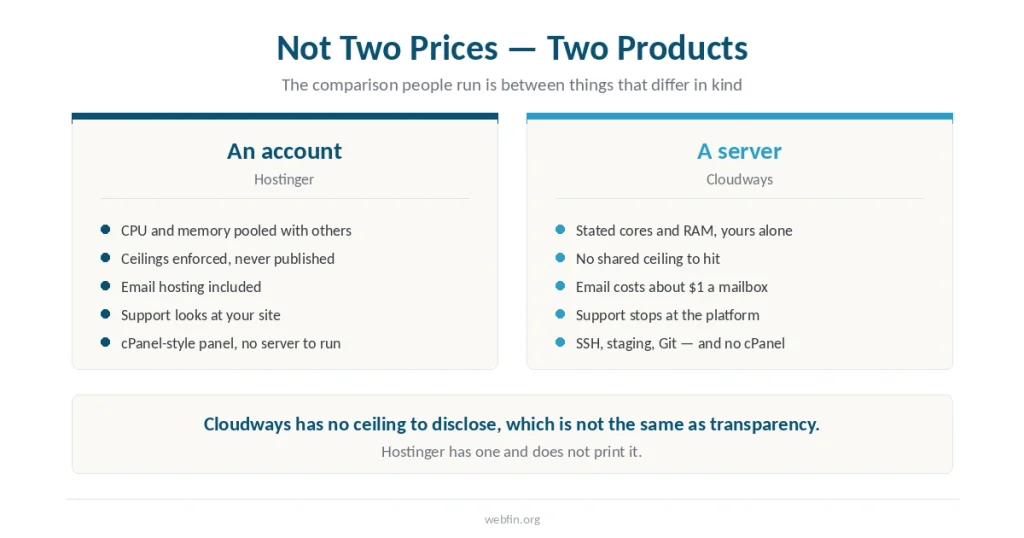
Hostinger sells you an account on a shared machine. Your CPU, memory and file count are pooled with strangers, and the ceilings are enforced but not published.
Cloudways sells you a virtual server. Stated RAM, stated cores, nobody else on them. There are no inode limits to hit because there is no shared pool to exhaust.
⚠️ We wrote a whole article about hosts that will not tell you your ceiling. Hostinger is the one that publishes nothing at all — the comparison is here. Cloudways is not more transparent; it simply has no shared ceiling to disclose.
The trade runs the other way too. A Cloudways server is yours to manage, there is no cPanel, and support stops at the platform boundary. Application problems are your problem.
Email Changes the Arithmetic
Cloudways does not include email hosting, and this is the detail that catches small businesses.
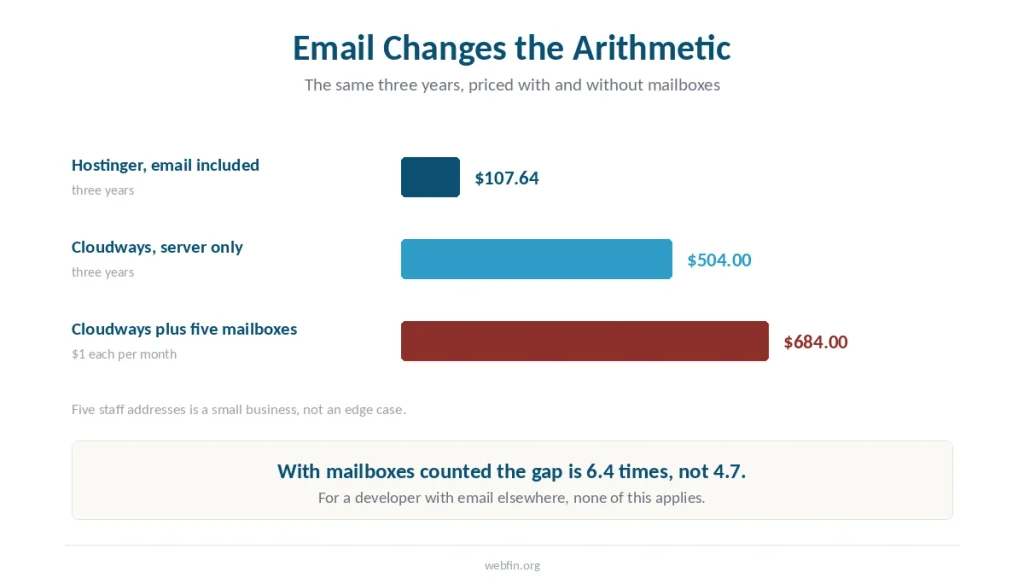
Mailboxes cost roughly a dollar each per month through Rackspace. Five addresses for a small business run $180 over three years, taking Cloudways to $684 against Hostinger’s $107.64 with email included.
For a developer with email at Google Workspace already, this is nothing. For a plumber with five staff addresses, it doubles the effective gap.
Speed
Closer than the price difference suggests.
Hostinger places 5th of 34 in one long-running benchmark, with a 351 ms global average and sub-480 ms origin response. Cloudways records 419–447 ms TTFB across five cloud configurations in the same project’s window, scoring 8 to 8.5 out of 10 on response time.
Neither is obviously faster. What differs is consistency: Cloudways’ figures land within 28 milliseconds of each other regardless of which cloud you pick, while Hostinger’s range from 87.5 ms in Europe to 396 ms in Asia.
⚠️ Both improve substantially with caching and a CDN active, and neither publishes that version prominently. The figures above are origin measurements.
Uptime
Cloudways wins this, and its figures lead every host we have reviewed so far.
Independent monitoring across five configurations recorded 99.996% to 99.999% over an eight-month window. Hostinger records 99.93% to 100% across seven projects, which is strong but not that.
The reason is structural. A Cloudways server is a virtual machine on DigitalOcean, Vultr, AWS, Google Cloud or Linode infrastructure, inheriting redundancy a single shared machine cannot match.
Support
Neither has a telephone, so the argument that decided the two previous comparisons does not apply here.
Hostinger runs chat and email around the clock, opening with an AI assistant that transfers you on request, usually inside two minutes. Cloudways runs chat and tickets around the clock with no automated gate.
The real difference is scope. Hostinger owns the whole stack and will look at your site. Cloudways owns the platform and will look at the server. Arriving from shared hosting, that boundary surprises people.
Ownership
Both are private, and both have something worth knowing.
Hostinger is headquartered in Vilnius with a private equity firm holding around 30% by the company’s own account. It owns its infrastructure and has no sister brands competing on a shortlist.
Cloudways belongs to DigitalOcean, which bought it for $350 million in 2022 — and DigitalOcean is one of the five cloud providers Cloudways offers you. At the time of the deal DigitalOcean stated that Cloudways already ran about half its customers on DigitalOcean infrastructure.
⚠️ Independent benchmarking gives the DigitalOcean Standard configuration the lowest compute allocation of the five tested. We are not alleging steering — Cloudways still supports Vultr, AWS, Google Cloud and Linode. But a buyer accepting the default deserves to know who benefits from it, and we set out the timeline separately.
Winners by Category
Three-year cost: Hostinger, by $396.
Steady-state cost: Hostinger, by $3.01 a month.
Uptime: Cloudways, decisively.
Resource headroom: Cloudways, by architecture rather than generosity.
Email: Hostinger, by including it.
Speed: a draw, with Cloudways more consistent and Hostinger faster in Europe.
Support scope: Hostinger, which will look at your site rather than your server.
Developer tooling: Cloudways, comfortably.
Pricing honesty: Cloudways, which has no promotional rate to expire.
When to Choose Cloudways Instead
A resource ceiling has already bitten you. If you have been throttled or suspended on shared hosting, this is the fix, and the $3 a month is not the question.
You need staging, SSH, WP-CLI or Git. They ship at every tier. Hostinger’s equivalents are thinner.
You would rather never think about renewal. No promotional rate, no expiry date, no calendar reminder.
You are running client sites. Hourly billing and cancel-any-time make a real difference when projects end.
Outside those, a competent shared plan does the job for a quarter of the money — and against Kinsta the ratio is twelve to one.
How We Research
Every figure comes from the two underlying reviews, where each is attributed to a named source with its window. Prices come from each company’s own pages. The totals here are arithmetic on those published rates, shown in full so they can be checked. We run no tests of our own.
Our criteria are on our About page. The long versions are in our Hostinger review and our Cloudways review.
Frequently Asked Questions
Hostinger, by $396 over three years. Most of that is Hostinger’s promotional term, which runs 48 months. Once it expires the two are $3.01 a month apart, though the accumulated gap keeps growing.
If you have hit a resource limit on shared hosting, yes. A Cloudways server has dedicated CPU and memory with no shared ceilings, and independent monitoring recorded 99.996% to 99.999% uptime. For a site that has never been throttled, the headroom goes unused.
No. Mailboxes cost roughly a dollar each per month through Rackspace, so five addresses run about $180 over three years. Hostinger includes email hosting in the plan price.
Hostinger does and does not publish them. Cloudways does not have shared ceilings at all, because you are allocated a virtual server with stated memory and cores rather than a slice of a shared machine.
Neither. Both run chat and tickets around the clock. Hostinger opens with an AI assistant that transfers you on request; Cloudways has no automated gate but scopes support to the platform rather than your application.
The Verdict
Hostinger, 4.2 against 4.1, and the margin is narrower than the price gap implies.
For a blog, a portfolio, a brochure site or a small shop, shared hosting is not a compromise — it is the correct product, and $396 over three years buys headroom most sites never reach.
Cloudways earns the difference the moment you need it. A dedicated server with no shared ceiling, uptime figures no other host we have reviewed matches, and a price that never moves. If a hosting limit has ever cost you a night’s sleep, three dollars a month is not a premium worth arguing about. Our page on Hostinger for Joomla covers the simplest of the platform cases.