
Disclosure: WebFin is reader-supported. If you buy hosting through links on this page, we may earn a commission at no extra cost to you. Commissions vary between providers and our ratings do not — here’s our full disclosure.
After twelve months, Hostinger costs $35.88 and Scala Hosting costs $35.40. That is a difference of 48 cents.
After thirty-six months the same two plans sit $214.56 apart. The reason is a single line in the terms: one promotion runs 48 months and the other runs 12.
The Short Answer
Hostinger, 4.2 against 4.0, and these are the closest two scores in our reviews.
However, the shared tier is not what Scala Hosting is for. Its managed VPS undercuts competitors at matching specifications, and Hostinger sells nothing comparable to it. The same Scala Hosting figures against Kinsta are in our Kinsta and Scala Hosting comparison.
Head to Head
| Hostinger Premium | Scala Mini | |
|---|---|---|
| Advertised | $2.99/mo | $2.95/mo |
| Intro term | 48 months | 12 months |
| Renews at | $10.99/mo | $11.95/mo |
| Twelve months | $35.88 | $35.40 |
| Three years | $107.64 | $322.20 |
| Six years | $407.28 | $752.40 |
| Refund | 30 days | 30 days plus unused term |
| Managed VPS | none priced | 4 cores, 8 GB near $37.50 |
| In our benchmark | 5th on Business, 28th on Premium | not covered |
| Our score | 4.2 | 4.0 |
The Crossover Lands in Month Thirteen
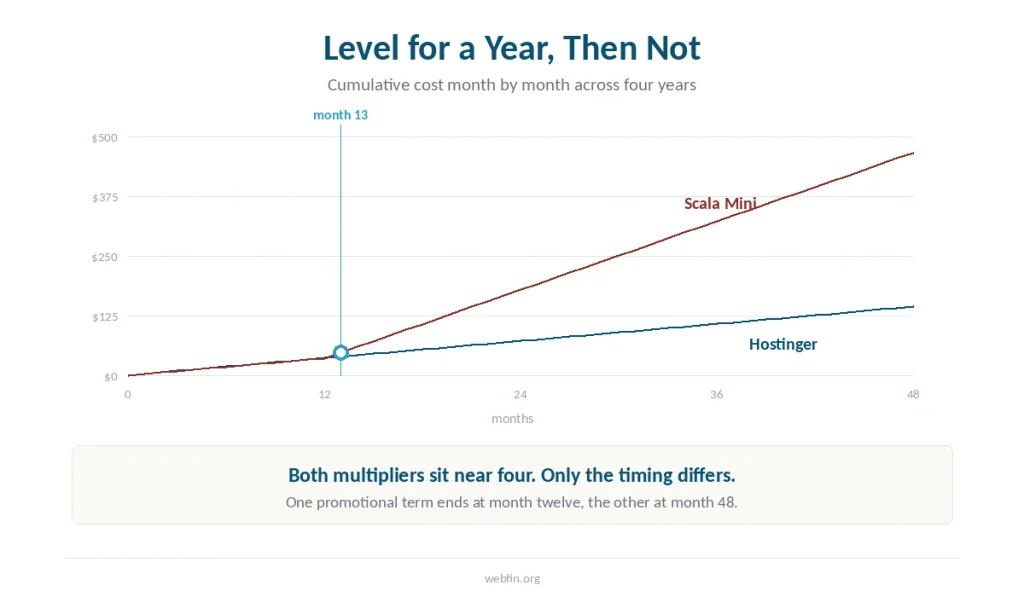
In practice, there is no gradual approach here. Scala’s promotional rate covers twelve months exactly, and Hostinger’s covers forty-eight.
So the two run level through the first year, then separate in the first month of the second. At month 13 Hostinger is $8.48 ahead and it never trails again.
Across three years Scala’s Mini plan reaches $322.20 against $107.64. Across six the figures are $752.40 and $407.28 — the full field is here.
The multipliers explain it: Hostinger renews at 3.68 times its opening rate and Scala at 4.05. Neither is extreme. The difference is entirely which promotion is still running.
Shared Is the Wrong Tier to Compare
Of course, we priced the shared plans because that is what the search term implies. It is also the part of Scala Hosting that its own coverage recommends least. The same Scala Hosting figures set against SiteGround are in our SiteGround and Scala Hosting comparison.
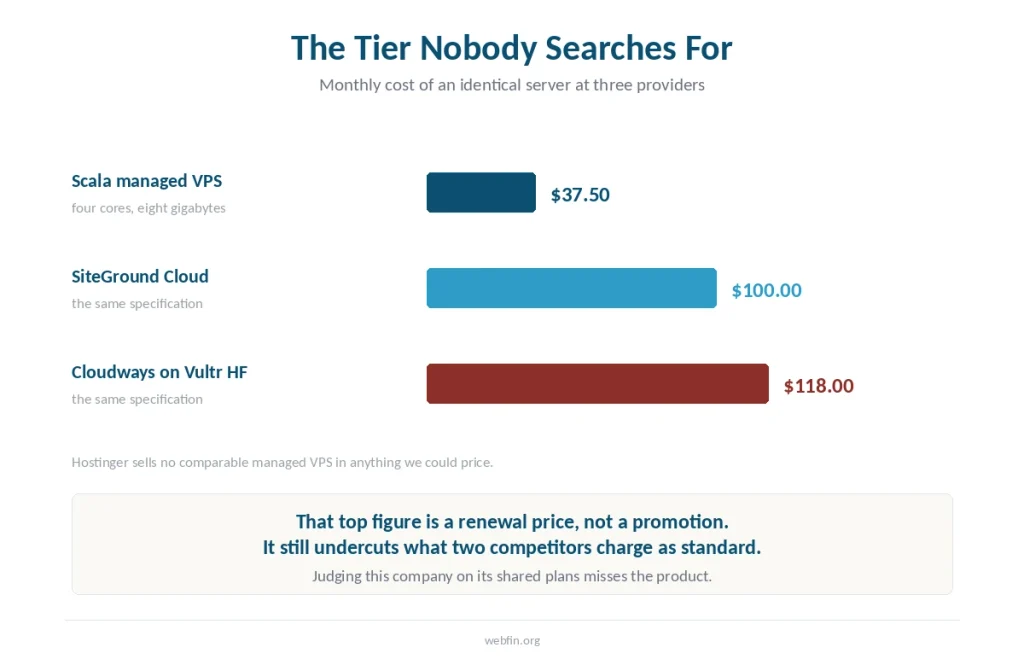
For instance, published comparison puts Scala’s managed VPS around $37.50 a month at four processor cores and eight gigabytes of memory. The same specification runs about $100 at one competitor and $118 at another.
⚠️ That is a renewal price still undercutting other companies’ regular pricing, which we found nowhere else across sixteen hosts. The same Scala Hosting figures set against Newfold Digital’s Bluehost are in our Bluehost and Scala Hosting comparison.
Hostinger does not sell a comparable managed VPS in anything we could price. So the honest reading is that these two companies meet on shared hosting, and one of them is aiming elsewhere.
Why Scala’s VPS Is Cheap
In short, two structural reasons, both checkable.
It prices resources by the unit rather than by tier: published rates put processor cores at $3 each and memory at $1 per gigabyte, adjustable at any time with unused portions credited back.
It also built its own control panel rather than licensing cPanel, which charges per-account fees that hosts pass on. Removing that line from the cost structure is part of why the arithmetic works.
Evidence Quality
This is the rare comparison where both sides have real measurement behind them.
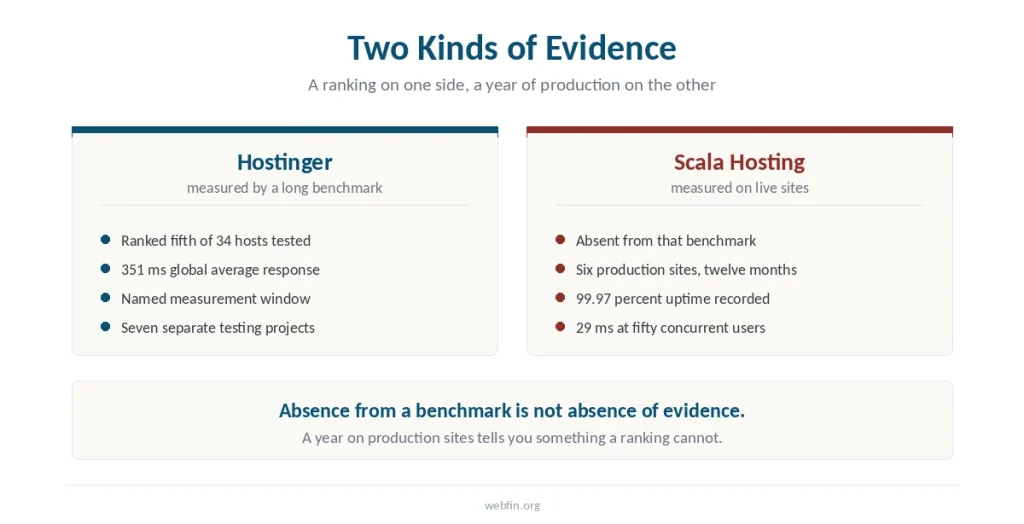
Meanwhile, that project ranks Hostinger Business fifth of 34 hosts at 223 milliseconds globally, and Hostinger Premium twenty-eighth at 495. Premium is the plan priced here.
Scala Hosting does not appear in that project, but the evidence for it is unusually good anyway: a reviewer ran six production WordPress sites on it for twelve months and recorded 99.97 percent uptime, and a separate load test of fifty concurrent users returned a 29 millisecond response at the 95th percentile. The same Scala Hosting figures against a Cloudways server are in our Cloudways and Scala Hosting comparison.
In truth, a twelve-month run on live sites is stronger evidence than most benchmark entries, even without the ranking attached.
The Refund Terms
Hostinger gives 30 days. Scala gives 30 days plus a term refund absent from the other fifteen hosts in these reviews.
After the initial window closes, it refunds the unused portion of your term at any point. Leave in month eight of a twenty-four month contract and you recover what you have not used.
Every other host we have reviewed ends its obligation when the window expires. This one does not — refund windows vary more than the category admits.
Winners by Category
Twelve-month cost: Scala, by 48 cents.
Three-year cost: Hostinger, by $214.56.
Six-year cost: Hostinger, by $345.12.
Renewal multiplier: Hostinger, at 3.68 against 4.05.
Promotional length: Hostinger, at 48 months against 12.
Managed VPS value: Scala, with no Hostinger equivalent.
Refund flexibility: Scala, by refunding unused term.
Benchmark ranking: Hostinger.
Live-site test evidence: Scala.
When to Choose Scala Hosting Instead
You want managed VPS rather than shared hosting, in which case this is the strongest value among the sixteen hosts we have priced, and Hostinger is not in the running.
Paying for exactly the resources you use appeals, adjusting them as the site changes rather than moving between tiers.
You are unsure how long the site will last and want the option to recover unused term rather than writing it off.
How We Research
Every figure comes from the two underlying reviews, where each is attributed to a named source with its window. Where our usual benchmark covers one host and not the other, we say so rather than presenting both columns as equally documented. We run no tests of our own.
Our criteria are on our About page. The long versions are in our Hostinger review and our Scala Hosting review.
Frequently Asked Questions
Hostinger, from month thirteen onward. The two shared plans finish a year 48 cents apart, then separate immediately because Scala’s promotion ends at twelve months and Hostinger’s runs to forty-eight.
Hostinger costs $107.64 and Scala’s Mini plan costs $322.20, a gap of $214.56. Across six years the figures are $407.28 and $752.40.
By published comparison, yes. Four processor cores and eight gigabytes of memory run around $37.50 a month, against roughly $100 and $118 for the same specification at two competitors we have reviewed.
Different kinds. Hostinger ranks fifth of 34 hosts in a long-running benchmark. Scala does not appear there, but a reviewer ran six production sites on it for twelve months and recorded 99.97 percent uptime.
Both give 30 days for a full refund. Scala also refunds the unused portion of your term at any point afterwards, which the other fifteen hosts in these reviews do not.
The Verdict
Hostinger, 4.2 against 4.0, on the shared tier that most people searching this comparison will buy.
But that verdict comes with a caveat we do not usually add. Scala Hosting is a VPS company that also sells shared plans, and judging it on the shared plans is like judging a restaurant by its bread.
If you are choosing shared hosting, Hostinger costs $214.56 less across three years. If you are choosing a server, Scala Hosting is the cheapest credible option in these reviews and the comparison does not apply.