
Disclosure: WebFin is reader-supported. If you buy hosting through links on this page, we may earn a commission at no extra cost to you. Commissions vary between providers and our ratings do not — here’s our full disclosure.
Neither of these is the cheap option. SiteGround renews at $17.99 a month, a sixfold increase on its advertised rate. Kinsta charges $35 flat, which is the highest entry price in our set.
So the question is not which is cheaper. It is what each premium actually buys — and the answers have almost nothing in common.
The Short Answer
Kinsta, 4.1 against 3.9, if your traffic is North American or European and you run sites for a living. Its edge network delivers in 25 to 42 milliseconds, and the tooling included would cost real money assembled separately.
SiteGround if you need a telephone, email in the box, or a bill under $500 over three years. On its 24-month term it costs a fifth of Kinsta and stays cheaper permanently.
Head to Head
| SiteGround StartUp | Kinsta Starter | |
|---|---|---|
| Advertised | $2.99/mo | $35/mo |
| Renews at | $17.99 annual, $14.99 on 24 months | $35, unchanged |
| Three years, annual | $467.64 | $1,260.00 |
| Three years, 24-month | $251.64 | $1,260.00 |
| The gap | — | $792 to $1,008 |
| Origin TTFB | 632 ms | 525 ms |
| Edge-cached | not published | 25–42 ms |
| Phone support | Yes | No |
| Email hosting | Included | Not offered |
| CDN | Add-on | Cloudflare Enterprise, included |
| Owner | Independent | Private, funding disputed |
| Our score | 3.9 | 4.1 |
The Gap Depends on the Term
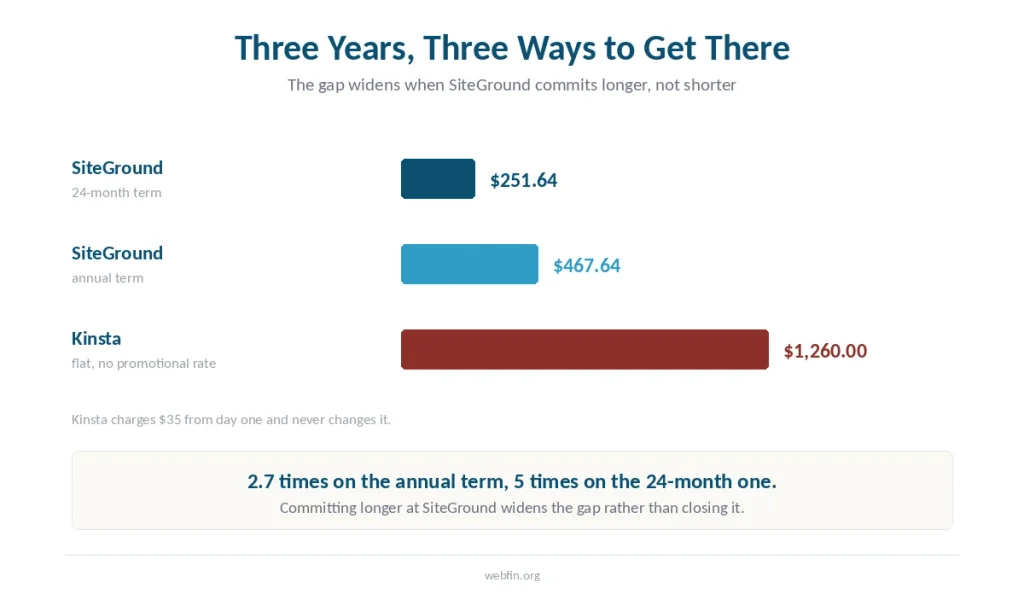
Kinsta costs 2.7 times SiteGround on its annual term and 5 times on its 24-month one.
SiteGround annual: $2.99 for twelve months, $17.99 thereafter, $467.64 over three years. SiteGround on 24 months: $14.99 at renewal, $251.64. Kinsta: $35 from the first day and forever, $1,260.00.
At steady state the monthly difference runs $17.01 or $20.01 depending on which SiteGround term you took. Neither host hides a renewal, which is worth saying: SiteGround publishes its increase and Kinsta has none — the full field is here.
Speed, and the Metric That Decides It
The same benchmarking project criticised both hosts, for opposite reasons.
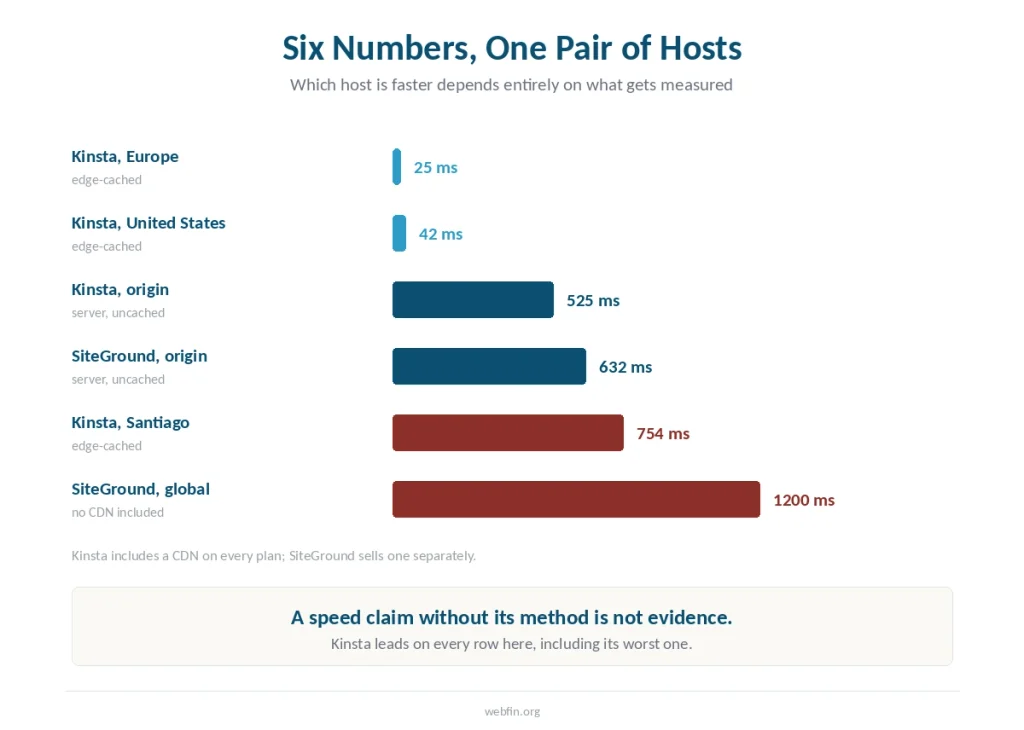
SiteGround it ranked 22nd of 34, recording 632 ms origin response — degraded from 403 ms in 2022 — and a global TTFB of 1,200 ms, the weakest of the 29 hosts it tested.
Kinsta it measured at 525 ms origin and concluded plainly that the premium outpaces the performance.
On origin response, then, Kinsta is faster and both are unremarkable.
⚠️ But origin is the wrong question for one of them. Kinsta includes Cloudflare Enterprise on every plan, so visitors reach the edge rather than the server. Measured there, Kinsta records 25 ms in Europe and 30–42 ms in the United States. SiteGround sells its CDN separately and publishes no equivalent figure. We explained the distinction in our Kinsta review, and it qualifies every speed number on this site.
SiteGround’s genuine strength is hardware and load. A server resources score of 8.4 out of 10, second highest of 34, and 147 ms average response under a ramp to 100 concurrent users with zero errors.
⚠️ Kinsta’s edge network has a hole. The same project recorded 481 ms in São Paulo and 754 ms in Santiago. For South American traffic the expensive option is measurably slower.
Uptime
Close, with Kinsta marginally ahead.
Kinsta records 99.98% over an eight-month window and 100% across a project monitoring twenty live sites. SiteGround records 99.96% to 100% depending on the window.
⚠️ One Kinsta dip in 2025 traces partly to a Cloudflare outage rather than to Kinsta. Renting someone else’s edge network means inheriting their bad days.
What Each Premium Buys
This is the comparison, and the two lists barely overlap.
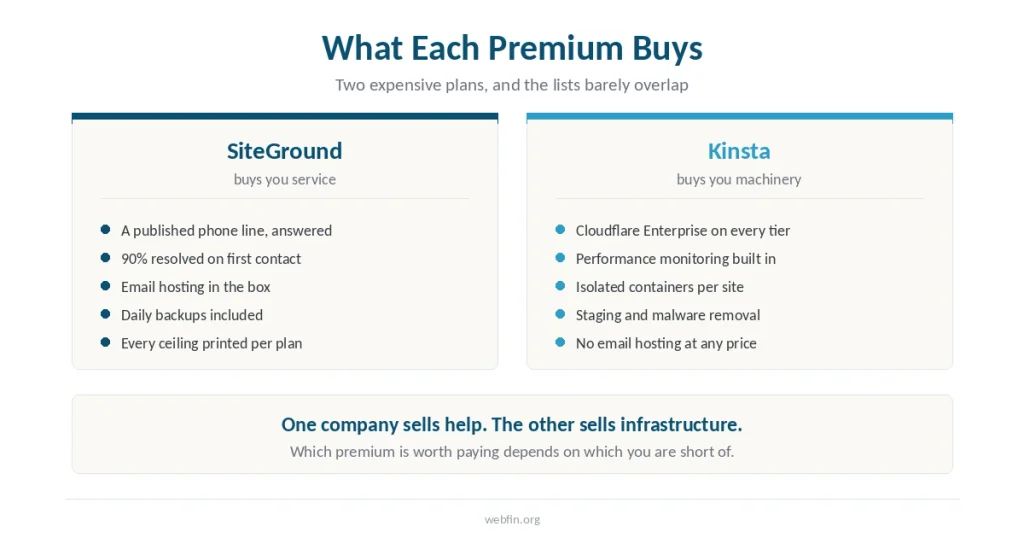
SiteGround’s premium buys service. A published telephone line answered around the clock, with a reported 90% first-contact resolution rate and a 4.9 out of 5 Trustpilot score. Email hosting included. Daily backups included. Every resource ceiling published per plan.
Kinsta’s premium buys infrastructure. Cloudflare Enterprise on every tier rather than as an upgrade. Application performance monitoring built in, which is normally a separate paid tool. Isolated containers, so a neighbor’s compromise cannot reach you. Staging and free malware removal.
⚠️ Kinsta does not offer email hosting at all — not as an add-on, not at a price. For a small business that means another vendor and another bill. SiteGround includes it.
So one company sells you help and the other sells you machinery. Which premium is worth paying depends entirely on which of those you are short of.
Support
SiteGround, and it is not close.
SiteGround publishes a phone number and answers it around the clock, with the clearest support evidence we found for any of the five. There is no automated gate before a person.
Kinsta runs chat and tickets only, and for Kinsta we could not find even the consistent third-party description that exists for others. We scored that criterion conservatively in its review and we are not inflating it here.
⚠️ Nobody publishes controlled measurement of support response times for any host. This rests on description rather than data throughout our site.
Ownership
Both are private, and one of them is clearer about it.
SiteGround is independent. Founded in Sofia in 2004 by university friends, still privately held, no parent group, no sister brands, no private equity portfolio. Its chief executive began there as a support agent.
Kinsta is privately held too, founded in 2013 by Mark Gavalda and headquartered in West Hollywood. ⚠️ Its funding history is reported two ways and we could not resolve it. Some company databases describe Kinsta as bootstrapped with no outside money; others record a single round with one institutional investor, and one names a private capital firm. We found no first-party statement.
Neither belongs to a group that would put two names on the same shortlist, which sets both apart from much of this category.
⚠️ One difference in infrastructure ownership: Kinsta owns neither its servers nor its CDN. Google Cloud underneath, Cloudflare in front. SiteGround runs on Google Cloud too but operates its own stack above it.
Winners by Category
Three-year cost: SiteGround, by $792 on its annual term and $1,008 on its 24-month one.
Origin speed: Kinsta, by 107 ms.
Edge-cached speed: Kinsta, comfortably.
South American delivery: SiteGround.
Server hardware and load: SiteGround.
Uptime: Kinsta, marginally.
Support: SiteGround, decisively.
Email: SiteGround, by offering it.
Included tooling: Kinsta, by a wide margin.
Published limits: SiteGround, on a page dated 2021.
Ownership clarity: SiteGround.
When to Choose SiteGround Instead
You want a phone number. Kinsta has none at any tier, and no infrastructure advantage substitutes for a person answering.
You need company email. Kinsta does not sell it. That is another vendor to manage.
Your visitors are South American. Kinsta’s own edge figures are worse there than a shared plan costing a fraction as much.
You will take the 24-month term. $251.64 against $1,260.00 is a fifth of the price, and the difference funds a great deal of other things.
How We Research
Every figure comes from the two underlying reviews, where each is attributed to a named project with its window and whether it measured origin or edge. Prices and limits come from each company’s own pages with update dates stated. We run no tests of our own.
Our criteria are on our About page. The long versions are in our SiteGround review and our Kinsta review.
Frequently Asked Questions
SiteGround, by $792 over three years on its annual term and $1,008 on its 24-month one. Kinsta costs $1,260 across the same period at a flat $35 a month with no increase at any point.
Kinsta, on the measurement that matters to visitors. Its edge-cached response times run 25 to 42 milliseconds against SiteGround’s 1,200 ms global TTFB. On origin response the gap narrows to 107 milliseconds.
No, and it does not sell it either. Email requires a separate provider and a separate bill. SiteGround includes email hosting and daily backups in the plan price.
No, at any tier. SiteGround publishes a telephone number answered around the clock, with a reported 90% first-contact resolution rate and a 4.9 out of 5 Trustpilot score.
SiteGround is independently held, founded in Sofia in 2004 with no parent group. Kinsta is privately held, founded in 2013 by Mark Gavalda, though company databases disagree on whether it took outside funding.
The Verdict
Kinsta, 4.1 against 3.9, and the score is doing a lot of work that price does not.
For an agency in North America or Europe, edge delivery at 25 milliseconds and tooling worth hundreds a year make a coherent case for $35 a month.
For everyone else SiteGround wins on the things that get used. A telephone line, email in the box, and a bill that on the right term is a fifth of the alternative. If you are comparing these two on price you are probably not the customer Kinsta was built for — and there is no shame in that, because most sites are not. Our page on Kinsta for Drupal covers where to get an edge network without leaving Drupal.