
Disclosure: WebFin is reader-supported. If you buy hosting through links on this page, we may earn a commission at no extra cost to you. Commissions vary between providers and our ratings do not — here’s our full disclosure.
Buy SiteGround on its annual term and it costs $467.64 over three years. Cloudways costs $504.00. Thirty-six dollars apart — a dollar a month between a shared hosting account and a dedicated cloud server.
Run the same numbers to four years and the order flips. SiteGround reaches $683.52; Cloudways reaches $672.00. The budget shared plan becomes the expensive option, and it stays that way.
The Short Answer
Cloudways, 4.1 against 3.9, unless you need a telephone. Flat pricing that never rises, dedicated resources with no ceiling, and uptime between 99.996% and 99.999%.
SiteGround if support decides it, if you want email included, or if you will commit to its 24-month term — which brings it to $251.64 over three years and keeps it genuinely cheaper.
Head to Head
| SiteGround StartUp | Cloudways | |
|---|---|---|
| Model | Shared hosting account | Managed cloud server |
| Advertised | $2.99/mo | From $14/mo |
| Renews at | $17.99/mo annual, $14.99 on 24 months | $14/mo, unchanged |
| Three years, annual term | $467.64 | $504.00 |
| Three years, 24-month term | $251.64 | $504.00 |
| Four years, annual term | $683.52 | $672.00 |
| Phone support | Yes | No |
| Email hosting | Included | About $1 per mailbox |
| Resource ceilings | Published per plan | None — dedicated |
| Uptime measured | 99.96–100% | 99.996–99.999% |
| Owner | Independent | DigitalOcean |
| Our score | 3.9 | 4.1 |
The Crossover
This is the finding, and it survives the arithmetic in a way the storefronts do not show.
On its annual term SiteGround pays $2.99 for twelve months, then $17.99 for every month after. Cloudways charges $14.00 from the first day forever.
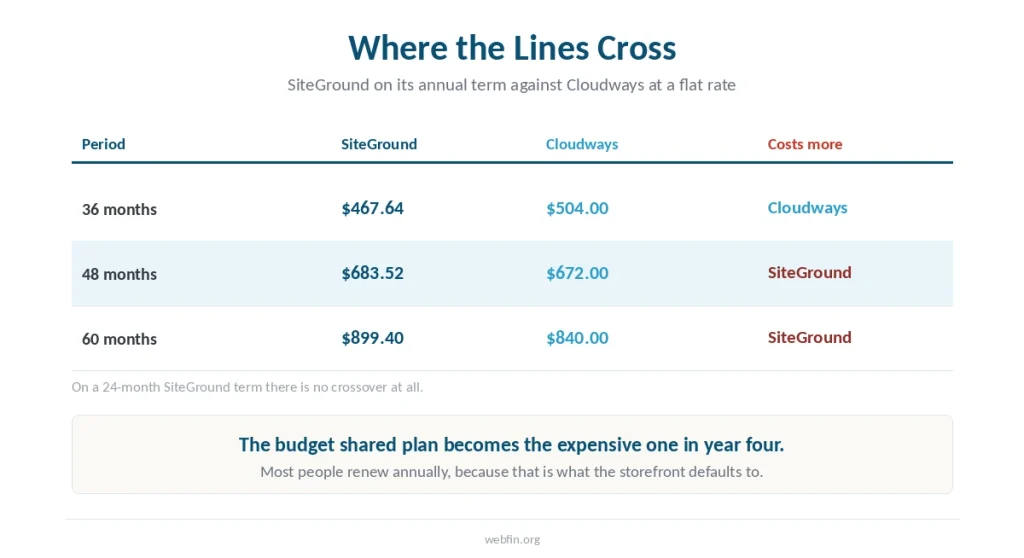
36 months   SiteGround $467.64   Cloudways $504.00   Cloudways +$36.36
48 months   SiteGround $683.52   Cloudways $672.00   SiteGround +$11.52
60 months   SiteGround $899.40   Cloudways $840.00   SiteGround +$59.40
Somewhere in year four the lines cross, and after that the shared plan is the expensive one. At steady state the difference is $3.99 a month in Cloudways’ favor — for a server nobody else is sharing.
⚠️ The 24-month term changes this entirely. SiteGround renews at $14.99 rather than $17.99 on that commitment, producing $251.64 over three years and a steady-state gap of 99 cents a month. On that term SiteGround stays cheaper indefinitely — the full renewal picture is here.
So the honest version: SiteGround is cheaper if you commit to two years at a time, and more expensive if you renew annually like most people do.
Two Different Products
The price comparison hides a difference in kind.
SiteGround sells an account on a shared machine. CPU seconds, inodes and memory are pooled, and the ceilings are real: 10,000 CPU seconds a day on StartUp, 200,000 inodes, 768 MB per process. Exceed them and the account is limited until usage falls.
Cloudways sells a virtual server. Stated cores, stated memory, nobody else on them. There is no ceiling to hit because there is no shared pool.
⚠️ Credit where it is due: SiteGround publishes every one of its limits, per plan, on one page. That is more than most of this category manages, and more than the host we usually recommend. We compared three hosts on exactly this. The page was last updated in October 2021.
Cloudways is not more transparent — it simply has nothing to disclose. Those are different virtues and only one of them is a choice.
Email and What Else Is Missing
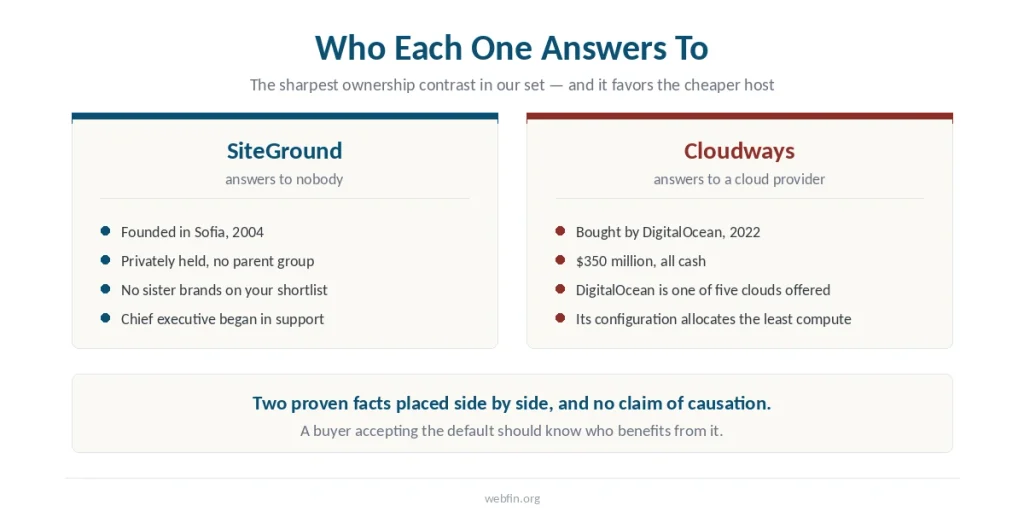
SiteGround includes email hosting and daily backups. Cloudways includes neither in the way a small business expects: mailboxes cost roughly a dollar each per month through Rackspace.
Five staff addresses run $180 over three years, which takes Cloudways to $684 and undoes the crossover for anyone who needs company email.
Cloudways includes what SiteGround does not: SSH, WP-CLI, Git deployment, staging at every tier, and hourly billing with no contract at all.
⚠️ Neither includes a CDN by default. Both sell one, and both publish speed figures measured without it.
Speed and Uptime
Uptime goes to Cloudways, clearly. Independent monitoring across five configurations recorded 99.996% to 99.999% over an eight-month window. SiteGround records 99.96% to 100% depending on the window — strong, but not that.
Speed is closer than the price gap implies. Cloudways records 419–447 ms TTFB across all five cloud providers, in a tight band. SiteGround records 632 ms origin, degraded from 403 ms in 2022, and a global TTFB of 1,200 ms — the weakest of the 29 hosts one project tested.
SiteGround’s answer is hardware and load handling, and it is real: a server resources score of 8.4 out of 10, second highest of 34, and 147 ms average response under a ramp to 100 concurrent users with zero errors.
So SiteGround has the stronger machine and the weaker delivery, while Cloudways is consistent everywhere and spectacular nowhere.
Support
SiteGround’s win, and the only one money cannot buy on the other side.
SiteGround publishes a telephone number and answers it around the clock, with a reported 90% first-contact resolution rate and a 4.9 out of 5 Trustpilot score. Cloudways runs chat and tickets only.
There is a second difference in scope. SiteGround owns the whole stack and will look at your site. Cloudways owns the platform and will look at the server — application problems are yours. Arriving from shared hosting, that boundary catches people out.
Ownership
A clean contrast, and it favors the cheaper host.
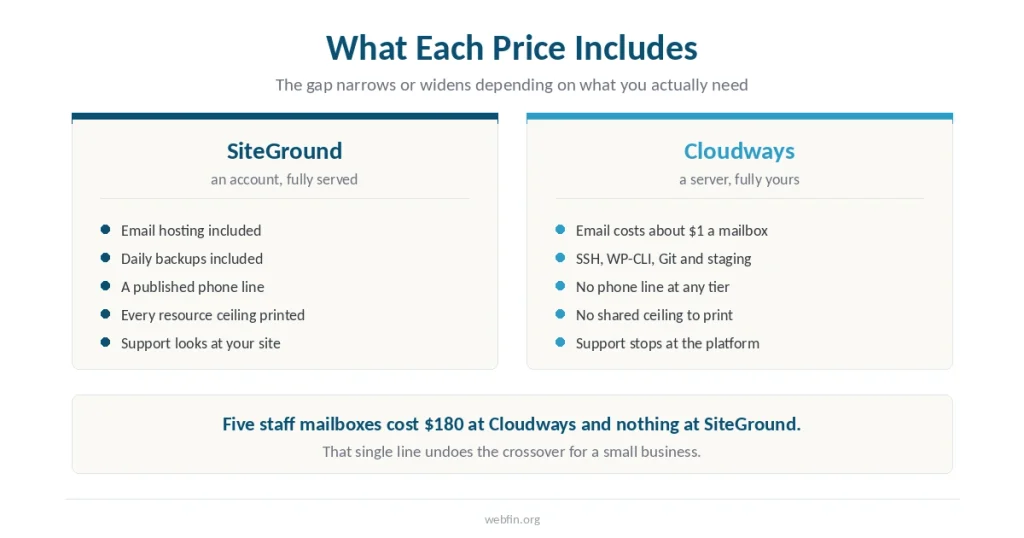
SiteGround is independent. Founded in Sofia in 2004, still privately held, no parent group, no sister brands, no private equity portfolio. Its chief executive started there as a support agent.
Cloudways belongs to DigitalOcean, which bought it for $350 million in 2022 — and DigitalOcean is one of the five cloud providers Cloudways invites you to choose between. At the time of the deal DigitalOcean stated Cloudways already ran about half its customers on DigitalOcean infrastructure.
⚠️ Independent benchmarking gives the DigitalOcean Standard configuration the lowest compute allocation of the five tested. We are not alleging steering, and Cloudways still supports Vultr, AWS, Google Cloud and Linode. But a buyer accepting the default should know who benefits from it — we set out the timeline separately.
Winners by Category
Three-year cost, annual term: SiteGround, by $36.
Three-year cost, 24-month term: SiteGround, by $252.
Four-year cost, annual term: Cloudways.
Uptime: Cloudways, decisively.
Delivery speed: Cloudways, by consistency.
Server hardware and load: SiteGround.
Support: SiteGround, by a telephone number.
Email: SiteGround, by including it.
Resource headroom: Cloudways, by architecture.
Published limits: SiteGround, on a page from 2021.
Ownership clarity: SiteGround.
Developer tooling: Cloudways.
When to Choose SiteGround Instead
You will telephone support. Cloudways has no line at any tier, and no amount of price advantage substitutes for one.
You need company email. Five mailboxes cost $180 over three years at Cloudways and nothing at SiteGround.
You will commit to 24 months. That term produces $251.64 over three years and keeps SiteGround cheaper permanently, not just until year four.
You want the ceiling published before you buy. SiteGround tells you. It is a five-year-old page, and it still beats not being told.
How We Research
Every figure comes from the two underlying reviews, where each is attributed to a named source with its window. Prices and limits come from each company’s own pages with update dates stated. We run no tests of our own.
Our criteria are on our About page. The long versions are in our SiteGround review and our Cloudways review.
Frequently Asked Questions
It depends on the term and how long you stay. On an annual term SiteGround costs $467.64 over three years against $504.00, then becomes more expensive from year four. On a 24-month term it costs $251.64 and stays cheaper indefinitely.
On uptime, resource headroom and price stability, yes. Independent monitoring recorded 99.996% to 99.999% for Cloudways. SiteGround has stronger server hardware, better support and includes email.
No, at any tier. SiteGround publishes a telephone number and answers it around the clock, with a reported 90% first-contact resolution rate. Both run chat and tickets continuously.
SiteGround does and publishes them per plan: 10,000 CPU seconds a day on StartUp, 200,000 inodes, 768 MB per process. Cloudways allocates a virtual server with stated cores and memory, so there is no shared ceiling.
SiteGround is independently held, founded in Sofia in 2004 with no parent company. Cloudways was acquired by DigitalOcean for $350 million in 2022, and DigitalOcean is one of the five cloud providers Cloudways offers.
The Verdict
Cloudways, 4.1 against 3.9, on uptime, headroom and a price that never moves.
The crossover is the argument. Bought annually, SiteGround is cheaper for three years and more expensive from the fourth onward — and most people renew annually because that is what the storefront defaults to.
SiteGround wins the parts that are hard to replace. A telephone line, email in the box, and an owner with nobody else on the menu. If any of those three is your deciding factor, take the 24-month term and stop reading — on that commitment it stays cheaper for good. Our page on Cloudways for Joomla covers why a managed server is more than most Joomla sites need.