
Disclosure: WebFin is reader-supported. If you buy hosting through links on this page, we may earn a commission at no extra cost to you. Commissions vary between providers and our ratings do not — here’s our full disclosure.
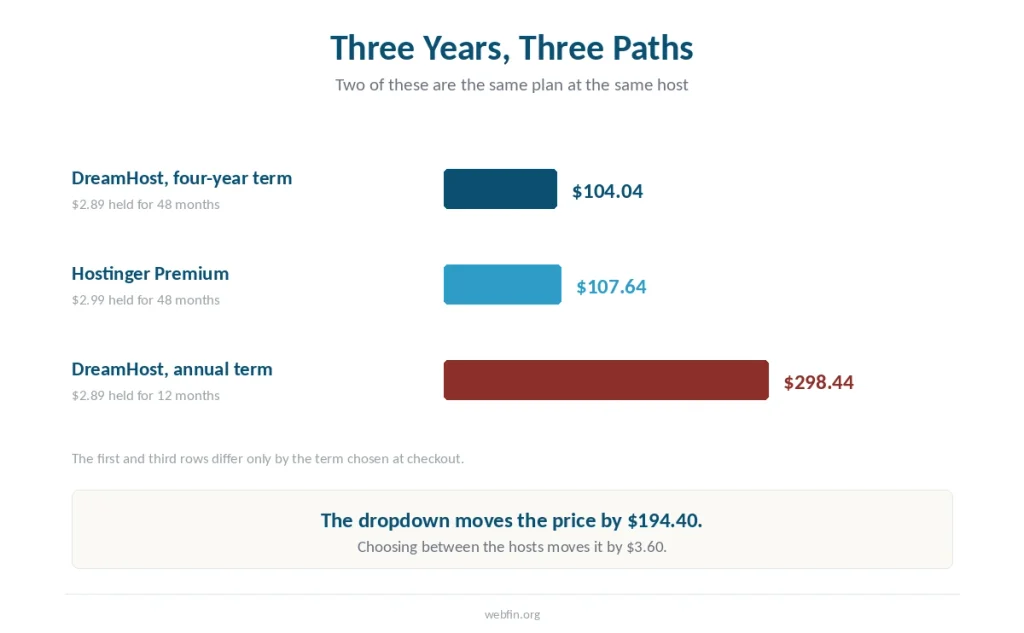
Pick the four-year term at DreamHost and three years costs $104.04. However, pick the annual term and the same plan costs $298.44. The same DreamHost figures set against Newfold Digital’s Bluehost are in our Bluehost and DreamHost comparison.
Therefore that is a swing of $194.40 from one selection at checkout, and it is larger than the entire three-year price of the cheaper option. Hostinger sits between the two at $107.64.
The Short Answer
Hostinger, 4.2 against 3.7, on evidence rather than price. It ranks in the benchmark we cite throughout and DreamHost does not appear in it. The same DreamHost figures against a Cloudways server are in our Cloudways and DreamHost comparison.
However, if you will commit to four years, DreamHost is $3.60 cheaper over three and $76.80 cheaper over six. The pricing question genuinely goes the other way.
Head to Head
| Hostinger Premium | DreamHost Launch | |
|---|---|---|
| Advertised | $2.99/mo | $2.89/mo |
| Intro term | 48 months | 12 or 48 months |
| Renews at | $10.99/mo | $10.99 or $7.99 |
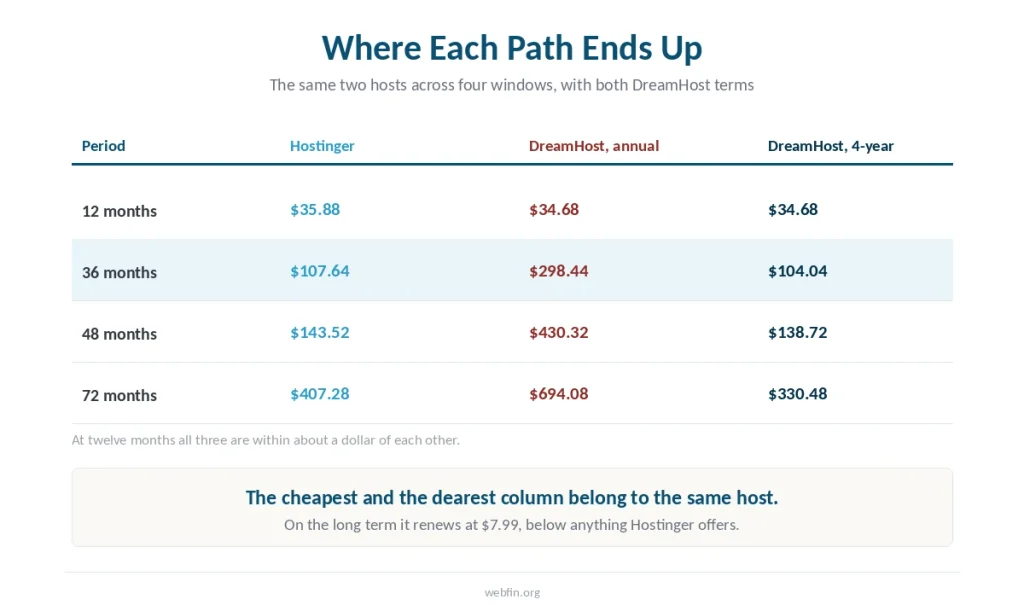
| Three years, short term | $107.64 | $298.44 |
| Three years, long term | $107.64 | $104.04 |
| Six years, long term | $407.28 | $330.48 |
| Refund window | 30 days | 97 or 30, disputed |
| In our benchmark | 5th of 34 | not covered |
| Web server | LiteSpeed | Apache |
| Owner | Private, ~30% PE-held | Independent |
| Our score | 4.2 | 3.7 |
The Dropdown Is Worth More Than the Host Choice
In practice, most comparisons on this site turn on which company you pick. This one turns on which term.
At DreamHost, $2.89 a month holds for 48 months on the four-year contract and for 12 months on the annual one. The renewal that follows is $7.99 on the long term and $10.99 on the short one. The same DreamHost figures against Kinsta are in our Kinsta and DreamHost comparison.
Consequently three years costs $104.04 on the long path and $298.44 on the short one. The gap between those two figures is nearly three times what Hostinger charges more than the cheaper of them.
⚠️ If you take one thing from this comparison, take that. Choosing between these hosts matters less than choosing the term at one of them — the full field is here.
Both Renew at $10.99
On the annual path, the two hosts renew at exactly the same rate.
This is the second pairing where that happens. Hostinger holds $2.99 for 48 months and DreamHost holds $2.89 for 12, then both charge $10.99.
The difference is entirely the length of the introductory term, which is why Hostinger wins the annual comparison by such a wide margin and loses the four-year one by a narrow one.
Where the Evidence Is Uneven
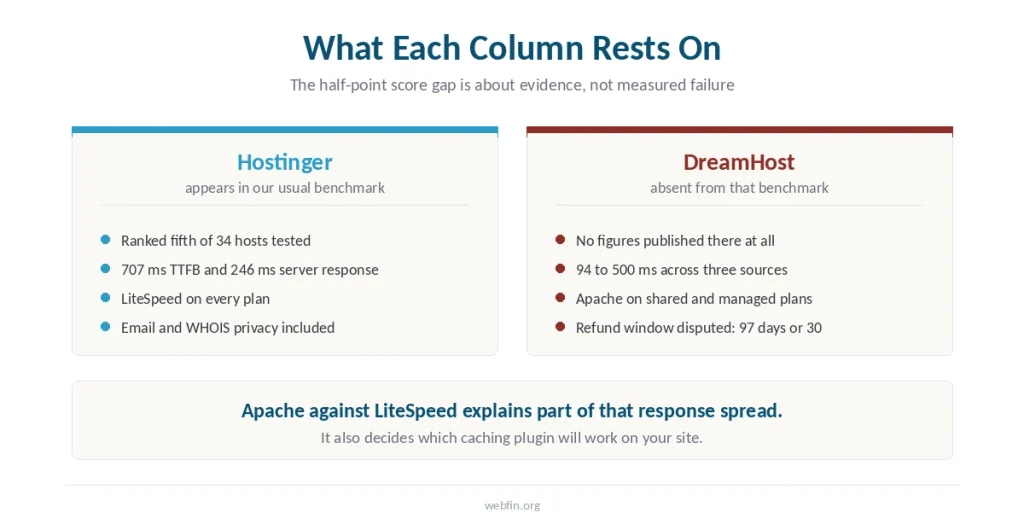
For instance, the benchmarking project we cite in every review ranks Hostinger fifth of 34 hosts. It does not publish figures for DreamHost.
Meanwhile, what exists for DreamHost is a spread. One 2026 benchmark places it between 450 and 500 milliseconds. Another records a 239 millisecond average. A third measured 142 on shared hosting and 94 on the managed plan.
Of course, part of that spread has a concrete explanation. DreamHost runs Apache on shared and managed WordPress plans; Hostinger runs LiteSpeed. On LiteSpeed servers, caching happens at the web server before the application starts — which decides your caching plugin.
⚠️ Hostinger’s own published figures are also mixed. One test recorded 707 milliseconds time to first byte and a 246 millisecond server response in the same window, which are different measurements of the same visit.
Two Things DreamHost Has
First, a refund window that may be much longer, and we could not settle by how much.
Besides, four 2026 reviews state 97 days. One states that the current terms describe 30 days on most plans, and that the longer figure circulates in older articles. ⚠️ We flagged that conflict in the review and repeat it here rather than picking the flattering version.
Second, ownership. DreamHost has never been acquired, describes itself as employee-owned, and has no parent group. Hostinger is privately held with a private equity firm holding around 30 percent by its own account.
Two Things Hostinger Has
In practice, email hosting and WHOIS privacy are included rather than sold, and a free domain comes with annual plans. DreamHost includes WHOIS privacy for the life of the domain, which is the better version of that particular perk.
Hostinger also appears in the benchmark. That is not a quality claim, it is an evidence claim, and it is the reason the scores differ by half a point despite the pricing going DreamHost’s way on the long term.
Winners by Category
Three years, annual term: Hostinger, by $190.80.
Three years, four-year term: DreamHost, by $3.60.
Six years, four-year term: DreamHost, by $76.80.
Renewal rate, annual: a draw at $10.99.
Renewal rate, long term: DreamHost, at $7.99.
Benchmark coverage: Hostinger.
Refund window: DreamHost, if the 97-day figure holds.
Ownership independence: DreamHost.
Included email: Hostinger.
When to Choose DreamHost Instead
You will commit to four years. That single condition flips the price comparison and it is the only condition that does.
You want a host with no parent company and no sister brands, which narrows the field considerably.
You value WHOIS privacy that does not expire after twelve months, which most registrars bill for annually from year two.
How We Research
Every figure comes from the two underlying reviews, where each is attributed to a named source with its window. Where our usual benchmark covers one host and not the other, we say so rather than presenting both columns as equally documented. We run no tests of our own.
Our criteria are on our About page. The long versions are in our Hostinger review and our DreamHost review.
Frequently Asked Questions
It depends on the term. On DreamHost’s four-year contract, three years costs $104.04 against Hostinger’s $107.64. Choosing the annual contract instead raises that to $298.44, because the renewal arrives after twelve months rather than forty-eight.
Yes, on the annual path, at exactly $10.99 a month. On DreamHost’s four-year contract the renewal is $7.99, which is lower than anything Hostinger offers.
Hostinger by the available evidence, though the comparison is uneven. One benchmark ranks Hostinger fifth of 34 hosts and does not cover DreamHost. Published DreamHost figures range from 94 to 500 milliseconds depending on the test and the plan.
Sources disagree. Four 2026 reviews state 97 days while another says the current terms describe 30. We could not settle it, so confirm the figure at checkout rather than relying on any review including this one.
DreamHost is independently owned and describes itself as employee-owned, with no parent group. Hostinger is privately held in Vilnius, with a private equity firm holding around 30 percent by its own account.
The Verdict
Hostinger, 4.2 against 3.7, and the gap is about what we could verify rather than what we measured against it.
On price the honest answer is that it depends on a dropdown. Take the four-year term at DreamHost and it is cheaper at every horizon. Take the annual term and it costs nearly three times as much over the same period.
Choose Hostinger if you want the host that appears in the benchmark. Choose DreamHost if you will sign for four years and you would rather your host answered to nobody.