
Disclosure: WebFin is reader-supported. If you buy hosting through links on this page, we may earn a commission at no extra cost to you. Commissions vary between providers and our ratings do not — here’s our full disclosure.
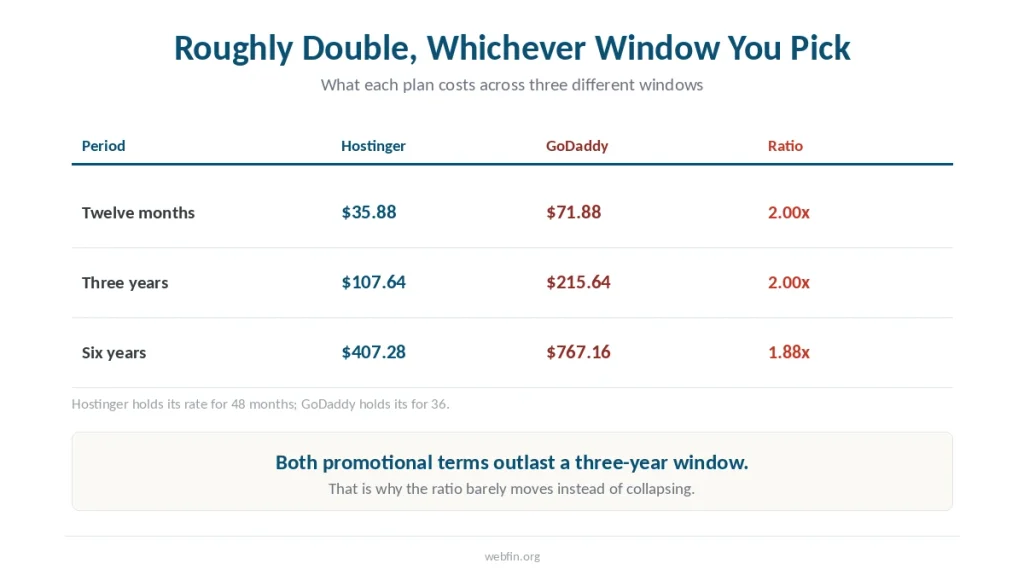
GoDaddy costs roughly twice what Hostinger does. Indeed, that holds at twelve months, at three years and at six.
Moreover, it renews above the price its own discount is calculated from, and its shared hosting failed the load test in the benchmark we cite throughout these reviews. The same GoDaddy figures against a Cloudways server are in our Cloudways and GoDaddy comparison.
The Short Answer
Hostinger, and this is the widest gap between two hosts we have compared. Our scores put them at 4.2 and 2.7, the highest and lowest across twenty reviews.
Of course, GoDaddy earns its place as a registrar with a phone line. As a host it is the more expensive option on every measure we can check.
Head to Head
| Hostinger Premium | GoDaddy Economy | |
|---|---|---|
| Advertised | $2.99/mo | $5.99/mo |
| Term for that price | 48 months | 36 months |
| Renews at | $10.99/mo | $15.32/mo |
| Three-year total | $107.64 | $215.64 |
| Six-year total | $407.28 | $767.16 |
| Global response | 351 ms | 751 ms shared |
| Uptime measured | 99.93–100% | 99.76% shared |
| Load test | completed | did not complete |
| Phone support | No | Yes |
| SSL | Included | $119.99/yr on Economy |
| In our benchmark | 5th of 34 on Business, 28th on Premium | 751 ms shared, weakest of 23 |
| Our score | 4.2 | 2.7 |
The Price, at Three Horizons
Besides, both plans advertise cheaply and both raise the price afterwards. The difference is how much.
In practice, Hostinger asks $2.99 a month for 48 months, then $10.99. GoDaddy asks $5.99 for 36 months, then $15.32.
Twelve months: $35.88 against $71.88. Three years: $107.64 against $215.64. Six years: $407.28 against $767.16.
Therefore the ratio stays near two throughout, which is unusual. In most pairings the gap narrows or widens once a promotional term ends. Here both terms are long enough that the shape holds — the full field is here.
The Renewal That Exceeds Its Own Regular Price
In fact, GoDaddy advertises the Economy plan at half off a regular price of $11.99. The plan then renews at $15.32. The same GoDaddy figures against Kinsta are in our Kinsta and GoDaddy comparison.
Consequently the renewal sits 28 percent above the figure the discount cites. We checked that arithmetic when reviewing it, and the number comes from dividing its published three-year renewal charge by 36 months.
Hostinger’s renewal of $10.99 is below GoDaddy’s regular price, let alone its actual one.
Speed
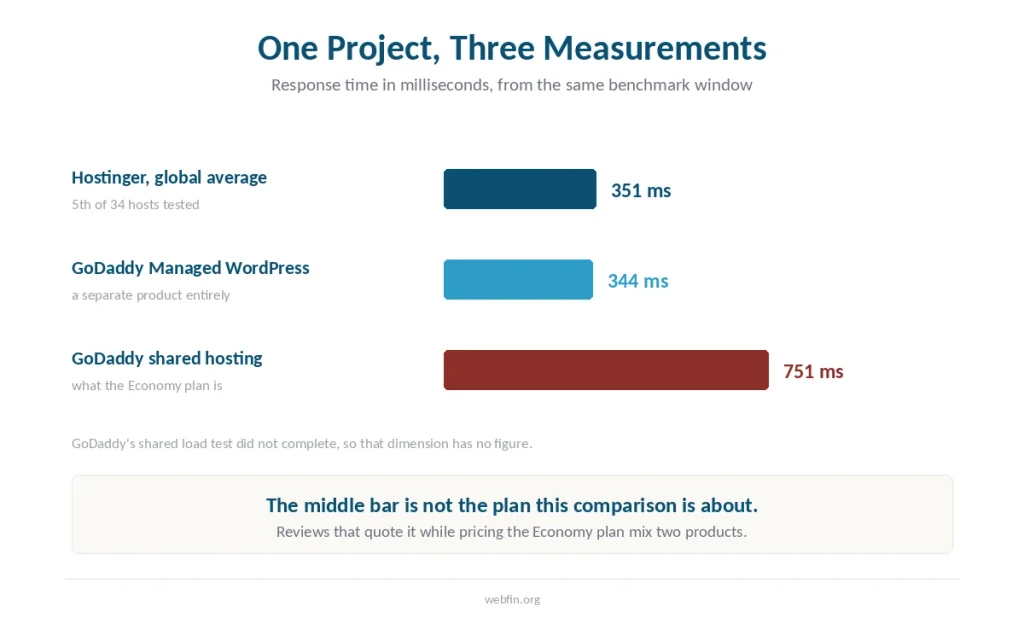
The same benchmarking project measured both, which makes this cleaner than most speed comparisons.
For instance, the same project places Hostinger Business 5th of 34 hosts at a 223 millisecond global average, and Hostinger Premium 28th at 495 milliseconds. Premium is the plan priced above, and it omits the content network that produces the difference. GoDaddy shared hosting records 751 milliseconds and 99.76 percent uptime, the weakest figures in a group of 23 hosts that project tested.
⚠️ More telling is what could not be measured. GoDaddy’s load test failed because the servers could not complete it.
Still, GoDaddy Managed WordPress is a different product on different infrastructure, recording 344 milliseconds. That line is not what the Economy plan sells you, and reviews that blur the two are describing something else.
Uptime
In practice, Hostinger records 99.93 to 100 percent across seven testing projects, with downtime falling from 1,228 minutes in 2021 to 33 minutes in 2025.
Meanwhile, GoDaddy shared hosting recorded 99.76 percent between November 2025 and June 2026. Its managed line recorded 99.99 percent across a full year, which is the same split that runs through everything about this host.
Support
GoDaddy wins this, and it is the only category where it does.
In particular, it answers the phone in more countries than most, which for a first-time site owner is real value. Hostinger runs chat and email only, opening with an AI assistant that transfers you on request, usually inside two minutes.
Nobody publishes controlled measurement of support response times for any host, so this rests on description rather than data throughout our site.
What Each One Includes
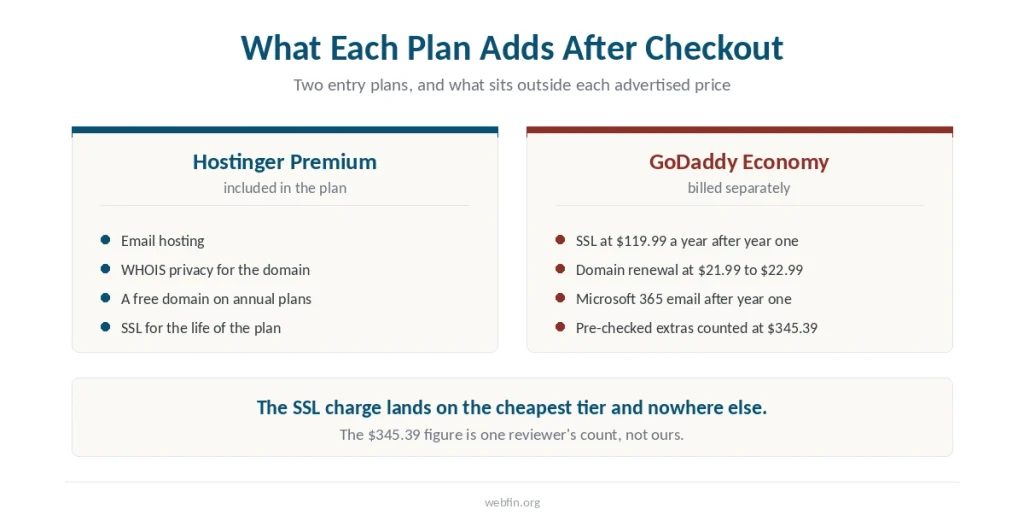
First, Hostinger includes email hosting, WHOIS privacy and a free domain on annual plans.
GoDaddy includes SSL free for one year on Economy, then charges $119.99 annually for it. Other GoDaddy plans include SSL for the life of the plan, so that charge lands specifically on the cheapest tier. The same GoDaddy figures set against Newfold Digital’s Bluehost are in our Bluehost and GoDaddy comparison.
⚠️ One published review counted $345.39 a year in pre-checked upsells at GoDaddy checkout. We could not verify that figure and report it as their count — we priced comparable catalogs elsewhere.
Winners by Category
Three-year cost: Hostinger, by $108.
Six-year cost: Hostinger, by $360.
Speed: Hostinger, by a factor of two on shared hosting.
Uptime: Hostinger.
Load handling: Hostinger, since the other test did not complete.
Support: GoDaddy, by a telephone line.
Email included: Hostinger.
SSL included: Hostinger.
Ownership clarity: a draw, both are publicly documented.
When to Choose GoDaddy Instead
First, you may want a domain registrar with a phone number while hosting elsewhere. That combination is genuinely reasonable and it is what the company does well.
Second, you may be buying Managed WordPress rather than Economy shared hosting. That product measures 344 milliseconds rather than 751, though its hardware score is the lowest in its own test group.
Otherwise, the shared plan costs twice as much and measures half as fast.
How We Research
Every figure comes from the two underlying reviews, where each is attributed to a named project with its window. Prices come from each company’s own pages and from published analyses stating what they read. We run no tests of our own.
Our criteria are on our About page. The long versions are in our Hostinger review and our GoDaddy review.
Frequently Asked Questions
Hostinger, and by almost exactly half at every horizon. Twelve months costs $35.88 against $71.88, three years $107.64 against $215.64, and six years $407.28 against $767.16.
Hostinger, on shared hosting. One benchmarking project records a 351 millisecond global average against 751 for GoDaddy shared, and GoDaddy’s load test failed to complete. GoDaddy Managed WordPress is a separate product recording 344 milliseconds.
Of course, it answers the phone, which Hostinger does not. GoDaddy provides telephone support in more countries than most hosts, while Hostinger runs chat and email opening with an AI assistant that transfers you on request.
Its Economy plan auto-renews at $551.63 for a further three years, which divides to $15.32 a month. That figure sits 28 percent above the $11.99 regular price its introductory discount is calculated from.
Hostinger includes it. GoDaddy includes SSL free for one year on Economy and then charges $119.99 a year, though its other plans include SSL for the life of the plan.
The Verdict
Hostinger, 4.2 against 2.7, and the margin is the widest in these comparisons.
In short, twice the price would need to buy something. On the evidence we gathered it buys a telephone line and an SSL bill.
Choose GoDaddy for domains. For hosting, the arithmetic does not support it.