
Disclosure: WebFin is reader-supported. If you buy hosting through links on this page, we may earn a commission at no extra cost to you. Commissions vary between providers and our ratings do not — here’s our full disclosure.
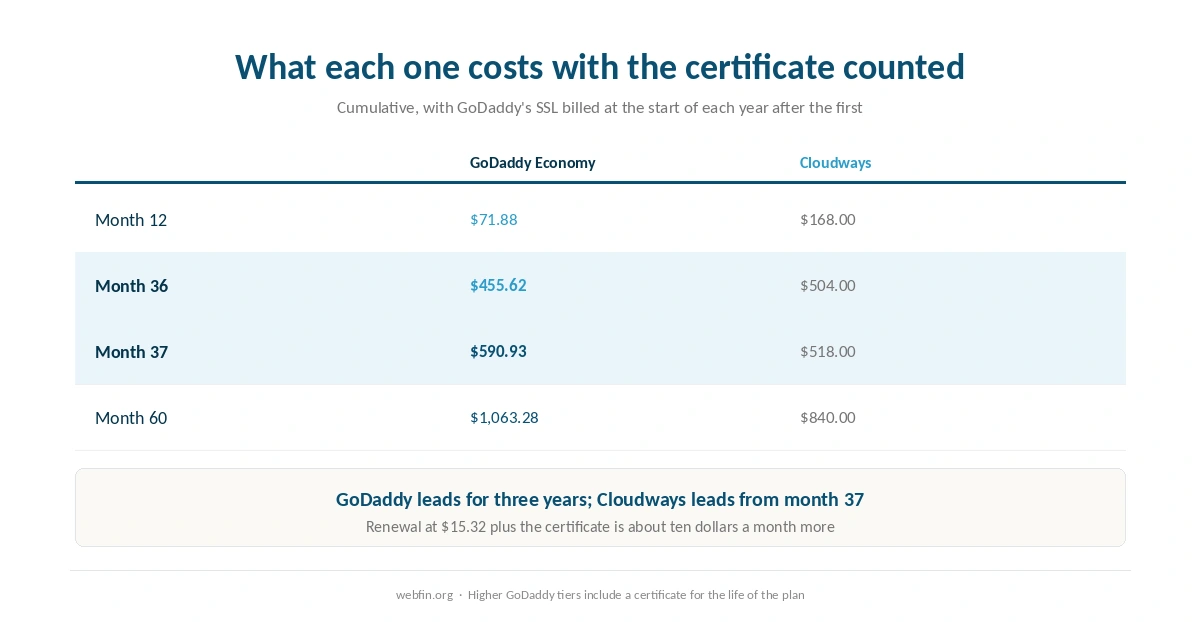
Cloudways vs GoDaddy looks like a cloud server against a budget plan, and the price gap is smaller than that suggests. GoDaddy Economy costs $5.99 a month for 36 months, but it charges $119.99 a year for an SSL certificate from the second year. Count that, and three years come to $455.62 against $504.00 for Cloudways at a flat $14.00. From month 37, when GoDaddy renews at $15.32 and bills the certificate again, Cloudways is cheaper for good. And on the measurements the two are not close. The same GoDaddy figures against Kinsta are in our Kinsta and GoDaddy comparison.
Cloudways vs GoDaddy: The Short Answer
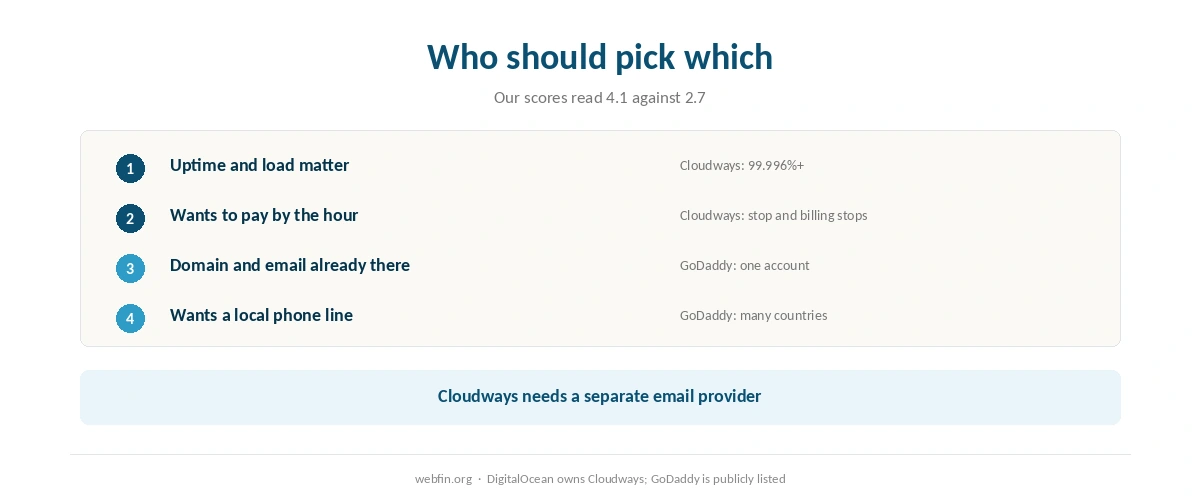
Cloudways, at 4.1 against 2.7 in our reviews. It holds 99.996% to 99.999% uptime across its plans in the benchmark project we cite. It completed the load test that GoDaddy’s shared plan did not, and it bills by the hour with no promotional term. GoDaddy suits a buyer who wants domain, email and site in one familiar account with phone support in their own country.
Head to Head
| Criterion | Cloudways | GoDaddy Economy |
|---|---|---|
| Product | Managed cloud server | Shared hosting |
| Price | $14.00/mo flat | $5.99/mo for 36 months, then $15.32 |
| SSL certificate | Included | $119.99 a year from year two |
| 36 months, certificate included | $504.00 | $455.62 |
| Cheaper overall from | Month 37, for good | Before month 37 |
| Uptime | 99.996% to 99.999% | 99.76% |
| Load test | Completed: 288 ms at 1.7% errors | Did not complete |
| Time to first byte | Measured per cloud | 751 ms |
| Billing | Hourly, no contract | Prepaid term |
| Support | Chat and tickets; phone as a paid add-on | Phone in many countries |
| Owner | DigitalOcean, 2022 | Publicly listed |
| Our score | 4.1 | 2.7 |
The Certificate Changes the Math
GoDaddy Economy opens at $5.99 on a 36-month term and renews at $15.32, which is 2.6× over 36 months. On Economy the SSL certificate costs $119.99 after the first year; higher GoDaddy tiers include one for the life of the plan. Browsers mark pages without a certificate as not secure, so in practice the real Economy price includes it.
With the certificate counted in years two and three, Economy comes to $455.62 across 36 months, still under Cloudways at $504.00. From month 37 it renews at $15.32 and the certificate bill arrives again, about ten dollars a month more. So Cloudways at a flat $14.00 is the cheaper of the two from then on. Our page on hidden hosting fees lists the certificate among the charges that arrive after checkout.
⚠️ One review counted pre-checked extras at GoDaddy’s checkout worth a large sum, which we could not verify, so treat the cart as something to read line by line. Cloudways has no promotional term to expire, and the figure above is the one you pay in year three.
| Host and plan | How it builds | 36-month total |
|---|---|---|
| ChemiCloud Starter, 36-month term | 36 prepaid months at $2.49 | $89.64 |
| InterServer Standard | 36 months at $2.50, price locked | $90.00 |
| DreamHost Launch, 48-month term | 36 of 48 prepaid months at $2.89 | $104.04 |
| Namecheap Stellar, 24-month term | 24 at $1.98, then 12 at $4.88 | $106.08 |
| Hostinger Premium, 48-month term | 36 of 48 prepaid months at $2.99 | $107.64 |
| HostGator Hatchling, 36-month term | 36 months at $3.75, renewal not reached | $135.00 |
| HostGator Hatchling, with daily backups | 36 at $3.75, plus CodeGuard at $35.88 a year | $242.64 |
| Bluehost Starter, 36-month term | 36 months at $3.99, renewal not reached | $143.64 |
| GoDaddy Economy, 36-month term | 36 months at $5.99, renewal not reached | $215.64 |
| GoDaddy Economy, with SSL from year two | 36 at $5.99, plus $119.99 in years two and three | $455.62 |
| Hostwinds Basic, annual | 12 at $4.54, then 24 at $6.99 | $222.24 |
| SiteGround StartUp, 24-month term | 24 at $2.99, then 12 at $14.99 | $251.64 |
| DreamHost Launch, annual | 12 at $2.89, then 24 at $10.99 | $298.44 |
| Scala Hosting Mini, annual | 12 at $2.95, then 24 at $11.95 | $322.20 |
| Bluehost Starter, 12-month term | 12 at $3.99, then 24 at $11.99 | $335.64 |
| IONOS Plus, annual | 12 at $1.00, then 24 at $14.00 | $348.00 |
| GreenGeeks Lite, 36-month prepay | 36 months at $2.95 | $106.20 |
| GreenGeeks Lite, annual | 12 at $2.95, then 24 at $13.95 | $370.20 |
| SiteGround StartUp, 12-month term | 12 at $2.99, then 24 at $17.99 | $467.64 |
| Cloudways, from | 36 months at $14.00, flat | $504.00 |
| A2 Hosting Turbo Boost, annual | 12 at $6.99, then 24 at $20.99 | $587.64 |
| Rocket.net Starter, annual | 12 at $25.00, then 24 at $30.00 | $1,020.00 |
| WP Engine Startup, annual | 12 at $27.00, then 24 at $35.00 | $1,164.00 |
| Liquid Web managed VPS | 36 months at $33.00 | $1,188.00 |
| Kinsta Starter | 36 months at $35.00, flat | $1,260.00 |
| InMotion Core, 36-month term | 36 months at $3.19, renewal not reached | $114.84 |
| InMotion Launch, 36-month term | 36 months at $4.99, renewal not reached | $179.64 |
The Measurements Are Not Close
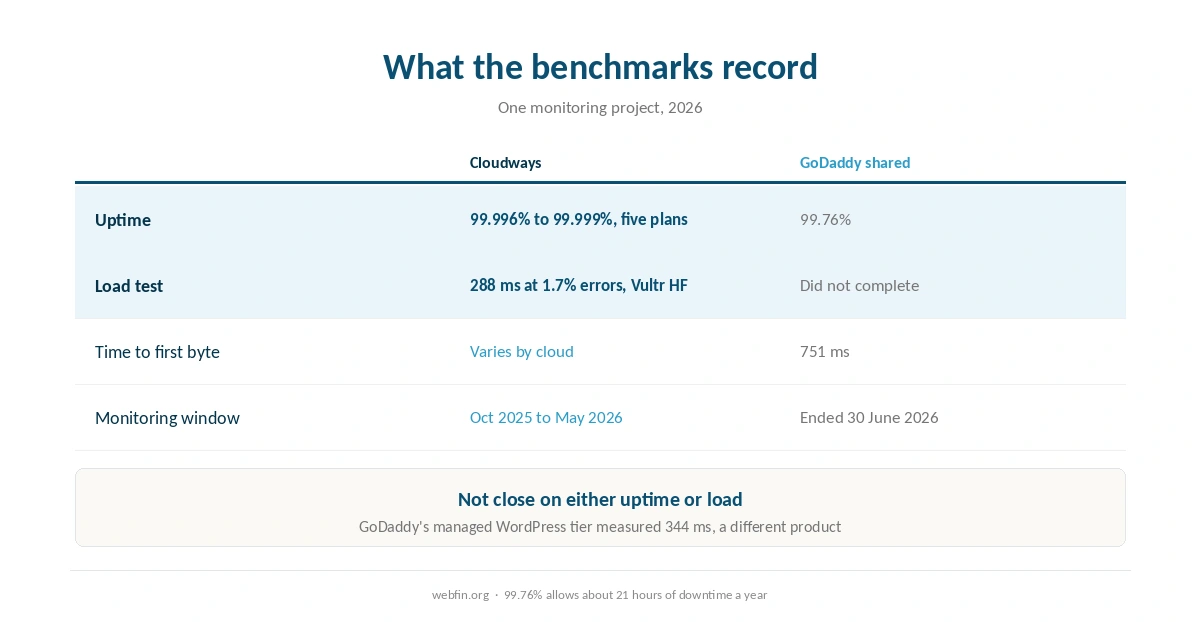
We run no tests, so these figures belong to Hostingstep. Cloudways held uptime between 99.996% and 99.999% across five plans from October 2025 to May 2026. GoDaddy’s shared hosting recorded 99.76% from November 2025 to June 2026, which allows about 21 hours of downtime a year against well under an hour.
Under load, Cloudways on its Vultr High Frequency plan served the test at 288 ms with a 1.7% error rate, which is its weakest result and still a completed test. GoDaddy’s shared plan did not complete it, and it recorded 751 ms to first byte. GoDaddy’s shared monitoring also stopped reporting after 30 June 2026, so its figures rest on a shortened window.
⚠️ GoDaddy is not one product. Its managed WordPress line records 344 ms to first byte in the same project, with a hardware score of 3.8. The brand is not the plan, and anyone set on GoDaddy should compare that tier. Our guide to reading an uptime report explains why the window matters.
The Cloudways load result above comes from one cloud, Vultr High Frequency, and our table holds no comparable load figure for the others. Its uptime range, by contrast, spans five plans. So the reliability case for Cloudways is broad, and the load case rests on a single configuration, which is worth knowing before choosing a cloud for a busy site.
For GoDaddy the shortened window cuts the other way. Its shared figures end on 30 June 2026, and nothing we can name has measured it since. A buyer is comparing a current, broad record with an older, narrower one, which is part of why the scores differ by 1.4 points.
What Cloudways Actually Is
Cloudways runs a managed server on the cloud provider you choose and handles the operating system, security patches and backups. SSH, WP-CLI, Git deployment, staging and PHP version selection ship on every tier, and a server launches in minutes. DigitalOcean has owned the company since 2022.
That makes it a different kind of product from shared hosting. You get resources that belong to your server, billed by the hour, and you can resize them. The cost is that you manage capacity yourself, email is not part of the service, and phone support is a paid add-on. Our Cloudways review covers each cloud.
Where GoDaddy Has an Advantage
GoDaddy is primarily a registrar, and many buyers already hold a domain there. Keeping domain, email and site under one login is a real convenience for a non-technical owner. It also publishes phone lines in many countries around the clock, which matters for a buyer outside the United States.
The cost of that convenience is that every extra is one click away from an account you already trust. Keep the domain where it is if you like, and point it at whichever host you choose; our guide to pointing a domain to a new host shows how.
Which Plans to Compare
Economy is GoDaddy’s cheapest shared plan. Its higher tiers include a certificate for the life of the plan, which removes the yearly charge. Its managed WordPress line measured 344 ms to first byte in the same project. A buyer set on GoDaddy should price one of those rather than Economy.
Cloudways’ $14.00 is its entry server, and it scales by resizing rather than by moving to a different product. The step from there is a larger server on the same account, which our guide to moving from shared to VPS compares with the shared route.
Email and the Rest of the Account
Cloudways does not host email, so a site there needs a separate email provider. That is an extra account and, unless you use a free service, an extra monthly cost, and it is worth pricing before choosing. Our guide to setting up email on your domain covers the records that make it work.
GoDaddy sells email alongside the domain and the hosting, which is the heart of its one-account appeal. The flip side is that each of those services renews on its own schedule and price, so the total is only visible when you add them up.
The Five-Year View
Over five years the certificate keeps arriving each year at GoDaddy, and Economy renews at $15.32 after month 36. Cloudways stays at $14.00 throughout. By month 60 Cloudways is about two hundred dollars cheaper in total, and the gap grows every year after that.
Billing and Leaving
Cloudways bills as you go, so stopping the server stops the bill, and there is no refund window in the usual sense because there is no prepayment to refund. GoDaddy refunds within 30 days, excluding domains and some services, and its best price needs 36 months up front.
For a project that might end within a year, that difference matters more than the monthly rate. Our guide to canceling hosting and getting a refund covers the prepaid case.
Who Owns Them
DigitalOcean acquired Cloudways in 2022, which put the managed layer on top of one of the clouds it already sold. GoDaddy is publicly listed, so its accounts are filed in public and its strategy answers to shareholders.
Neither ownership is a verdict on service. For a buyer, the practical point is that Cloudways’ price is set by a company that also sells the underlying cloud, while GoDaddy earns across domains, email, security products and hosting together.
Where Each One Is Weakest
GoDaddy Economy is weakest on the certificate, on load and on evidence. A certificate that costs $119.99 a year after the first, a load test the plan did not complete and a shortened monitoring window add up to a weak shared offer.
Cloudways is weakest on simplicity. You manage server capacity, email lives elsewhere, and its weakest load result showed a 1.7% error rate on one cloud. For someone who never wants to think about a server, that is real friction. Our list of hosting for developers is where it fits best.
Winners by Category
Three years, certificate included: GoDaddy, at $455.62 against $504.00. From month 37: Cloudways, for good. Uptime: Cloudways, at 99.996% or better. Load: Cloudways, which completed the test. Billing flexibility: Cloudways, hourly. Phone support: GoDaddy, in many countries. One account for everything: GoDaddy.
When to Choose GoDaddy Instead
Take GoDaddy if your domain and email already live there and you value one login and a phone number in your country over measured performance. Consider its managed WordPress line rather than Economy, and price a tier that includes the certificate. Our comparison of Bluehost against GoDaddy weighs its shared plan against another budget host, a Newfold Digital brand.
For the budget end of the field, see our roundup of cheap web hosting, where the certificate charge is one of the lines that separate the plans.
Take Cloudways for anything where uptime, load and control matter, or where you want to pay by the hour. Our comparison of Cloudways against Kinsta sets it against a managed alternative.
How We Research
We run no tests. Uptime, load and response figures come from Hostingstep’s 2026 benchmarks and reviews, each with its window, and we note where GoDaddy’s monitoring paused. Prices and the certificate charge come from the providers’ own pages, read on 20 September 2026. The crossover month comes from month-by-month arithmetic, with the certificate billed at the start of each year after the first.
The criteria behind our scores are on our about page, and the full workings for the shared side are in our GoDaddy review.
Cloudways vs GoDaddy FAQ
GoDaddy Economy for the first three years once its certificate is counted, at $455.62 against $504.00. From month 37 it renews at $15.32 and bills the certificate again, and Cloudways at a flat $14.00 is cheaper from then on.
On Economy, yes: $119.99 a year after the first year. Higher GoDaddy tiers include a certificate for the life of the plan. Cloudways includes certificates at no extra cost.
Cloudways, on the published figures: 99.996% to 99.999% uptime across five plans, against 99.76% for GoDaddy’s shared hosting, whose monitoring also stopped reporting after 30 June 2026.
No. It is a managed cloud server on a provider you choose, billed by the hour. You get resources that belong to your server and manage capacity yourself, and email hosting is not included.
DigitalOcean has owned Cloudways since 2022. GoDaddy is a publicly listed company. Neither ownership decides service quality, though it shapes how each one earns.
The Verdict
Cloudways takes this clearly, at 4.1 against 2.7. It is more reliable, and it completed a load test GoDaddy’s shared plan did not. It bills by the hour, and from month 37 it is also the cheaper of the two once GoDaddy’s certificate is counted. Our page on Cloudways for Drupal covers the shell that shared plans leave in doubt.
GoDaddy Economy is cheaper only in the first three years, and only by less than the headline suggests. For a buyer who values one account and a local phone line, look at GoDaddy’s managed tier instead. For everyone else, the cloud server is the better buy. Our page on what web hosting costs runs both totals further.