
Disclosure: WebFin is reader-supported. If you buy hosting through links on this page, we may earn a commission at no extra cost to you. Commissions vary between providers and our ratings do not — here’s our full disclosure.
Hosting companies make environmental claims constantly, and almost none of them can be verified from outside. GreenGeeks matches 300 percent of its energy use with renewable credits, and one 2026 review states outside sources have confirmed that match rather than the company only claiming it. The same figures against Hostinger are in Hostinger vs GreenGeeks.
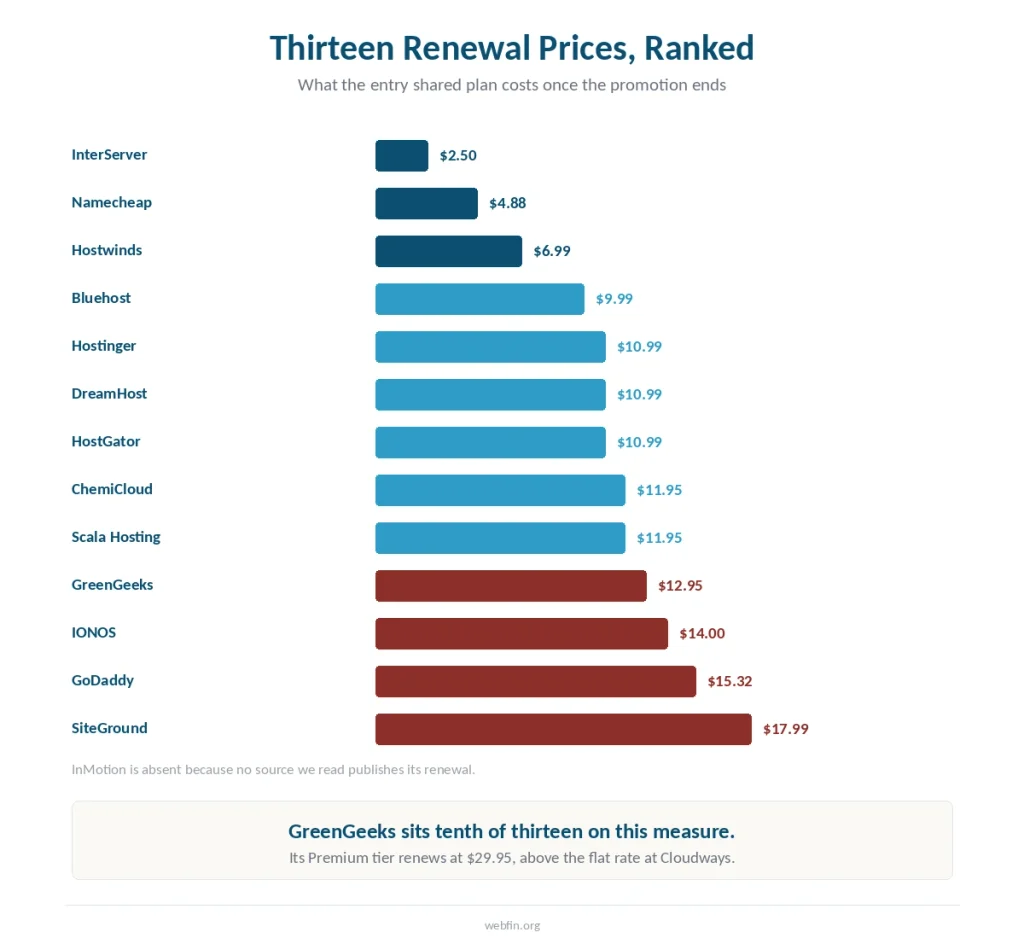
The renewal prices are a separate matter. Lite now renews at $13.95 a month, up from $12.95 earlier this year, and one source reports Pro and Premium at $18.95 and $30.95. From a $2.95 intro that is a step of 4.7× after one term. We compare GreenGeeks directly with Bluehost, a Newfold Digital brand, in Bluehost vs GreenGeeks.
Is GreenGeeks Good in 2026?
For a site with North American or European visitors, yes. LiteSpeed with built-in caching runs on every plan, uptime sits between 99.96 and 99.98 percent across several independent accounts, and support is praised consistently.
However, response times climb sharply outside those two regions, and the renewal is steep enough that the entry plan stops being a budget option in year two.
The Renewal, and What Changed This Year
⚠️ Both prices are now on record, though sources disagree on the term behind the first one.
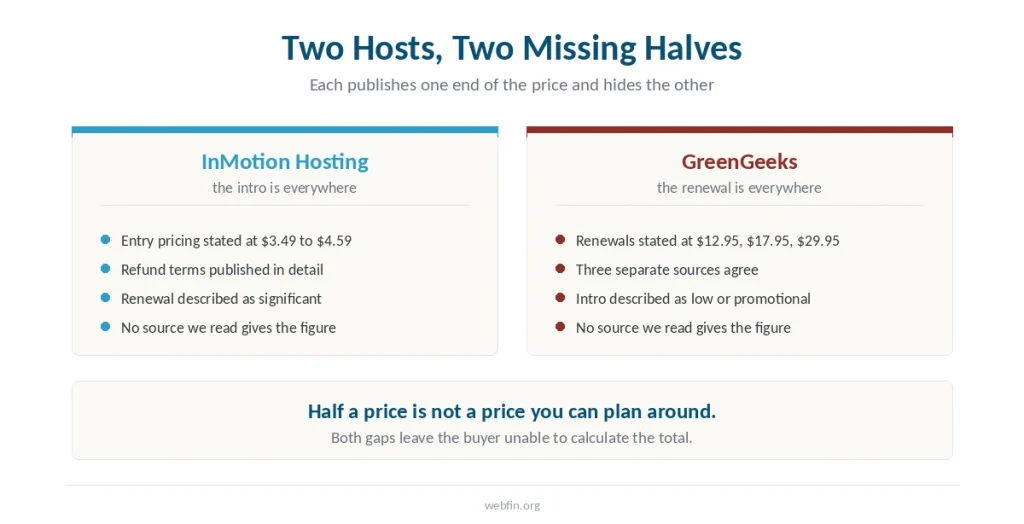
Earlier this year three sources agreed the shared plans renewed at $12.95, $17.95 and $29.95 a month. Sources from this summer, including the benchmark project we cite, put Lite at $2.95 to start and $13.95 at renewal. They disagree on whether the intro needs a 36-month or a 12-month term, so confirm it in the cart.
The term is now the open question rather than the price. At another host, the introductory price was everywhere and, until this year, the renewal was nowhere. That gap left buyers unable to calculate the total at all. We set GreenGeeks against a managed cloud server in Cloudways vs GreenGeeks.
Three years on the entry plan cost $106.20 on a 36-month prepay and $370.20 on annual terms. Which of those applies depends on the term the $2.95 rate requires.
One Product Line Renews and One Does Not
Inside the same company, two pricing policies operate.
Shared hosting follows the pattern this site documents everywhere: a promotional term, then a substantially higher rate. VPS plans reportedly renew at their purchase price.
That is worth knowing before you choose a tier. The shared plans are the ones with the renewal problem, and the VPS plans are not — the full field is here.
The Environmental Claim
In practice, three hundred percent means the company buys renewable energy credits equal to three times the electricity its servers consume.
What makes this different from most green marketing is that a 2026 review states outside sources have verified the match rather than the company simply asserting it. ⚠️ We have not seen that verification ourselves and report it as their finding.
The company also supports reforestation and has run the program for years rather than announcing it recently.
Speed
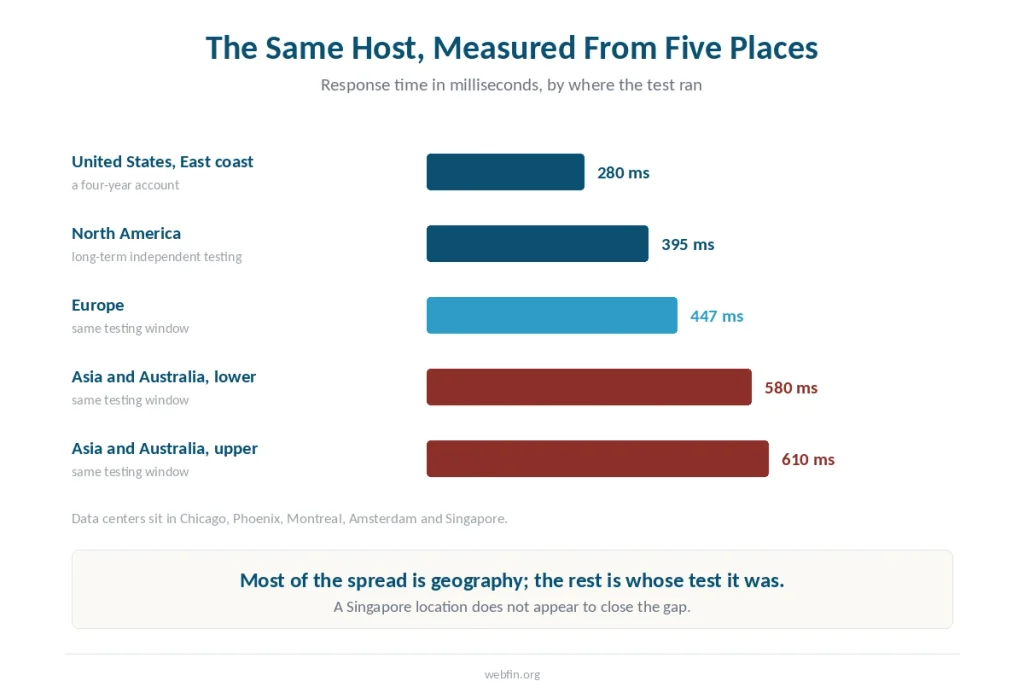
Published measurements vary by a factor of three, and most of that variation follows geography rather than method.
Independent long-term testing puts time to first byte around 395 milliseconds in North America and 447 in Europe. A four-year account from the United States East coast records 280 milliseconds. Another source gives a range of 150 to 260.
⚠️ Asia and Australia are where it falls away. The same long-term testing records 580 to 610 milliseconds there, and one reviewer describes checking Tokyo and São Paulo and getting a much less flattering picture.
Meanwhile, data centers sit in Chicago, Phoenix, Montreal, Amsterdam and Singapore. The Singapore location does not appear to close the regional gap.
Uptime, and a Missing Page
Uptime figures are consistent in a way speed figures are not. Independent accounts cluster between 99.96 and 99.98 percent, against a published guarantee of 99.9 percent.
⚠️ One reviewer notes the absence of a public status page. The company emails customers about planned maintenance, which is good practice, but during an unplanned outage there is nothing to check.
That matters more than it sounds. A status page is how you tell a hosting problem from your own problem at two in the morning.
What the Stack Looks Like
LiteSpeed web servers with LSCache, NVMe storage, HTTP/3 and Cloudflare CDN integration on all plans.
Developer tools are better than the price tier suggests: SSH, Git and WP-CLI are included, alongside cPanel and one-click WordPress installation. The support team handles migration rather than leaving it to a plugin. Shell access on a shared plan is rare enough to feature in the best hosting for developers.
Besides, one source reports shared hosting handling up to 2,500 simultaneous sessions without major slowdown, and zero errors under 100 concurrent users. A blog post that goes viral is this kind of test, which the best hosting for bloggers weighs.
Where It Is Weak
The Lite plan hosts one website only, so anyone running more than a single site starts at Pro.
Phone support stops overnight, unlike live chat and tickets.
Not every plan includes migration and domain privacy free, which is the kind of detail that appears at checkout rather than on the pricing page.
How We Research
Renewal figures come from published sources, rechecked on 20 September 2026 after the Lite renewal rose to $13.95. Where sources disagree, as they do on the term behind the introductory price, we say so instead of choosing one. Performance figures are attributed to named accounts with their locations, because the variation here is geographic.
We run no tests of any kind. Our five criteria are on our About page.
Frequently Asked Questions
Lite renews at $13.95 a month, up from $12.95 earlier in 2026, and one source reports Pro and Premium at $18.95 and $30.95. Lite opens at $2.95, though sources disagree on whether that rate needs a 36-month or a 12-month term.
It matches 300 percent of its server energy use with renewable energy credits, and one 2026 review states outside sources have confirmed that match rather than only the company claiming it. It also supports reforestation programs.
In North America and Europe, yes. Independent testing records time to first byte around 395 and 447 milliseconds respectively, with a four-year account reporting 280 from the US East coast. Asia and Australia climb to 580 to 610.
Independent accounts cluster between 99.96 and 99.98 percent against a published guarantee of 99.9 percent. The company does not operate a public status page, so there is nothing to check during an unplanned outage.
Reportedly not. One 2026 review states VPS plans renew at their purchase price, which makes them behave differently from the shared tiers within the same company.
GreenGeeks
Summary
An environmental claim that reportedly survives outside checking, attached to a renewal above most of the field.
The Verdict
GreenGeeks earns 3.7, and the environmental claim is the part we found most solid.
Choose it if your visitors are North American or European, you want LiteSpeed and developer tools at a shared price, and the sustainability position matters to you. Our page on Kinsta against GreenGeeks covers a cheap clean load result beside a managed platform.
Skip it if your audience is in Asia or South America, or if you need to know the year-two price before committing, because the renewal is high and the term behind the starting price is disputed. We compare GreenGeeks directly with SiteGround in SiteGround vs GreenGeeks.