
Disclosure: WebFin is reader-supported. If you buy hosting through links on this page, we may earn a commission at no extra cost to you. Commissions vary between providers and our ratings do not — here’s our full disclosure.
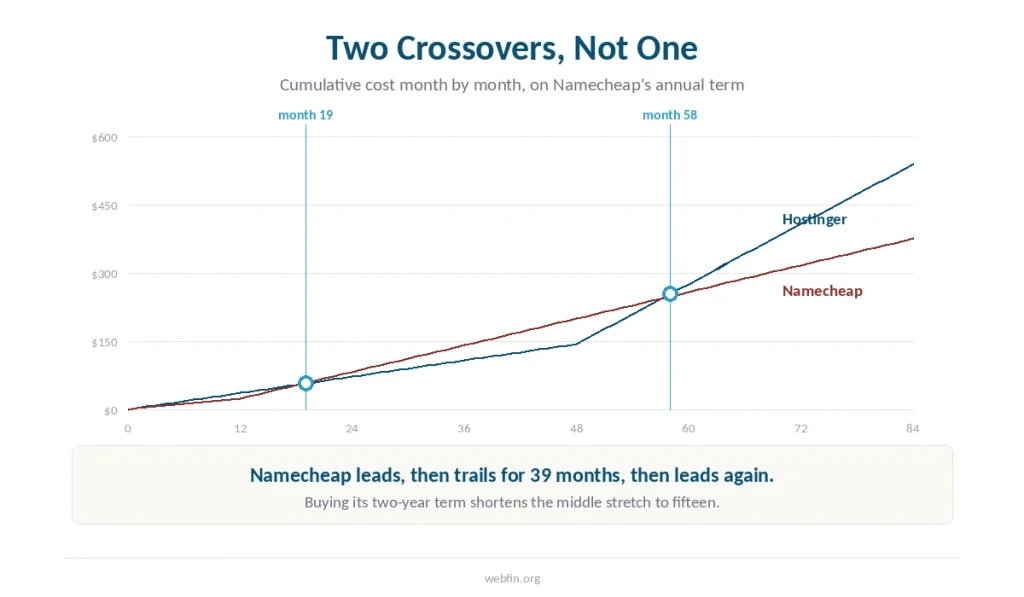
In practice, Namecheap starts cheaper. Hostinger overtakes it in month 19. Namecheap takes the lead back in month 58 and keeps it. The same Namecheap figures set against Newfold Digital’s Bluehost are in our Bluehost and Namecheap comparison.
Among the fourteen pairings we have published, that pattern appears here alone. Elsewhere one host leads throughout or overtakes once and stays ahead.
Why the Lead Moves
Of course, two mechanisms pull in opposite directions.
Hostinger holds a $2.99 introductory rate for 48 months, which is the longest promotional term in these reviews. Namecheap holds $1.98 for 12 months and then renews at $4.88. The same Namecheap figures against a Cloudways server are in our Cloudways and Namecheap comparison.
In fact, that renewal is the lowest across the fifteen plans we have priced, less than half of Hostinger’s $10.99. So the long promotion wins the middle years and the low renewal wins the late ones — the full field is here.
The Short Answer
Hostinger, 4.2 against 3.7, and the scores reflect evidence more than price.
If your site will outlive five years, Namecheap costs less and keeps costing less. Neither host answers the phone, which for first-time buyers is a real gap at both.
Head to Head
| Hostinger Premium | Namecheap Stellar | |
|---|---|---|
| Advertised | $2.99/mo | $1.98/mo |
| Intro term | 48 months | 12 or 24 months |
| Renews at | $10.99/mo | $4.88/mo |
| Twelve months | $35.88 | $23.76 |
| Three years | $107.64 | $140.88 or $106.08 |
| Ten years | $934.80 | $550.80 or $516.00 |
| Phone support | No | No |
| Email hosting | Included | Included |
| In our benchmark | 5th of 34 | not covered |
| Our score | 4.2 | 3.7 |
Where Each Crossover Falls
On Namecheap’s annual term, Hostinger pulls ahead at month 19 and holds the lead until month 58.
Meanwhile, on the two-year term Namecheap’s promotion covers more of the window. Hostinger only leads between month 37 and month 52, a stretch of about fifteen months.
Therefore buying the two-year term shrinks Hostinger’s advantage from 39 months to 15, without changing either host’s prices.
The Numbers at Four Horizons
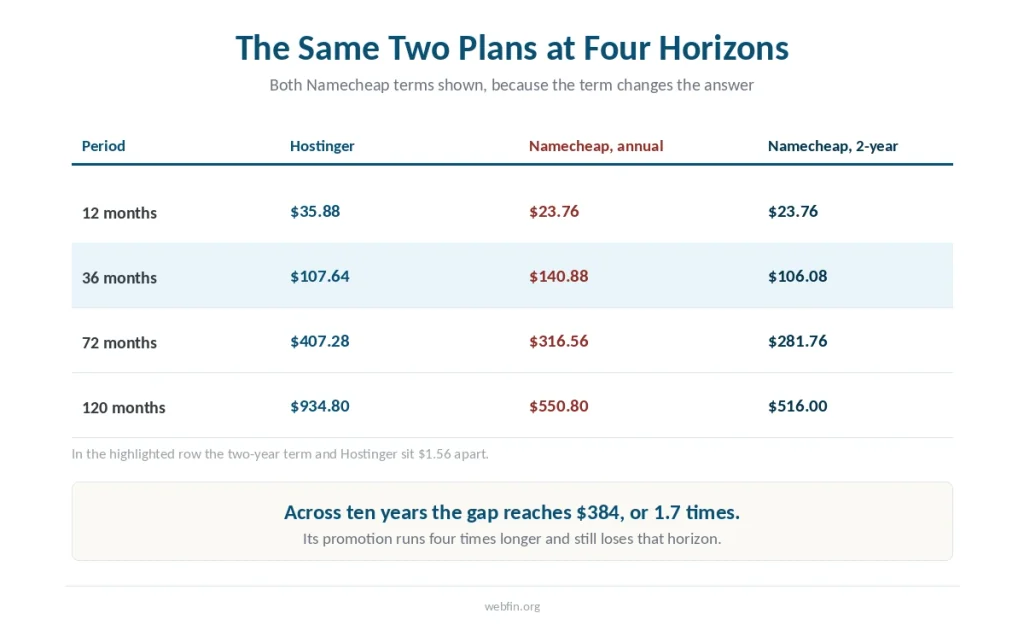
For instance, twelve months costs $35.88 at Hostinger against $23.76 at Namecheap.
Three years costs $107.64 against $140.88 on the annual term, or $106.08 on the two-year term. Those last two figures are $1.56 apart, which is close enough to call level.
Six years costs $407.28 against $316.56 and $281.76. Ten years costs $934.80 against $550.80 and $516.00.
⚠️ The ten-year figure is the clearest picture of what a low renewal does. The gap reaches $384 across a decade, or 1.7 times, despite Hostinger holding its promotion four times longer.
Neither Answers the Phone
This is the category that has decided several comparisons on this site, and here it is a draw.
In practice, Hostinger runs chat and email, opening with an AI assistant that transfers you on request. Namecheap runs chat and tickets around the clock with no telephone line at any tier.
For a host aimed at first-time buyers, that is a real gap at both. If a voice channel decides hosting for you, neither of these is your answer.
Speed and Evidence
The benchmarking project we cite in every review ranks Hostinger fifth of 34 hosts. It does not publish figures for Namecheap.
Besides, published Namecheap figures come from smaller tests: 232 milliseconds response time on shared hosting in one 2026 test, and 380 milliseconds on the entry managed WordPress tier dropping to 220 on the tier above. The same Namecheap figures against Kinsta are in our Kinsta and Namecheap comparison.
Hostinger’s own published figures include a 246 millisecond server response and a 707 millisecond time to first byte from the same window, which measure different things about the same visit.
⚠️ Neither column is strong enough to decide this. The price arithmetic is.
What Each One Includes
First, Hostinger includes email hosting, WHOIS privacy and a free domain on annual plans.
Namecheap includes domain privacy free for the life of the domain, which is the better version of that perk, and cPanel on shared hosting.
Moreover, its managed WordPress platform meters plans by monthly visits rather than by disk, with 50,000 on the entry tier. Hostinger imposes no visit ceiling, though it publishes no resource limits either — we wrote about that separately.
A Trial Instead of a Refund
Still, Namecheap’s EasyWP includes a 30-day trial with no credit card required.
Every other host in these reviews sells you the plan and refunds it afterwards if you cancel in time. This one lets you use it first, which removes the risk of forgetting a cancellation date entirely.
That applies to the managed WordPress product rather than to shared hosting, so it is narrower than it sounds. It is still the sole arrangement of its kind across these reviews.
Winners by Category
Twelve-month cost: Namecheap, by $12.12.
Three-year cost: Hostinger on the annual term, level on the two-year term.
Six-year cost: Namecheap, by $90.72 to $125.52.
Ten-year cost: Namecheap, by $384.00 to $418.80.
Renewal rate: Namecheap, at $4.88 against $10.99.
Promotional length: Hostinger, at 48 months against 12 or 24.
Benchmark coverage: Hostinger.
Phone support: a draw, neither offers it.
Free trial: Namecheap, on managed WordPress only.
When to Choose Namecheap Instead
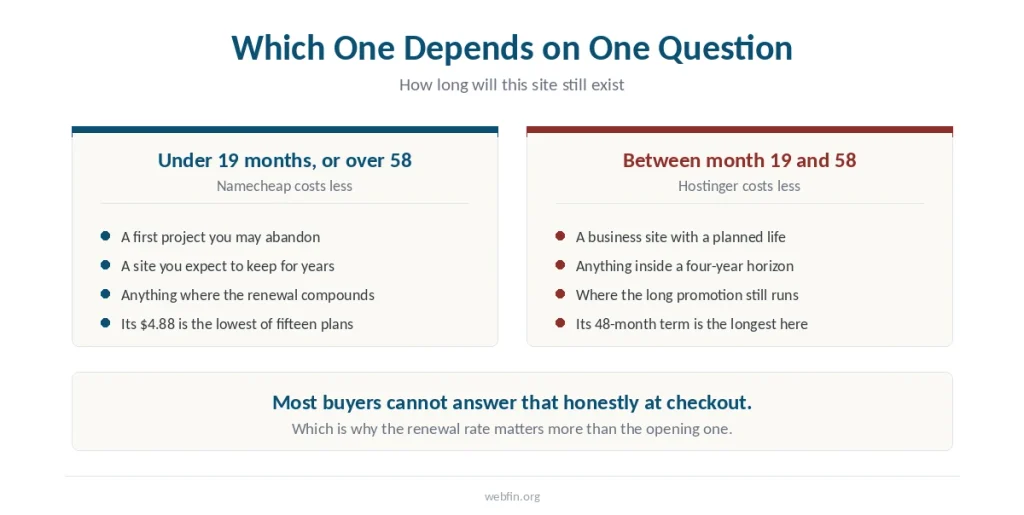
You expect the site to outlive five years. That is the horizon where the low renewal starts compounding, and it does not stop.
You are buying the two-year term rather than the annual one, which cuts Hostinger’s window of advantage from 39 months to 15.
You want to test managed WordPress without handing over a card, which is available at Namecheap and nowhere else in these reviews.
How We Research
Every figure comes from the two underlying reviews, where each is attributed to a named source with its window. The crossover months are arithmetic on published rates, computed month by month rather than estimated. We run no tests of our own.
Our criteria are on our About page. The long versions are in our Hostinger review and our Namecheap review.
Frequently Asked Questions
It depends on the horizon. Namecheap is cheaper for the first 19 months, Hostinger from month 19 to month 58, and Namecheap again after that. Across ten years Namecheap costs $550.80 against $934.80.
Hostinger holds a $2.99 rate for 48 months, the longest promotion in these reviews. Namecheap holds $1.98 for 12 months then renews at $4.88, the lowest renewal across those fifteen plans. The long promotion wins the middle years and the low renewal wins the late ones.
Neither. Hostinger runs chat and email with an AI assistant that transfers on request. Namecheap runs chat and tickets around the clock. Both omit a telephone line at every tier.
Hostinger by the available evidence, though the comparison is uneven. One benchmark ranks Hostinger fifth of 34 hosts and does not cover Namecheap, whose published figures come from smaller tests at 232 and 380 milliseconds.
On EasyWP, its managed WordPress platform, yes: 30 days with no credit card required. Shared hosting follows the usual buy-then-refund model that every other host in these reviews uses.
The Verdict
Hostinger, 4.2 against 3.7, and the scores reflect evidence more than price.
On price the answer depends entirely on how long you plan to stay. Under 19 months or past five years, Namecheap costs less. Between those points, Hostinger does.
In truth, most people cannot answer that question honestly at the point of purchase, which is why the renewal rate matters more than the introductory one. Namecheap’s is the lowest across the fifteen plans we have priced. The same Namecheap figures set against SiteGround are in our SiteGround and Namecheap comparison.