
Disclosure: WebFin is reader-supported. If you buy hosting through links on this page, we may earn a commission at no extra cost to you. Commissions vary between providers and our ratings do not — here’s our full disclosure.
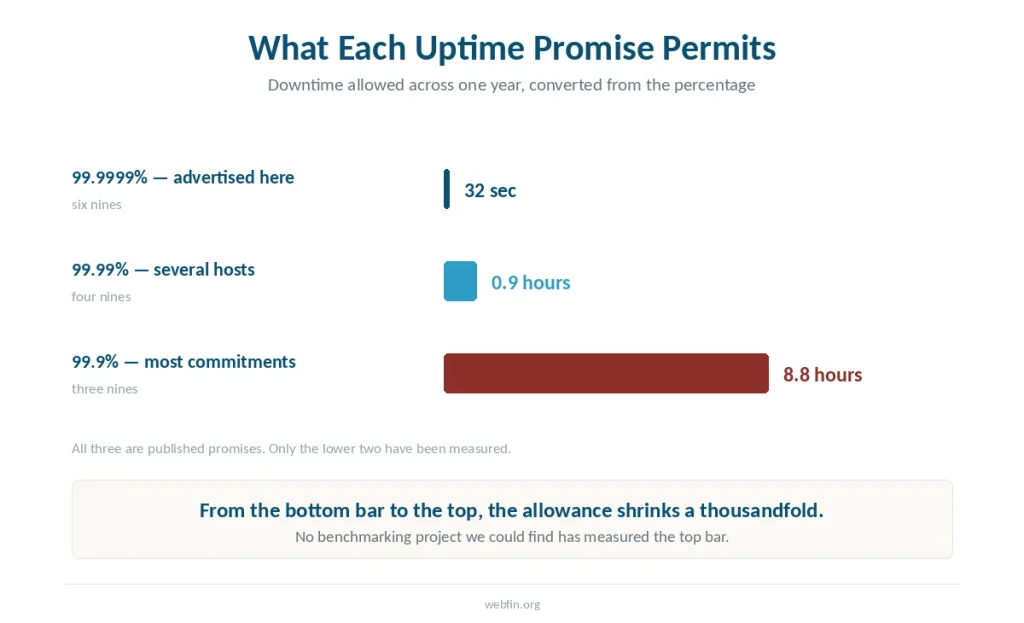
Hostwinds advertises 99.9999 percent uptime. That is six nines, so it permits about 32 seconds of downtime across an entire year. We set Hostwinds against a managed cloud server in Cloudways vs Hostwinds.
No benchmarking project we could find has measured this host. The figure comes from the company, and the strongest independent evidence for it is the absence of complaints rather than the presence of data.
Is Hostwinds Good in 2026?
Its renewal behavior is genuinely restrained. Published figures put the Basic shared plan at $4.54 rising to $6.99, a multiplier of 1.54 and the second gentlest across the thirteen hosts we have priced. We compare Hostwinds directly with SiteGround in SiteGround vs Hostwinds.
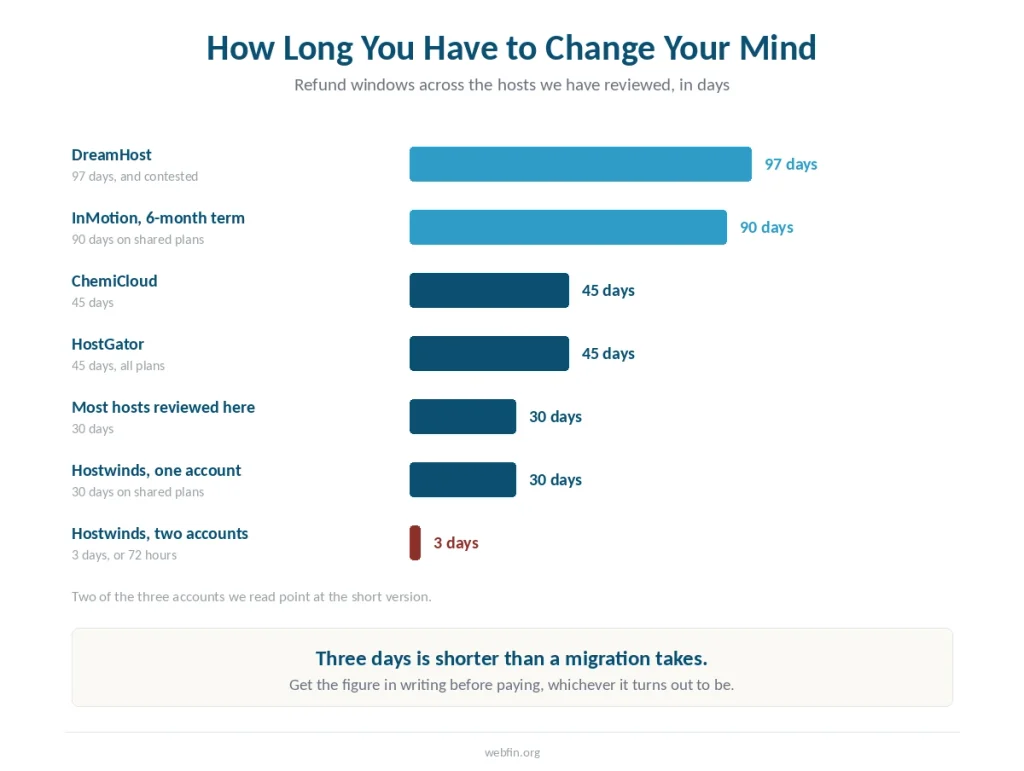
However, sources disagree on the refund window by a factor of ten, and none of our usual performance benchmarks covers it at all.
The Refund Window Nobody Agrees On
This is the sharpest conflict in the sources, and it matters more than most.
One 2026 review states a 30-day money-back guarantee on shared and business plans. Another states three days, describing it as shorter than industry standards. A customer quoted in a third describes being refused a refund for missing a 72-hour window by a few hours.
Of course, seventy-two hours is three days. Two of the three accounts therefore point the same way, and the outlier is the generous one.
⚠️ We could not settle this, so treat the short version as the working assumption until you have it in writing. A three-day window is not enough time to migrate a site, let alone test one — we set out that timing separately.
The Uptime Claim
In fact, six nines is an unusual thing to advertise, and the company backs it with an infrastructure argument rather than a measurement.
Besides, it states that it owns its equipment rather than renting from third parties, builds to 2N redundancy with duplicated routers, power and fibre paths, and routes across multiple carriers.
That is a coherent explanation of how such a figure could be achieved. It is not evidence that it has been.
For comparison, the 99.9 percent that most hosts here commit to allows about 8.8 hours of downtime a year. Six nines allows 32 seconds. The gap between those two promises is larger than the gap between any two measured results in these reviews.
Two of Our Sources Are the Company
⚠️ We need to flag something about the material available on this host.
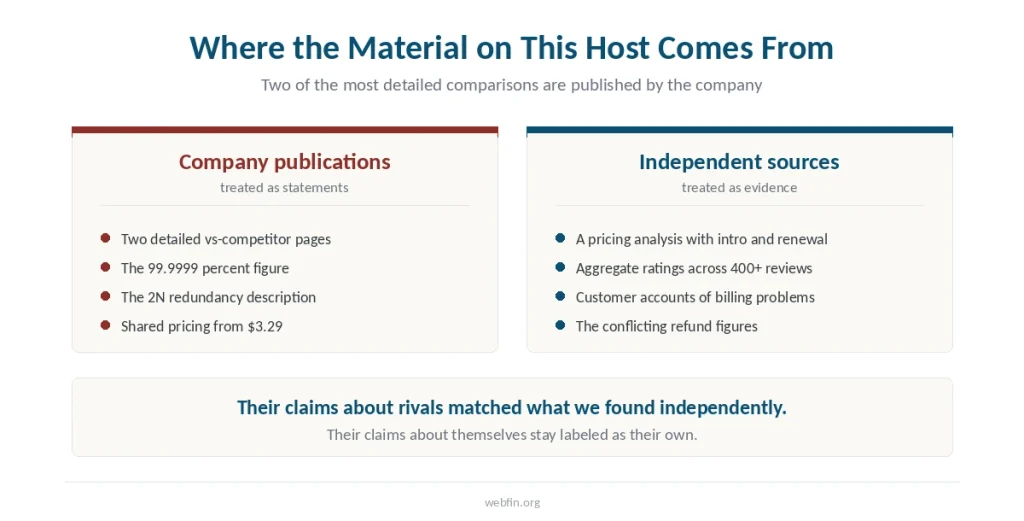
Two of the most detailed comparisons we found are published on Hostwinds’ own blog, setting it against competitors we have reviewed. They are well written and specific, and they are marketing.
Where those pages make claims about Hostwinds we treat them as company statements. Where they make claims about competitors we have checked them against our own reviews, and the renewal figures they cite for other hosts broadly match what we found independently. We compare Hostwinds directly with Bluehost, a Newfold Digital brand, in Bluehost vs Hostwinds.
Price and Renewal
In practice, published figures split, and the spread is worth listing.
The company’s own blog gives shared hosting from $3.29 a month. One pricing analysis gives $4.54 rising to $6.99. Another review lists $6.99, $8.99 and $10.99 across the three shared tiers, which read as list rather than promotional rates.
Taking the pricing analysis, three years comes to $222.24, which places it eighth of the twelve shared plans we have priced — the full field is here.
Meanwhile, the VPS side is where the value sits. Unmanaged Linux VPS starts at $7.14 a month and managed at $8.24, against $29.95 and higher at hosts we have reviewed for comparable specifications. Selling hosting under your own brand is a separate decision, covered in the best reseller hosting.
What Costs Extra
Standard SSL runs $75 a year and wildcard SSL $150, though shared accounts get free AutoSSL through cPanel covering up to 1,000 domains.
Nightly backups are included on shared plans. Cloud backups are an add-on with pricing available only on request, which is unusual enough to note.
Support and Billing
In practice, support is the thing reviewers praise most consistently. It runs 24 hours in house, and aggregate ratings sit at 4.9 out of 5 across more than 400 business software reviews.
⚠️ Two complaints recur and both concern billing rather than hosting. Some users report storage charges continuing after they cancel a VPS, with no way to remove them through the portal. Others describe repeated payment failures, one reporting more than sixty attempts across four cards.
Neither is a performance issue. Both are the kind of thing that turns a cheap plan into an expensive afternoon.
Who Owns It
Finally, founded in 2010 and based in Seattle, independently owned and operated, serving a reported 200,000 clients.
That is the third independently owned host in these reviews, and unlike several earlier ones it says so plainly rather than leaving us to guess — we hit that wall repeatedly.
What We Don’t Love
The refund window is either 30 days or three, and we could not determine which.
No independent benchmark covers it, so speed and uptime rest on company claims and scattered user reports.
Billing complaints recur in a way that performance complaints do not.
How We Research
Pricing comes from published analyses that state what they read and when. Where a source is the company’s own marketing we say so rather than citing it as independent. Where our usual benchmarks do not cover a host we say that too, instead of substituting weaker evidence quietly.
We run no tests of any kind. Our five criteria are on our About page.
Frequently Asked Questions
The company advertises 99.9999 percent, which permits about 32 seconds of downtime a year. No independent benchmarking project we could find measures this host, so the figure rests on the company’s own infrastructure claims.
Sources disagree by a factor of ten. One 2026 review states 30 days, another states three, and a customer account describes a 72-hour window. Confirm the figure in writing before paying rather than relying on any review.
One pricing analysis gives the Basic shared plan at $4.54 rising to $6.99, a multiplier of 1.54. That is the second gentlest increase across the thirteen hosts we have priced. Across three years it comes to $222.24.
On price, clearly. Unmanaged Linux VPS starts at $7.14 a month and managed at $8.24, well below what hosts we have reviewed charge for comparable specifications. The company also owns its equipment rather than renting capacity.
It is independently owned and operated, founded in 2010 and based in Seattle, serving a reported 200,000 clients. Unlike several hosts in these reviews, it states its ownership plainly rather than leaving it unmentioned.
Hostwinds
Summary
Cheap VPS on owned infrastructure, sold with an uptime claim nobody has measured and a refund window nobody agrees on.
The Verdict
Hostwinds earns 3.4, and the score is limited by what we could not verify rather than by what we found.
Choose it if you want cheap VPS with owned infrastructure and you will confirm the refund terms in writing before paying. Our page on Kinsta against Hostwinds covers the comparison with no load figures on one side.
Skip it if you need a benchmark you can check, or if a three-day return window would leave you stuck.