
Disclosure: WebFin is reader-supported. If you buy hosting through links on this page, we may earn a commission at no extra cost to you. Commissions vary between providers and our ratings do not — here’s our full disclosure.
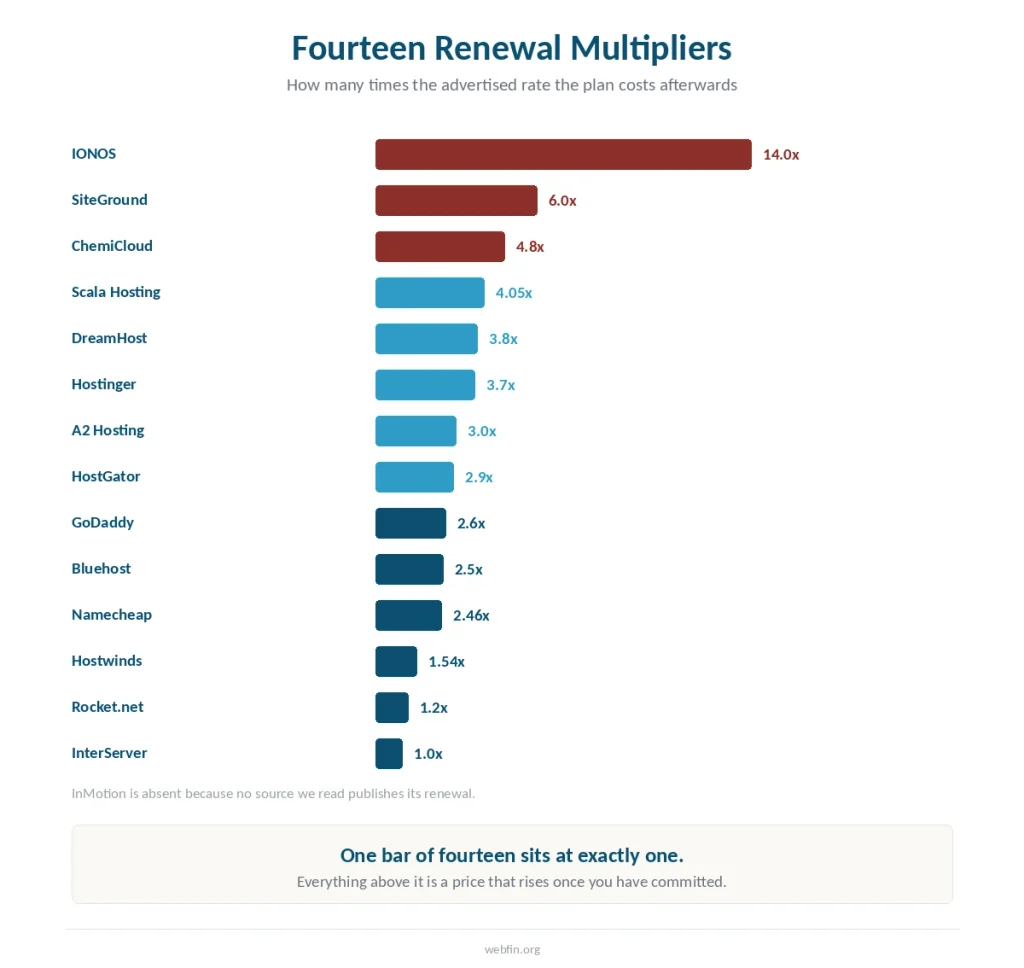
This site exists because hosting plans cost more in year two than in year one. Across sixteen hosts we have priced, the multiplier runs from 1.2 to 14.
InterServer’s is 1.00. A reviewer who signed up at $2.50 in October 2024 passed renewal cycles in April 2025 and April 2026 and reported still paying $2.50. We set InterServer against a managed cloud server in Cloudways vs InterServer.
Is InterServer Good in 2026?
For anyone who intends to stay, yes, and the arithmetic is not close. Three years costs $90.00, which is within a dollar of the lowest three-year total across the sixteen plans we have priced. Six years costs $180.00, against $519.84 for that same plan once its promotion ends. InterServer also sells a reseller plan, compared in the best reseller hosting.
However, the data centers are American only, the stack has no managed WordPress tooling, and sources disagree about whether it runs LiteSpeed at all.
The Price Lock, and What Tested It
Most hosting claims in these reviews come from marketing pages or from measurements taken once. This one has been through the event it describes.
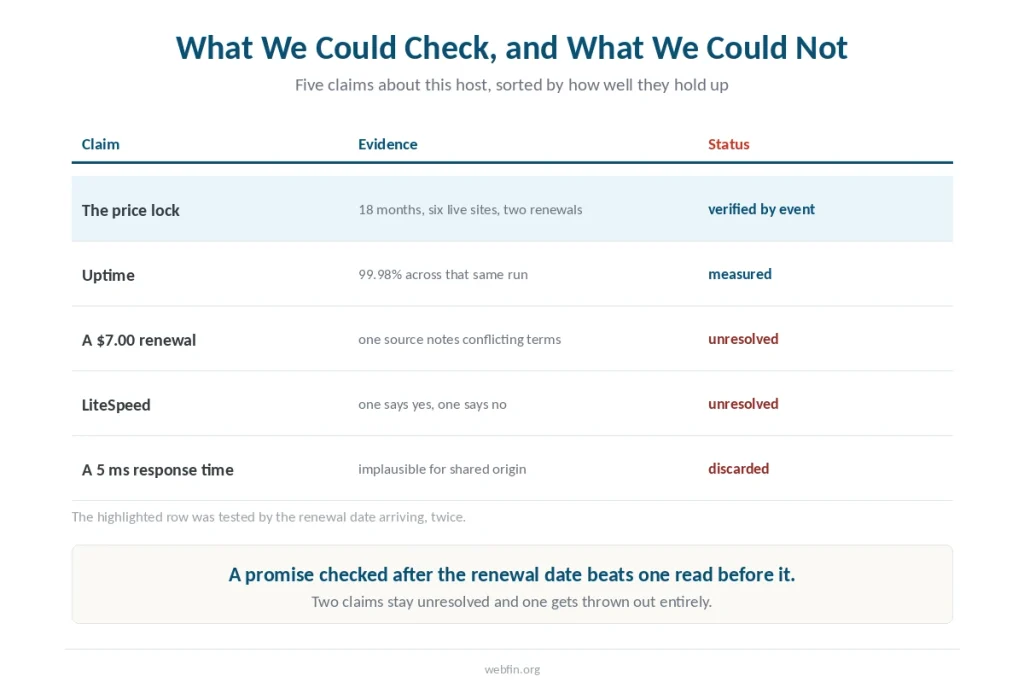
A published review reports hosting six production WordPress sites on the Standard plan since October 2024, an eighteen-month run covering two renewal dates. Its finding is that the rate held at $2.50 both times.
One plan exists rather than three, priced at $2.50 a month, with unlimited storage, bandwidth, email accounts and websites. There are no tiers to compare and no upgrade path priced above it on shared hosting. We compare InterServer directly with Bluehost, a Newfold Digital brand, in Bluehost vs InterServer.
A promotional code reduces the first three months to $1 in total, and a 30-day refund applies to all shared plans.
The One Dissenting Account
⚠️ One 2026 review notes conflicting information about whether the Standard plan renews at $7.00 rather than holding at $2.50, and recommends checking current terms before committing.
We are reporting that because it exists, not because it outweighs the other evidence. The eighteen-month account describes two completed renewals at the locked rate, which is stronger than a note about conflicting information.
Confirm it at checkout anyway. A price lock is a contractual promise, and contractual promises are worth reading.
What Six Years Costs
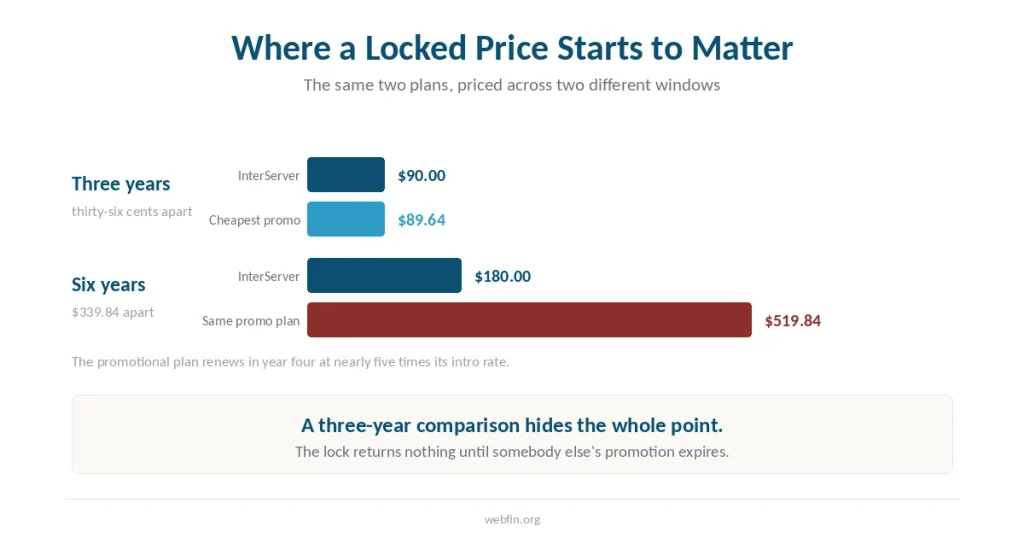
The three-year figure understates this host, because a locked price only shows its value once other promotions expire.
Across three years InterServer costs $90.00 and the lowest promotional total among the sixteen plans we have priced costs $89.64. The difference is thirty-six cents. We compare InterServer directly with SiteGround in SiteGround vs InterServer.
Across six years InterServer costs $180.00 and that same plan reaches $519.84, because its renewal arrives in year four at nearly five times the introductory rate — the full field is here.
That gap of roughly $340 is the entire argument for reading renewal terms before signing anything.
Speed and Uptime
Uptime evidence is unusually consistent across sources.
The eighteen-month test on six production sites recorded 99.98 percent. Independent monitoring elsewhere recorded 99.99 percent, another source reports an average of 99.9931 percent, and a two-week UptimeRobot window recorded 100 percent. The published guarantee is 99.9 percent, which permits about 8.76 hours a year.
Speed figures are respectable rather than remarkable. Load times are reported under 700 milliseconds by one source and under 1.5 seconds by another, both for shared hosting.
The company states publicly that it runs servers at no more than 50 percent capacity, deliberately leaving headroom so that one busy account does not degrade its neighbors. That is a policy claim rather than a measurement, but it is the kind of policy that would explain consistent figures.
Two Things Sources Disagree About
⚠️ The first is LiteSpeed. One review lists LiteSpeed servers with multiple caching layers as a strength. Another states plainly that LiteSpeed is not used here and that InterServer runs a more traditional stack. Both were published in 2026.
⚠️ The second is a response time figure of about 5 milliseconds cited by one source. That number is implausible for origin response from a shared server and almost certainly describes something cached or measured locally. We are not repeating it as a performance claim.
Where It Is Weak
Data centers sit in Secaucus, New Jersey and Los Angeles, and nowhere else. Performance is strongest in North America and acceptable across Western Europe, which makes it a poor fit for Asian or South American audiences.
There is no staging environment, no server-level WordPress caching and no specialized WordPress support. One-click installation through Softaculous and automatic core updates are the extent of it — we set out what WordPress actually needs.
Who Owns It
Founded in 1999 and independently owned for 27 years, operating its own data centers rather than renting capacity, and hosting a reported two million websites for more than 250,000 customers.
That is another independently owned host in these reviews, and the ownership matters here more than usual. A company that owns its buildings and its hardware has a cost structure that makes a permanent price lock possible — several brands we traced do not.
What We Don’t Love
American data centers only, which caps what it can do for global audiences.
No managed WordPress tooling, so staging and server-level caching have to come from elsewhere.
One source disputes the price lock at the Standard tier, and we could not resolve that from published material alone.
How We Research
Pricing comes from published reviews stating what they read and when, and the price lock claim rests on an eighteen-month account covering two actual renewal dates rather than on a marketing page. Where sources contradict each other we print both. Where a figure looks implausible we say so instead of repeating it.
We run no tests of any kind. Our five criteria are on our About page.
Frequently Asked Questions
Published accounts say it does not. One reviewer signed up at $2.50 in October 2024 and passed renewal dates in April 2025 and April 2026 still paying $2.50. One other source notes conflicting information about a $7.00 renewal.
$90.00, since the rate does not change. That sits within thirty-six cents of the lowest promotional total among the fourteen plans we have priced, and the gap opens to about $340 by year six once that promotion expires.
Respectable for its price. Load times are reported under 700 milliseconds by one source and under 1.5 seconds by another. Data centers are in New Jersey and Los Angeles only, so performance outside North America and Western Europe is weaker.
An eighteen-month test on six production sites recorded 99.98 percent. Other sources report 99.99 percent and 99.9931 percent. The published guarantee is 99.9 percent, which permits about 8.76 hours of downtime a year.
It has been independently owned since 1999 and operates its own data centers rather than renting capacity. It hosts a reported two million websites for more than 250,000 customers.
InterServer
Summary
A renewal multiplier of one, tested through two actual renewal cycles, attached to an American-only network.
The Verdict
InterServer earns 4.1, carried almost entirely by a single structural decision.
Choose it if you plan to keep the site for years, your visitors are American or European, and you want to stop thinking about renewal dates entirely.
Skip it if you need managed WordPress features, a global network, or a control panel that has been redesigned this decade. Our page on Kinsta against InterServer covers a locked $2.50 plan beside a $35.00 one.