
Disclosure: WebFin is reader-supported. If you buy hosting through links on this page, we may earn a commission at no extra cost to you. Commissions vary between providers and our ratings do not — here’s our full disclosure.
Both of these plans advertise at $2.99 a month. Over three years one costs $107.64 and the other $467.64.
That is the whole comparison in two numbers, and the storefronts give you no way to see it. What the extra $360 buys is a phone number, published resource limits and email hosting — which for some people is worth every cent and for most people is not.
The Short Answer
Hostinger for almost everyone. It costs roughly a quarter as much over three years, delivers faster to most of the world, and its renewal increase is the gentler of the two. SiteGround if you will actually call support, or if knowing your exact resource ceiling before you buy matters more than the price difference.
Head to Head
| Hostinger Premium | SiteGround StartUp | |
|---|---|---|
| Advertised | $2.99/mo | $2.99/mo |
| Renews at | $10.99/mo | $17.99/mo (annual) |
| Term for the offer | 48 months | 12 months |
| Three-year total | $107.64 | $467.64 |
| Phone support | No | Yes |
| Resource limits | Not published | Published per plan |
| Email hosting | Included | Included |
| Owner | Private, ~30% PE-held | Independent |
| WordPress.org listed | Yes | Removed 2023 |
| Our score | 4.2 | 3.9 |
Renewal figures for the annual term. Both hosts price differently on other terms; the detail is in the reviews.
Price and Renewal
The multiplier comparison everyone makes is wrong, and it is worth explaining why before using either number.
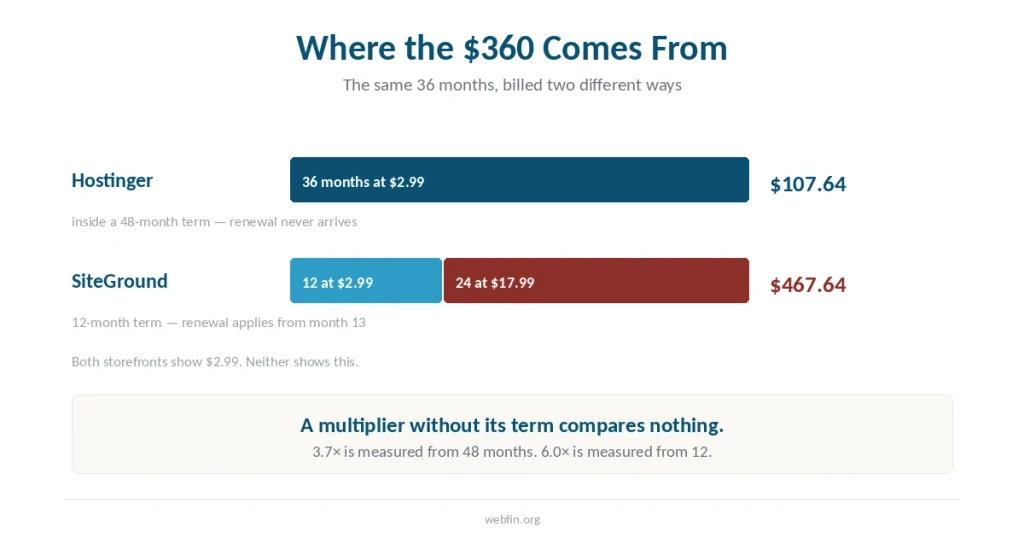
Hostinger’s Premium plan renews at $10.99 after an advertised $2.99 — a multiplier of 3.7. SiteGround’s StartUp renews at $17.99 after the same $2.99 — a multiplier of 6.0. Those look comparable and are not: Hostinger calculates from a 48-month term and SiteGround from 12.
So Hostinger asks for $143.52 on day one and does not raise the price for four years. SiteGround asks for $35.88 and raises it after twelve months. One is a bigger commitment at a lower rate; the other is a smaller commitment at a much higher one.
Over 36 months the arithmetic settles it. Hostinger: 36 months inside the promotional term, $107.64. SiteGround: 12 months at $2.99 then 24 at $17.99, $467.64. The gap is $360, or a full extra year of the more expensive plan.
⚠️ Committing longer softens SiteGround’s figure. Its 24-month term renews at $14.99 rather than $17.99, which most comparisons never mention. It does not close a gap this size — the full renewal picture is here.
Speed
Neither host wins this outright, and anyone who tells you otherwise is quoting one number.
Hostinger delivers better globally. Independent monitoring puts its business plan at a 351 ms global average, with sub-480 ms origin response and European latency measured at 87.5 milliseconds.
SiteGround has better hardware and worse delivery. The same benchmarking project scores its server resources 8.4 out of 10 — second highest of thirty-four hosts — while recording a global TTFB of 1,200 ms, the highest of the twenty-nine it tested. Origin response has drifted from 403 ms in 2022 to 632 ms in 2025.
Under load the picture flips again: SiteGround handled a ramp to 100 concurrent users at 147 ms average with zero errors.
So SiteGround is the stronger machine and the weaker network. For a site with heavy processing and local traffic, that is a fair trade. For a site with visitors spread around the world, it is not.
⚠️ Both hosts publish flattering figures from European probes. Our audience is largely American, and both slow down considerably at that distance.
Uptime
Close enough to call a draw.
SiteGround records 99.96% to 100% depending on the window; Hostinger records 99.93% to 100% across seven testing projects. Hostinger’s longest continuous dataset shows downtime falling from 1,228 minutes in 2021 to 33 minutes in 2025, which is a better trajectory than a snapshot suggests.
Neither will cost you visitors through downtime. This criterion does not decide anything here.
Support
This is SiteGround’s win, and it is decisive if you need it.
SiteGround publishes a phone number and answers it around the clock. Independent review reports a 90% first-contact resolution rate and a 4.9 out of 5 Trustpilot score across thousands of reviews. There is no automated gate.
Hostinger runs chat and email only, and chat opens with an AI assistant. Typing “human” or “agent” transfers you, usually within about two minutes, which is fast. But two minutes to reach a person is not the same as a number you can call, and the people most likely to need help are the least comfortable describing a technical problem in writing.
⚠️ Nobody publishes controlled measurement of support response times for any host, so this rests on consistent description rather than data.
Resource Limits
Two opposite approaches, and both are informative.
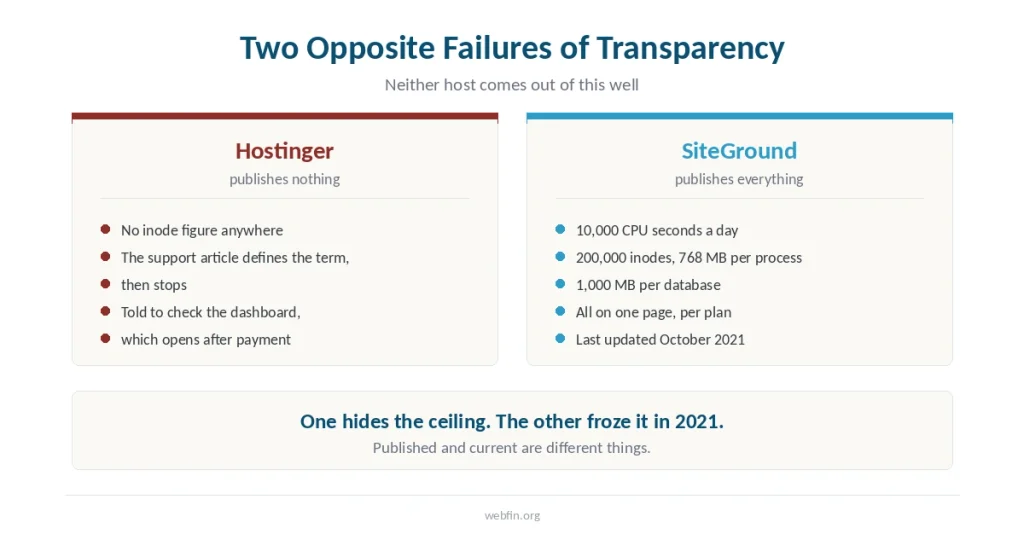
SiteGround publishes everything, per plan, on one page: 10,000 CPU seconds a day on StartUp, 200,000 inodes, 768 MB RAM per process, 1,000 MB per database, cron no more often than every 30 minutes. You know exactly what you are buying.
Hostinger publishes nothing. Its support article explains what an inode is and how to reduce your count, then tells you to check your dashboard — which opens after payment.
⚠️ SiteGround’s page was last updated in October 2021. Published and current are different things, and nearly five years is a long time for a document describing limits enforced daily.
The practical warning belongs to SiteGround, though. Ten thousand CPU seconds a day is a real ceiling on a plugin-heavy site, and exceeding it limits the account until usage falls. Hostinger’s ceilings exist too; you simply cannot see them before you pay. We compared how three hosts document this, and neither of these two comes out well.
Ownership and Reputation
SiteGround is independent, founded in Sofia in 2004 and still privately held with no parent group and no sister brands. Hostinger is private too, with a private equity firm holding around 30% by the company’s own account, headquartered in Vilnius.
Neither belongs to the kind of portfolio that puts two names on your shortlist without saying so, which is worth noting given how common that is in this category.
One difference in public standing: Hostinger appears on the WordPress.org recommended hosts page and SiteGround was removed from it in 2023, with no reason published. That list describes its own selection as arbitrary, so the removal is weaker evidence than it looks.
Winners by Category
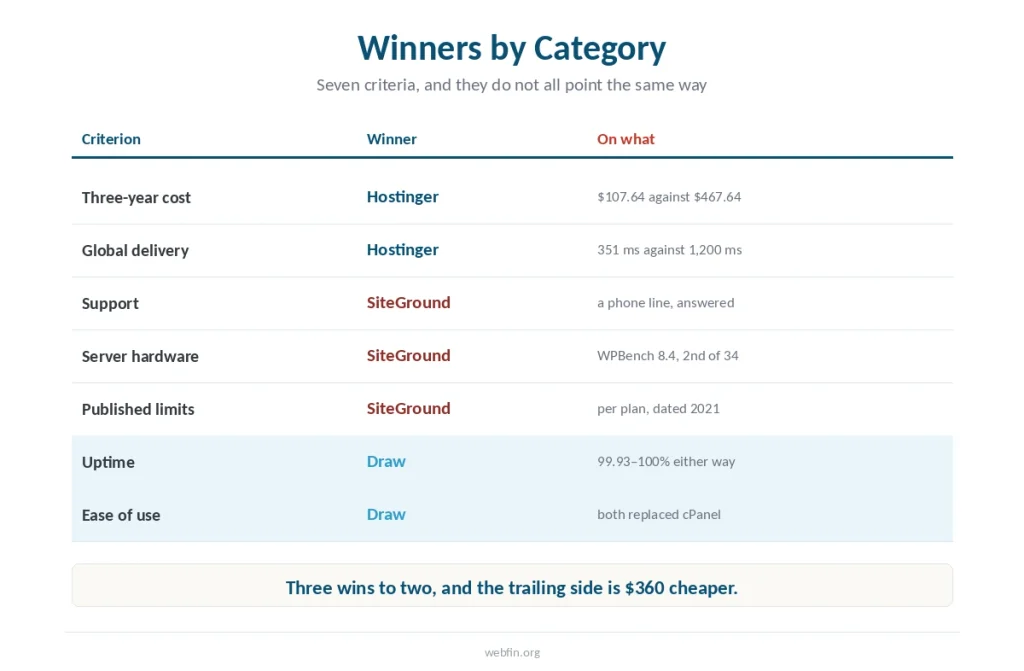
Three-year cost: Hostinger, by $360.
Support: SiteGround, by a phone number and a measured resolution rate.
Global delivery: Hostinger.
Server hardware and load handling: SiteGround.
Transparency about limits: SiteGround, with an asterisk about the 2021 date.
Uptime: a draw.
Ease of use: a draw — both replaced cPanel with their own panel, and neither transfers if you leave.
When to Choose SiteGround Instead
Three situations, and only three.
You will telephone support. If that sentence describes you, stop reading comparisons and buy SiteGround. Nothing else on this page matters as much.
Your site is processing-heavy and your visitors are local. SiteGround’s hardware advantage is real and its delivery weakness is geographic.
You need to know the ceiling before you commit. If you have been throttled on shared hosting before, published limits are worth paying for even at these prices.
Outside those three, the $360 is buying something you will not use.
How We Research
Every figure here comes from the two underlying reviews, where each is attributed to a named source with its window. Prices come from each company’s own pages, resource limits from their documentation with update dates stated, and performance from named testing projects. We run no tests of our own.
Our five criteria and the reasoning behind each score are on our About page. The long versions are in our Hostinger review and our SiteGround review.
Frequently Asked Questions
Hostinger, by a wide margin. Both advertise at $2.99 a month, but over three years Hostinger’s Premium plan costs $107.64 against $467.64 for SiteGround’s StartUp. The difference comes from renewal rates and the length of each introductory term.
It depends where your visitors are. Hostinger delivers better globally, with a 351 ms average against SiteGround’s 1,200 ms in the same benchmark. SiteGround has stronger server hardware, scoring 8.4 out of 10 against the field, and handles heavy load better.
Yes, published and answered around the clock, with a reported 90% first-contact resolution rate. Hostinger offers chat and email only, opening with an AI assistant that transfers you to a person on request, usually within about two minutes.
SiteGround publishes every ceiling per plan on one page: CPU seconds, inodes, memory, database size and cron frequency. Hostinger publishes no figure and directs you to a dashboard available after purchase. SiteGround’s page was last updated in October 2021.
In three situations: you will telephone support, your site is processing-heavy with local visitors, or you need published limits before committing. Outside those, the extra $360 over three years buys capability most sites never use.
The Verdict
Hostinger, 4.2 against 3.9, and the margin is mostly money.
Four times the three-year cost is a large premium for support you may never call and limits you could look up after buying. For a first site, a blog, a portfolio or a small business site, the answer is not close. Against Bluehost it is much closer.
SiteGround earns its price in one scenario, and it is a real one: you want a human on the telephone at an awkward hour, and you would rather pay every month than discover you cannot get one. If that is you, the $360 is not a premium. It is the product. Our page on Hostinger for Joomla covers the simplest of the platform cases.