
Disclosure: WebFin is reader-supported. If you buy hosting through links on this page, we may earn a commission at no extra cost to you. Commissions vary between providers and our ratings do not — here’s our full disclosure.
An uptime guarantee sounds like a promise that your site will stay online. In practice, it is a promise of a partial refund if it does not, and usually only if you ask in time. Kinsta’s service level agreement, for example, gives no credit at all for up to 43 minutes of downtime in a month, and credits must be requested in writing.
This guide explains what the percentages mean in minutes, what most guarantees exclude and how to judge a host by its record rather than by its promise.
What an Uptime Guarantee Promises
Most hosts guarantee 99.9% uptime a month. If they fall short, you receive a credit, which is a discount on a future bill rather than cash. Kinsta’s SLA, for instance, says you receive credits upon request, and that unused credits disappear if the account ends.
In other words, the guarantee sets out what the host owes you after an outage. It does not, by itself, make outages less likely.
What the Percentages Mean in Minutes
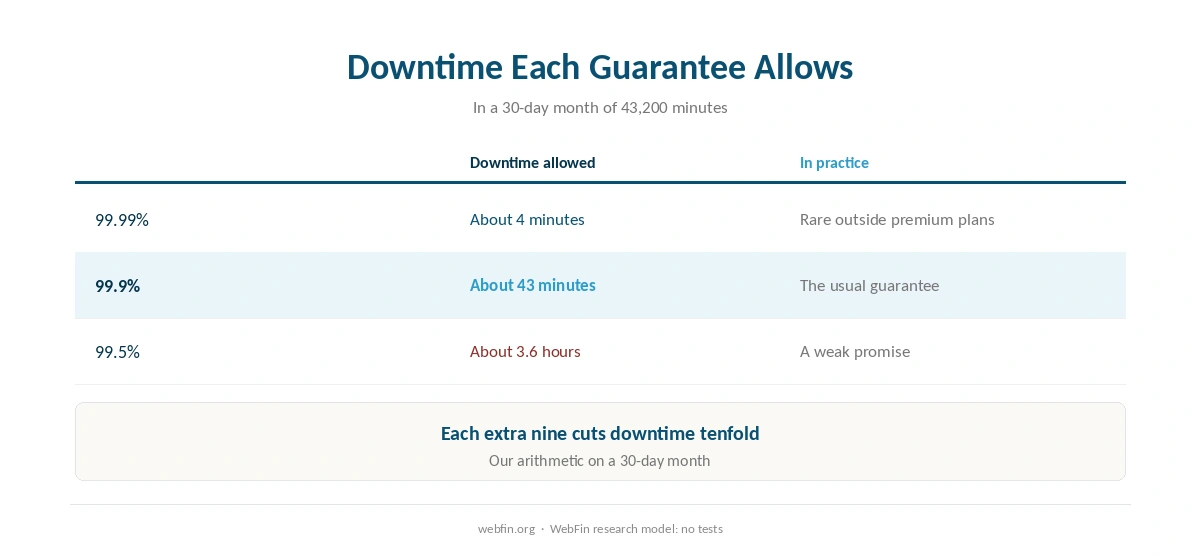
A 30-day month has 43,200 minutes. So a 99.9% guarantee allows about 43 minutes of downtime, which matches the threshold in Kinsta’s SLA and the figure ServerPoint gives in its own.
Each extra nine cuts that sharply. A 99.99% guarantee allows about four minutes a month, while 99.5% allows about three and a half hours. Our guide on reading a hosting uptime report explains how measured figures compare.
What Uptime Guarantees Exclude
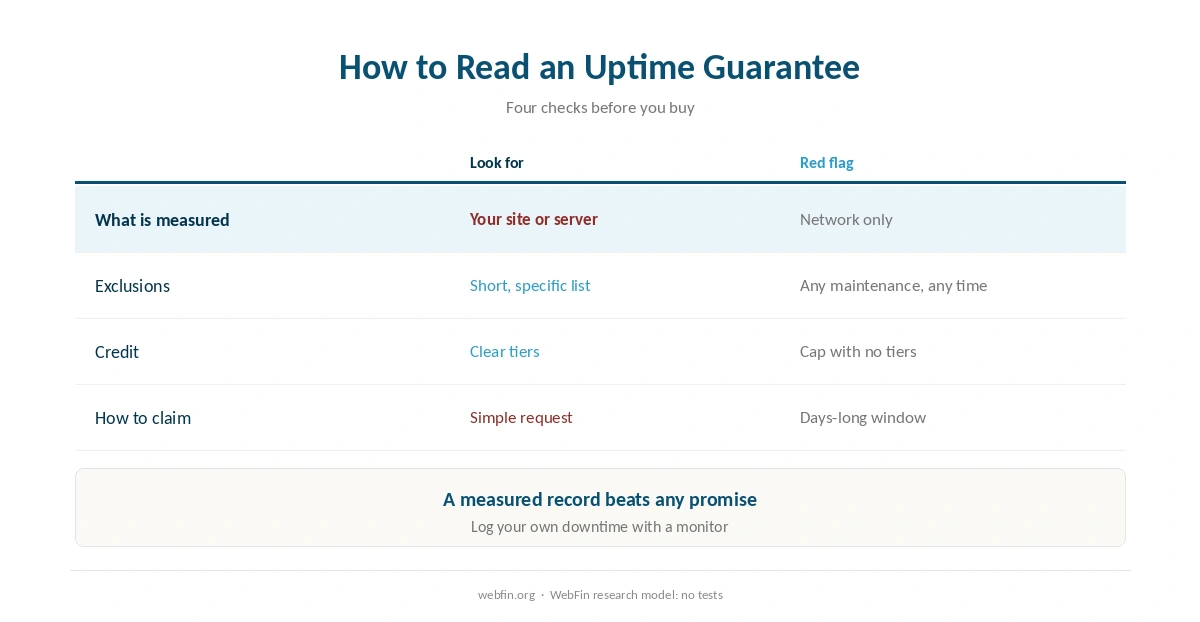
Almost every guarantee excludes scheduled maintenance. Kinsta’s SLA also excludes emergency maintenance, scheduled outages and problems caused by the customer’s own code or breach of terms.
Some guarantees are narrower still. ServerPoint’s SLA covers its network and states plainly that the failure of an individual server is not covered. So read what the uptime guarantee measures, not only the percentage.
How the Credit Works
Credits are usually a small share of the monthly fee. ServerPoint gives 10% for uptime between 99.0% and 99.9%, while Kinsta’s tiers start at 5% of the monthly fee.
You also have to claim it. Kinsta requires a written request, and other hosts set windows as short as a few days after the month ends. As a result, many customers never collect a credit at all.

Judge the Record, Not the Promise
A guarantee tells you the host’s liability; a measured record tells you its behavior. Hostingstep’s figures for Cloudways, for example, show 99.996% to 99.999% across five plans between October 2025 and May 2026.
Claims without measurement deserve caution. Hostwinds advertises 99.9999% uptime, but we found no independent measurement of it, so it remains the company’s own claim. Our guide to website speed test tools covers the speed side of the record.
Log Your Own Downtime
To claim a credit, you need evidence, and the host’s own figures may not match yours. An external monitor checks the site every few minutes and keeps a log, as our guide to uptime monitoring explains.
When an outage does happen, our guide on fixing a website that is down covers the first steps. Then file the credit request with your log attached.
Comparing Uptime Guarantees Between Hosts
Two hosts can both advertise a 99.9% uptime guarantee and mean very different things. One may measure your server, the other only its network, and the credit tiers and claim windows also differ.
So compare the full terms side by side before you buy, as our guide to choosing a hosting plan suggests. Renewal terms deserve the same attention, as our renewal price guide shows.
If the host keeps missing its uptime guarantee, leaving may be the better remedy than credits. Our guide on canceling hosting and getting a refund covers the exit.
When Downtime Costs More Than the Credit
For a store, an hour offline can cost far more than a month’s hosting fee, so the credit will never cover the loss. In that case, pay for resilience instead, as our guides to ecommerce hosting and high-traffic hosting explain.
Keep an off-site backup as well, so a long outage does not become lost data. Our guide to website backup services covers it, and our guide to cloud hosting explains how pooled servers help uptime.
Host-by-Host Guides
For measured uptime at individual hosts, these guides set out the record.
- Bluehost uptime record
- ChemiCloud uptime record
- Cloudways uptime record
- GoDaddy uptime record
- GreenGeeks uptime record
- HostGator uptime record
- Hostinger uptime record
- InMotion Hosting uptime record
- InterServer uptime record
- IONOS uptime record
- Kinsta uptime record
- Namecheap uptime record
- Rocket.net uptime record
- Scala Hosting uptime record
- SiteGround uptime record
- WP Engine uptime record
How We Research
We run no tests. The SLA terms come from Kinsta’s and ServerPoint’s published agreements, and measured uptime comes from Hostingstep’s records in our TablePress tables. The minute figures are our arithmetic on a 30-day month.
Read your own host’s current SLA, since terms change. Our guide on reading a hosting agreement shows where to find it, and the criteria behind our scores are on our about page.
Uptime Guarantee FAQ
That the host owes you a credit if your site is down for more than about 43 minutes in a 30-day month, excluding what the SLA leaves out.
Usually not cash. Most hosts give a credit on a future bill, and only if you request it in time.
Typically scheduled and emergency maintenance, plus problems caused by your own code. Some cover only the network, not your server.
Often 5% to 10% of the monthly fee for a small shortfall, rising as uptime falls further.
Yes, for choosing a host. A guarantee shows the host’s liability; a record shows how it actually performed.
The Verdict
An uptime guarantee is a small, conditional refund, not a promise that your site stays online. Most cover about 43 minutes a month at 99.9%, exclude maintenance and pay out only if you ask.
So choose a host by its measured record, log your own downtime and keep backups. Then treat the guarantee as a minor bonus.