
Disclosure: WebFin is reader-supported. If you buy hosting through links on this page, we may earn a commission at no extra cost to you. Commissions vary between providers and our ratings do not — here’s our full disclosure.
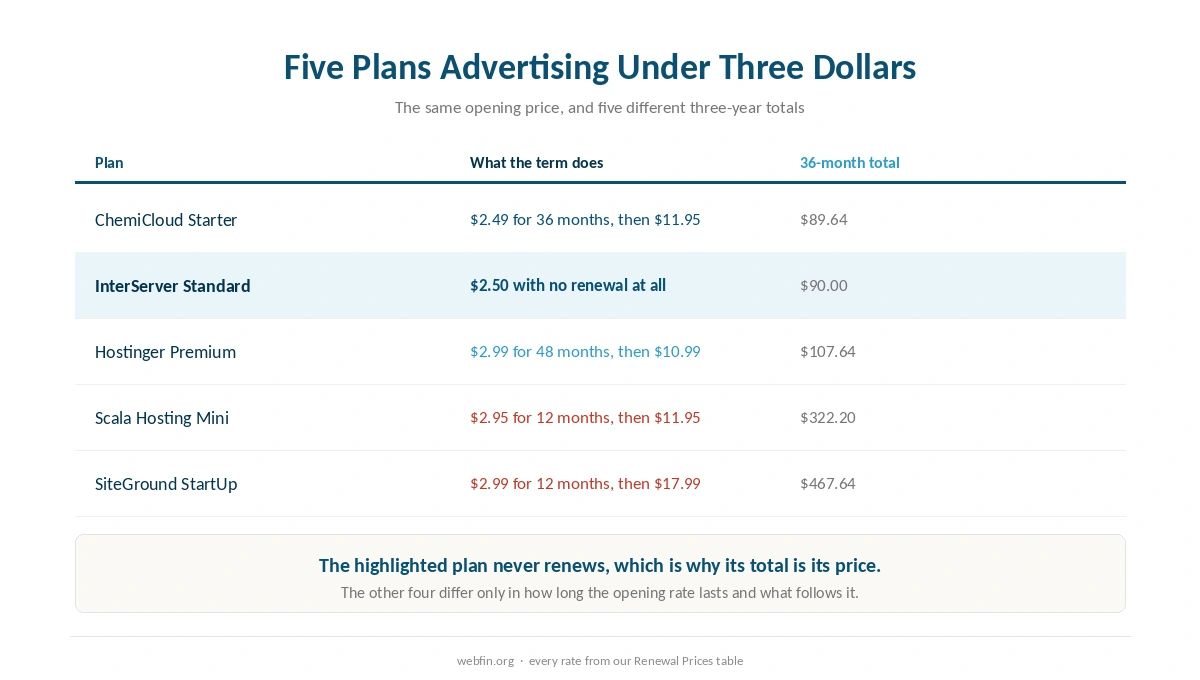
Five plans in our tables advertise under three dollars a month. Across three years they cost between $89.64 and $467.64.
So the advertised price tells you nothing about which one you are buying. Four questions do, and none of them is the monthly rate.
Five Plans, One Price, Five Totals
ChemiCloud opens at $2.49, InterServer at $2.50, Scala Hosting at $2.95, and both Hostinger and SiteGround at $2.99.
Across 36 months those become $89.64, $90.00, $322.20, $107.64 and $467.64. The spread reaches $378.00 on plans that looked identical.
Two things create that spread. How long the opening rate lasts, and what replaces it.
The Short Answer
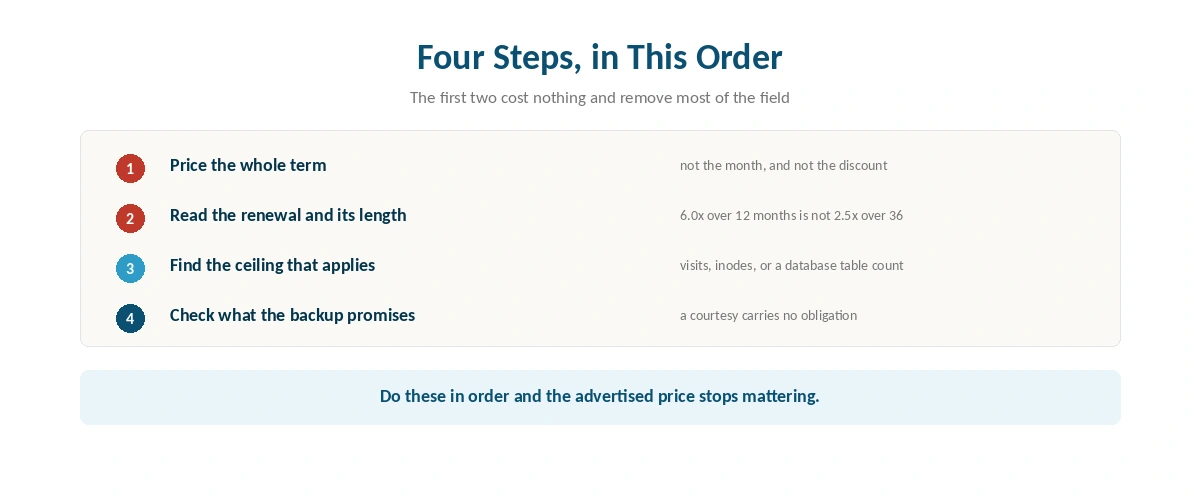
Price the whole term before anything else. Multiply the opening rate by its months, then add the renewal rate for what remains. If the site is a blog, the best hosting for bloggers applies the same test to that case.
That single calculation removes most of the field, and it takes a minute — we have already done it for twenty hosts.
Question One: What Does It Renew At
Renewal multipliers in our tables run from 1.0 to 14.0. One plan never changes price and another charges fourteen times its opening rate. Before paying, reading a hosting agreement covers the six clauses that cost money.
A multiplier alone is useless, because the term matters as much. Six times after twelve months is a different product from 2.5 times after 36.
So read both columns together. That is why our table carries the term beside every multiplier.
| Host and plan | Intro → Renewal | Multiplier |
|---|---|---|
| IONOS Plus | $1.00 → $14.00 | 14.0× over 12 months |
| SiteGround StartUp | $2.99 → $17.99 | 6.0× over 12 months |
| SiteGround GrowBig | $4.99 → $29.99 | 6.0× over 12 months |
| SiteGround GoGeek | $7.99 → $44.99 | 5.6× over 12 months |
| ChemiCloud Starter | $2.49 → not published | Renewal shown at checkout only |
| Scala Hosting Mini | $2.95 → $11.95 | 4.1× over 12 months |
| DreamHost Launch, annual | $2.89 → $10.99 | 3.8× over 12 months |
| Hostinger Premium | $2.99 → $10.99 | 3.7× over 48 months |
| Bluehost Starter | $3.99 → $11.99 | 3.0× over 12 months |
| A2 Hosting Turbo Boost | $6.99 → $20.99 | 3.0× over 12 months |
| HostGator Hatchling | $3.75 → $10.99 | 2.9× over 36 months |
| GoDaddy Economy | $5.99 → $15.32 | 2.6× over 36 months |
| Bluehost Starter | $3.99 → $9.99 | 2.5× over 36 months |
| Namecheap Stellar | $1.98 → $4.88 | 2.5× over 12 or 24 months |
| Namecheap Stellar Plus | $2.98 → $6.88 | 2.3× over 12 or 24 months |
| Namecheap Stellar Business | $4.98 → $9.88 | 2.0× over 12 or 24 months |
| DreamHost Launch, 4-year | $2.89 → $7.99 | 2.8× over 48 months |
| DreamHost, eligible US nonprofits | One shared plan free for the account's life | 501(c)(3) or (c)(19); help article, checked 10 Jun 2026 by a nonprofit directory |
| Bluehost Business | $6.99 → $13.99 | 2.0× over 36 months |
| Bluehost Starter, second reading | $1.99 → $8.99 | Hostingstep, July 2026; conflicts with Bluehost's help page |
| Hostwinds Basic | $4.54 → $6.99 | 1.5× over 12 months |
| WP Engine Startup | $27.00 → $35.00 | 1.3× over 12 months |
| Rocket.net Starter | $25.00 → $30.00 | 1.2× over 12 months |
| InterServer Standard | $2.50 flat | 1.0×, price lock |
| Cloudways, from | $14.00 flat | no promotional term |
| Kinsta Starter | $35.00 flat | no promotional term |
| Liquid Web managed VPS, annual billing | $33.00, no promotional term | No increase described on annual billing |
| Liquid Web managed VPS, monthly billing | $36.00 → $72.00 reported | 2.0× over one month; one pricing guide, disputed |
| GreenGeeks Lite | $2.95 → $13.95 | 4.7× after one term; renewal was $12.95 before 2026 |
| ChemiCloud Starter, third-party figures | $9.95, $11.95 or $12.95 quoted | Sources disagree; 4.0× to 5.2× over 36 months |
| SiteGround StartUp, by term | $2.99 → $14.99, $17.99 or $24.99 | 5.0× over 24 months, 6.0× over 12, 8.4× month to month |
| ChemiCloud Kickstart, reseller | $8.99 → $29.95 | Term not stated in the source we read |
| InterServer reseller | $19.95, price locked | No increase described in sources |
| GreenGeeks reseller | $19.95 with WHMCS included | Promotional rate; renewal not published |
| Hostwinds white-label reseller | $10.00 with WHMCS included | Plain reseller plan excludes WHMCS |
| InMotion Core, 36-month term | $3.19 → $10.99 | 3.4× over 36 months; TechRadar, 2026 |
| InMotion Launch, 36-month term | $4.99 → $13.99 | 2.8× over 36 months; TechRadar and plan cards, 2026 |
| InMotion Core, by term | Renews at $10.99, $11.99 or $14.49 | Longest term lowest; one review, May 2026 |
Two rows say the renewal is not published at all. Those plans cannot be priced, and we say so rather than estimating.
Question Two: How Long Does the Opening Rate Last
Terms in our tables run from 12 months to 48. That range matters more than the multiplier.
One host holds $2.99 for 48 months, so a three-year window sits entirely inside its promotion. Another holds $2.99 for twelve, so two of your three years are at $17.99.
Same opening price, different terms, and $360.00 between the totals.
Watch for one trap here. Some hosts sell the same plan on two terms with different renewals, which means the dropdown at checkout changes your bill. For a first site specifically, the best hosting for beginners applies these checks to five hosts.
Question Three: Which Ceiling Applies to You
Storage almost never runs out first. Three other limits do, and each host publishes a different one.
Monthly visits on managed plans, commonly 25,000 on an entry tier. Traffic above that triggers overage charges rather than a slowdown.
Inodes on shared plans, which counts files rather than gigabytes. Bluehost publishes three different thresholds in three different articles. It has belonged to Newfold Digital since 2021.
Database tables, which most hosts never mention. A store with a few thousand products meets that one first — unlimited means none of these are absent.
Question Four: Is the Backup a Service or a Courtesy
One host in our tables describes its weekly backups as courtesy copies. That wording means no obligation if a copy is missing when you need it.
Daily backups at that host cost $35.88 a year as a separate product, which is $107.64 across three years.
Search the terms for the word courtesy before buying, and keep a copy outside the account whatever the answer.
What to Ignore
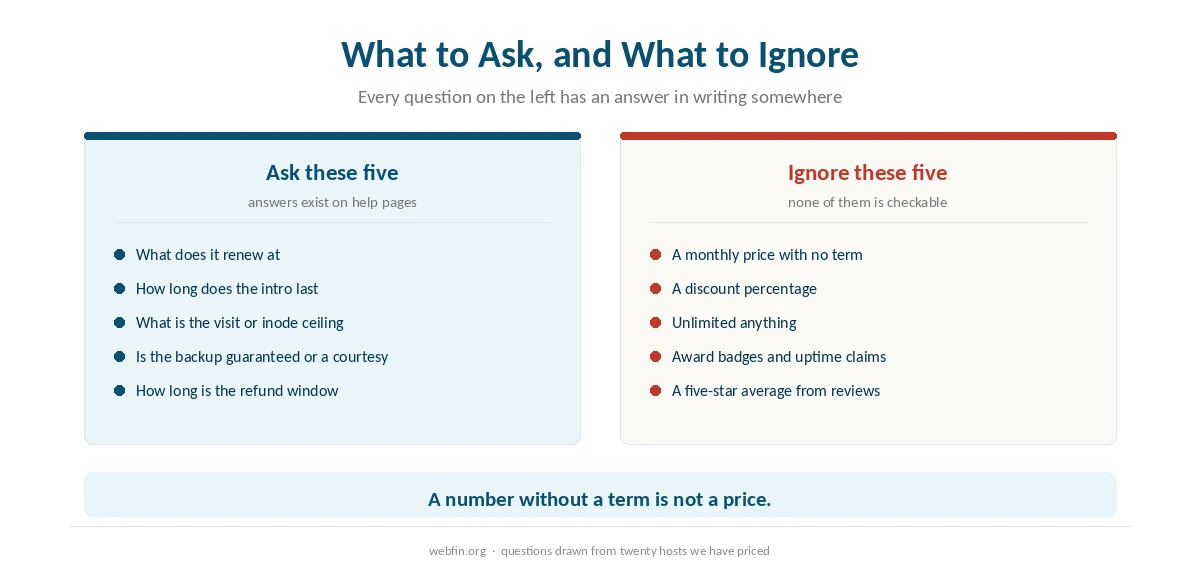
A monthly price with no term attached. It is not a price, because you cannot multiply it by anything.
A discount percentage. Seventy-three percent off tells you about the crossed-out figure, not about what you will pay.
The word unlimited. Every plan has ceilings, and unlimited only means they are not printed on that page. The panel that shows those limits is covered in understanding cPanel.
Uptime claims without a measurement. One host advertises 99.9999 percent, which permits 32 seconds a year, and no benchmark we could find has tested it.
Use the Refund Window as a Measuring Tool
Windows in our tables run from 30 days to 97, with two hosts disputed and one offering a pro-rated refund at any point.
That window is the only free test you get. Install what you actually plan to run, then read your own resource page in week one.
Therefore treat the first month as measurement rather than setup. It costs nothing while the refund is live.
How We Research
Every figure here comes from our own tables, each row naming the source that published it, checked on 12 September 2026. Two figures are arithmetic on those rows: $378.00 is the gap between $89.64 and $467.64, and $360.00 is the gap between $107.64 and $467.64.
Where a host publishes no figure, we record the absence rather than filling it. We run no tests of our own. Our criteria are on our About page.
Choosing a Hosting Plan FAQ
Multiply the opening rate by the months it lasts, then add the renewal rate for the remaining months of your window. Five plans advertising under three dollars finish three years between $89.64 and $467.64.
Because the term changes what it means. A six times rise after twelve months costs far more across three years than a 2.5 times rise after 36 months, since the second one barely arrives.
Rarely storage. Monthly visits on managed plans, commonly 25,000 on an entry tier. Inodes on shared plans, which count files. And database table counts, which most hosts never publish.
Search the hosting terms for the word courtesy. One host in our tables uses it for weekly copies, which means no obligation if one is missing, and sells daily backups at $35.88 a year.
A monthly price with no term, a discount percentage, the word unlimited, and any uptime claim without a named measurement behind it.
The Verdict
Price the term, read the renewal with its length, find your ceiling, and check the backup wording. In that order.
In short, the four answers are all published somewhere, usually on a help page rather than a pricing page. None of them appears in the number on the billboard.
Five plans advertised under three dollars and finished $378.00 apart. That gap is what the four questions are for.