
Disclosure: WebFin is reader-supported. If you buy hosting through links on this page, we may earn a commission at no extra cost to you. Commissions vary between providers and our ratings do not — here’s our full disclosure.
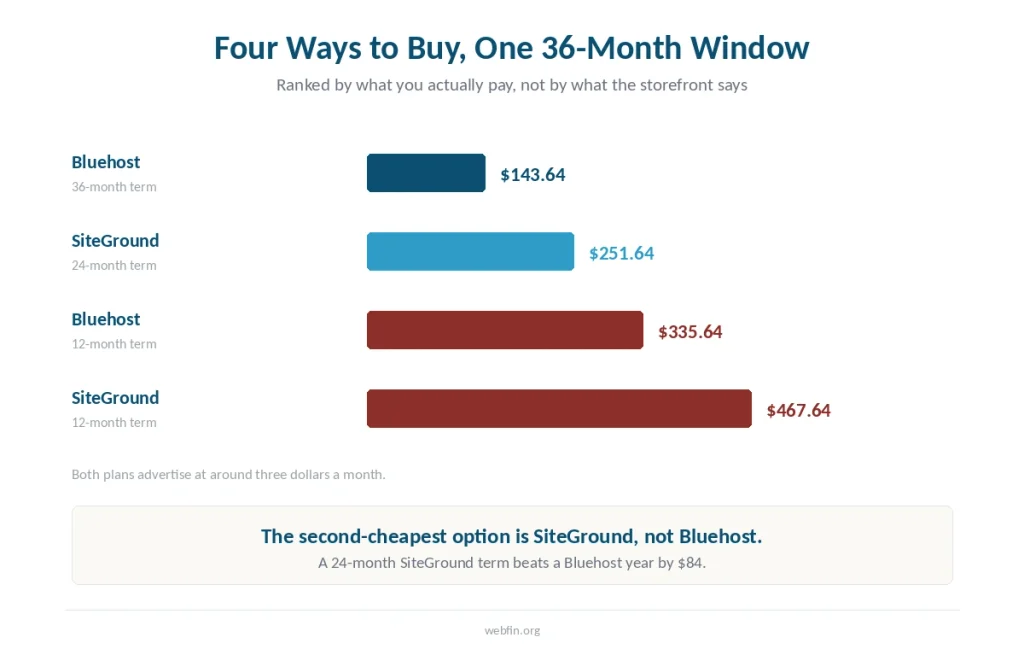
Both of these plans advertise at around three dollars a month. Over three years they can cost $143.64, $251.64, $335.64 or $467.64, and which host comes out cheaper depends entirely on the term you tick at checkout.
SiteGround bought on 24 months beats Bluehost bought on 12 by $84. So the honest answer to “which is cheaper” is another question: cheaper on what commitment?
The Short Answer
Bluehost, 4.0 against 3.9, on price at the long term, on speed and on hardware. SiteGround if support quality decides it for you, or if you would rather buy from a company that has no sister brands and publishes every ceiling it enforces.
Head to Head
| SiteGround StartUp | Bluehost Starter | |
|---|---|---|
| Advertised | $2.99/mo | $3.99/mo |
| Renews at, annual | $17.99/mo | $11.99/mo |
| Renews at, longest term | $14.99/mo (24 mo) | $9.99/mo (36 mo) |
| Three-year, best case | $251.64 | $143.64 |
| Three-year, annual | $467.64 | $335.64 |
| Phone support | Yes | Yes |
| Resource limits | Published per plan, dated 2021 | Published four ways |
| Email hosting | Included | Included |
| Owner | Independent | Newfold Digital |
| Sister brands | None | Eight named |
| Rank in one benchmark | 22nd of 34 | 14th of 34 |
| Our score | 3.9 | 4.0 |
The Term Decides
Four ways of buying, one 36-month window.
Bluehost on a 36-month term costs $143.64 and never reaches its renewal inside the window. SiteGround on 24 months costs $251.64. Bluehost on 12 months costs $335.64. SiteGround on 12 months costs $467.64.
Read that order again. The second-cheapest option is SiteGround, and it beats a Bluehost purchase by $84. The storefront that looks more expensive produces the better outcome, because the commitment length moves the total further than the brand does.
⚠️ Both hosts default to shorter terms, and both quote a single renewal figure in most comparisons. SiteGround’s 24-month renewal of $14.99 against its annual $17.99 is published and almost never mentioned — the full renewal picture is here.
The multipliers are not comparable either, for the reason that recurs across this whole category. SiteGround’s 6.0× is measured from 12 months; Bluehost’s 2.5× from 36.
Speed
Bluehost wins this on both halves, which is unusual.
One benchmarking project scores server hardware at 9.6 out of 10 for Bluehost against 8.4 for SiteGround — the two highest we have recorded — and ranks them 14th and 22nd of 34 overall.
Delivery separates them further. Bluehost records 501 ms origin response and 224 ms cached globally, with European nodes measured at 52 ms in Frankfurt and 53 ms in London. SiteGround records 632 ms origin, degraded from 403 ms in 2022, and a global TTFB of 1,200 ms — the weakest of the 29 hosts that project tested.
SiteGround’s answer is load handling, and it is a real one: a ramp to 100 concurrent users produced 147 ms average response with zero errors.
⚠️ Bluehost is mid-migration to Oracle Cloud, and the same project states its figures mix old and new infrastructure. Treat them as a moving target through 2026.
Uptime
A draw, and neither will cost you visitors.
SiteGround records 99.96% to 100% depending on window; Bluehost records 99.95% to 100%. Both improve on longer datasets rather than degrading, which is the pattern you want.
Support
Both hosts publish a phone number, so the argument that decided the earlier comparisons does not apply here.
That leaves quality, and here SiteGround leads. Independent review reports a 90% first-contact resolution rate and a 4.9 out of 5 Trustpilot score across thousands of reviews, with no automated gate before a person.
Bluehost’s line answers around the clock too. The recurring complaint in published reviews is not speed but content: performance questions are reported to attract upgrade suggestions rather than fixes.
⚠️ Nobody publishes controlled measurement of support response times for any host. This criterion rests on consistent description rather than data, and we treat it as the softest of the five throughout the site.
After Checkout
This is where Bluehost’s price advantage can evaporate.
Bluehost sells a long catalog of extras that renew separately: SiteLock Essentials at $95.88 a year, premium SSL at $89.88, domain privacy at $15 — free in year one on Business and above, but not on Starter — and Yoast SEO Premium at $99.99, sold by the company that owns both. The 30-day refund covers hosting only, and cancelling early deducts $15.99 for the free domain.
SiteGround’s list is shorter. Email hosting and daily backups are included rather than sold, which for a small business closes part of the price gap on its own.
Accept one Bluehost add-on and the cheaper plan stops being cheaper — we priced the catalog separately.
Documentation
Both fail, in opposite directions, and we have written about both.
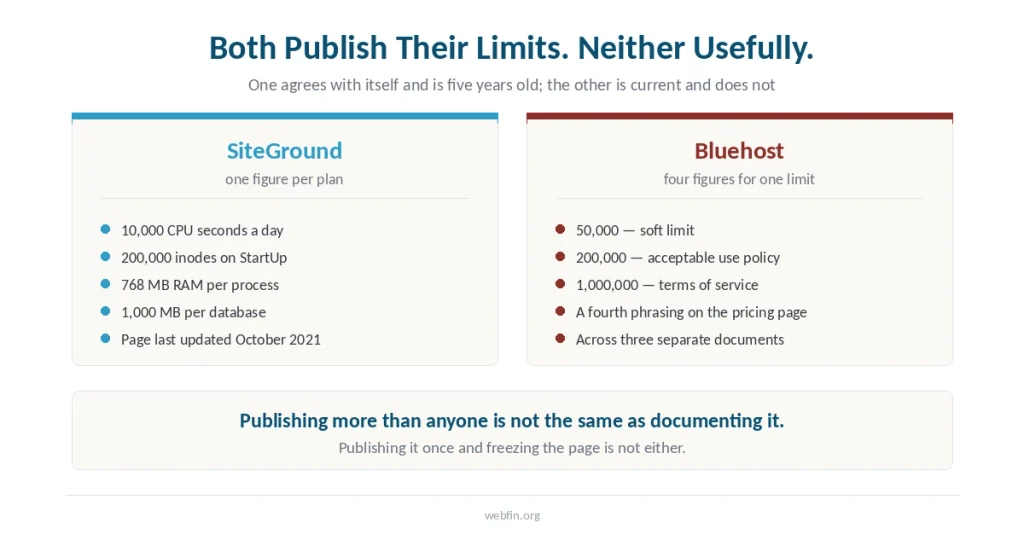
SiteGround publishes everything, per plan, on one page: 10,000 CPU seconds a day on StartUp, 200,000 inodes, 768 MB per process, 1,000 MB per database. You know exactly what you are buying. ⚠️ That page was last updated in October 2021.
Bluehost publishes four different statements of one limit — 50,000, 200,000, 1,000,000, and a fourth phrasing on the pricing page. More documentation, less agreement.
We compared three hosts on exactly this. SiteGround came out best of the three and still carries a five-year-old page.
Ownership
This is the clearest difference, and it cuts against the host we recommend.
SiteGround is independent. Founded in Sofia in 2004 by university friends, still privately held, no parent group, no sister brands. Its current chief executive started there as a technical support agent.
Bluehost belongs to Newfold Digital, backed by Clearlake Capital and Siris Capital. Newfold’s own boilerplate also names HostGator, Network Solutions, Register.com, Crazy Domains, Web.com, Yoast and YITH.
Two consequences. A shortlist containing Bluehost and HostGator contains one company twice. And the SEO plugin offered inside the Bluehost dashboard carries the same owner as the hosting — we traced the paper trail.
⚠️ One more difference in public standing: Bluehost has appeared on the WordPress.org recommended hosts page since 2005, while SiteGround was removed from it in 2023 with no reason published. That page calls its own selection arbitrary, so the removal is weaker evidence than it looks.
Winners by Category
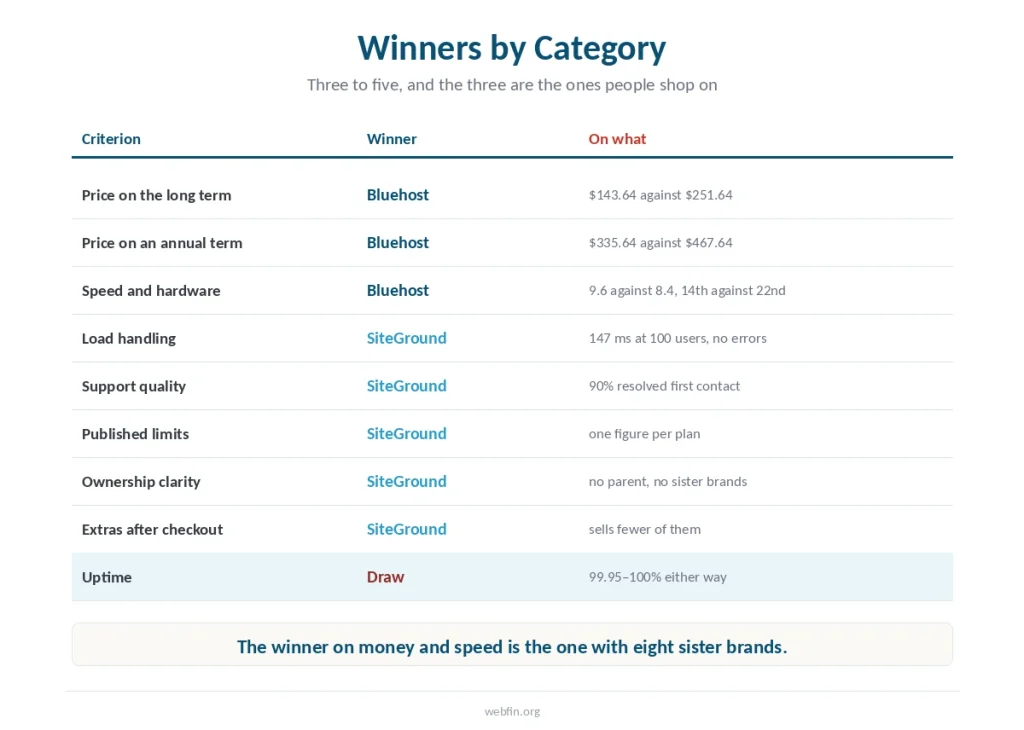
Three-year cost, long term: Bluehost, by $108.
Three-year cost, annual term: Bluehost, by $132.
Best available price on any term: Bluehost.
Second-best available price: SiteGround, beating Bluehost’s annual option.
Speed and hardware: Bluehost, on both halves.
Load handling: SiteGround.
Support quality: SiteGround.
Documentation: SiteGround, with a five-year-old page.
Ownership clarity: SiteGround.
Extras after checkout: SiteGround, by selling fewer.
Uptime: a draw.
When to Choose SiteGround Instead
Support quality decides it for you. A 90% first-contact resolution rate is the strongest support evidence published about any host we have reviewed.
You want to know your ceiling before buying. SiteGround tells you. Bluehost tells you four things.
Ownership matters to you. No parent group, no sister brands, nothing competing with itself on your shortlist.
You will not commit to three years. On a 24-month term SiteGround costs $84 less than Bluehost bought annually, and most people buy annually.
How We Research
Every figure comes from the two underlying reviews, where each is attributed to a named source with its window. Prices and limits come from each company’s own pages with update dates stated. We run no tests of our own.
Our criteria are on our About page. The long versions are in our SiteGround review and our Bluehost review.
Frequently Asked Questions
It depends on the term. Bluehost on a 36-month term costs $143.64 over three years, the lowest of the four combinations. SiteGround on 24 months costs $251.64, which beats Bluehost bought annually at $335.64.
SiteGround, on the evidence available. Independent review reports a 90% first-contact resolution rate and a 4.9 out of 5 Trustpilot score. Both hosts publish a telephone number and answer it around the clock, which is unusual in this category.
Bluehost, on both hardware and delivery. One project scores server resources 9.6 against 8.4 and ranks Bluehost 14th of 34 against SiteGround’s 22nd. SiteGround handles heavy concurrent load better.
SiteGround is independently held, founded in Sofia in 2004 with no parent group. Bluehost belongs to Newfold Digital, which also owns HostGator, Network Solutions, Register.com, Crazy Domains, Web.com, Yoast and YITH.
Yes, and both publish resource limits, though differently. SiteGround lists every ceiling per plan on one page last updated in 2021. Bluehost states four different inode figures across three pages.
The Verdict
Bluehost, 4.0 against 3.9, and the margin is thin enough that two of these arguments could flip it.
On the long term Bluehost costs $108 less over three years, scores higher on hardware, ranks better overall and delivers far faster in Europe. Those are real advantages and we are not going to talk around them.
SiteGround answers the phone better, publishes what it enforces and belongs to nobody. If any of those three matter more to you than $108 across three years, buy SiteGround — and if you will not commit to a 36-month term, the price argument weakens sharply anyway. Our page on Bluehost for Joomla covers the pairing that needs nothing confirmed first.