
Disclosure: WebFin is reader-supported. If you buy hosting through links on this page, we may earn a commission at no extra cost to you. Commissions vary between providers and our ratings do not — here’s our full disclosure.
Most comparisons in this category spend half their length on renewal arithmetic. This one needs none of it.
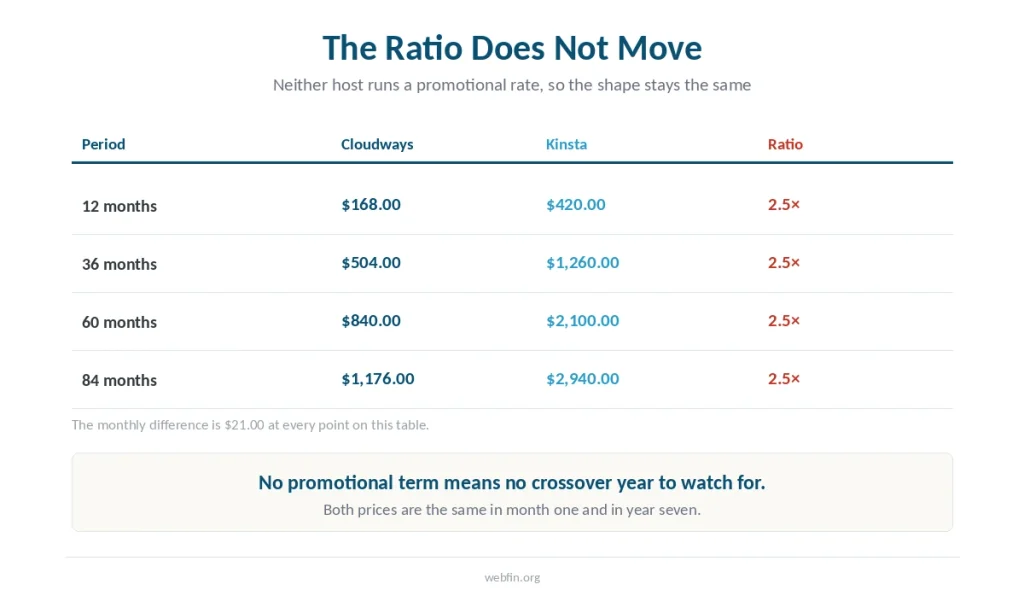
Cloudways charges $14 a month and Kinsta charges $35. Neither runs a promotional rate, neither has a renewal date, and neither raises the price later. The ratio is 2.5 to one at twelve months, at three years and at seven.
The Short Answer
Cloudways, and our tie-break rule decides it. Both score 4.1, and when scores are level we rank by three-year cost: $504.00 against $1,260.00.
Kinsta if your visitors are in North America or Europe and you want an edge network included rather than bought. Twenty-five milliseconds in Europe is not a figure Cloudways publishes.
Head to Head
| Cloudways | Kinsta Starter | |
|---|---|---|
| Price | From $14/mo | $35/mo |
| Promotional rate | None | None |
| Three-year total | $504.00 | $1,260.00 |
| Seven-year total | $1,176.00 | $2,940.00 |
| Ratio | — | 2.5 at every horizon |
| Origin TTFB | 419–447 ms | 525 ms |
| Edge-cached | not published | 25–42 ms |
| CDN | Add-on | Cloudflare Enterprise, included |
| Uptime measured | 99.996–99.999% | 99.98% |
| Phone support | No | No |
| Email hosting | About $1 per mailbox | Not offered |
| Billing | Hourly, no contract | Monthly, no contract |
| Our score | 4.1 | 4.1 |
No Renewal Math
Cloudways bills hourly and settles monthly, with no contract and no cancellation penalty. Kinsta bills a flat tier. What you pay in month one is what you pay in year seven at both.
12 months    Cloudways   $168.00    Kinsta     $420.00
36 months    Cloudways   $504.00    Kinsta   $1,260.00
84 months    Cloudways $1,176.00    Kinsta   $2,940.00
The monthly difference is $21.00 throughout, and it never changes shape. Compared against the promotional structures elsewhere in this category, both of these are unusually easy to plan around — the full field is here.
Speed Splits on the CDN
Both were measured by the same benchmarking project, which makes this a cleaner comparison than most.
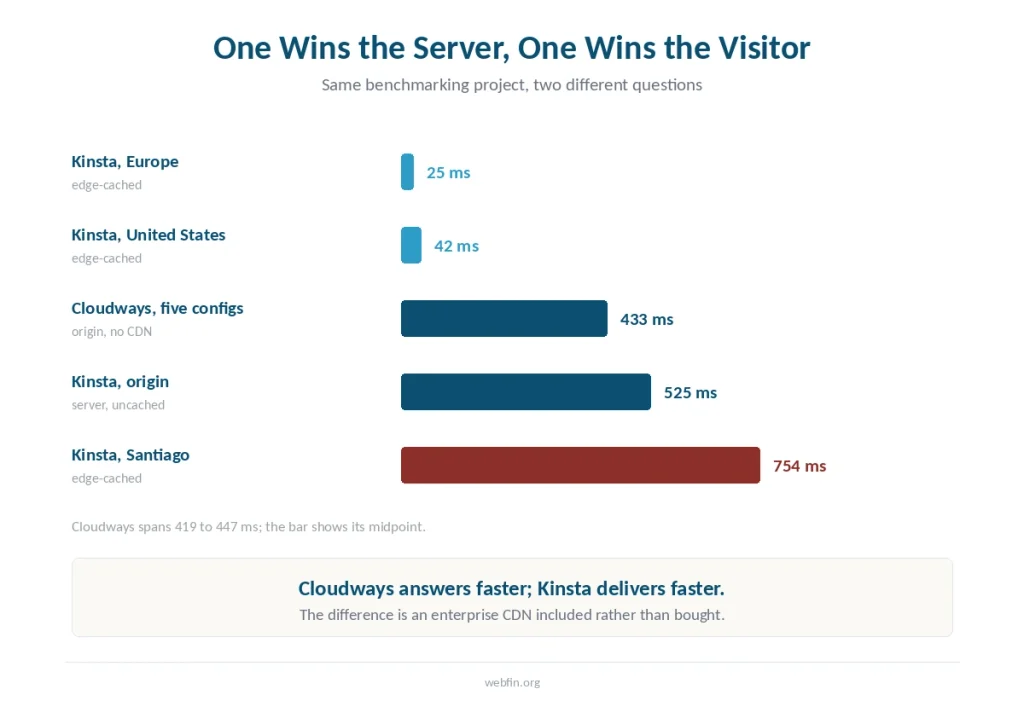
Cloudways records 419 to 447 milliseconds across five cloud configurations, a band 28 milliseconds wide regardless of which provider you pick. Kinsta records 525 milliseconds at the origin.
On the server, Cloudways is faster by roughly 90 milliseconds.
Then the architectures diverge. Kinsta includes Cloudflare Enterprise on every plan, so a visitor reaches the edge rather than the server. Measured there it records 25 milliseconds in Europe and 30 to 42 in the United States. Cloudways sells its Edge CDN as an add-on and publishes no equivalent cached figure.
⚠️ So Cloudways wins the server and Kinsta wins the visitor — provided the visitor sits where the network reaches. Kinsta records 481 milliseconds in São Paulo and 754 in Santiago, where it does not. We explained the origin-versus-edge distinction in our Kinsta review.
Uptime
Cloudways, on the longer measurement.
Cloudways records 99.996% to 99.999% across five configurations over an eight-month window. Kinsta records 99.98% over its own eight-month window and 100% across a project monitoring twenty live sites.
Both figures are strong enough that uptime will not cost you visitors at either.
⚠️ One Kinsta dip in 2025 traces partly to a Cloudflare outage rather than to Kinsta itself. Renting an edge network means inheriting the outages of whoever runs it.
What Neither One Gives You
This section is usually short. Here it carries the decision.
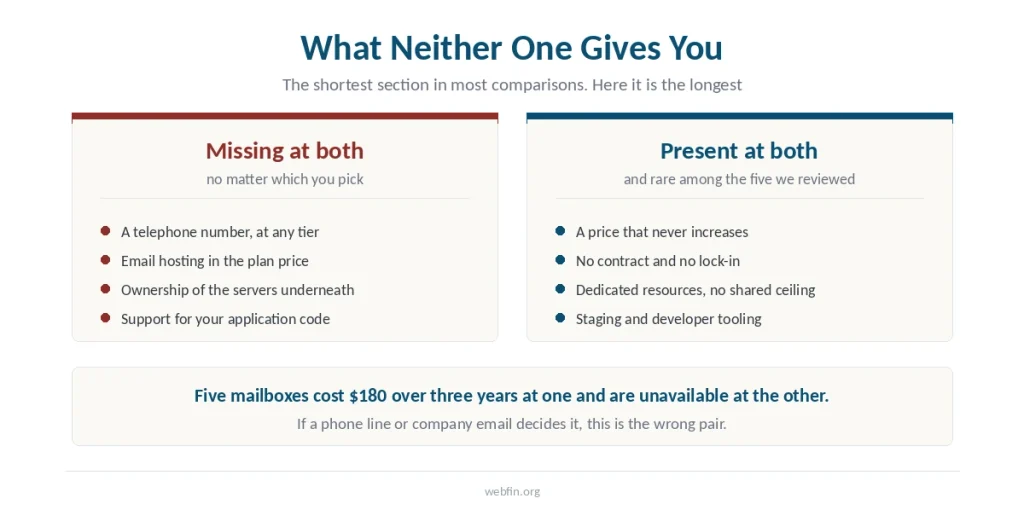
Neither publishes a telephone number at any tier. Both run chat and tickets around the clock. If a voice channel decides hosting for you, neither of these is your answer.
Neither includes email hosting. Cloudways sells mailboxes through Rackspace at about a dollar each per month, which puts five staff addresses at $180.00 over three years and takes its total to $684.00. Kinsta does not sell email at any price, so it means another vendor either way.
Neither owns the infrastructure it runs on. Cloudways places you on DigitalOcean, Vultr, AWS, Google Cloud or Linode. Kinsta runs on Google Cloud with Cloudflare in front. Both inherit their suppliers’ incidents.
Ownership
Both have a complication, and neither is hidden.
Cloudways belongs to DigitalOcean, which bought it for $350 million in 2022 and is one of the five cloud providers Cloudways invites you to choose between. At the time of the deal DigitalOcean stated that about half of Cloudways customers already ran on its infrastructure. Independent benchmarking gives that configuration the lowest compute allocation of the five tested — we set out the timeline separately.
Kinsta is privately held, founded in 2013 by Mark Gavalda and headquartered in West Hollywood. ⚠️ Its funding history is reported two ways and we could not resolve it: some databases describe it as bootstrapped with no outside money, others record a single round with one institutional investor. We found no first-party statement.
Neither belongs to a group that would place two names on the same shortlist, which distinguishes both from much of this category.
Winners by Category
Three-year cost: Cloudways, by $756.
Cost predictability: a draw — neither has a renewal.
Origin response: Cloudways, by roughly 90 ms.
Edge-cached response: Kinsta, comfortably.
South American delivery: Cloudways.
Uptime: Cloudways, on the longer window.
Included CDN: Kinsta.
Included tooling: Kinsta, by a wide margin.
Choice of infrastructure: Cloudways, across five providers.
Support: a draw, and neither has a phone.
Email: a draw, and neither includes it.
When to Choose Kinsta Instead
Your visitors are European or North American and speed is revenue. Edge delivery at 25 milliseconds is a genuine advantage and Cloudways does not match it without buying its CDN.
You would otherwise pay for APM, a CDN and staging. Add those to the Cloudways column before comparing the sticker prices; the gap narrows considerably.
You want one supplier rather than a menu. Kinsta makes the infrastructure decision for you, which some people want and others resent.
You run many client sites. Container isolation and the dashboard are built for that, and the tooling replaces separate purchases.
How We Research
Every figure comes from the two underlying reviews, where each is attributed to a named project with its window and whether it measured origin or edge. Prices come from each company’s own pages. We run no tests of our own.
Our criteria, including the tie-break rule used above, are on our About page. The long versions are in our Cloudways review and our Kinsta review.
Frequently Asked Questions
Cloudways, by $756.00 over three years — $504.00 against $1,260.00. Because neither host uses promotional pricing, that 2.5 ratio holds at twelve months and at seven years just as it does at three.
It depends what is measured. Cloudways is roughly 90 milliseconds faster at the origin, recording 419 to 447 against 525. Kinsta includes an enterprise CDN, so visitors reach the edge at 25 to 42 milliseconds.
No. Cloudways sells mailboxes through Rackspace at about a dollar each per month, roughly $180 for five addresses over three years. Kinsta does not offer email at any price, so a separate provider is required either way.
Neither, at any tier. Both run live chat and tickets around the clock. Cloudways scopes support to the platform; application problems remain yours at both hosts.
DigitalOcean acquired Cloudways for $350 million in 2022, and DigitalOcean is one of the five cloud providers Cloudways offers. Kinsta is privately held, founded in 2013, though databases disagree on whether it took outside funding.
The Verdict
Cloudways, on the tie-break, at 40 percent of the price.
Both score 4.1. Cloudways is ahead on uptime, on origin response and on cost. Kinsta is ahead on edge delivery and on included tooling, and that tooling case is real for anyone who would otherwise buy an APM and a CDN separately.
Neither host will answer your telephone or host your email. If either of those matters, this is the wrong pair entirely, and a shared plan costing a fraction of both will serve you better. Our page on Cloudways for Joomla covers why a managed server is more than most Joomla sites need.