
Disclosure: WebFin is reader-supported. If you buy hosting through links on this page, we may earn a commission at no extra cost to you. Commissions vary between providers and our ratings do not — here’s our full disclosure.
Cloudways vs Scala Hosting produces a result that runs against expectation. Scala’s shared plan, Mini, served the benchmark load test at 48 ms without an error. Cloudways’ weakest published cloud served it at 288 ms with a 1.7% error rate. Scala’s hardware also scores higher, and it costs less at every stage: $322.20 across 36 months against $504.00. Cloudways answers with stronger uptime, a choice of cloud and billing by the hour. The two are different products, a shared plan against a server, and that difference decides who should buy which. The same Scala Hosting figures against Kinsta are in our Kinsta and Scala Hosting comparison.
Cloudways vs Scala Hosting: The Short Answer
Scala Hosting, for most small and growing sites. It is cheaper at every stage, measured better under load, and includes daily backups, a malware monitor and email. Cloudways scores a tenth higher in our reviews, at 4.1 against 4.0, on uptime and flexibility, and it is the better choice for a developer who wants a server on the cloud of their choice, billed by the hour. For the same host against Hostinger, see Hostinger vs Scala Hosting.
Head to Head
| Criterion | Cloudways | Scala Hosting Mini |
|---|---|---|
| Product | Managed cloud server | Shared hosting, own panel |
| Price | $14.00/mo flat | $2.95/mo, then $11.95 |
| 36 months, annual terms | $504.00 | $322.20 |
| Load test | 288 ms at 1.7% errors, Vultr HF | 48 ms, no errors |
| Server hardware | 7.6 of 10, Vultr HF | 8.8 of 10 |
| Uptime | 99.996% to 99.999% | 99.98% |
| Backups and security | Not documented in our review | Daily backups, malware monitor |
| Not included | Included in SPanel | |
| Choice of cloud | Several providers | Scala’s own |
| Billing | Hourly, no contract | Prepaid; pro-rated refund after 30 days |
| Owner | DigitalOcean, 2022 | Not documented |
| Our score | 4.1 | 4.0 |
Cheaper at Every Stage
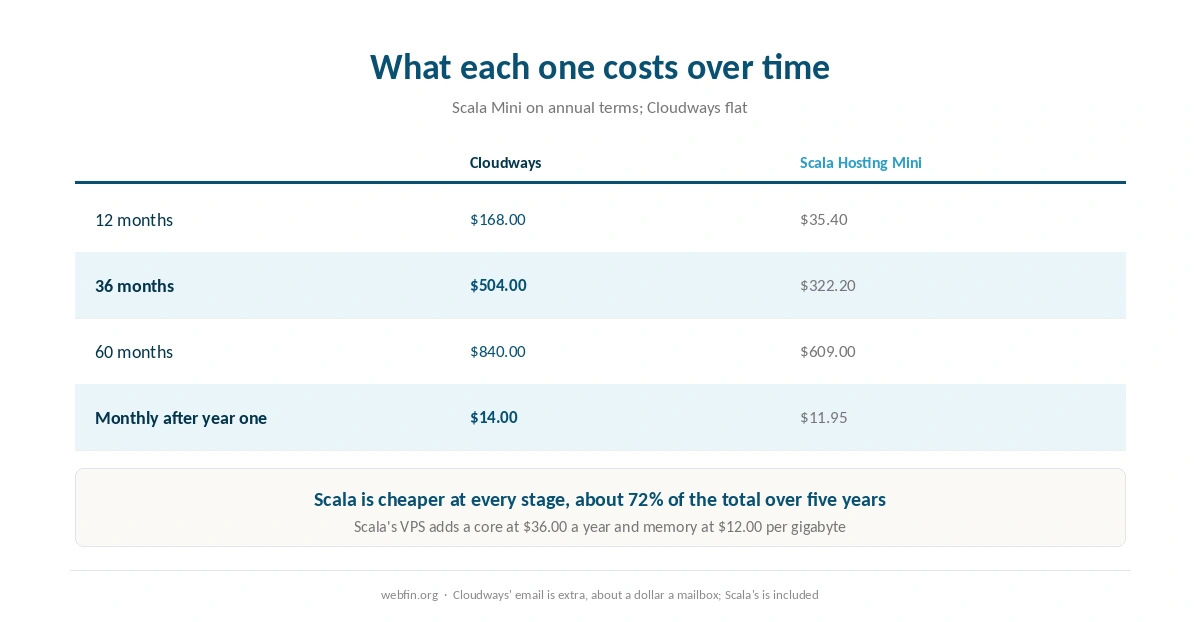
Scala Mini opens at $2.95 a month and renews at $11.95, which is 4.1× over 12 months. On annual terms three years come to $322.20. Cloudways charges $14.00 from the first month with no promotional term, which is $504.00 across the same stretch.
Scala’s renewal also sits two dollars below Cloudways’ flat rate, so the gap keeps widening after the first year. Over five years Scala totals about 72% of the Cloudways figure on the published rates. Our page on hosting renewal prices puts Scala’s step of 4.1× over 12 months beside the field.
⚠️ These are the entry products, and they are not the same kind of product. Scala Mini is shared hosting on Scala’s own panel. Cloudways’ entry plan is a server. The fairer server-to-server comparison is Scala’s VPS, priced by the unit at $36.00 a year per processor core and $12.00 per gigabyte of memory, against a larger Cloudways server.
| Host and plan | How it builds | 36-month total |
|---|---|---|
| ChemiCloud Starter, 36-month term | 36 prepaid months at $2.49 | $89.64 |
| InterServer Standard | 36 months at $2.50, price locked | $90.00 |
| DreamHost Launch, 48-month term | 36 of 48 prepaid months at $2.89 | $104.04 |
| Namecheap Stellar, 24-month term | 24 at $1.98, then 12 at $4.88 | $106.08 |
| Hostinger Premium, 48-month term | 36 of 48 prepaid months at $2.99 | $107.64 |
| HostGator Hatchling, 36-month term | 36 months at $3.75, renewal not reached | $135.00 |
| HostGator Hatchling, with daily backups | 36 at $3.75, plus CodeGuard at $35.88 a year | $242.64 |
| Bluehost Starter, 36-month term | 36 months at $3.99, renewal not reached | $143.64 |
| GoDaddy Economy, 36-month term | 36 months at $5.99, renewal not reached | $215.64 |
| GoDaddy Economy, with SSL from year two | 36 at $5.99, plus $119.99 in years two and three | $455.62 |
| Hostwinds Basic, annual | 12 at $4.54, then 24 at $6.99 | $222.24 |
| SiteGround StartUp, 24-month term | 24 at $2.99, then 12 at $14.99 | $251.64 |
| DreamHost Launch, annual | 12 at $2.89, then 24 at $10.99 | $298.44 |
| Scala Hosting Mini, annual | 12 at $2.95, then 24 at $11.95 | $322.20 |
| Bluehost Starter, 12-month term | 12 at $3.99, then 24 at $11.99 | $335.64 |
| IONOS Plus, annual | 12 at $1.00, then 24 at $14.00 | $348.00 |
| GreenGeeks Lite, 36-month prepay | 36 months at $2.95 | $106.20 |
| GreenGeeks Lite, annual | 12 at $2.95, then 24 at $13.95 | $370.20 |
| SiteGround StartUp, 12-month term | 12 at $2.99, then 24 at $17.99 | $467.64 |
| Cloudways, from | 36 months at $14.00, flat | $504.00 |
| A2 Hosting Turbo Boost, annual | 12 at $6.99, then 24 at $20.99 | $587.64 |
| Rocket.net Starter, annual | 12 at $25.00, then 24 at $30.00 | $1,020.00 |
| WP Engine Startup, annual | 12 at $27.00, then 24 at $35.00 | $1,164.00 |
| Liquid Web managed VPS | 36 months at $33.00 | $1,188.00 |
| Kinsta Starter | 36 months at $35.00, flat | $1,260.00 |
| InMotion Core, 36-month term | 36 months at $3.19, renewal not reached | $114.84 |
| InMotion Launch, 36-month term | 36 months at $4.99, renewal not reached | $179.64 |
The Cheaper Plan Handled Load Better
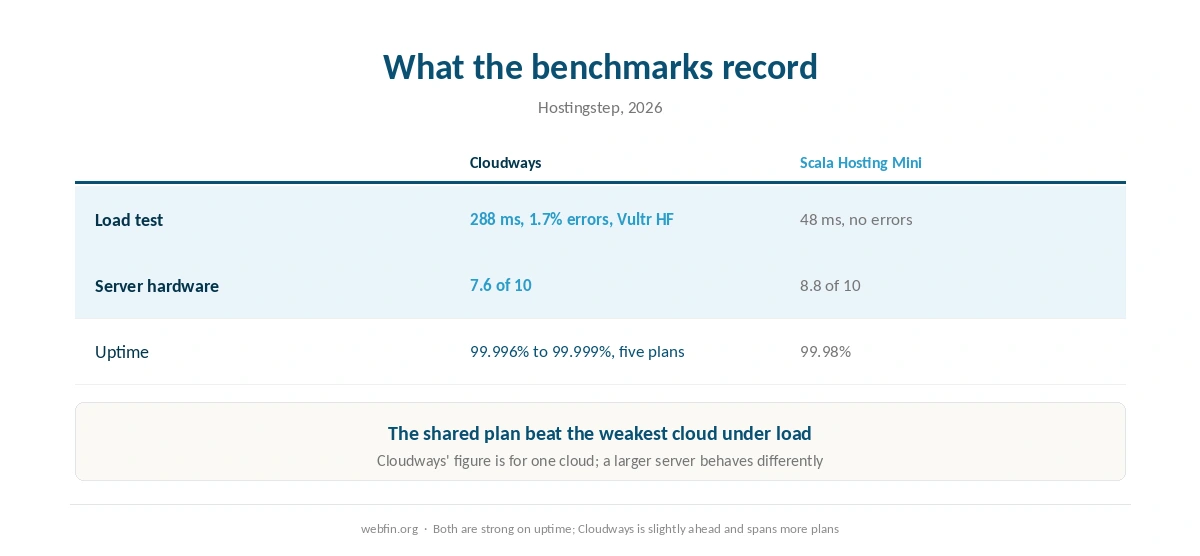
We run no tests, so these figures belong to Hostingstep. Its load test ramps to 100 concurrent visitors over 60 seconds. Scala’s shared plan finished at 48 ms without an error, and its hardware scores 8.8 of 10, the strongest shared result in that project apart from Bluehost. Cloudways on its Vultr High Frequency plan finished at 288 ms with a 1.7% error rate, and that plan scores 7.6 on hardware.
Uptime points the other way. Cloudways held between 99.996% and 99.999% across five plans from October 2025 to May 2026. Scala recorded 99.98%. Both are strong; Cloudways’ is slightly stronger and spans more plans.
⚠️ The Cloudways figure is for one cloud, and a larger server on another would behave differently. That is both the caveat and the Cloudways argument: you can buy more capacity by the hour. Our guide to reading an uptime report explains how to weigh records like these.
What Scala Includes
Scala’s own panel, SPanel, handles domains, email, databases and certificates, and it includes daily backups, WordPress staging and cloning, and a real-time malware monitor. For a small business that wants those things without buying them separately, the plan is unusually complete. Our Scala Hosting review covers each.
Refunds are better than they look, too. After the first 30 days, Scala refunds the unused part of the term, pro-rated, excluding domains and licenses. Support answers chat and tickets with no phone line.
Support on Both
Neither host answers the phone as standard. Scala offers chat and tickets; Cloudways offers chat and tickets around the clock and sells phone support as an add-on. Neither publishes a measured response time, and no controlled test of hosting support exists in the sources we found, so support does not separate them.
What does differ is how much support you will need. A Scala customer is on a managed shared plan with backups and a malware monitor running for them. On Cloudways, the owner manages a server and its capacity, which asks more of them on a bad day.
What Cloudways Includes, and Leaves Out
Cloudways runs a managed server on the cloud provider you choose. SSH, WP-CLI, Git deployment, staging and PHP version selection ship on every tier, and it runs any PHP application. You can resize the server when traffic grows and shrink it afterward, paying only for the hours used.
It leaves out email, and our review does not document its backup terms, so check what the plan includes. Mailboxes come through Rackspace at about a dollar each per month, and phone support is a paid add-on. Our list of hosting for developers explains why many developers accept those trades.
Growing on Each
Both offer a path that avoids changing company. On Scala, a site that outgrows Mini moves to a VPS on the same panel and sizes processor and memory by the unit. On Cloudways, a server grows by resizing, and a portfolio grows by adding applications to the server you already pay for.
The difference is granularity. Scala sells resources in yearly units; Cloudways sells server sizes by the hour. For steady growth either works. For a short spike, Cloudways’ hourly billing is the cleaner answer. Our guide to moving from shared to VPS covers the signals.
Panels and Portability
Scala runs SPanel, which it built to avoid per-account cPanel licenses. Cloudways runs its own console. Neither exports an account in the standard cPanel format, so leaving either means moving the site rather than the account. Our guide to migrating web hosting covers the steps.
That is a real consideration for anyone who expects to move later, and here it weighs equally on both sides. The domain can stay at its registrar in either case, as our guide to pointing a domain to a new host explains.
Which Result Matters for Your Site
For a brochure site or a blog behind a page cache, most visitors receive a stored copy, and both hosts will feel fast. The deciding lines there are price and what is included, and both point to Scala.
For a store, a membership site or an application, uncached pages make the load result and the hardware matter. On the published figures Scala’s shared plan did well there too. A site that outgrows it can move to Scala’s VPS, or to a Cloudways server sized for the traffic. Our list of hosting for multiple sites covers the case of several sites growing together.
The Five-Year View
Over five years Scala Mini totals about 72% of the Cloudways figure on the published rates, because it is cheaper in the first year and renews two dollars lower every month after. Add Cloudways’ email and the gap widens. Only a buyer who needs what a server on a chosen cloud provides should pay the difference.
Moving Between Them
A site can move from Scala to Cloudways when it needs a particular cloud region or hourly billing, or the other way when a simpler, cheaper plan with backups included makes more sense. Cloudways provides a migration plugin for WordPress, and the domain can point at whichever host runs the site.
Move email deliberately in either direction, because Cloudways will not host it and Scala will. Our guide to setting up email on your domain covers the records that make mail arrive.
Who Owns Them
DigitalOcean acquired Cloudways in 2022 and sells the cloud underneath many of its servers. Scala describes itself as a Dallas-based company in business since about 2008, and its ownership is not documented in anything we read.
That gap is a gap, not an implication. For a buyer prepaying a year or more, it is worth knowing which kind of company holds the other end of the contract. For a buyer paying by the hour, it matters less.
Which Site Belongs Where
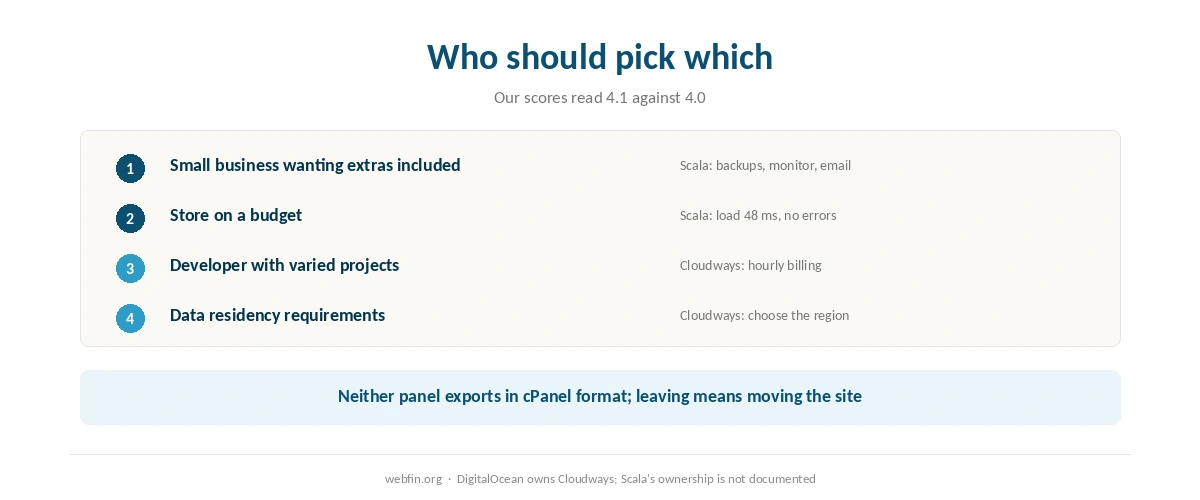
A small business that wants backups, security and email included. Scala, for a complete plan at a lower price.
A store on a budget. Scala, whose shared plan passed the load test cleanly. Our list of hosting for ecommerce names it for a growing store.
A developer with short or varied projects. Cloudways, for billing by the hour and a choice of cloud. Our comparisons of Cloudways against WP Engine and Cloudways against Liquid Web weigh it against two other managed routes.
A site with data residency requirements. Cloudways, which lets you place the server in a chosen region.
Where Each One Is Weakest
Scala is weakest on portability, ownership and the phone. SPanel is proprietary, its owner is not documented, and there is no telephone line. Its renewal step of 4.1× over 12 months is also steep in percentage terms, even though the dollar figure stays below Cloudways.
Cloudways is weakest on its published load result and on what it leaves out. Its weakest cloud showed a 1.7% error rate, it includes no email, and phone support costs extra.
Winners by Category
Price at every stage: Scala, at $322.20 against $504.00 over 36 months. Load test: Scala, at 48 ms without errors. Hardware: Scala, at 8.8 against 7.6. Uptime: Cloudways, narrowly. Included extras: Scala, with backups, malware monitoring and email. Flexibility: Cloudways, hourly and on any cloud. Documented ownership: Cloudways.
How We Research
We run no tests. Load, hardware and uptime figures come from Hostingstep’s 2026 benchmarks with their windows. Prices, inclusions and refund terms come from the providers’ own pages, read on 20 September 2026, and features are those documented in our reviews. Where our review does not document a feature, we say so.
The criteria behind our scores are on our about page. For Scala against a shared rival, see our comparison of Bluehost against Scala Hosting; Bluehost belongs to Newfold Digital.
Cloudways vs Scala Hosting FAQ
Scala, at every stage. Mini costs $322.20 across 36 months on annual terms against $504.00 at Cloudways, and it renews at $11.95 against Cloudways’ flat $14.00.
On the published figures, Scala’s shared plan: it served the 2026 load test at 48 ms without an error. Cloudways’ weakest cloud served it at 288 ms with a 1.7% error rate, and a larger Cloudways server would behave differently.
Both are strong. Cloudways held 99.996% to 99.999% uptime across five plans, and Scala recorded 99.98%. Cloudways is slightly ahead and its record spans more plans.
Scala’s SPanel includes email, daily backups and a malware monitor. Cloudways includes no email, with mailboxes through Rackspace at about a dollar each, and our review does not document its backup terms.
DigitalOcean has owned Cloudways since 2022. Scala describes itself as a Dallas-based company in business since about 2008, and its ownership is not documented in anything we read.
The Verdict
Scala Hosting is the better buy for most small and growing sites. It costs less at every stage, its shared plan handled the load test better than Cloudways’ weakest cloud, and it includes the backups, security monitoring and email that a small business would otherwise buy separately.
Our scores read 4.1 against 4.0 in Cloudways’ favor, because its uptime, choice of cloud and hourly billing are real advantages. For a developer, a data residency requirement or a short project, those decide it. Our page on what web hosting costs runs both totals further.