
Disclosure: WebFin is reader-supported. If you buy hosting through links on this page, we may earn a commission at no extra cost to you. Commissions vary between providers and our ratings do not — here’s our full disclosure.
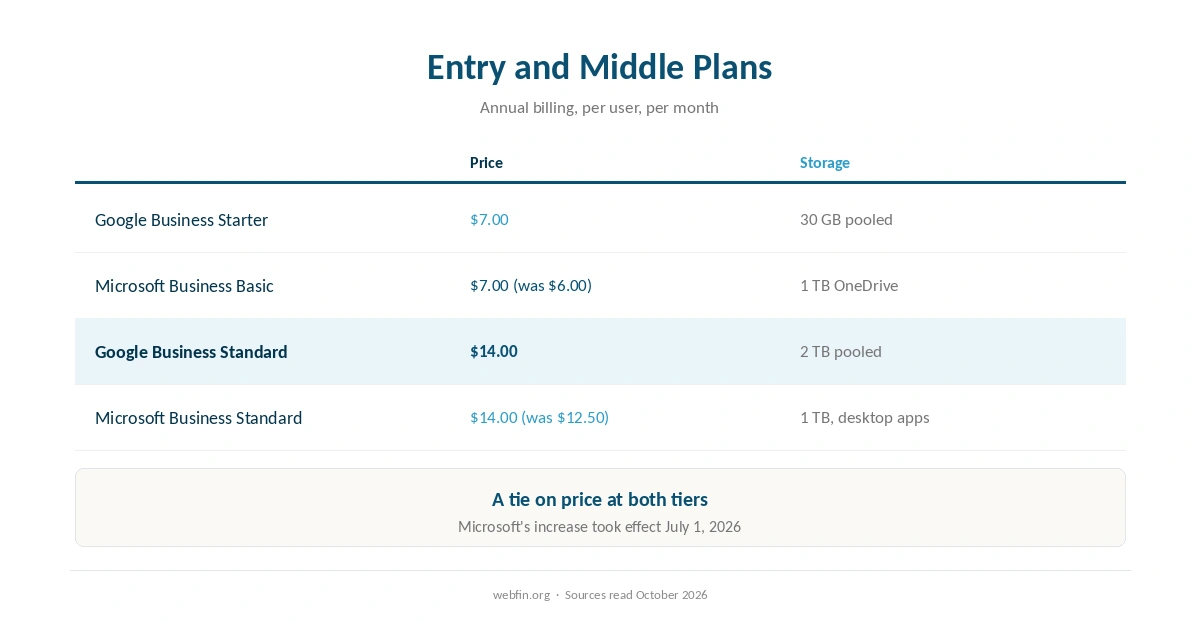
Google Workspace vs Microsoft 365 used to be partly a price question. Since Microsoft’s increase on July 1, 2026, it mostly is not. Business Basic now costs $7.00 a user, the same as Google’s Business Starter, and Business Standard costs $14.00 on both sides. Storage, desktop apps and how your team already works now decide it.
This guide therefore compares the two suites as email hosting for a small business, which is how most of our readers meet them.
Google Workspace vs Microsoft 365: The Short Answer
Choose Microsoft 365 if your team lives in desktop Word, Excel and Outlook. By contrast, choose Google Workspace if it works in the browser and shares documents all day. On price alone, the two now tie at the entry and middle tiers, so let habits and storage break the tie.
Prices After Microsoft’s July 2026 Increase
Microsoft raised Business Basic from $6.00 to $7.00 a user and Business Standard from $12.50 to $14.00 on July 1, 2026, according to a 2026 comparison of the two suites. Google Workspace, meanwhile, lists Business Starter at $7.00, Business Standard at $14.00 and Business Plus at $22.00 a user on annual plans.
Google also sells flexible, month-to-month plans at a higher rate: $8.40, $16.80 and $26.40 a user, according to a 2026 Google Workspace pricing guide. So committing to a year saves about a sixth on Google’s side.
Storage Is Where They Differ
On the entry plans, however, Microsoft gives more room. Business Basic includes 1 TB of OneDrive storage per user, while Google’s Business Starter pools 30 GB per user across mail and files.
On the middle plans, the order flips. Google’s Business Standard pools 2 TB per user; Microsoft’s gives 1 TB. A team that stores large files therefore gets more from Google once it moves up a tier.
Desktop Apps or the Browser
Microsoft’s Business Basic gives web and mobile versions of Word, Excel and PowerPoint only. Business Standard, however, adds the installed desktop apps, which many finance and legal teams still need.
Google’s suite, by contrast, runs in the browser at every tier. That suits a team that writes and edits together in real time, but it can frustrate one that depends on advanced Excel features.
What Ten Users Pay
Ten users on either middle plan pay $14.00 a user a month, or $1,680 a year on annual billing. On Google’s flexible plan, the same ten users would pay $16.80 each instead.
Also remember the costs outside the suite. Your domain renews every year, as our page on domain renewal prices explains, and our page on hidden hosting fees lists other charges to budget for.

Setting Up Either Suite on Your Domain
Both suites need DNS records at your domain registrar: MX records for mail, plus SPF, DKIM and DMARC records so your messages reach inboxes. Our guide on setting up email on your domain walks through them.
If you are moving the domain itself, our guide on pointing a domain to a new host explains the order of steps. Our domain registrar guide covers where to keep the domain.
Backups Are Still Your Job
After all, neither suite promises to keep everything you delete forever, and a compromised account can delete a lot quickly. Many IT guides recommend a third-party backup for mail and files on either platform.
Our guide to website backup services covers the same principle for websites: keep one copy you control.
Choosing for a Growing Team
The Google Workspace vs Microsoft 365 choice gets harder to undo as a team grows. Moving years of mail and files later costs real time, so pick with the next three years in mind.
Agencies and nonprofits face particular trade-offs here. Our guides to hosting for agencies and hosting for nonprofits cover the wider stack.
Contracts matter too, and our guide on reading a hosting agreement applies to suite terms as well.
Before switching suites, plan the move like a migration, as our guide on migrating web hosting describes for websites. Our guide to web hosting costs helps you budget the whole stack.
When Neither Fits
A very small team that needs only mail may not need a full suite at all. Our guide to email hosting covers cheaper mail-only options, including plans that cost a dollar a user.
Likewise, many hosting plans include basic email, which suits a one-person site. Our guide to hosting for small business covers that route.

How We Research
We run no tests. Prices and storage come from published 2026 pricing guides and comparisons, which agree on the figures we print. Microsoft’s increase took effect on July 1, 2026; we read every source in October 2026.
Confirm the price on each vendor’s own page before you buy, since regional prices differ. The criteria behind our scores are on our about page.
Google Workspace vs Microsoft 365: FAQ
Since July 1, 2026, neither at the entry and middle tiers: both cost $7.00 and $14.00 a user on annual billing.
Microsoft on the entry plan, with 1 TB per user against Google’s 30 GB; Google on the middle plan, with 2 TB pooled per user against 1 TB.
No. Business Basic has web and mobile apps only; Business Standard adds the desktop apps.
Flexible plans cost $8.40, $16.80 and $26.40 a user a month.
Many IT guides recommend one, because neither suite keeps everything you delete forever.
The Verdict
After Microsoft’s July 2026 increase, Google Workspace vs Microsoft 365 is no longer a price contest at the tiers small teams use. Both entry plans cost $7.00 and both middle plans $14.00.
So decide on habits and storage. Desktop Office users should take Microsoft 365, while browser-first teams that share large files should take Google Workspace.