
Disclosure: WebFin is reader-supported. If you buy hosting through links on this page, we may earn a commission at no extra cost to you. Commissions vary between providers and our ratings do not — here’s our full disclosure.
The best hosting for nonprofits starts with a question most buyers never get to ask: is it free? For a US-registered charity, it can be. DreamHost gives one shared hosting plan, email included, to eligible 501(c)(3) and 501(c)(19) organizations for the life of the account. For everyone else, the priorities are the ones a board cares about. The price must fit an annual budget, staff and volunteers need mailboxes, and donation pages should keep payment details off your own server.
Best Hosting for Nonprofits: The Short Answer
DreamHost, if you hold a US determination letter, because its shared plan is free for the life of the account. InterServer for anyone else on a tight budget, at $2.50 a month with the price locked. Kinsta for a larger organization whose campaigns bring traffic spikes, at $35.00 a month flat.
What a Nonprofit Needs From Hosting
A price the board can plan. Budgets are set a year ahead. A renewal that triples in year two is a governance problem as well as a cost, and a free plan or a locked price removes that risk.
Mailboxes for people who come and go. Staff and volunteers need addresses on the organization’s domain. A plan with enough mailboxes saves a monthly bill per user.
Donations handled elsewhere. A donation form that sends payment to a processor keeps card details off your server entirely. The site then needs a certificate and good security, not payment infrastructure.
Help that volunteers can use. Whoever looks after the site may change every year. Standard tools and a support line reduce what each new volunteer has to learn.
| Host and plan | Intro → Renewal | Multiplier |
|---|---|---|
| IONOS Plus | $1.00 → $14.00 | 14.0× over 12 months |
| SiteGround StartUp | $2.99 → $17.99 | 6.0× over 12 months |
| SiteGround GrowBig | $4.99 → $29.99 | 6.0× over 12 months |
| SiteGround GoGeek | $7.99 → $44.99 | 5.6× over 12 months |
| ChemiCloud Starter | $2.49 → not published | Renewal shown at checkout only |
| Scala Hosting Mini | $2.95 → $11.95 | 4.1× over 12 months |
| DreamHost Launch, annual | $2.89 → $10.99 | 3.8× over 12 months |
| Hostinger Premium | $2.99 → $10.99 | 3.7× over 48 months |
| Bluehost Starter | $3.99 → $11.99 | 3.0× over 12 months |
| A2 Hosting Turbo Boost | $6.99 → $20.99 | 3.0× over 12 months |
| HostGator Hatchling | $3.75 → $10.99 | 2.9× over 36 months |
| GoDaddy Economy | $5.99 → $15.32 | 2.6× over 36 months |
| Bluehost Starter | $3.99 → $9.99 | 2.5× over 36 months |
| Namecheap Stellar | $1.98 → $4.88 | 2.5× over 12 or 24 months |
| Namecheap Stellar Plus | $2.98 → $6.88 | 2.3× over 12 or 24 months |
| Namecheap Stellar Business | $4.98 → $9.88 | 2.0× over 12 or 24 months |
| DreamHost Launch, 4-year | $2.89 → $7.99 | 2.8× over 48 months |
| DreamHost, eligible US nonprofits | One shared plan free for the account's life | 501(c)(3) or (c)(19); help article, checked 10 Jun 2026 by a nonprofit directory |
| Bluehost Business | $6.99 → $13.99 | 2.0× over 36 months |
| Bluehost Starter, second reading | $1.99 → $8.99 | Hostingstep, July 2026; conflicts with Bluehost's help page |
| Hostwinds Basic | $4.54 → $6.99 | 1.5× over 12 months |
| WP Engine Startup | $27.00 → $35.00 | 1.3× over 12 months |
| Rocket.net Starter | $25.00 → $30.00 | 1.2× over 12 months |
| InterServer Standard | $2.50 flat | 1.0×, price lock |
| Cloudways, from | $14.00 flat | no promotional term |
| Kinsta Starter | $35.00 flat | no promotional term |
| Liquid Web managed VPS, annual billing | $33.00, no promotional term | No increase described on annual billing |
| Liquid Web managed VPS, monthly billing | $36.00 → $72.00 reported | 2.0× over one month; one pricing guide, disputed |
| GreenGeeks Lite | $2.95 → $13.95 | 4.7× after one term; renewal was $12.95 before 2026 |
| ChemiCloud Starter, third-party figures | $9.95, $11.95 or $12.95 quoted | Sources disagree; 4.0× to 5.2× over 36 months |
| SiteGround StartUp, by term | $2.99 → $14.99, $17.99 or $24.99 | 5.0× over 24 months, 6.0× over 12, 8.4× month to month |
| ChemiCloud Kickstart, reseller | $8.99 → $29.95 | Term not stated in the source we read |
| InterServer reseller | $19.95, price locked | No increase described in sources |
| GreenGeeks reseller | $19.95 with WHMCS included | Promotional rate; renewal not published |
| Hostwinds white-label reseller | $10.00 with WHMCS included | Plain reseller plan excludes WHMCS |
| InMotion Core, 36-month term | $3.19 → $10.99 | 3.4× over 36 months; TechRadar, 2026 |
| InMotion Launch, 36-month term | $4.99 → $13.99 | 2.8× over 36 months; TechRadar and plan cards, 2026 |
| InMotion Core, by term | Renews at $10.99, $11.99 or $14.49 | Longest term lowest; one review, May 2026 |
DreamHost: Free for Eligible US Charities
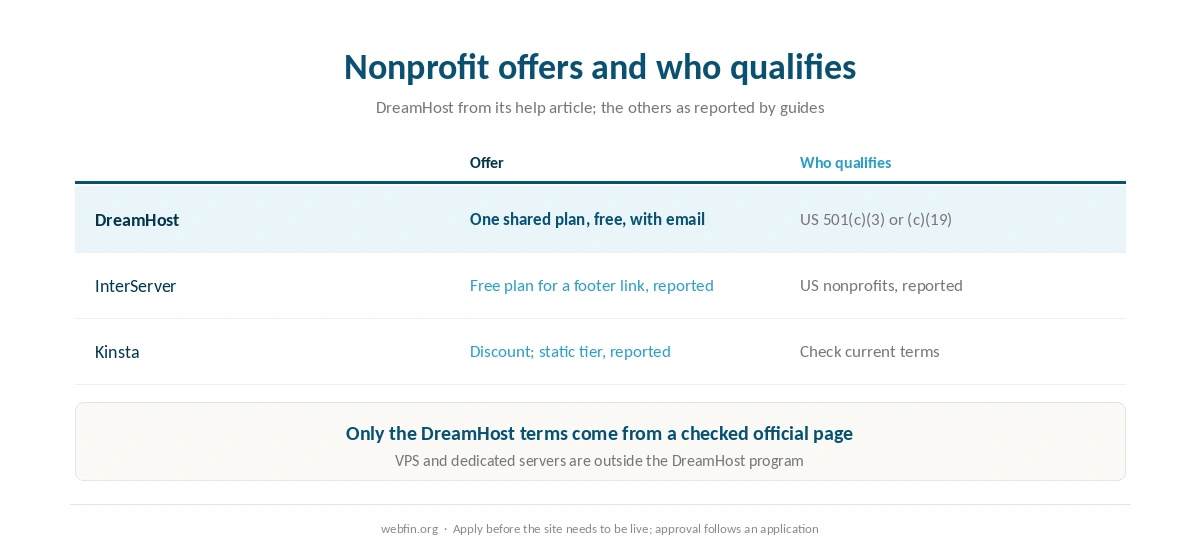
DreamHost offers one free shared hosting plan, email hosting included, to US-based 501(c)(3) and 501(c)(19) organizations. The offer lasts for the lifetime of the account and covers one shared plan per organization. VPS and dedicated servers are not included.
Eligibility requires an IRS determination letter, and approval follows an application. So apply well before the site needs to go live. One nonprofit directory checked DreamHost’s help page in June 2026 and notes that an older discount on its managed WordPress line no longer appears in the current terms.
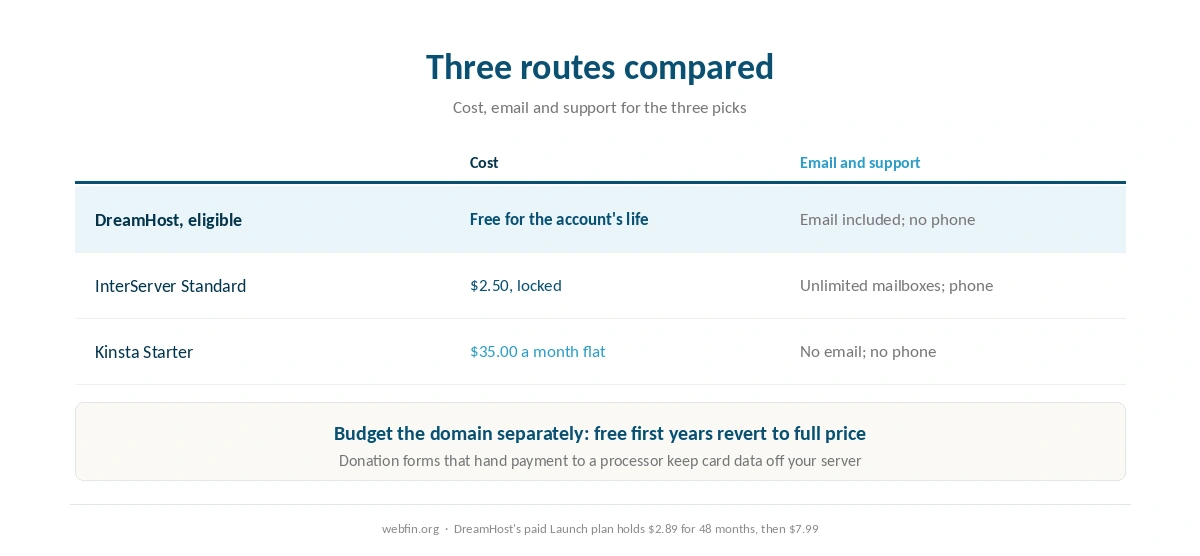
For organizations outside the program, DreamHost Launch holds $2.89 a month for 48 months and renews at $7.99. It includes WHOIS privacy for the life of the domain. Choose it if you hold a US determination letter. Skip it if you need a phone line, which DreamHost does not offer. Our DreamHost review covers the paid plans.
One plan per organization has a practical consequence. Put every site the organization runs into that one account, under the organization’s own login, rather than letting projects scatter across volunteers’ personal accounts. It keeps the free plan useful and the handover simple when people move on.
InterServer: A Price the Board Can Plan
InterServer Standard costs $2.50 a month, and the price is locked for the life of the account. The figure in this year’s budget is the figure in every future one. One plan holds unlimited sites and email under an acceptable use policy, and support answers by phone, chat and tickets around the clock.
Several nonprofit guides this year also describe a free InterServer plan for US-registered nonprofits, in exchange for a link in the site’s footer. We have not verified those terms first-hand, so confirm them with InterServer before relying on them. The paid plan is cheap enough on its own, as our InterServer review explains.
Kinsta: For Campaign Traffic
A national charity whose appeals go out by email and social media meets traffic in bursts. That is where managed hosting earns its price. In the benchmark project we cite, Kinsta served the load test at 40 ms with every request answered.
It runs each site in its own container and includes Cloudflare Enterprise on every plan. Starter is $35.00 a month flat, which a small local group will find hard to justify. Nonprofit guides this year report a discount for charities and a free tier for static sites open to any organization, so confirm the current terms directly.
Kinsta hosts WordPress only, includes no email and has no phone line. Our Kinsta review covers the rest, and our roundup of hosting for high traffic explains why the load result matters on appeal day.
Which Organization Needs Which
A small local group run by volunteers. DreamHost if you qualify, InterServer if you do not. Either keeps the hosting bill at nothing or close to it, and both include email.
A charity outside the United States. InterServer, for a price that never changes, or DreamHost’s paid plan for four years at the opening rate.
A national organization with online appeals. Kinsta, for a clean load result and a content network on every plan. Pair it with an email provider.
A group whose volunteers change often. A host with standard cPanel and a phone line, such as InterServer, so each new volunteer finds familiar tools and someone to call. Our guide to understanding cPanel is a useful handover document.
Before You Apply or Buy
Find the determination letter first. Programs that require one will not start without it, and locating an old letter can take longer than the application.
Ask what happens if status lapses. A free plan tied to tax-exempt status may change if that status does. Know the terms before you depend on them.
Price the plan you would pay for anyway. A discount on an expensive plan can still cost more than a cheap plan at full price. Compare the totals, not the percentages.
Check what the free plan leaves out. Domains, extra mailboxes and add-ons may sit outside a hosting offer. List what the site needs, then see which of those the offer covers. Our list of hosting for beginners walks through the same checks for a first site.
Email for Staff and Volunteers
Mailbox counts matter more for a nonprofit than for most small sites. Every volunteer coordinator and board member may need an address. DreamHost’s free plan includes email hosting, InterServer includes unlimited mailboxes, and Kinsta includes none.
Several dedicated email providers also run programs for nonprofits, so check eligibility before paying per user. Whichever route you choose, publish SPF and DKIM so appeals and receipts reach inboxes. Our guide to setting up email on your domain covers the records.
Donations Without the Risk
Keep card details off your own server. A donation form that hands payment to a processor means the site never stores or sees the card number. The security burden then stays with the company built for it. Some processors built for charities also send donor receipts, which spares the site that job.
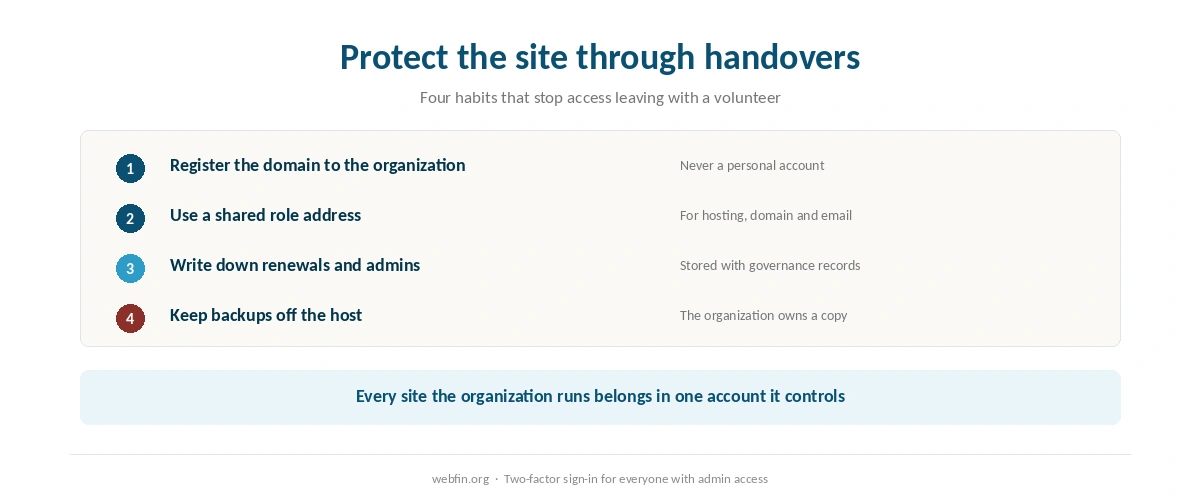
Your site still needs a certificate and careful updates, because a compromised donation page damages trust fast. Keep backups off the host, update plugins, and require two-factor sign-in for everyone with admin access. Our guides to backing up a WordPress site and recovering a hacked website cover both ends.
Handing the Site to the Next Volunteer
Nonprofit sites change hands more often than business sites, and each handover is a chance to lose access. Keep the hosting account, the domain and the email under a shared role address the organization controls, not a volunteer’s personal inbox.
Write down where the site is hosted, where the domain is registered, when each renews and who has admin access. Store that note with the organization’s other governance records. The next volunteer then starts with a map rather than a search, and nothing depends on one person.
The Domain Is Not Free Forever
Free first-year domains revert to a standard renewal price, and that includes .org names. Budget for the domain as a separate line, and register it in the organization’s name.
Keeping the domain at a registrar rather than bundled with the host also makes a later move simple. Our guide to pointing a domain to a new host covers why, and our page on hidden hosting fees lists the other charges that follow a domain.
How We Research
We run no tests. DreamHost’s nonprofit terms come from its help article as reported by several nonprofit guides in 2026, one of which checked the official page on 10 June 2026. InterServer’s and Kinsta’s nonprofit offers come from third-party guides, and we mark them as reported rather than verified.
Prices come from the providers’ own pages, read on 20 September 2026, and Kinsta’s load figure from Hostingstep’s 2026 benchmarks. The criteria behind our scores are on our about page, and the wider budget field is in our roundup of cheap web hosting.
Nonprofit Hosting FAQ
Yes, for eligible US organizations. DreamHost gives one free shared hosting plan, email included, to 501(c)(3) and 501(c)(19) organizations for the life of the account. It requires an IRS determination letter and does not cover VPS or dedicated plans.
A US registration as a 501(c)(3) or 501(c)(19) organization and the IRS determination letter to prove it. The offer covers one shared plan per organization. Approval follows an application, so apply before the site needs to launch.
The DreamHost program does not apply. InterServer at $2.50 a month with the price locked is a low, predictable option. DreamHost’s paid Launch plan holds $2.89 for 48 months before renewing at $7.99.
It is safer not to store them. A donation form that passes payment to a processor keeps card details off your server entirely. The site then needs a certificate and good security rather than payment infrastructure.
The organization, not a volunteer. Register it in the organization’s name with a shared role address, and budget for its renewal, because free first-year domains revert to a standard price.
The Verdict
For a US-registered charity with a determination letter, DreamHost’s free shared plan is the obvious start: no hosting bill for the life of the account, and email included. For everyone else, InterServer’s locked $2.50 gives the board a figure it can plan around for years.
Larger organizations with campaigns that bring sudden traffic should look at Kinsta and confirm its nonprofit terms directly. Whatever you choose, keep the domain in the organization’s name, handle donations through a processor, and keep backups off the host. Our list of hosting for small business covers the paid options in more depth.