
Disclosure: WebFin is reader-supported. If you buy hosting through links on this page, we may earn a commission at no extra cost to you. Commissions vary between providers and our ratings do not — here’s our full disclosure.
The best Magento hosting starts with a host that can actually run it. Magento 2.4 wants about 8 GB of memory, PHP 8.3 and an OpenSearch search engine, according to Cloudways’ setup guide, which rules out ordinary shared plans.
Adobe’s requirements also moved in 2026, with older search and database versions out of support. This guide sets out what a host must provide and which hosts in our tables fit.
Best Magento Hosting: The Short Answer
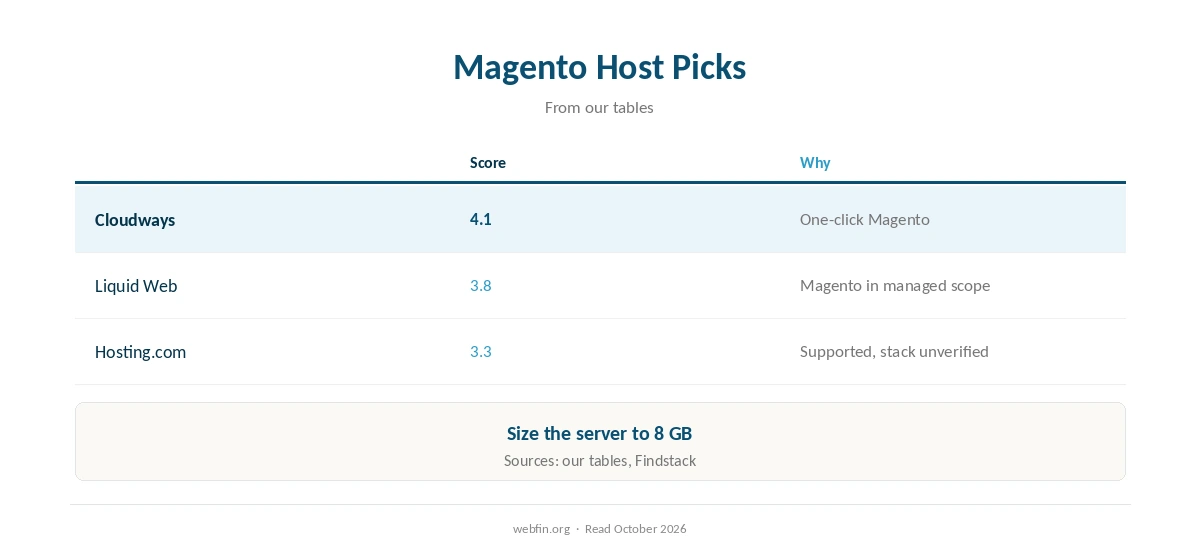
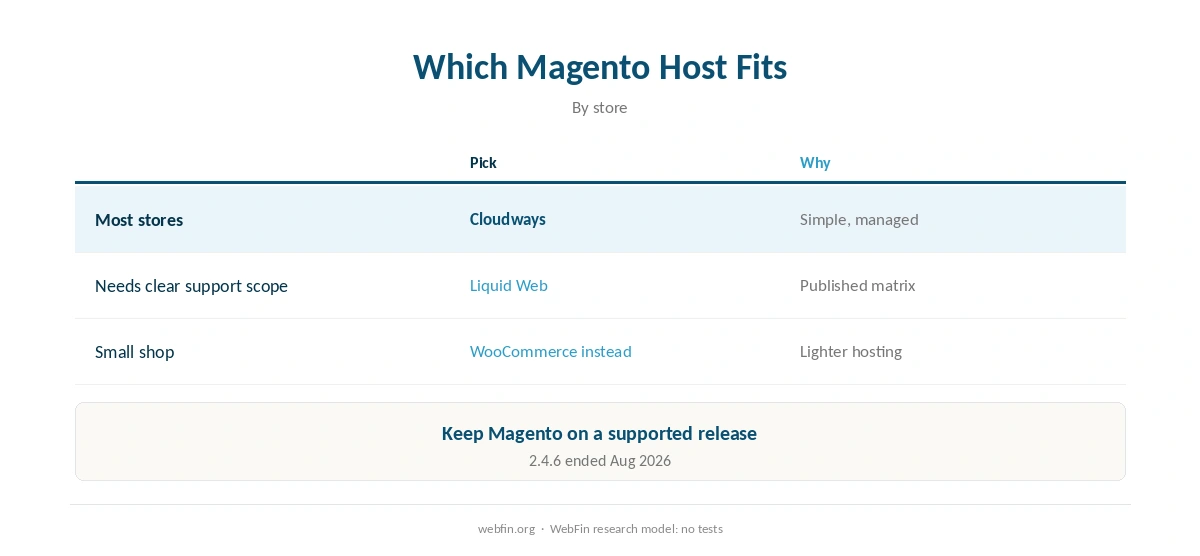
In short, our best Magento hosting pick is Cloudways, the simplest managed route, with a one-click Magento install, and Liquid Web names Magento among its managed applications. Avoid shared hosting for a real store.
What Magento 2.4 Needs
| Requirement | Recommended | Source |
|---|---|---|
| Memory | About 8 GB (4 GB works, but slowly) | Cloudways guide |
| PHP | 8.3 | Cloudways guide |
| Search engine | OpenSearch (version 3 for current releases) | Adobe, via Findstack |
| Database | Supported MySQL or MariaDB | MySQL 8.0 support ended April 2026 |
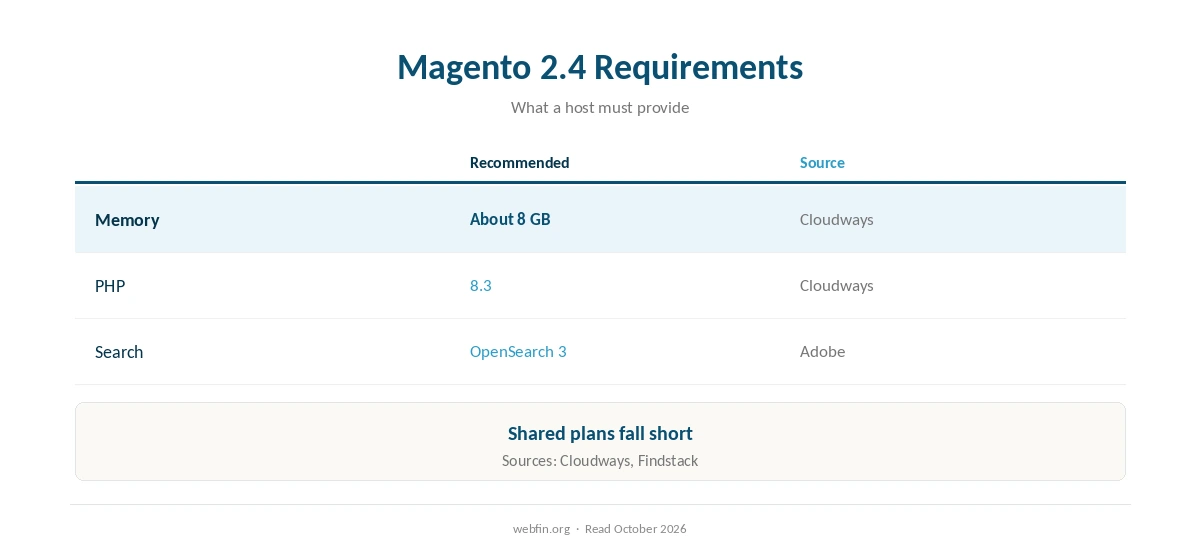
According to Cloudways’ Magento 2 guide, Magento 2.4 can install on 4 GB but may face performance problems, so 8 GB is the practical floor for a store.
⚠️ Requirements moved in 2026: Elasticsearch 7.17 and MySQL 8.0 left support, and current releases list OpenSearch 3, according to Findstack’s August 2026 summary of Adobe’s requirements. Magento 2.4.6 also left regular support in August 2026, according to EveryHost’s checklist.
Cloudways
To begin with, Cloudways installs Magento in a few clicks and warns you if the server falls short of the requirements. Its entry server costs $14.00 a month, but a Magento store needs a larger one, so price the 8 GB size in its calculator.
Our Cloudways pricing guide explains how server size drives the bill, and our Cloudways review covers support.
| Host | Rating | Renewal price |
|---|---|---|
| Hostinger | ⭐ 4.2 | $10.99/mo after 48 months |
| InterServer | ⭐ 4.1 | $2.50/mo, never changes |
| Cloudways | ⭐ 4.1 | $14.00/mo, never changes |
| WP Engine | ⭐ 4.1 | $35.00/mo after 12 months |
| Kinsta | ⭐ 4.1 | $35.00/mo, never changes |
Liquid Web
Liquid Web lists Magento among its managed applications, alongside WordPress and WooCommerce, and publishes a clear matrix of what each tier supports, according to Findstack. That clarity matters when a store goes down.
Our Liquid Web review and best VPS picks cover its managed servers.
Hosting.com and Others
Hosting.com, formerly A2 Hosting, lists Magento among its supported applications, though Findstack notes it has not verified the current stack. So confirm the OpenSearch and PHP versions before you buy.
Our A2 Hosting review covers that host, and our Scala Hosting review covers another managed VPS option.
Running a Magento Store Well
Whichever best Magento hosting you choose, a few habits protect the store. First of all, keep backups off the server, as our guide to backups explains.
Next, add uptime monitoring and plan for traffic peaks, as our guide on handling a traffic spike explains.
A delivery network in front also helps, as our guide to CDNs shows.
Why Shared Hosting Will Not Do
After all, a real Magento store needs several gigabytes of memory, a search service and caching, which shared plans do not provide. Our shared vs VPS guide explains the difference.
For a smaller shop, WooCommerce on WordPress runs on lighter hosting, as our WooCommerce hosting guide shows.
Moreover, these guides cover related questions: Windows Hosting and Linux Hosting. Related reading also includes Static Website Hosting.
How We Research
We run no tests. Requirements come from Cloudways’ Magento guide, Adobe’s requirements as summarized by Findstack in August 2026 and EveryHost’s checklist; host positioning from Findstack and Cloudways. We recorded them in our TablePress tables in October 2026.
Magento’s requirements change with each release, so check Adobe’s page before you build. Host scores follow the criteria on our about page.
Best Magento Hosting FAQ
About 8 GB for a store; it installs on 4 GB but may run slowly, according to Cloudways.
Not well; it needs more memory, a search service and caching than shared plans give.
OpenSearch; current releases list version 3, according to Adobe’s requirements.
Cloudways, with a one-click Magento install on a managed server.
Its regular support ended in August 2026, so plan an upgrade.
The Verdict
The best Magento hosting is a managed server with enough memory and a current search stack. Cloudways is the simplest route, and Liquid Web names Magento in its managed scope.
In practice, size for about 8 GB, confirm OpenSearch and PHP versions, and keep Magento itself on a supported release.