
Disclosure: WebFin is reader-supported. If you buy hosting through links on this page, we may earn a commission at no extra cost to you. Commissions vary between providers and our ratings do not — here’s our full disclosure.
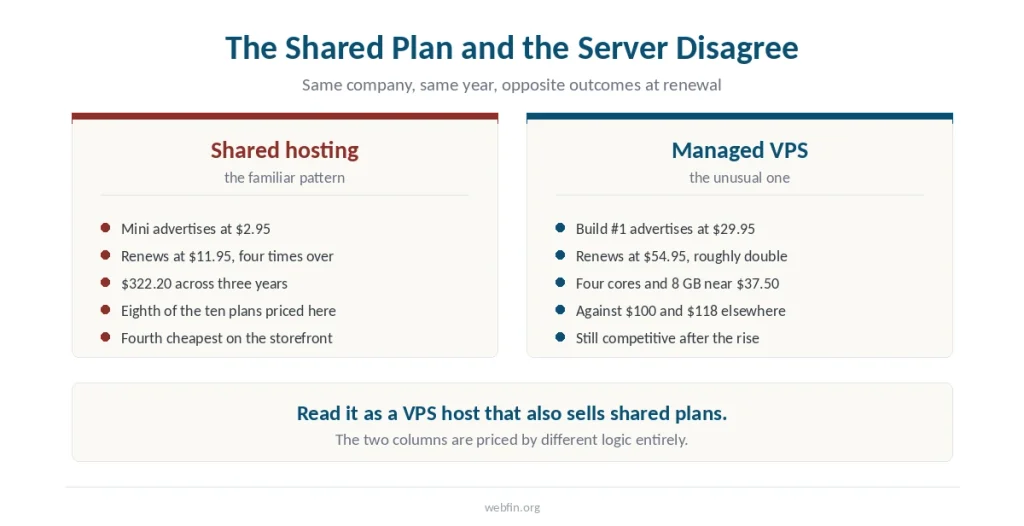
Scala Hosting quadruples the price of its entry shared plan at renewal, from $2.95 to $11.95. That places its three-year total eighth of the ten shared plans we have priced. We compare Scala Hosting directly with SiteGround in SiteGround vs Scala Hosting.
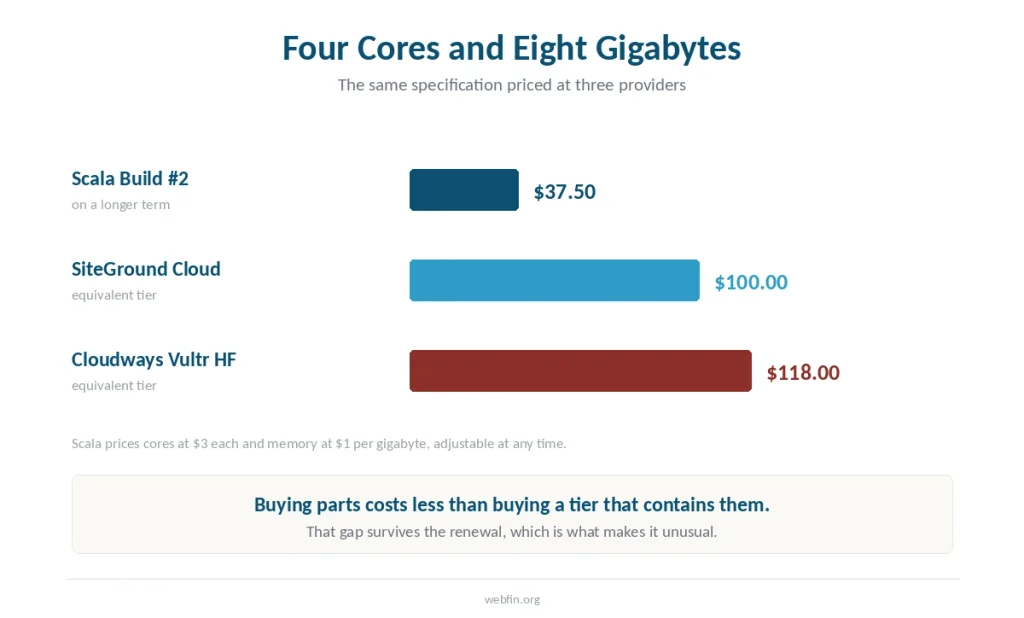
However, its managed VPS does the opposite. At four cores and eight gigabytes of memory, published comparison puts Scala around $37.50 a month against $100 at SiteGround Cloud and $118 at Cloudways.
Is Scala Hosting Good in 2026?
For a VPS, unusually good. A twelve-month test on a live site with 40,000 monthly visitors recorded 99.97 percent uptime, and a load test of fifty concurrent users returned a 29 millisecond response at the 95th percentile.
For shared hosting, the renewal is steep enough that the cheaper plans stop being cheap. The company is better read as a VPS host that also sells shared plans.
Two Products, Two Pricing Stories
First, the shared tiers follow the pattern this site documents everywhere. Mini advertises at $2.95 and renews at $11.95, a multiplier of four. Start runs $5.95 to $14.95, and Advanced $9.95 to $19.95.
Across three years the Mini plan comes to $322.20, which is more than triple what the cheapest plans here cost and close to the most expensive — the full field is here.
The VPS tiers tell a different story, and it is the more interesting one. Another host splits its policies the same way. Build #1 advertises at $29.95 and renews at $54.95, roughly double. Yet one published comparison found that even after renewal, Scala’s managed VPS undercut both Cloudways and SiteGround Cloud at matching specifications. We set Scala Hosting against a managed cloud server in Cloudways vs Scala Hosting.
Among the eleven hosts we have reviewed, that combination appears here alone.
Resources Priced by the Unit
In practice, most hosts sell fixed tiers. Scala prices the parts.
Published rates put processor cores at $3 each and memory at $1 per gigabyte, adjustable at any time. Scaling down credits back the unused portion automatically.
Therefore that structure explains the comparison above. Buying four cores and eight gigabytes costs what four cores and eight gigabytes cost, rather than what a tier containing them is priced at.
SPanel Instead of cPanel
Besides, Scala built its own control panel rather than licensing cPanel, and the reason is financial rather than technical.
cPanel charges per-account license fees, and hosts pass those on. SPanel carries no such fee, which is part of why the VPS pricing works. For reselling under your own brand, see the best reseller hosting.
It handles domains, email, databases, SSL, daily backups, WordPress staging and cloning, plus a real-time malware monitor. Reviews describe a short adjustment period for anyone used to cPanel, and no missing capability.
Speed and Uptime
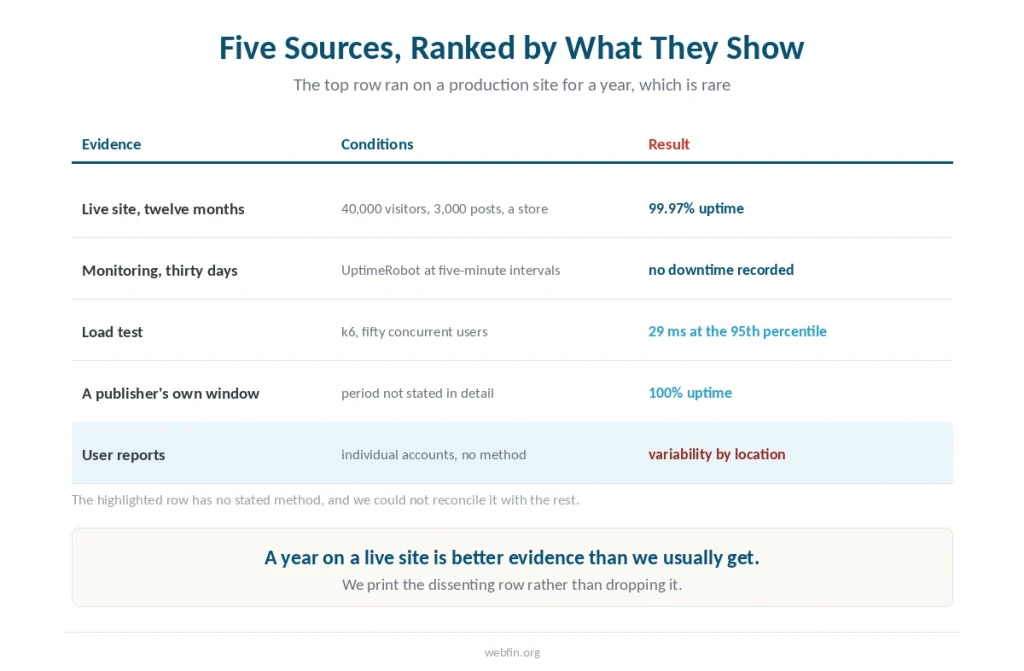
The evidence here is better than we usually get, because one test ran on a live production site for a full year.
For instance, one reviewer migrated a site with 40,000 monthly visitors, 3,000 posts and an active store, then ran it for twelve months. UptimeRobot recorded 99.97 percent.
Meanwhile, a separate thirty-day monitoring window at five-minute intervals recorded no downtime and no incidents. A load test using fifty concurrent virtual users returned a 29 millisecond response at the 95th percentile, with the response curve staying flat.
⚠️ One source notes a major outage in November 2018, when uptime fell to roughly 98 percent for about twenty days, and nothing comparable since. Individual users still report occasional variability across server locations.
The Refund Terms
In short, thirty days for a full refund, and afterwards a pro-rated refund of the unused portion of the term at any time.
The second half is what matters. Every other host in these reviews ends its obligation when the window closes, and at one of them that window may be three days. This one lets you leave in month eight and recover what you have not used — refund windows vary more than the category admits.
No credit card is required to sign up, though there is no free trial in the sense of using the product before paying.
Who Owns It
In brief, founded in 2007 and headquartered in Dallas, Texas, according to the sources we read.
⚠️ None of them states its ownership structure, and as with two earlier reviews we are not going to infer one. What is clear is that no hosting group appears above it in anything we found — unlike several brands we have traced to shared parents.
What We Don’t Love
The shared renewal quadruples, which makes those tiers hard to recommend on price. We compare Scala Hosting directly with Bluehost, a Newfold Digital brand, in Bluehost vs Scala Hosting.
SPanel is capable but unfamiliar, and knowledge of it does not transfer if you leave.
Reports of performance variability across locations sit alongside excellent test results, and we could not reconcile them.
How We Research
Pricing comes from published reviews that state the figures they read and when. Performance figures come from tests that name their monitoring tools and windows, one of them running on a live production site for a year, which is stronger evidence than we usually find. Where sources disagree, we print both.
We run no tests of any kind. Our five criteria are on our About page.
Frequently Asked Questions
The Mini shared plan renews at $11.95 a month against an advertised $2.95, a multiplier of four. Managed VPS Build #1 renews at $54.95 against $29.95. Across three years the Mini plan comes to $322.20.
At matching specifications, published comparison says yes. A four-core server with eight gigabytes of memory runs around $37.50 a month on a longer Scala term against $118 on Cloudways and $100 on SiteGround Cloud.
Scala’s own control panel, built to replace cPanel. It handles domains, email, databases, SSL, backups, WordPress staging and malware monitoring. Because Scala pays no per-account licence fee, that saving shows up in the VPS pricing.
Test evidence is strong. A twelve-month run on a live site with 40,000 monthly visitors recorded 99.97 percent uptime, and a separate thirty-day window recorded none. One source notes a major outage in November 2018 and nothing comparable since.
Thirty days for a full refund, and afterwards a pro-rated refund of the unused portion of your term at any time. Every other host in these reviews ends its obligation when the initial window closes.
Scala Hosting
Summary
A VPS host that also sells shared plans, with a renewal that still competes and a refund that never fully closes.
The Verdict
Scala Hosting earns 4.0, and the score belongs almost entirely to the VPS side.
Choose it if you want managed VPS at a price that stays competitive after renewal, and you are comfortable learning a control panel that is not cPanel. We set Scala Hosting against managed WordPress at Kinsta in Kinsta vs Scala Hosting.
Skip it if you want cheap shared hosting, because the renewal takes that plan from fourth cheapest on the storefront to eighth on the bill.