
Disclosure: WebFin is reader-supported. If you buy hosting through links on this page, we may earn a commission at no extra cost to you. Commissions vary between providers and our ratings do not — here’s our full disclosure.
The benchmark we cite in every review on this site ranked WP Engine first for response time out of 34 hosts. In short, that is the strongest performance evidence we have published about anyone.
However, the same company has been in federal litigation since September 2024 with the organization that maintains WordPress.org, and that fight has already cost its customers access to plugin updates once.
Is WP Engine Worth It in 2026?
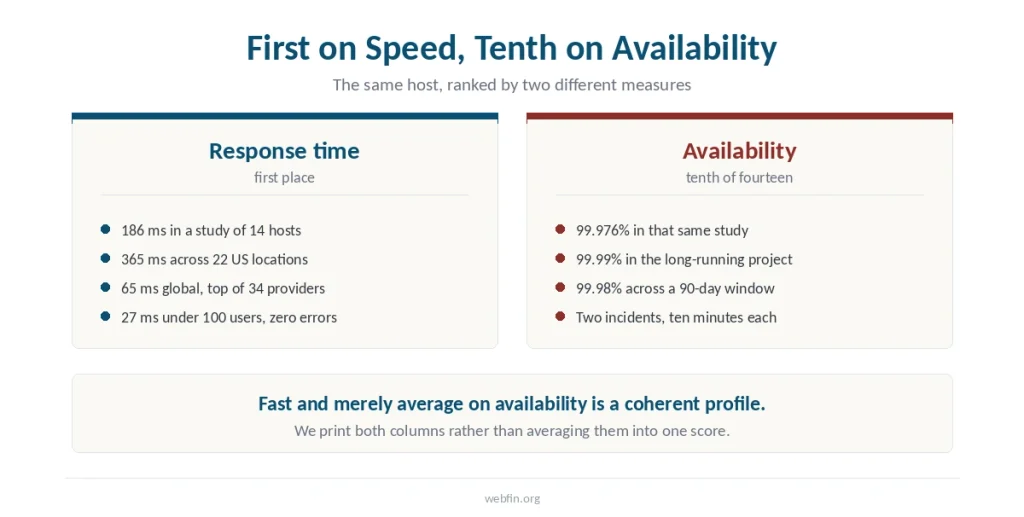
On performance, without argument. In fact, it records 365 milliseconds across 22 United States test locations and 65 milliseconds globally, both top of its test group, with a load test returning 27 milliseconds at zero errors.
On price, however, it depends what you are running. The Startup plan costs $27 a month and renews at $35, and plans are metered by monthly visits rather than by disk or bandwidth. We compare WP Engine directly with Bluehost, a Newfold Digital brand, in Bluehost vs WP Engine.
Speed
Every figure here comes from a named project with its window stated. We run no tests of our own.
For instance, one project has monitored WP Engine since 2020 across more than three million individual checks, with 349,920 in its current window from October 2025 to May 2026. It records 355 milliseconds average response, improved from 463 milliseconds in 2024.
In its 2025 rankings the same project placed WP Engine first for response time among 34 providers, with a load test of 27 milliseconds at a zero percent error rate, second of 34. We set WP Engine against a managed cloud server in Cloudways vs WP Engine.
Moreover, regional figures show where that comes from: 47 milliseconds in Frankfurt, 114 across Europe, 136 in the Americas and 246 across Asia-Pacific.
Besides that, a separate study of 14 managed hosts measured 186 milliseconds and placed WP Engine first on response time in that group as well. We set WP Engine against managed WordPress at Kinsta in Kinsta vs WP Engine.
Uptime
Consistently high, though one measurement dissents and is worth naming.
Meanwhile, the long-running project recorded 99.99 percent across 2025. A 90-day study recorded 99.98 percent with two incidents resolved inside ten minutes each.
⚠️ The study of 14 managed hosts recorded 99.976 percent and placed WP Engine tenth of 14 on that metric alone. Fast and merely average on availability is a coherent profile, and we would rather show it than average the numbers together.
Metered by Visits, Not by Disk
This is the structural difference between WP Engine and most of what we have reviewed.
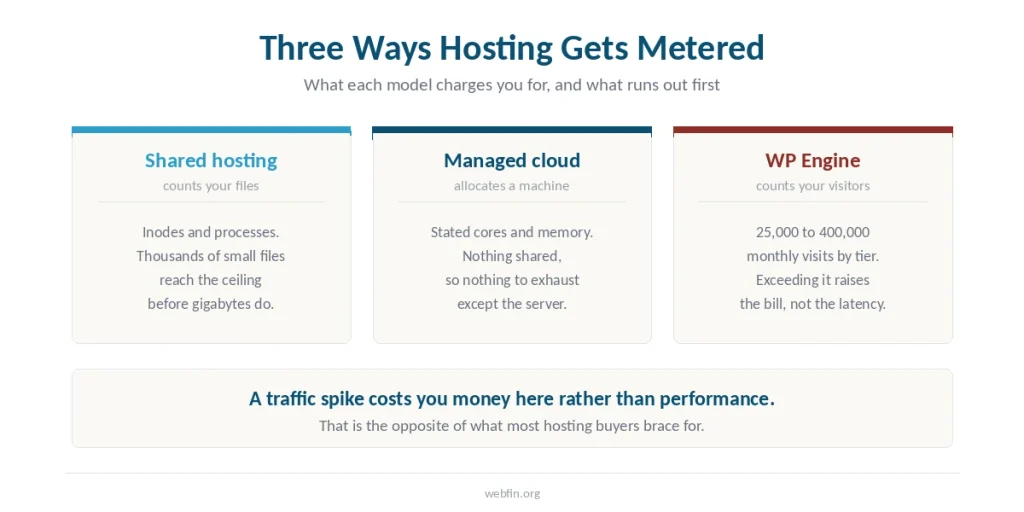
In practice, entry plans are metered by monthly visits, from 25,000 to 400,000 depending on tier. Traffic above the allowance triggers overage handling rather than throttling, and growing means moving up a plan.
Shared hosts meter file counts and processes. Cloud hosts allocate cores and memory. WP Engine charges by how many people arrive, which is a different question entirely — though not a unique one. The ceilings we wrote about elsewhere do not apply in the same way.
Of course, for a predictable site that is fine. For a site that occasionally goes viral it is a billing surprise rather than a performance one.
Price and Renewal
In practice, the Startup plan advertises at $27 a month and renews at $35 a month, a 30 percent increase.
Therefore three years comes to $1,164.00, against $504.00 for Cloudways and $1,260.00 for Kinsta — the full field is here. The project that ranks WP Engine first on speed also notes it costs roughly seven times what budget hosts charge, and recommends a cheaper premium alternative at $20.83 a month.
Besides that, infrastructure differs by tier, and another host builds its whole product on the edge. Entry plans run on Google Cloud across 13 regions, while premium tiers run on AWS or Azure, which is why regional response varies as much as it does.
The Dispute With Automattic
This belongs in a hosting review because it has affected customers directly, and because it bears on how the WordPress.org recommended list works.
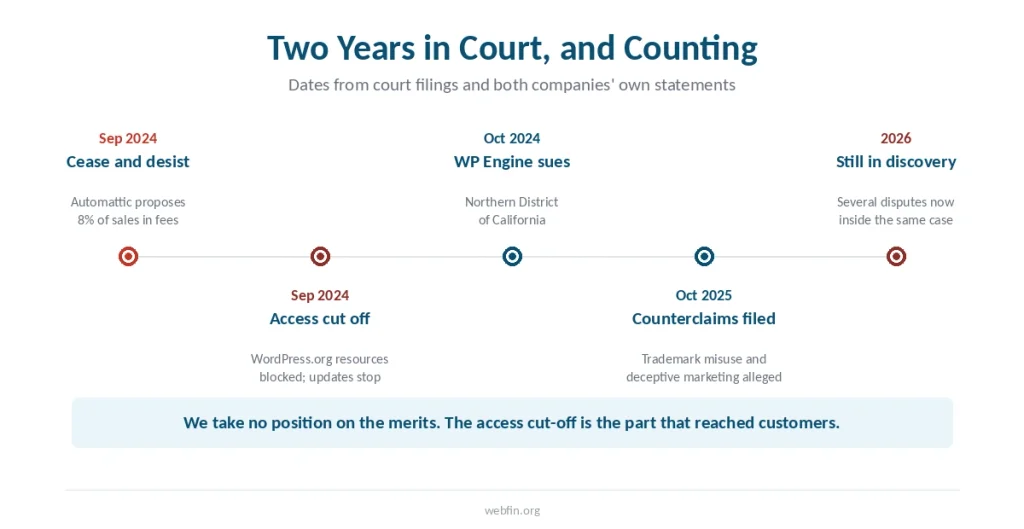
In September 2024, Automattic chief executive Matt Mullenweg publicly criticized WP Engine and Automattic sent a cease-and-desist letter over WordPress trademark use. Automattic proposed a licensing agreement at 8 percent of sales, around $32 million a year on WP Engine’s reported $400 million revenue. The same figures against SiteGround are in SiteGround vs WP Engine.
Automattic then banned WP Engine from WordPress.org resources, which interrupted plugin updates for its customers. WP Engine sued Automattic and Mullenweg in October 2024. Automattic filed counterclaims in October 2025 alleging trademark misuse and deceptive marketing.
Still, as of mid-2026 the case remains active in the Northern District of California, in discovery, and has expanded into several separate disputes within the same matter.
⚠️ We are not taking a position on the merits. What matters for a buyer is narrower: the organization that decides which hosts appear on the WordPress.org recommended page has been in litigation with one of the largest WordPress hosts, and did at one point cut off its access — we read that page in full separately.
Who Owns It
Meanwhile, Silver Lake, a private equity firm, acquired a majority stake in WP Engine in 2018 for a reported $250 million.
However, that ownership is central to the litigation rather than incidental to it. Automattic has argued in filings that Silver Lake is not a neutral third party, and has asked a federal court to compel it to produce financial documents.
For scale, WP Engine reports serving more than 1.5 million websites.
What We Don’t Love
First, metering by visits means your bill responds to traffic, which is the opposite of what most hosting buyers expect.
The litigation is unresolved, and its clearest customer impact to date was loss of access to plugin updates.
Finally, entry pricing is roughly ten times what the cheapest plan in our reviews costs across three years.
How We Research
Performance figures are attributed to named projects with their windows and test counts, and where two projects disagree we publish both. The litigation account comes from court filings, both companies’ own statements and reporting that names its sources. We run no tests of any kind.
Our five criteria are on our About page.
Frequently Asked Questions
By the strongest evidence available, yes. One project monitoring 34 providers ranked it first for response time, recording 365 milliseconds across 22 United States locations and 65 milliseconds globally, with a load test of 27 milliseconds at zero errors.
The Startup plan renews at $35 a month against an advertised $27, a 30 percent increase. Over three years that comes to $1,164.00, roughly ten times the cheapest plan in our reviews.
Entry plans allow between 25,000 and 400,000 monthly visits depending on tier. Exceeding the allowance triggers overage handling rather than throttling, so the consequence is a larger bill rather than a slower site.
Automattic, which maintains WordPress.org, sent a cease-and-desist over trademark use in September 2024 and proposed an 8 percent licensing fee. It then blocked WP Engine’s access to WordPress.org resources. WP Engine sued in October 2024 and the case remains active.
Silver Lake, a private equity firm, took a majority stake in 2018 for a reported $250 million. That ownership features directly in the litigation, with Automattic asking a court to compel Silver Lake to produce financial documents.
WP Engine
Summary
The fastest response times published about any host we have reviewed, sold with a visit meter and an unresolved lawsuit.
The Verdict
WP Engine earns 4.1, tying with two other hosts, and our tie-break rule on three-year cost places it between them.
Choose it if performance is revenue and your visitor numbers are predictable. Indeed, on the evidence we have gathered nothing in our reviews responds faster.
Skip it if your traffic spikes unpredictably, or if you would rather not have a hosting decision entangled with a trademark lawsuit.