
Disclosure: WebFin is reader-supported. If you buy hosting through links on this page, we may earn a commission at no extra cost to you. Commissions vary between providers and our ratings do not — here’s our full disclosure.
SiteGround vs ChemiCloud comes down to two questions a plan page will not answer. What happens when fifty people arrive at once, and what does year two cost. ChemiCloud is far cheaper across three years, at $89.64 against $251.64, and it answers a single request faster. SiteGround holds up under load where ChemiCloud does not. It also prints a renewal price, where ChemiCloud shows one at checkout. So the cheap host wins the quiet hours and loses the busy ones. The same ChemiCloud figures set against Newfold Digital’s Bluehost are in our Bluehost and ChemiCloud comparison.
SiteGround vs ChemiCloud: The Short Answer
SiteGround, for a site that gets busy. It answers a load test in 170 ms with no errors, where ChemiCloud records 1,068 ms at a 4.2% error rate, and its uptime reads 99.96% against 99.76%. ChemiCloud costs $89.64 across three years against $251.64, which wins on any quiet site. The same ChemiCloud figures against a Cloudways server are in our Cloudways and ChemiCloud comparison.
Head to Head
| Criterion | SiteGround StartUp | ChemiCloud Starter |
|---|---|---|
| Intro rate | $2.99/mo, 12-month term | $2.49/mo, 36-month term |
| Renewal | $14.99 to $24.99, printed | Not printed; shown at checkout |
| 36-month total | $251.64 on 24-month terms | $89.64 |
| Time to first byte | 632 ms | 460 ms global, 531 ms US |
| Uptime | 99.96% across 2025 | 99.76% and declining |
| Load test | 170 ms, no errors | 1,068 ms at 4.2% errors |
| Refund window | 30 days | 45 days |
| Published limits | Storage and visit guidance | Storage, sites, backups, inodes |
| Support | Phone, chat and tickets | Chat and tickets, 24/7 |
| Owner | Founder-held, Sofia | CChosting, Inc. |
| Our score | 3.9 | 3.8 |
Fast Until It Is Busy
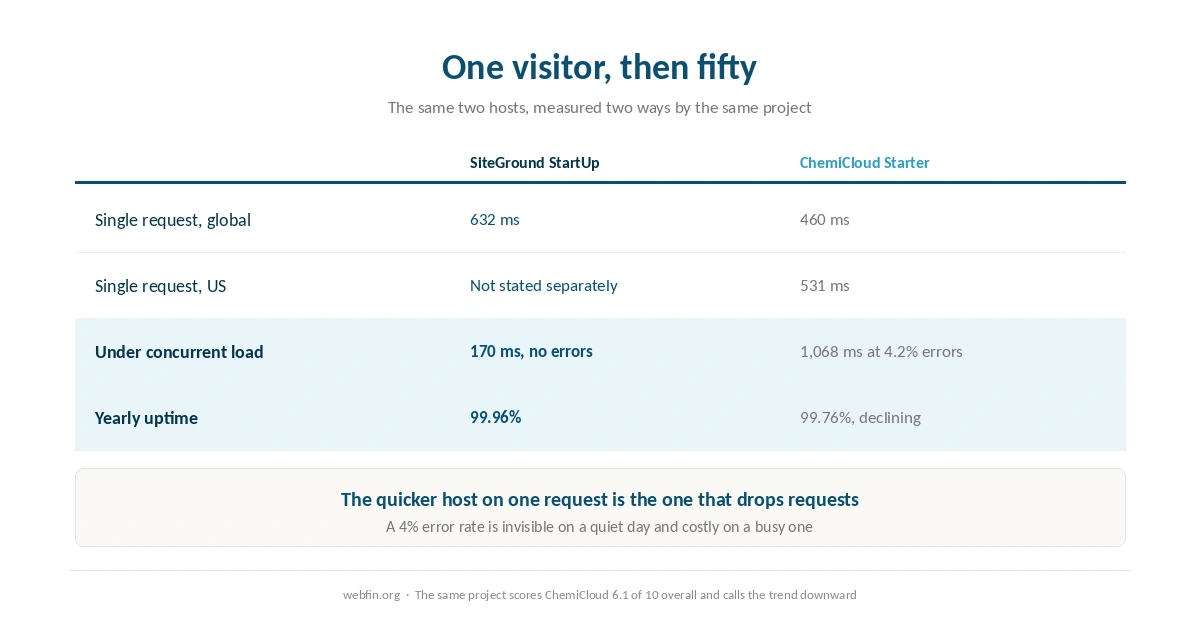
On a single request ChemiCloud is the quicker host. The 2026 benchmarks record 460 ms globally and 531 ms from the United States, against 632 ms at SiteGround. For a blog or a brochure site that is the number a visitor feels, and ChemiCloud wins it.
The load test reverses the result completely. Ramping to concurrent visitors, ChemiCloud records 1,068 milliseconds at a 4.2% error rate. A share of requests went unserved. SiteGround answers the same test in 170 ms with no errors. A 4% failure rate is invisible on a quiet Tuesday and expensive on the morning a newsletter lands.
⚠️ The trend is the other half of this. The same project scores ChemiCloud 6.1 of 10 overall and describes year-over-year degradation, with uptime at 99.76%. SiteGround reads 99.96%. Its outage count still rose from 18 in 2024 to 44 in 2025, so neither record is clean. Our guide to reducing TTFB explains why a single-request figure and a load result answer different questions.
One Host Prints the Renewal, the Other Does Not
SiteGround publishes three renewal prices for StartUp, which sounds worse than it is. The plan renews at $14.99 on a 24-month term, $17.99 on a 12-month one and $24.99 month to month. Confusing, but all three are knowable before you pay.
ChemiCloud publishes none. Its plan table shows $2.49 a month on a 36-month term with a struck-through $11.95 beside it. The footnote says introductory pricing applies to the first billing term, and that renewal rates appear at checkout and in the client area. So the $11.95 that review pages quote as its renewal is a list price the company never called one.
Third-party figures disagree with each other as a result. One coupon page cites the official site for $9.95 a month on the 36-month cycle and $12.95 on monthly and annual billing, while review pages repeat $11.95. Our page on hosting renewal prices records the range rather than picking one, and the practical instruction is short: save the checkout summary before you pay.
| Host and plan | Intro → Renewal | Multiplier |
|---|---|---|
| IONOS Plus | $1.00 → $14.00 | 14.0× over 12 months |
| SiteGround StartUp | $2.99 → $17.99 | 6.0× over 12 months |
| SiteGround GrowBig | $4.99 → $29.99 | 6.0× over 12 months |
| SiteGround GoGeek | $7.99 → $44.99 | 5.6× over 12 months |
| ChemiCloud Starter | $2.49 → not published | Renewal shown at checkout only |
| Scala Hosting Mini | $2.95 → $11.95 | 4.1× over 12 months |
| DreamHost Launch, annual | $2.89 → $10.99 | 3.8× over 12 months |
| Hostinger Premium | $2.99 → $10.99 | 3.7× over 48 months |
| Bluehost Starter | $3.99 → $11.99 | 3.0× over 12 months |
| A2 Hosting Turbo Boost | $6.99 → $20.99 | 3.0× over 12 months |
| HostGator Hatchling | $3.75 → $10.99 | 2.9× over 36 months |
| GoDaddy Economy | $5.99 → $15.32 | 2.6× over 36 months |
| Bluehost Starter | $3.99 → $9.99 | 2.5× over 36 months |
| Namecheap Stellar | $1.98 → $4.88 | 2.5× over 12 or 24 months |
| Namecheap Stellar Plus | $2.98 → $6.88 | 2.3× over 12 or 24 months |
| Namecheap Stellar Business | $4.98 → $9.88 | 2.0× over 12 or 24 months |
| DreamHost Launch, 4-year | $2.89 → $7.99 | 2.8× over 48 months |
| DreamHost, eligible US nonprofits | One shared plan free for the account's life | 501(c)(3) or (c)(19); help article, checked 10 Jun 2026 by a nonprofit directory |
| Bluehost Business | $6.99 → $13.99 | 2.0× over 36 months |
| Bluehost Starter, second reading | $1.99 → $8.99 | Hostingstep, July 2026; conflicts with Bluehost's help page |
| Hostwinds Basic | $4.54 → $6.99 | 1.5× over 12 months |
| WP Engine Startup | $27.00 → $35.00 | 1.3× over 12 months |
| Rocket.net Starter | $25.00 → $30.00 | 1.2× over 12 months |
| InterServer Standard | $2.50 flat | 1.0×, price lock |
| Cloudways, from | $14.00 flat | no promotional term |
| Kinsta Starter | $35.00 flat | no promotional term |
| Liquid Web managed VPS, annual billing | $33.00, no promotional term | No increase described on annual billing |
| Liquid Web managed VPS, monthly billing | $36.00 → $72.00 reported | 2.0× over one month; one pricing guide, disputed |
| GreenGeeks Lite | $2.95 → $13.95 | 4.7× after one term; renewal was $12.95 before 2026 |
| ChemiCloud Starter, third-party figures | $9.95, $11.95 or $12.95 quoted | Sources disagree; 4.0× to 5.2× over 36 months |
| SiteGround StartUp, by term | $2.99 → $14.99, $17.99 or $24.99 | 5.0× over 24 months, 6.0× over 12, 8.4× month to month |
| ChemiCloud Kickstart, reseller | $8.99 → $29.95 | Term not stated in the source we read |
| InterServer reseller | $19.95, price locked | No increase described in sources |
| GreenGeeks reseller | $19.95 with WHMCS included | Promotional rate; renewal not published |
| Hostwinds white-label reseller | $10.00 with WHMCS included | Plain reseller plan excludes WHMCS |
| InMotion Core, 36-month term | $3.19 → $10.99 | 3.4× over 36 months; TechRadar, 2026 |
| InMotion Launch, 36-month term | $4.99 → $13.99 | 2.8× over 36 months; TechRadar and plan cards, 2026 |
| InMotion Core, by term | Renews at $10.99, $11.99 or $14.49 | Longest term lowest; one review, May 2026 |
What Three Years Cost
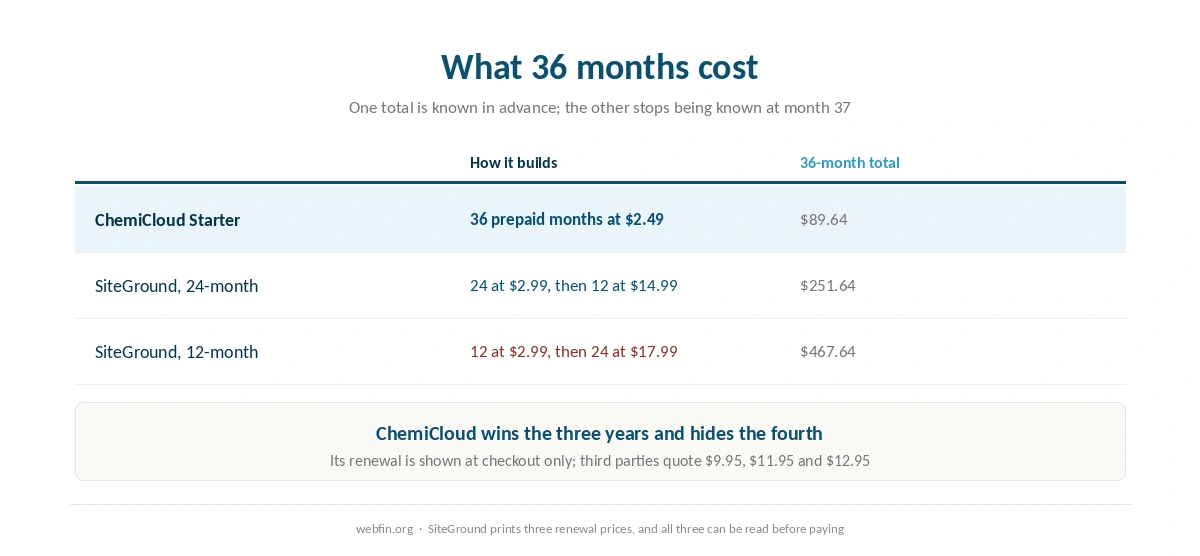
ChemiCloud bills 36 months at $2.49 up front, so three years come to $89.64 and the promotional rate covers the whole window. SiteGround bills 24 months at $2.99 and then 12 at $14.99, which is $251.64. On annual SiteGround terms the figure reaches $467.64 instead.
That is a real gap, and it is the strongest argument ChemiCloud has. Still, the two terms end at different moments. ChemiCloud renews at month 37 at a rate nobody can read in advance, while the SiteGround number is already known. Our page on what web hosting costs runs both shapes across the catalog.
Limits, and Who Publishes Them
ChemiCloud states what Starter includes: one website, 20 GB of NVMe storage, ten days of backups and a guidance figure of about 25,000 monthly visits. It also sells an inode boost at $2.95 a month, which tells you inodes are metered and counted.
SiteGround states storage and a visit guidance figure per tier as well, so both are clearer than the parts of this market that publish nothing. That is worth saying plainly, because the word that usually fills this gap is the subject of our piece on what unlimited hosting means, and neither of these two hides behind it.
Where they differ is what happens at the ceiling. SiteGround moves you to GrowBig at $29.99 on renewal or GoGeek at $44.99, both over 12 months. ChemiCloud sells the boost as an add-on instead, which is cheaper in the short run and harder to compare.
Support and Refunds
SiteGround answers the phone, alongside chat and tickets around the clock. ChemiCloud answers chat and tickets, and reviewers praise it consistently, but there is no phone line. Neither company publishes a measured response time, and no controlled test of hosting support exists in the sources we found.
ChemiCloud gives 45 days to change your mind against 30 at SiteGround, with domains and add-ons excluded. That matters more than usual here, because its cheapest rate requires paying three years up front. Six weeks is enough to run real traffic and find out whether the load behavior above shows up on your site.
Who Owns Them
SiteGround Hosting Ltd has been private since it was founded in Sofia in 2004, with no outside group in its ownership. ChemiCloud is harder to pin down: its own site carries a copyright line for CChosting, Inc., which we read on 20 September 2026, and beyond that nothing is documented in what we found.
Neither belongs to a larger hosting group, which is unusual in this market. The shared ownership pattern we traced in who owns Bluehost brings shared infrastructure and a shared renewal policy, and it does not apply to either side here.
Paying Three Years Up Front Is Its Own Decision
The $89.64 figure assumes a 36-month prepayment. That is the whole cost of ownership handed over on day one, to a company whose ownership is not documented and whose benchmark trend the tester calls downward. The 45-day window covers the first six weeks of that, and nothing covers month twenty.
SiteGround asks for 24 months to reach $251.64, which is a smaller bet on the same kind of promise. Neither arrangement is unusual in shared hosting, where the discount exists precisely to buy the long commitment. The question worth asking before either is what happens if the site closes in year two, because in both cases the answer is that the money is spent.
⚠️ This is the argument for monthly billing that this market rarely makes out loud. Paying more per month and keeping the option to leave is a real product, and the hosts that offer it are priced accordingly, and the discount you give up is the price of that option.
Panels, Staging and Everyday Use
SiteGround runs Site Tools, built in-house. ChemiCloud runs cPanel, which most people arriving from another host already know. On familiarity ChemiCloud wins, and on coherence SiteGround does, since its own panel is built around the WordPress workflow rather than around a general hosting account.
Staging separates them further. SiteGround starts it above the entry tier, so a StartUp customer does not get it. ChemiCloud includes staging on its WordPress Pro plan rather than the cheapest one. Our guide to setting up a staging site covers the free plugin route, which works on either entry plan and costs nothing.
Winners by Category
Three-year price: ChemiCloud, at $89.64 against $251.64. Price transparency: SiteGround, which prints the renewal. Single-request speed: ChemiCloud, at 460 ms against 632 ms. Load handling: SiteGround, at 170 ms with no errors. Uptime: SiteGround, at 99.96% against 99.76%. Refunds: ChemiCloud, at 45 days against 30. Support channels: SiteGround, which publishes a phone number. Published limits: ChemiCloud, marginally, for stating inodes.
When to Choose ChemiCloud Instead
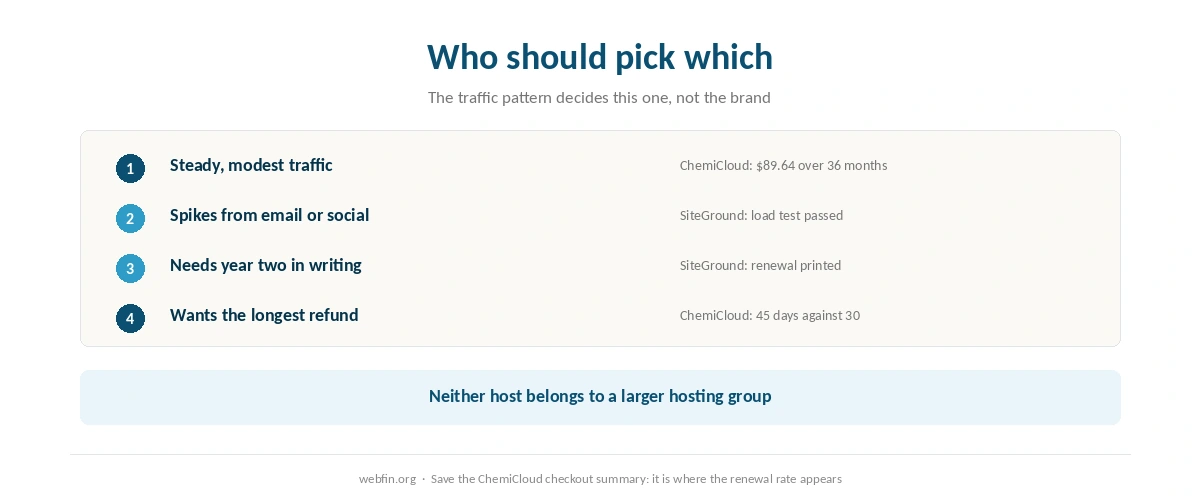
Take ChemiCloud if traffic is steady and modest. Three years for $89.64 is the kind of price that makes an argument on its own, the refund window is the longest of the two, and the plan page tells you what you are allowed to use. For a personal site or a small brochure, our roundup of cheap web hosting puts it in context.
Take SiteGround if the site has spikes, or if you need the second-term price in writing. The load result is the clearest difference between these two, and a phone line matters to anyone who escalates by voice. For a WordPress build in particular, our list of the best WordPress hosting shows where both sit.
How We Research
We run no speed or uptime tests. Every measurement above is attributed to Hostingstep’s 2026 benchmarks with the window it covers. Prices come from the providers’ own pages, read on 20 September 2026, and the SiteGround renewal figures follow its own renewal table as reported in August 2026.
Where sources disagree, as they do on the ChemiCloud renewal, we print the range and say what the company itself states. The criteria behind our scores are on our about page, and the full workings sit in our SiteGround review.
SiteGround vs ChemiCloud FAQ
ChemiCloud, at $89.64 against $251.64. Its promotional rate covers all 36 months, while SiteGround renews in the third year. The catch is that ChemiCloud renews at month 37 at a price it does not publish, so the fourth year cannot be budgeted in advance.
ChemiCloud on a single request, at 460 ms globally against 632 ms. Under concurrent load the order reverses hard: ChemiCloud records 1,068 ms with a 4.2% error rate, while SiteGround answers in 170 ms with none. Which figure matters depends on your traffic.
No. The plan table shows a struck-through $11.95 beside the $2.49 promotion, and the footnote says renewal rates appear at checkout and in the client area. Third-party pages quote $9.95, $11.95 and $12.95 for the same plan, so save the checkout summary.
ChemiCloud, at 45 days against 30 at SiteGround. Domains and add-ons are excluded. The longer window is worth more here than usual, because the cheapest ChemiCloud rate requires paying 36 months in advance before you know how the site behaves.
Not as far as we can establish. SiteGround has been private since 2004 in Sofia. The ChemiCloud site carries a CChosting, Inc. copyright and nothing further is documented. Neither sits inside Newfold Digital or a similar portfolio, which is unusual in this market.
The Verdict
SiteGround takes this on the measurements that matter when a site is busy, and ChemiCloud takes it on price by a distance. Our scores read 3.9 against 3.8, which is as close as the numbers suggest. The deciding question is not which host is better but which failure you can live with: a bill that triples in year three, or a 4.2% error rate when the traffic arrives.
For a quiet site the arithmetic is decisive and ChemiCloud wins it. For anything that takes orders, the load result and the published renewal both point the other way. If you are moving either way, our guide to migrating web hosting covers the order of operations, and the charges that arrive later sit in hidden hosting fees.