
Disclosure: WebFin is reader-supported. If you buy hosting through links on this page, we may earn a commission at no extra cost to you. Commissions vary between providers and our ratings do not — here’s our full disclosure.
Cloudways vs WP Engine is a tie in our reviews, at 4.1 each, and they tie for opposite reasons. WP Engine is the faster host on every named measurement we hold. It placed first in a global ranking of 34 hosts at 65 ms and passed a load test at 27 ms without an error. Cloudways is the cheaper and more flexible one: $504.00 across 36 months against $1,164.00, any cloud, any application, billed by the hour. Our published tie-break settles it on cost of ownership, and this page shows what that choice gives up.
Cloudways vs WP Engine: The Short Answer
Cloudways, by our tie-break: it costs less than half as much across three years, has no visit cap, and runs more than WordPress. WP Engine is the better buy when speed under load and a built-in development workflow matter more than price, as they can for a site that earns. Our comparison of SiteGround against WP Engine covers another managed rival.
Head to Head
| Criterion | Cloudways | WP Engine Startup |
|---|---|---|
| Product | Managed cloud server, any app | Managed WordPress only |
| Price | $14.00/mo flat | $27.00/mo, then $35.00 |
| 36 months | $504.00 | $1,164.00 |
| Visit allowance | None; sized by server | 25,000 monthly visits |
| Load test | 288 ms at 1.7% errors, Vultr HF | 27 ms, no errors |
| Global time to first byte | Varies by cloud | 65 ms, 1st of 34 |
| Uptime, named | 99.996% to 99.999% | Not from a named project |
| Environments per site | Production and staging | Production, staging, development |
| Billing | Hourly, pay as you go | Monthly, cancel before the cycle |
| Not included | Not included | |
| Owner | DigitalOcean, 2022 | Silver Lake majority, 2018 |
| Our score | 4.1 | 4.1 |
A Tie, and the Rule That Breaks It
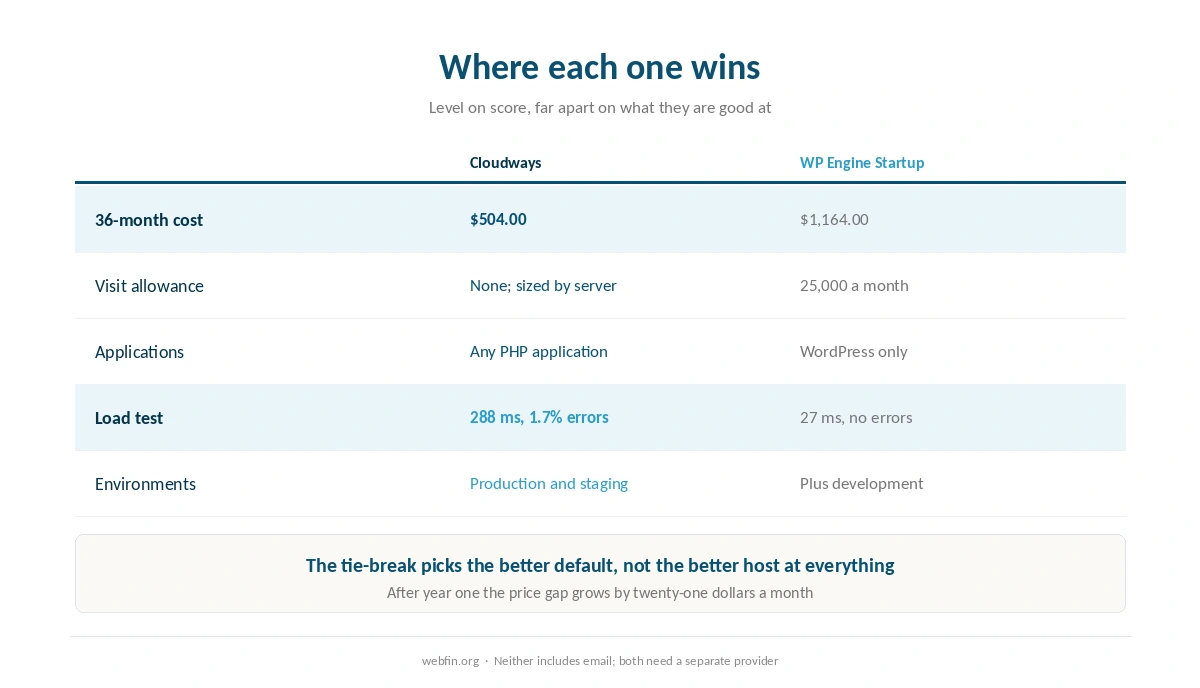
Both hosts score 4.1. Our about page says in advance what happens next. A tie goes to the lower cost of ownership over 36 months, and if that ties too, to the host that publishes its renewal. Cloudways costs $504.00 over 36 months and WP Engine $1,164.00, so the first test decides it. The rule is on our about page, written before this comparison.
A rule that settles a tie on price will always favor the cheaper host, and it is worth being clear about what that leaves out. WP Engine is faster under load and on first byte, and its workflow is built for sites that change often. The tie-break says which host is the better default purchase, not which is better at everything.
The Price Gap
Cloudways charges $14.00 a month from the start with no promotional term, which is $504.00 across 36 months. WP Engine Startup opens at $27.00 and renews at $35.00, which is 1.3× over 12 months and $1,164.00 over the same stretch. That is 2.3 times the Cloudways figure over 36 months, and our page on hosting renewal prices lists both.
Neither includes email, so both need a separate provider; Cloudways offers Rackspace mailboxes at about a dollar each. Neither has a refund window in the usual sense either. Cloudways stops billing when you stop the server, and WP Engine bills monthly and stops at the next cycle. Our page on what web hosting costs puts both beside shared hosting.
| Host and plan | How it builds | 36-month total |
|---|---|---|
| ChemiCloud Starter, 36-month term | 36 prepaid months at $2.49 | $89.64 |
| InterServer Standard | 36 months at $2.50, price locked | $90.00 |
| DreamHost Launch, 48-month term | 36 of 48 prepaid months at $2.89 | $104.04 |
| Namecheap Stellar, 24-month term | 24 at $1.98, then 12 at $4.88 | $106.08 |
| Hostinger Premium, 48-month term | 36 of 48 prepaid months at $2.99 | $107.64 |
| HostGator Hatchling, 36-month term | 36 months at $3.75, renewal not reached | $135.00 |
| HostGator Hatchling, with daily backups | 36 at $3.75, plus CodeGuard at $35.88 a year | $242.64 |
| Bluehost Starter, 36-month term | 36 months at $3.99, renewal not reached | $143.64 |
| GoDaddy Economy, 36-month term | 36 months at $5.99, renewal not reached | $215.64 |
| GoDaddy Economy, with SSL from year two | 36 at $5.99, plus $119.99 in years two and three | $455.62 |
| Hostwinds Basic, annual | 12 at $4.54, then 24 at $6.99 | $222.24 |
| SiteGround StartUp, 24-month term | 24 at $2.99, then 12 at $14.99 | $251.64 |
| DreamHost Launch, annual | 12 at $2.89, then 24 at $10.99 | $298.44 |
| Scala Hosting Mini, annual | 12 at $2.95, then 24 at $11.95 | $322.20 |
| Bluehost Starter, 12-month term | 12 at $3.99, then 24 at $11.99 | $335.64 |
| IONOS Plus, annual | 12 at $1.00, then 24 at $14.00 | $348.00 |
| GreenGeeks Lite, 36-month prepay | 36 months at $2.95 | $106.20 |
| GreenGeeks Lite, annual | 12 at $2.95, then 24 at $13.95 | $370.20 |
| SiteGround StartUp, 12-month term | 12 at $2.99, then 24 at $17.99 | $467.64 |
| Cloudways, from | 36 months at $14.00, flat | $504.00 |
| A2 Hosting Turbo Boost, annual | 12 at $6.99, then 24 at $20.99 | $587.64 |
| Rocket.net Starter, annual | 12 at $25.00, then 24 at $30.00 | $1,020.00 |
| WP Engine Startup, annual | 12 at $27.00, then 24 at $35.00 | $1,164.00 |
| Liquid Web managed VPS | 36 months at $33.00 | $1,188.00 |
| Kinsta Starter | 36 months at $35.00, flat | $1,260.00 |
| InMotion Core, 36-month term | 36 months at $3.19, renewal not reached | $114.84 |
| InMotion Launch, 36-month term | 36 months at $4.99, renewal not reached | $179.64 |
The Speed Gap
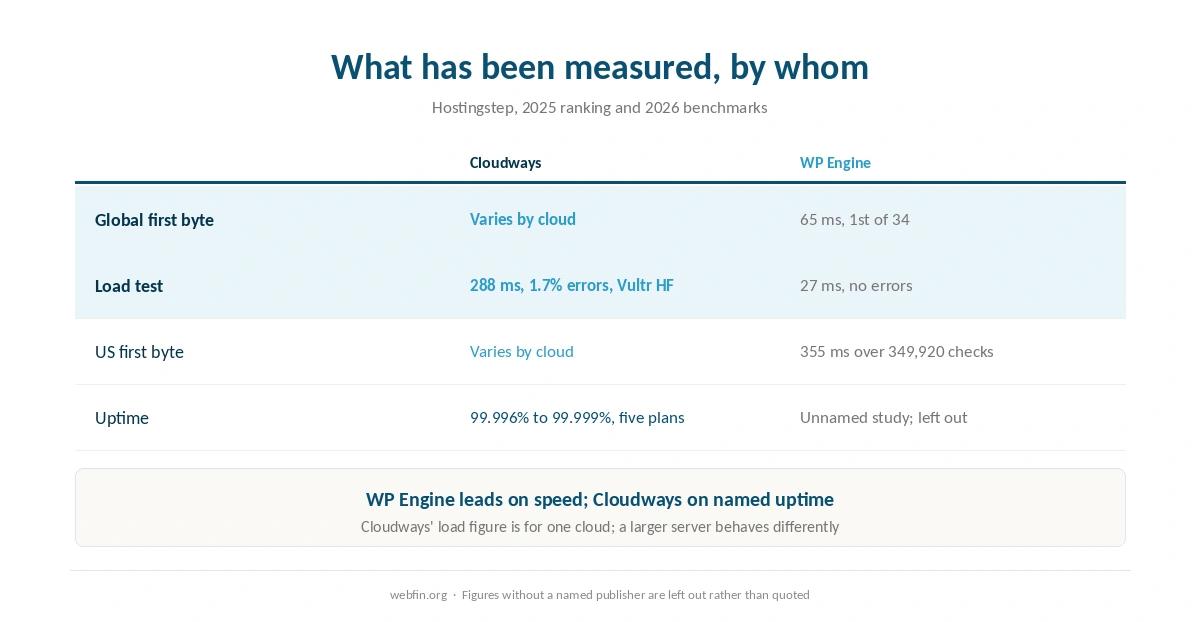
We run no tests, so these figures belong to Hostingstep. In its 2025 global ranking across 40 locations, WP Engine answered in 65 ms and placed first of 34 hosts. Across October 2025 to May 2026 it averaged 355 ms from US locations over 349,920 checks. Its load test, which ramps to 100 concurrent visitors, finished at 27 ms without an error.
Cloudways’ load result is from its Vultr High Frequency plan: 288 ms with a 1.7% error rate. Its uptime is the stronger named figure, between 99.996% and 99.999% across five plans. WP Engine’s uptime figure in our table comes from a study we have not attributed to a named publication, so we leave it out. The same WP Engine figures against Kinsta are in our Kinsta and WP Engine comparison.
⚠️ The Cloudways figure is for one cloud, and a larger server on the same cloud would behave differently. That is both its weakness and its strength: you can buy more capacity by the hour, while WP Engine’s capacity comes with the plan. Our guide to reducing TTFB explains what drives first-byte time.
Workflow: Environments Against a Server
WP Engine gives every site a production, staging and development environment, none of which count against the site limit, and installs can transfer between accounts. That makes building, reviewing and handing over client sites a supported routine rather than a workaround. Our guide to setting up a staging site explains why the separate development stage matters.
Cloudways ships staging, SSH, WP-CLI, Git deployment and PHP version selection on every tier, and it runs any PHP application, not only WordPress. You get a server with the tools; WP Engine gives you a workflow with the server hidden. Which is better depends on whether you want to manage the server. Our list of hosting for developers weighs both.
Visits Against Resources
WP Engine prices by monthly visits: 25,000 on Startup, rising to 400,000 across its tiers, with overage handling above the allowance. That is simple to budget and awkward for a site with unpredictable spikes, because a good month can push it past the plan.
Cloudways prices by server size and has no visit cap. A spike is limited only by what the server can serve, and you can resize it for a busy week and shrink it afterward. The trade is that you decide when to resize, rather than the plan deciding for you. Our roundup of hosting for high traffic covers both approaches.
Support and Everyday Use
Both answer chat and tickets around the clock. WP Engine adds a phone line on higher tiers; Cloudways sells phone support as a paid add-on. Neither publishes a measured response time, and no controlled test of hosting support exists in the sources we found.
Day to day, WP Engine feels like a WordPress service and Cloudways like a server console with good defaults. Owners who are not technical will find WP Engine easier, while developers running several kinds of project will find Cloudways more useful.
Which Sites Each One Suits
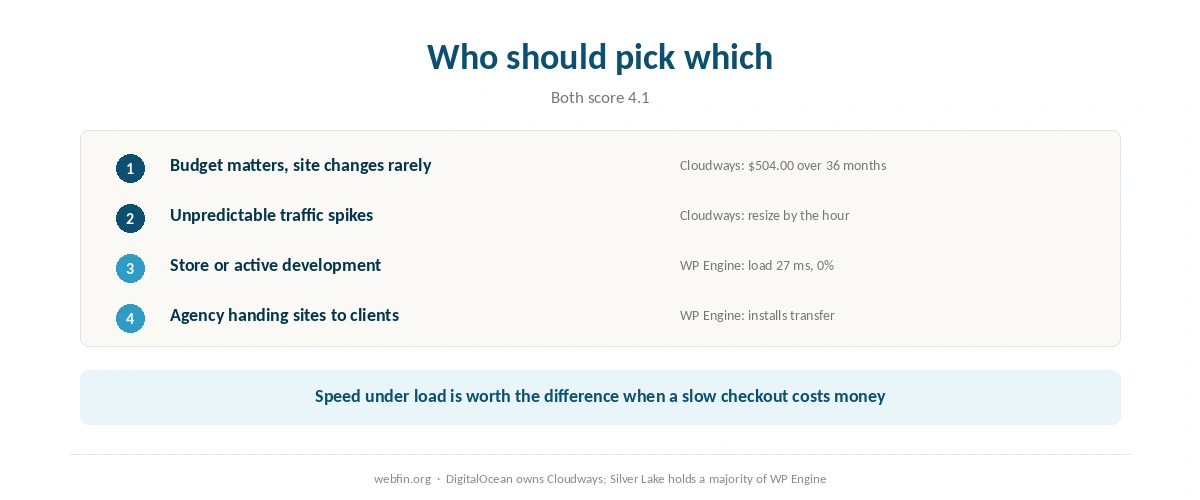
A content site or a small business on WordPress that changes rarely gains little from WP Engine’s development stage. Its cached pages do not test the load result much either. For that site, Cloudways at less than half the price is the sensible default, and a spare staging copy covers the occasional update.
A store, a membership site or a site under active development is different. Uncached pages and frequent releases are exactly where WP Engine’s load result and three environments earn their price. Our list of hosting for ecommerce names it for an established store for that reason.
The Five-Year View
Neither host has a promotional term that ends in a surprise. Cloudways stays at $14.00, and WP Engine at $35.00 after its first year. The gap therefore grows at a steady twenty-one dollars a month after year one. That is the number to weigh against the speed difference for your own site.
Who Owns Them
DigitalOcean acquired Cloudways in 2022 and sells the cloud underneath many of its servers. Silver Lake took a majority stake in WP Engine in 2018, reported at about $250 million. Both are owned by larger companies with their own priorities.
Neither ownership is a verdict on service. It does explain the models: DigitalOcean earns from the servers, and WP Engine earns from a managed product priced by visits.
Where Each One Is Weakest
Cloudways is weakest on its published load result and on simplicity. A 1.7% error rate on one cloud is its worst figure, and managing a server is a real job for someone who never wanted one.
WP Engine is weakest on price and flexibility. It costs 2.3 times as much over 36 months and hosts WordPress only. Its visit allowance can also push a successful site into a higher tier. Our WP Engine review prices each tier.
Moving Between Them
Sites move in both directions. A WordPress site that outgrows WP Engine’s visit allowance can move to a Cloudways server sized for its traffic. Cloudways provides a migration plugin for the transfer. A site whose owner tires of managing a server can go the other way, into a workflow that needs no maintenance.
In either direction the domain can stay at its registrar and simply point at the new host. Our guide to pointing a domain to a new host covers that step, and the move itself is routine for a WordPress site on either platform.
Winners by Category
Tie-break, cost of ownership: Cloudways, at $504.00 against $1,164.00. Load test: WP Engine, at 27 ms without errors. Global first byte: WP Engine, first of 34 at 65 ms. Named uptime: Cloudways, at 99.996% or better. Development workflow: WP Engine, with three environments per site. Flexibility: Cloudways, any cloud and any application. Visit caps: Cloudways, which has none.
When to Choose WP Engine Instead
Take WP Engine for a WordPress site that earns enough that speed under load and a clean release process are worth more than twice the price. It also suits an agency handing sites to clients. Its load result is the strongest we cite, and its workflow needs no setup. Our list of hosting for agencies covers the handover case.
Take Cloudways for a developer, a mixed portfolio of applications, a site with unpredictable traffic, or anyone who wants to pay by the hour. Our comparison of Cloudways against GoDaddy covers the budget end, and Cloudways against Kinsta sets it against another managed option.
How We Research
We run no tests. Speed and load figures come from Hostingstep’s 2025 ranking and 2026 benchmarks and reviews, each with its window. Figures we could not attribute to a named publication are left out. Prices, visit allowances and billing terms come from the providers’ own pages, read on 20 September 2026.
When two hosts tie on score, we apply the tie-break published on our about page and say what it leaves out. The full workings are in our Cloudways review.
Cloudways vs WP Engine FAQ
Cloudways, at $14.00 a month flat, or $504.00 across 36 months. WP Engine Startup opens at $27.00 and renews at $35.00, which is $1,164.00 over the same stretch, or 2.3 times as much over 36 months.
WP Engine, on the named figures: first of 34 hosts at 65 ms in a global ranking, and a load test at 27 ms without an error. Cloudways on its Vultr High Frequency plan served the load test at 288 ms with a 1.7% error rate.
They win different criteria and land level. Our published tie-break gives a tie to the lower 36-month cost of ownership, which is Cloudways. WP Engine remains the faster host and the better workflow for sites that change often.
Yes. Startup includes 25,000 monthly visits, and tiers run to 400,000, with overage handling above the allowance. Cloudways has no visit cap; its limit is the size of the server, which you can change by the hour.
Neither does. Cloudways offers Rackspace mailboxes at about a dollar each per month, and WP Engine sites need a separate email provider.
The Verdict
Cloudways takes this on our published tie-break, because both score 4.1 and it costs less than half as much over three years. It is also the more flexible host, with any cloud, any application and billing by the hour.
WP Engine is the faster host and the smoother workflow. For a WordPress site where a slow checkout or a broken release costs real money, it may well be worth the difference. The tie-break picks the better default; your site may not be the default case. If you move later, our guide to migrating web hosting covers the order.