
Disclosure: WebFin is reader-supported. If you buy hosting through links on this page, we may earn a commission at no extra cost to you. Commissions vary between providers and our ratings do not — here’s our full disclosure.
Bluehost vs GreenGeeks is a contest between a cheaper start and a cheaper stay. GreenGeeks Lite opens at $2.95 and renews at $13.95. Bluehost Starter opens at $3.99 and renews at $9.99 on a 36-month term or $11.99 on an annual one. So GreenGeeks wins the first stretch and Bluehost wins everything after it: from month 46 on three-year prepayments, and from month 19 on annual terms. The measurements split the same way, with GreenGeeks ahead on the load test and Bluehost far ahead on hardware. The same GreenGeeks figures against a Cloudways server are in our Cloudways and GreenGeeks comparison.
Bluehost vs GreenGeeks: The Short Answer
Bluehost, at 4.0 against 3.7 in our reviews. Its lower renewal makes it the cheaper host for any site kept longer than a few years, its hardware scores 9.6 against 5.0, and it answers the phone. GreenGeeks is cheaper for the first three years on a prepayment, served the load test faster, and backs its green claim with documented credits.
Head to Head
| Criterion | Bluehost Starter | GreenGeeks Lite |
|---|---|---|
| Intro rate | $3.99/mo | $2.95/mo |
| Renewal | $9.99 on 36 months, $11.99 on 12 | $13.95/mo |
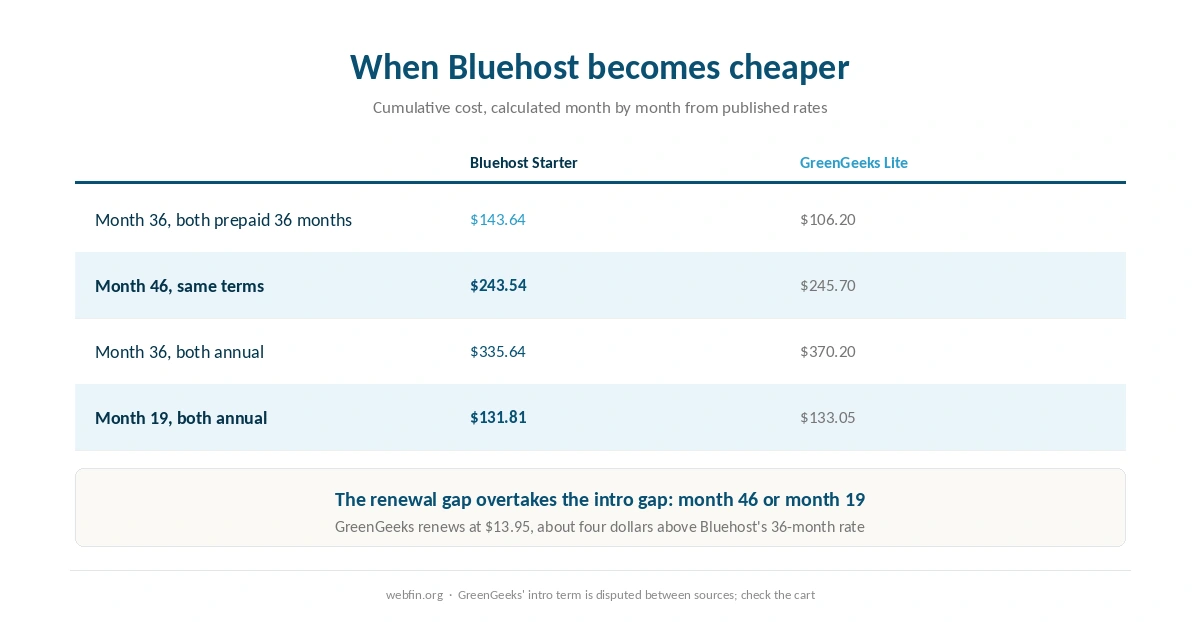
| 36 months, 36-month prepay | $143.64 | $106.20 |
| 36 months, annual terms | $335.64 | $370.20 |
| Cheaper overall from | Month 46 or month 19 | Before those months |
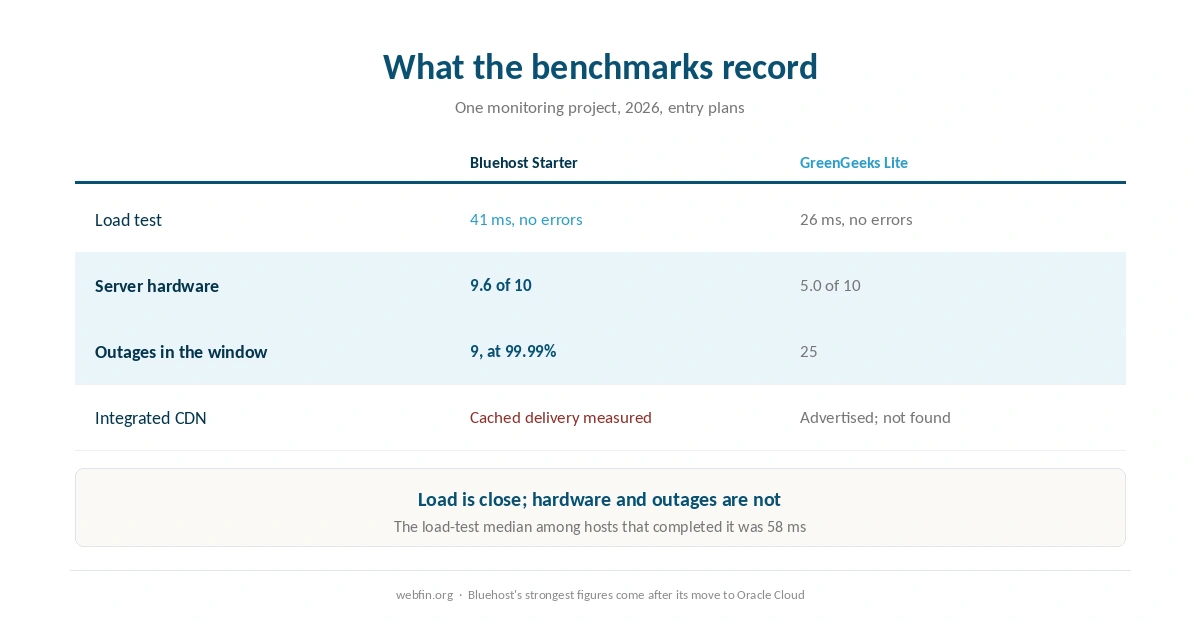
| Load test | 41 ms, no errors | 26 ms, no errors |
| Server hardware | 9.6 of 10 | 5.0 of 10 |
| Outages in the window | 9, at 99.99% | 25 |
| Support | Phone and chat, 24/7 | Chat and tickets, 24/7 |
| Energy commitment | Not a selling point | 300% renewable credits |
| Owner | Newfold Digital, 2021 | Founder-led, independent |
| Our score | 4.0 | 3.7 |
A Cheaper Start Against a Cheaper Stay
On three-year prepayments at both, GreenGeeks costs $106.20 across 36 months against $143.64 at Bluehost. Then GreenGeeks renews at $13.95 and Bluehost at $9.99, so Bluehost closes the gap by almost four dollars a month and becomes the cheaper of the two in month 46. Every month after that widens its lead.
On annual terms the crossover comes much sooner. GreenGeeks is cheaper for the first year at $2.95 against $3.99, then renews at $13.95 against Bluehost’s $11.99. Bluehost overtakes it in month 19 and reaches $335.64 across 36 months against $370.20.
⚠️ GreenGeeks’ renewal rose to $13.95 this year from $12.95, and sources disagree on whether its $2.95 intro needs a 36-month or a 12-month term. Bluehost pricing is also disputed, with a July 2026 review quoting $1.99 renewing at $8.99. Check the term in the cart at either host. Our page on hosting renewal prices records all of these readings.
| Host and plan | Intro → Renewal | Multiplier |
|---|---|---|
| IONOS Plus | $1.00 → $14.00 | 14.0× over 12 months |
| SiteGround StartUp | $2.99 → $17.99 | 6.0× over 12 months |
| SiteGround GrowBig | $4.99 → $29.99 | 6.0× over 12 months |
| SiteGround GoGeek | $7.99 → $44.99 | 5.6× over 12 months |
| ChemiCloud Starter | $2.49 → not published | Renewal shown at checkout only |
| Scala Hosting Mini | $2.95 → $11.95 | 4.1× over 12 months |
| DreamHost Launch, annual | $2.89 → $10.99 | 3.8× over 12 months |
| Hostinger Premium | $2.99 → $10.99 | 3.7× over 48 months |
| Bluehost Starter | $3.99 → $11.99 | 3.0× over 12 months |
| A2 Hosting Turbo Boost | $6.99 → $20.99 | 3.0× over 12 months |
| HostGator Hatchling | $3.75 → $10.99 | 2.9× over 36 months |
| GoDaddy Economy | $5.99 → $15.32 | 2.6× over 36 months |
| Bluehost Starter | $3.99 → $9.99 | 2.5× over 36 months |
| Namecheap Stellar | $1.98 → $4.88 | 2.5× over 12 or 24 months |
| Namecheap Stellar Plus | $2.98 → $6.88 | 2.3× over 12 or 24 months |
| Namecheap Stellar Business | $4.98 → $9.88 | 2.0× over 12 or 24 months |
| DreamHost Launch, 4-year | $2.89 → $7.99 | 2.8× over 48 months |
| DreamHost, eligible US nonprofits | One shared plan free for the account's life | 501(c)(3) or (c)(19); help article, checked 10 Jun 2026 by a nonprofit directory |
| Bluehost Business | $6.99 → $13.99 | 2.0× over 36 months |
| Bluehost Starter, second reading | $1.99 → $8.99 | Hostingstep, July 2026; conflicts with Bluehost's help page |
| Hostwinds Basic | $4.54 → $6.99 | 1.5× over 12 months |
| WP Engine Startup | $27.00 → $35.00 | 1.3× over 12 months |
| Rocket.net Starter | $25.00 → $30.00 | 1.2× over 12 months |
| InterServer Standard | $2.50 flat | 1.0×, price lock |
| Cloudways, from | $14.00 flat | no promotional term |
| Kinsta Starter | $35.00 flat | no promotional term |
| Liquid Web managed VPS, annual billing | $33.00, no promotional term | No increase described on annual billing |
| Liquid Web managed VPS, monthly billing | $36.00 → $72.00 reported | 2.0× over one month; one pricing guide, disputed |
| GreenGeeks Lite | $2.95 → $13.95 | 4.7× after one term; renewal was $12.95 before 2026 |
| ChemiCloud Starter, third-party figures | $9.95, $11.95 or $12.95 quoted | Sources disagree; 4.0× to 5.2× over 36 months |
| SiteGround StartUp, by term | $2.99 → $14.99, $17.99 or $24.99 | 5.0× over 24 months, 6.0× over 12, 8.4× month to month |
| ChemiCloud Kickstart, reseller | $8.99 → $29.95 | Term not stated in the source we read |
| InterServer reseller | $19.95, price locked | No increase described in sources |
| GreenGeeks reseller | $19.95 with WHMCS included | Promotional rate; renewal not published |
| Hostwinds white-label reseller | $10.00 with WHMCS included | Plain reseller plan excludes WHMCS |
| InMotion Core, 36-month term | $3.19 → $10.99 | 3.4× over 36 months; TechRadar, 2026 |
| InMotion Launch, 36-month term | $4.99 → $13.99 | 2.8× over 36 months; TechRadar and plan cards, 2026 |
| InMotion Core, by term | Renews at $10.99, $11.99 or $14.49 | Longest term lowest; one review, May 2026 |
The Measurements Split
We run no tests, so these figures belong to Hostingstep. GreenGeeks served the load test, which ramps to 100 concurrent visitors, at 26 ms without an error. Bluehost, rerun after its move to Oracle Cloud, served it at 41 ms, also without an error. On load, GreenGeeks is slightly ahead and both are excellent.
Hardware reverses the order sharply. Bluehost scores 9.6 of 10, at the top of that project’s shared results, and GreenGeeks scores 5.0. Outages favor Bluehost too: 9 across its window at 99.99% uptime, against 25 in GreenGeeks’ window. So GreenGeeks handles a burst of visitors well on modest hardware, and Bluehost combines a clean load result with far stronger machines.
⚠️ One more finding from the same project: it reports no integrated content network on GreenGeeks, although GreenGeeks advertises Cloudflare integration on all plans. Check your own dashboard rather than the plan page. Our guide to setting up a CDN covers what to look for.
For scale, the median among hosts that completed that load test was 58 ms, so both of these sit comfortably better than the middle of the field. A buyer choosing between them on load alone would be splitting hairs. The hardware and outage gaps are the ones large enough to matter, and they point the same way.
Which Result Matters for Your Site
For a blog or a brochure site behind a page cache, the hardware gap is rarely felt. Most visitors receive a stored copy, and both hosts handle a burst of visitors cleanly. On a site like that, the renewal is the number that shows up every month after the promotion.
For a store or a site with heavy plugins, hardware matters more, because carts, searches and admin pages are built fresh on every request. There, a score of 9.6 against 5.0 is worth more than a few milliseconds on a cached load test. Our list of hosting for ecommerce covers that case.
The Green Claim, and What It Is
GreenGeeks buys wind energy credits equal to three times its electricity use through the Bonneville Environmental Foundation, and it has been an EPA Green Power Partner since 2009. Those partner records are public. It is a genuine and documented commitment, and one that some audiences notice.
It is worth being precise about it. A renewable energy credit pays for renewable generation somewhere on the grid, while the servers still draw ordinary grid power. So it is a generous offset rather than a green power source, which our GreenGeeks review explains in more detail.
Growing Past the Entry Plan
GreenGeeks Lite is limited to one website, so a second site means moving up a tier. Bluehost Business, one step above Starter, opens at $6.99 and renews at $13.99 on a 36-month term, which is 2.0× over 36 months and the gentlest step in its range.
That makes the renewal comparison tighter one tier up, because GreenGeeks’ entry renewal sits within a few cents of Bluehost Business. A buyer who expects to add sites should price the tier they will actually need, which our guide to choosing a hosting plan walks through.
What a Three-Year Prepay Asks of You
Both hosts give their best entry price for paying 36 months up front, and both refund only the first 30 days of that. If the site closes in year two, the remaining months are spent at either one. The prepayment is the price of the discount, not a detail of it.
For GreenGeeks the prepay is also where its advantage lives: $106.20 for three years is its strongest number. For Bluehost the prepay unlocks the $9.99 renewal rather than $11.99. So the commitment helps both, and it helps GreenGeeks more in the short run and Bluehost more in the long one.
Developer Tools and Everyday Use
GreenGeeks includes SSH, Git and WP-CLI alongside cPanel on its shared plans, which is more than the price suggests, and its servers run LiteSpeed with built-in caching. For a developer’s side project that is useful. Our list of hosting for developers features it for that reason.
Bluehost wraps cPanel in a WordPress dashboard that guides a beginner through setup and also sells add-ons: a premium certificate at $89.88 that most sites do not need, SiteLock and Yoast SEO Premium. Newfold Digital owns both Bluehost and Yoast. Starter caps each mailbox at 100 MB. Both run cPanel, so accounts export cleanly, as our guide to understanding cPanel explains.
Support and Refunds
Bluehost answers phone and chat around the clock. GreenGeeks answers chat and tickets around the clock, with phone available but not at all hours. Neither publishes a measured response time, and no controlled test of hosting support exists in the sources we found.
Both refund within 30 days. GreenGeeks excludes domains and add-ons, and Bluehost keeps $15.99 for a free domain if you cancel early. Our guide to canceling hosting and getting a refund covers the order that keeps the domain safe.
Who Owns Them
Bluehost has belonged to Newfold Digital since 2021, alongside HostGator and Yoast SEO, and who owns Bluehost traces the group. GreenGeeks was founded by Trey Gardner, who still runs it, and it describes itself as independent.
For a buyer that shows up mainly in renewal policy. GreenGeeks’ own renewal rose this year under the same owner, which shows that independence is not a promise of stable prices. It does mean the decision was made by the people who run the host.
Where Each One Is Weakest
GreenGeeks is weakest on renewal and on hardware. A step to $13.95 after the intro, a disputed intro term and a hardware score of 5.0 make it a better short stay than a long one. The missing content network the benchmark reports is a further point to check.
Bluehost is weakest at the start and after checkout. It costs more for the first three years on a prepayment, its dashboard sells extras, and Starter keeps weekly rather than daily backups according to the benchmark project. Our page on hidden hosting fees lists the extras.
Winners by Category
First three years on a prepay: GreenGeeks, at $106.20 against $143.64. Anything longer: Bluehost, from month 46. Annual terms: Bluehost, from month 19. Load test: GreenGeeks, narrowly, at 26 ms against 41. Hardware: Bluehost, at 9.6 against 5.0. Outages: Bluehost, at 9 against 25. Phone support: Bluehost. Environmental commitment: GreenGeeks.
When to Choose GreenGeeks Instead
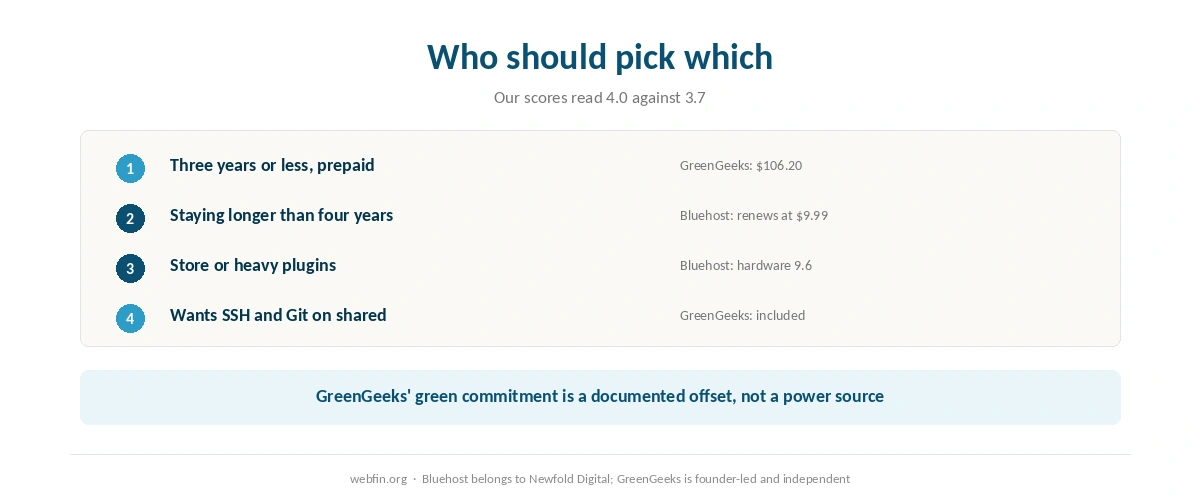
Take GreenGeeks for a site you expect to run for about three years or less on a prepayment, for a developer project that wants SSH and Git on shared hosting, or when a documented environmental commitment matters to your audience. Our comparison of SiteGround against GreenGeeks covers it against another rival.
Take Bluehost for a site meant to last, a store that needs strong hardware, or a buyer who wants a phone line. Our list of hosting for beginners weighs both for a first site.
How We Research
We run no tests. Load, hardware and outage figures come from Hostingstep’s 2026 benchmarks, reviews and changelog, each with its window. Prices come from the providers’ own pages and reviews, read on 20 September 2026, and the crossover months come from month-by-month arithmetic on the published rates.
Where sources disagree, as they do on both hosts’ pricing, we print the readings rather than choose one. The criteria behind our scores are on our about page, and the full workings are in our Bluehost review.
Bluehost vs GreenGeeks FAQ
GreenGeeks for the first stretch, Bluehost after it. On three-year prepayments GreenGeeks costs $106.20 against $143.64, and Bluehost becomes cheaper from month 46. On annual terms Bluehost is cheaper from month 19, reaching $335.64 across 36 months against $370.20.
It depends on the measure. GreenGeeks served the 2026 load test at 26 ms and Bluehost at 41 ms, both without errors. Bluehost’s hardware scores 9.6 of 10 against 5.0, and it recorded 9 outages against 25.
As an offset, yes. It buys wind energy credits equal to three times its electricity use through the Bonneville Environmental Foundation and has been an EPA Green Power Partner since 2009. The servers still draw ordinary grid power.
It advertises Cloudflare integration on all plans, but the benchmark project we cite reports finding no integrated content network. Check your own dashboard before relying on it, and set one up yourself if it is missing.
Bluehost belongs to Newfold Digital, which also owns HostGator and Yoast SEO. GreenGeeks was founded by Trey Gardner, who still runs it, and describes itself as independent.
The Verdict
Bluehost takes this, at 4.0 against 3.7, because its lower renewal makes it the cheaper host for any stay longer than a few years, and its hardware and outage record are stronger. The phone line is a further advantage for owners who want to talk a problem through.
GreenGeeks is the better buy for a shorter stay on a prepayment, for developers who want a shell on shared hosting, and for audiences who care about its documented green commitment. Just price the renewal before the intro, because $13.95 is what decides the long run. Our page on what web hosting costs runs both totals further.