
Disclosure: WebFin is reader-supported. If you buy hosting through links on this page, we may earn a commission at no extra cost to you. Commissions vary between providers and our ratings do not — here’s our full disclosure.
Cloudways vs InterServer is a tie in our reviews, at 4.1 each, and the rule that breaks it is not close. A tie goes to the lower cost of ownership across 36 months: InterServer costs $90.00 at a locked $2.50 a month, and Cloudways costs $504.00 at a flat $14.00. That is 5.6 times as much over 36 months. What Cloudways offers in return is the better evidence, because its uptime is measured across five plans while InterServer’s record is thinner. So the tie-break and the benchmark point in opposite directions, and this page shows both. A shared plan against the same server is priced in Hostinger vs Cloudways.
Cloudways vs InterServer: The Short Answer
InterServer, by our published tie-break, for almost any small site: a locked $2.50, unlimited sites and email on one plan, and phone support around the clock. Cloudways is the better choice for a developer, for a site that needs measured uptime, or for a project that should be billed by the hour.
Head to Head
| Criterion | Cloudways | InterServer Standard |
|---|---|---|
| Product | Managed cloud server | Shared hosting with cPanel |
| Price | $14.00/mo flat | $2.50/mo, locked |
| 36 months | $504.00 | $90.00 |
| Renewal step | None | None; the price is locked |
| Uptime, named | 99.996% to 99.999%, five plans | 99.98%, one reviewer |
| Response time | Varies by cloud | 450 to 500 ms band |
| Load test | 288 ms at 1.7% errors | No named result |
| Sites and email | One server; email extra | Unlimited, one plan |
| Support | Chat and tickets; phone as a paid add-on | Phone, chat and tickets, 24/7 |
| Billing | Hourly, no contract | Prepaid term |
| Owner | DigitalOcean, 2022 | Independent since 1999 |
| Our score | 4.1 | 4.1 |
A Tie, and the Rule That Breaks It
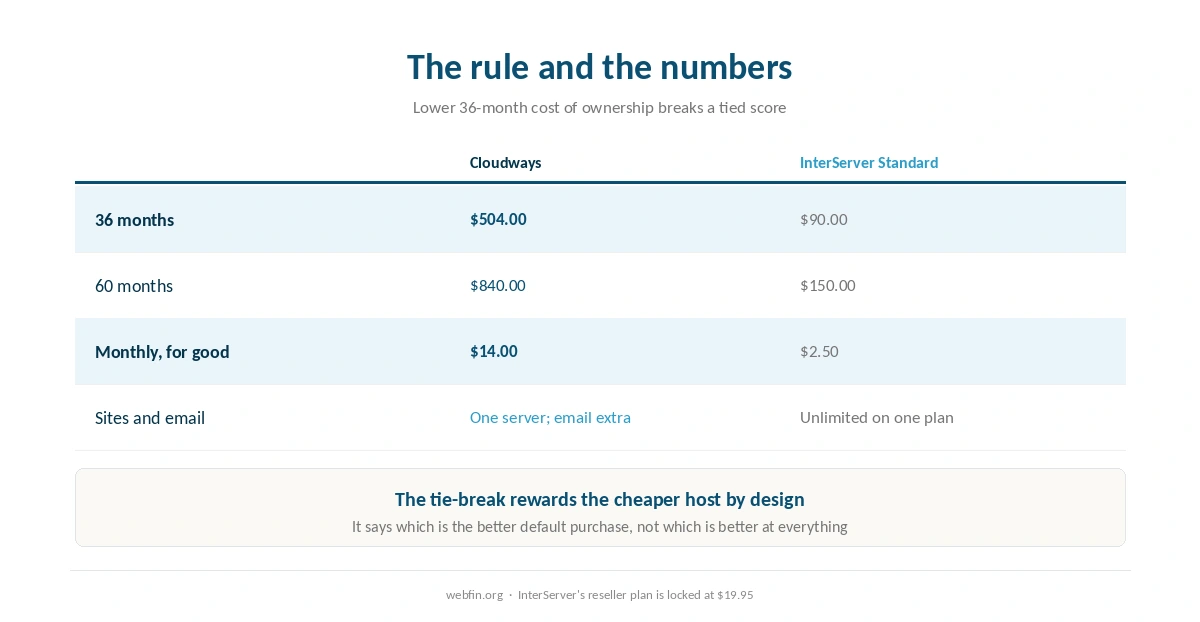
Both hosts score 4.1. What happens next is written on our about page rather than decided here. A tie goes to the lower cost of ownership over 36 months, and if that ties too, to the host that publishes its renewal price rather than showing it at checkout.
The first test settles it immediately. InterServer costs $90.00 across 36 months and Cloudways $504.00. Over five years the gap is larger still, because neither price changes and InterServer’s is a sixth of the other. The rule was written before this comparison, and it rewards the cheaper host by design.
⚠️ It is worth naming what the rule leaves out. Cloudways has the stronger measured record, the choice of cloud and hourly billing. A tie-break on price says which host is the better default purchase, not which is better at everything.
| Host and plan | How it builds | 36-month total |
|---|---|---|
| ChemiCloud Starter, 36-month term | 36 prepaid months at $2.49 | $89.64 |
| InterServer Standard | 36 months at $2.50, price locked | $90.00 |
| DreamHost Launch, 48-month term | 36 of 48 prepaid months at $2.89 | $104.04 |
| Namecheap Stellar, 24-month term | 24 at $1.98, then 12 at $4.88 | $106.08 |
| Hostinger Premium, 48-month term | 36 of 48 prepaid months at $2.99 | $107.64 |
| HostGator Hatchling, 36-month term | 36 months at $3.75, renewal not reached | $135.00 |
| HostGator Hatchling, with daily backups | 36 at $3.75, plus CodeGuard at $35.88 a year | $242.64 |
| Bluehost Starter, 36-month term | 36 months at $3.99, renewal not reached | $143.64 |
| GoDaddy Economy, 36-month term | 36 months at $5.99, renewal not reached | $215.64 |
| GoDaddy Economy, with SSL from year two | 36 at $5.99, plus $119.99 in years two and three | $455.62 |
| Hostwinds Basic, annual | 12 at $4.54, then 24 at $6.99 | $222.24 |
| SiteGround StartUp, 24-month term | 24 at $2.99, then 12 at $14.99 | $251.64 |
| DreamHost Launch, annual | 12 at $2.89, then 24 at $10.99 | $298.44 |
| Scala Hosting Mini, annual | 12 at $2.95, then 24 at $11.95 | $322.20 |
| Bluehost Starter, 12-month term | 12 at $3.99, then 24 at $11.99 | $335.64 |
| IONOS Plus, annual | 12 at $1.00, then 24 at $14.00 | $348.00 |
| GreenGeeks Lite, 36-month prepay | 36 months at $2.95 | $106.20 |
| GreenGeeks Lite, annual | 12 at $2.95, then 24 at $13.95 | $370.20 |
| SiteGround StartUp, 12-month term | 12 at $2.99, then 24 at $17.99 | $467.64 |
| Cloudways, from | 36 months at $14.00, flat | $504.00 |
| A2 Hosting Turbo Boost, annual | 12 at $6.99, then 24 at $20.99 | $587.64 |
| Rocket.net Starter, annual | 12 at $25.00, then 24 at $30.00 | $1,020.00 |
| WP Engine Startup, annual | 12 at $27.00, then 24 at $35.00 | $1,164.00 |
| Liquid Web managed VPS | 36 months at $33.00 | $1,188.00 |
| Kinsta Starter | 36 months at $35.00, flat | $1,260.00 |
| InMotion Core, 36-month term | 36 months at $3.19, renewal not reached | $114.84 |
| InMotion Launch, 36-month term | 36 months at $4.99, renewal not reached | $179.64 |
The Price Lock Against a Flat Rate
Neither host has a promotional term that expires, which is rare in this market. InterServer holds $2.50 for the life of the account, and Cloudways charges $14.00 from the first month to the last. So a buyer comparing these two is comparing steady prices rather than guessing at renewals.
InterServer’s one plan also holds unlimited sites, storage and email under an acceptable use policy, so a second or fifth site costs nothing extra. Cloudways prices by server, and a portfolio of sites can share one, though email needs a separate provider at about a dollar a mailbox. Our list of hosting for multiple sites covers both shapes.
The Evidence Favors Cloudways
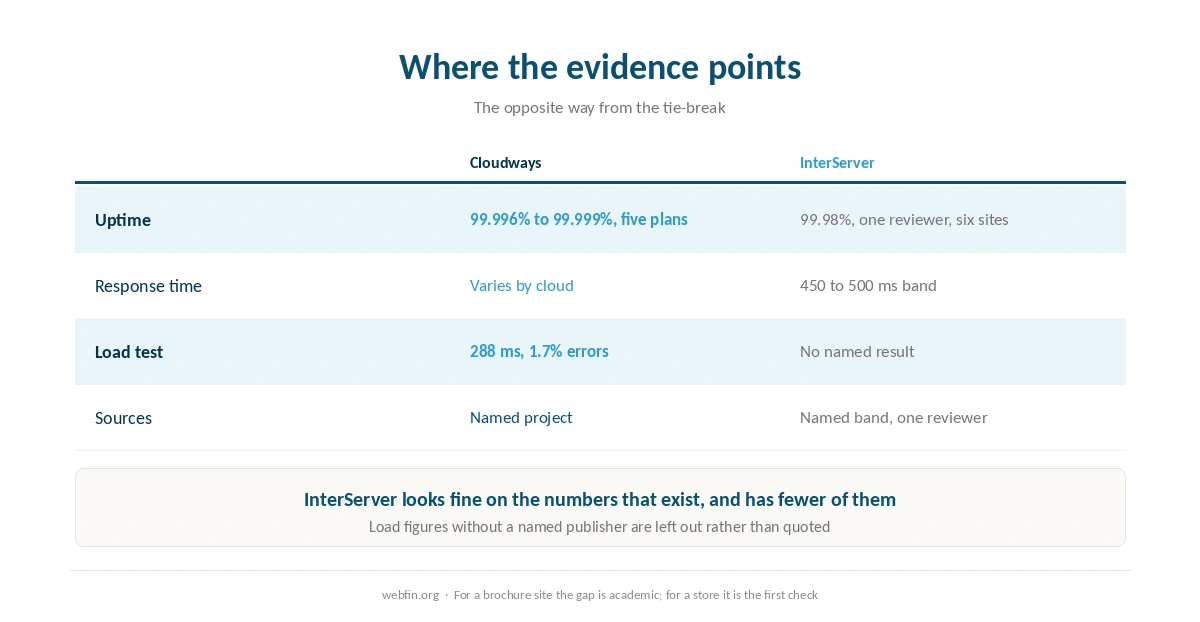
We run no tests, so these figures belong to Hostingstep. Cloudways held uptime between 99.996% and 99.999% across five plans from October 2025 to May 2026. Its weakest published result is a load test on the Vultr High Frequency plan, at 288 ms with a 1.7% error rate.
InterServer sits in the 450 to 500 ms band for response time in the same project, a reasonable result. Its uptime figure of 99.98% comes from one reviewer monitoring six production sites for eighteen months, which we name as that rather than as a benchmark. The load figures we hold for it come from sources we could not attribute, so we leave them out.
⚠️ That is an evidence gap rather than a verdict. InterServer looks fine on the numbers that exist and has fewer of them. For a brochure site the difference is academic; for a store it is the first thing to check. Our guide to reading an uptime report explains why a named monitor weighs more than a single reviewer.
Two Different Kinds of Simplicity
InterServer is simple because there is one plan and one price. There are no tiers to be upsold into, no renewal to diarize and no visit allowance to watch. It runs standard cPanel, so every tutorial matches the screen, as our guide to understanding cPanel describes.
Cloudways is simple in the opposite way: the server is managed for you, and the console is organized around applications rather than hosting accounts. SSH, WP-CLI, Git deployment, staging and PHP version selection ship on every tier. You still decide the cloud and the size. Our list of hosting for developers covers that tooling.
Support and Leaving
InterServer answers phone, chat and tickets around the clock. Cloudways answers chat and tickets and sells phone support as an add-on. Neither publishes a measured response time, and no controlled test of hosting support exists in the sources we found, so the difference is the channel.
Leaving differs more. An InterServer account exports in the standard cPanel format that another cPanel host can import. Cloudways has its own console, so moving away means moving each site. Our guide to migrating web hosting covers both routes.
Commitment
InterServer asks for a prepaid term and refunds within 30 days, excluding domains. Cloudways asks for nothing: stop the server and billing stops. For a project that may end within months, that flexibility is worth part of the difference, though at $2.50 a month the sum at risk is small either way.
For a site you expect to keep, the lock is the stronger promise. A price that never moves removes the single most common surprise in shared hosting, which our page on hosting renewal prices documents across the field.
Who Owns Them
DigitalOcean acquired Cloudways in 2022 and sells the cloud underneath many of its servers. InterServer states that it has been independent since 1999 and owns its data centers, which is rare at this price.
For a price lock, that history is the guarantee. A lock is only a policy, and a policy outlives an owner only if the owner does. InterServer has kept the same one for more than two decades; the renewal changes we have documented across this site followed sales.
The Five-Year View
Neither host has a renewal to plan for, so five years is simple arithmetic. InterServer charges sixty times $2.50, and Cloudways sixty times $14.00. The second figure is nearly six times the first, and every further year keeps that ratio. For a site that earns nothing, the ratio is the whole argument. For a site that earns, the question is whether measured uptime and a server you can resize are worth the other five sixths.
Moving Between Them
A site can move from InterServer to Cloudways when it outgrows shared hosting, and Cloudways provides a migration plugin for WordPress. Email has to move separately, because Cloudways does not host it, and our guide to setting up email on your domain covers the records.
The other direction is easier than usual: a Cloudways site that no longer justifies a server can go to a cPanel account for $2.50 a month. Either way the domain stays at its registrar and points at the new host, as our guide to pointing a domain to a new host explains.
Which Site Belongs Where
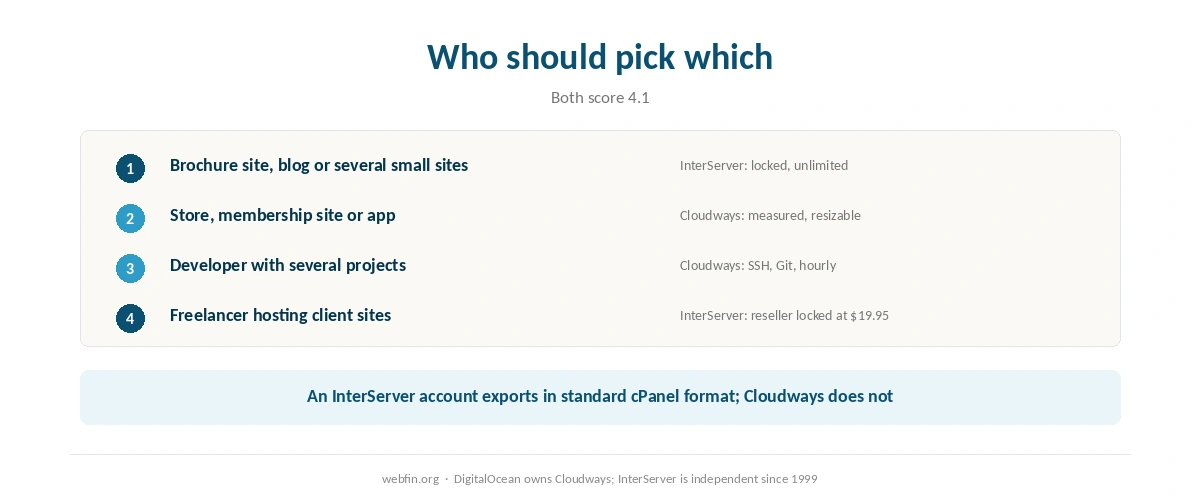
A brochure site, a blog or several small sites. InterServer, for a locked price and unlimited sites on one plan.
A store, a membership site or an application. Cloudways, because you can check how it behaves and size it for the work. Our list of hosting for ecommerce covers that case.
A developer with several projects. Cloudways, for SSH, Git and billing by the hour.
A freelancer hosting client sites. InterServer’s reseller plan is locked at $19.95, which our roundup of reseller hosting covers.
Where Each One Is Weakest
InterServer is weakest on evidence and on tooling. There is no named load result, its uptime figure comes from one reviewer, and there is no staging layer or choice of region built in.
Cloudways is weakest on price for a small site and on what it leaves out: no email, no cPanel, and phone support only as an add-on. Its own load result is not clean either, at a 1.7% error rate on one cloud.
Winners by Category
Tie-break, cost of ownership: InterServer, at $90.00 against $504.00. Sites and email: InterServer, unlimited on one plan. Support channels: InterServer, with a phone line. Named uptime: Cloudways, across five plans. Load evidence: Cloudways, which completed the test. Billing flexibility: Cloudways, hourly. Portability: InterServer, on standard cPanel.
How We Research
We run no tests. Cloudways figures and the InterServer response band come from Hostingstep with their windows. The InterServer uptime figure comes from a reviewer who monitored six production sites, and we name it as that. Figures we could not attribute to a named publication are left out.
Prices come from the providers’ own pages, read on 20 September 2026. When two hosts tie on score we apply the tie-break published on our about page and say what it leaves out. The full workings are in our InterServer review.
Cloudways vs InterServer FAQ
InterServer, by a wide margin: $90.00 across 36 months at a locked $2.50 a month, against $504.00 at Cloudways’ flat $14.00. Neither price steps up, so the gap simply grows with time.
They win different criteria and land level. Our published tie-break gives a tie to the lower 36-month cost of ownership, which is InterServer. Cloudways keeps the stronger measured record, the choice of cloud and hourly billing.
Cloudways has the better evidence: 99.996% to 99.999% uptime across five plans from a named project. InterServer’s 99.98% comes from one reviewer monitoring six sites for eighteen months, and it has no named load result.
Its price lock commits to the same monthly rate for the life of the account, and Standard has stayed at $2.50. It is a policy rather than a contract clause, which is why the company’s long independent ownership matters.
InterServer for several small sites, because one plan holds unlimited sites and email. Cloudways can host many applications on one server, but email lives elsewhere at about a dollar a mailbox.
The Verdict
InterServer takes this on our published tie-break, and the margin is not subtle: $90.00 against $504.00 across three years, with unlimited sites and email on one plan and a phone line included. For a brochure site, a blog or a handful of small projects, it is the better purchase by a wide margin. Our page on Cloudways for WordPress covers a shape rather than a speed.
Cloudways is the better host to verify and the better server to grow into. Its uptime is measured across five plans, it bills by the hour, and it runs anything. For a store, an application or a developer’s portfolio, that is worth the difference. Our page on what web hosting costs runs both totals further.