
Disclosure: WebFin is reader-supported. If you buy hosting through links on this page, we may earn a commission at no extra cost to you. Commissions vary between providers and our ratings do not — here’s our full disclosure.
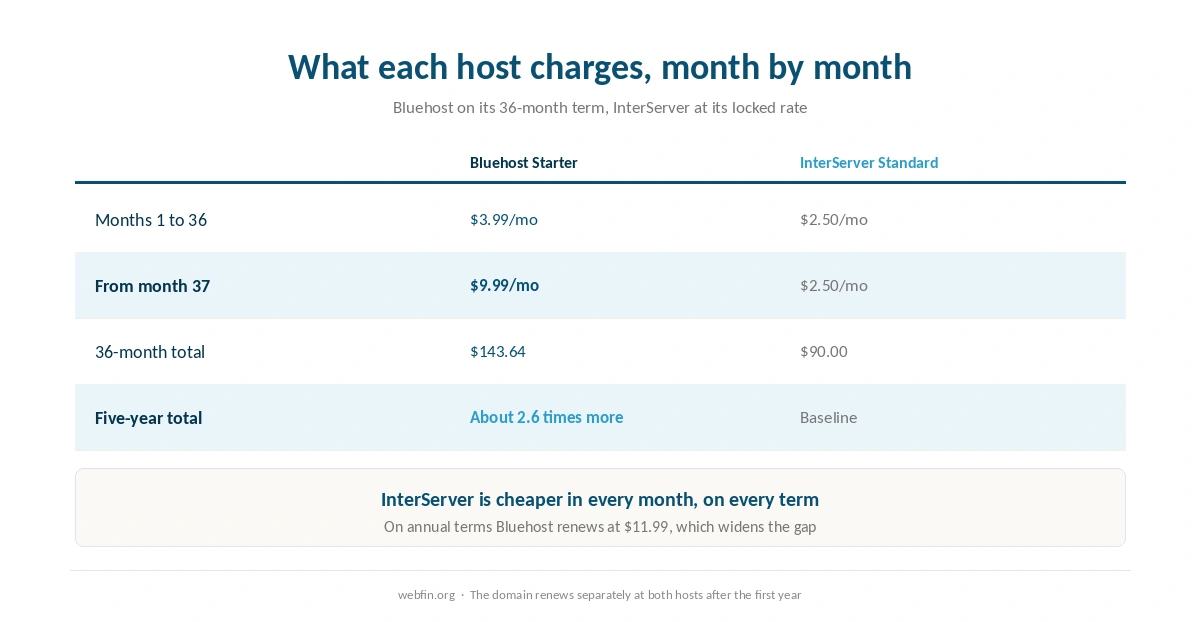
Bluehost vs InterServer is a price lock against the most thoroughly measured shared host we cite. InterServer Standard costs $2.50 a month and keeps costing $2.50, so three years come to $90.00 and five years to well under half of what Bluehost charges. Bluehost Starter costs $143.64 across 36 months and renews at $9.99. InterServer also scores higher in our reviews, at 4.1 against 4.0. What Bluehost offers in return is evidence: a load test passed at 41 ms, a hardware score of 9.6 and uptime counted outage by outage. The same InterServer figures against a Cloudways server are in our Cloudways and InterServer comparison.
Bluehost vs InterServer: The Short Answer
InterServer, for most small sites. It is cheaper at every stage, its price never renews upward, one plan holds unlimited sites and email, and it answers the phone. Bluehost is the better choice for a store or any site that expects traffic spikes, because its behavior under load is measured and InterServer’s is not.
Head to Head
| Criterion | Bluehost Starter | InterServer Standard |
|---|---|---|
| Intro rate | $3.99/mo, 36-month term | $2.50/mo |
| Renewal | $9.99 on 36 months, $11.99 on 12 | $2.50, locked |
| Renewal step | 2.5× over 36 months | 1.0× over any term |
| 36 months | $143.64 | $90.00 |
| Sites and email | Starter limits; 100 MB per mailbox | Unlimited on one plan |
| Load test | 41 ms, no errors | No named result |
| Server hardware | 9.6 of 10 | Not in our table |
| Uptime | 99.99%, 9 outages counted | 99.98% on six sites, one reviewer |
| Support | Phone and chat, 24/7 | Phone, chat and tickets, 24/7 |
| Owner | Newfold Digital, 2021 | Independent since 1999 |
| Our score | 4.0 | 4.1 |
Cheaper at Every Stage, and for Good
InterServer’s price lock means the $2.50 rate holds for as long as the account exists. Across 36 months that is $90.00, against $143.64 at Bluehost on its three-year term. After that the gap widens every month, because Bluehost renews at $9.99 and InterServer stays where it started.
On annual terms the difference is larger still. Bluehost renews at $11.99 on a 12-month term, which takes its three-year total to $335.64. There is no term, length of stay or renewal scenario on either host’s published pricing in which Bluehost costs less. Our page on hosting renewal prices puts both at opposite ends of the field.
⚠️ A lock is a policy, not a law. It holds as long as the company keeps it, which is why InterServer’s ownership below matters more than it would for most hosts. Bluehost pricing is also disputed between sources, with a July 2026 review quoting $1.99 renewing at $8.99. Even that reading stays well above $2.50.
| Host and plan | How it builds | 36-month total |
|---|---|---|
| ChemiCloud Starter, 36-month term | 36 prepaid months at $2.49 | $89.64 |
| InterServer Standard | 36 months at $2.50, price locked | $90.00 |
| DreamHost Launch, 48-month term | 36 of 48 prepaid months at $2.89 | $104.04 |
| Namecheap Stellar, 24-month term | 24 at $1.98, then 12 at $4.88 | $106.08 |
| Hostinger Premium, 48-month term | 36 of 48 prepaid months at $2.99 | $107.64 |
| HostGator Hatchling, 36-month term | 36 months at $3.75, renewal not reached | $135.00 |
| HostGator Hatchling, with daily backups | 36 at $3.75, plus CodeGuard at $35.88 a year | $242.64 |
| Bluehost Starter, 36-month term | 36 months at $3.99, renewal not reached | $143.64 |
| GoDaddy Economy, 36-month term | 36 months at $5.99, renewal not reached | $215.64 |
| GoDaddy Economy, with SSL from year two | 36 at $5.99, plus $119.99 in years two and three | $455.62 |
| Hostwinds Basic, annual | 12 at $4.54, then 24 at $6.99 | $222.24 |
| SiteGround StartUp, 24-month term | 24 at $2.99, then 12 at $14.99 | $251.64 |
| DreamHost Launch, annual | 12 at $2.89, then 24 at $10.99 | $298.44 |
| Scala Hosting Mini, annual | 12 at $2.95, then 24 at $11.95 | $322.20 |
| Bluehost Starter, 12-month term | 12 at $3.99, then 24 at $11.99 | $335.64 |
| IONOS Plus, annual | 12 at $1.00, then 24 at $14.00 | $348.00 |
| GreenGeeks Lite, 36-month prepay | 36 months at $2.95 | $106.20 |
| GreenGeeks Lite, annual | 12 at $2.95, then 24 at $13.95 | $370.20 |
| SiteGround StartUp, 12-month term | 12 at $2.99, then 24 at $17.99 | $467.64 |
| Cloudways, from | 36 months at $14.00, flat | $504.00 |
| A2 Hosting Turbo Boost, annual | 12 at $6.99, then 24 at $20.99 | $587.64 |
| Rocket.net Starter, annual | 12 at $25.00, then 24 at $30.00 | $1,020.00 |
| WP Engine Startup, annual | 12 at $27.00, then 24 at $35.00 | $1,164.00 |
| Liquid Web managed VPS | 36 months at $33.00 | $1,188.00 |
| Kinsta Starter | 36 months at $35.00, flat | $1,260.00 |
| InMotion Core, 36-month term | 36 months at $3.19, renewal not reached | $114.84 |
| InMotion Launch, 36-month term | 36 months at $4.99, renewal not reached | $179.64 |
Five Years at Each Host
Most small sites outlast their promotion, so the long view is the honest one. At InterServer, sixty months cost sixty times $2.50. At Bluehost, thirty-six months at $3.99 are followed by twenty-four at $9.99, and the total is more than two and a half times the InterServer figure.
The domain sits outside both numbers. Each host bundles a free domain for the first year and then renews it at its own rate on its own date, so budget that line separately. Our page on what web hosting costs runs these totals across the field.
The Measured Record Favors Bluehost
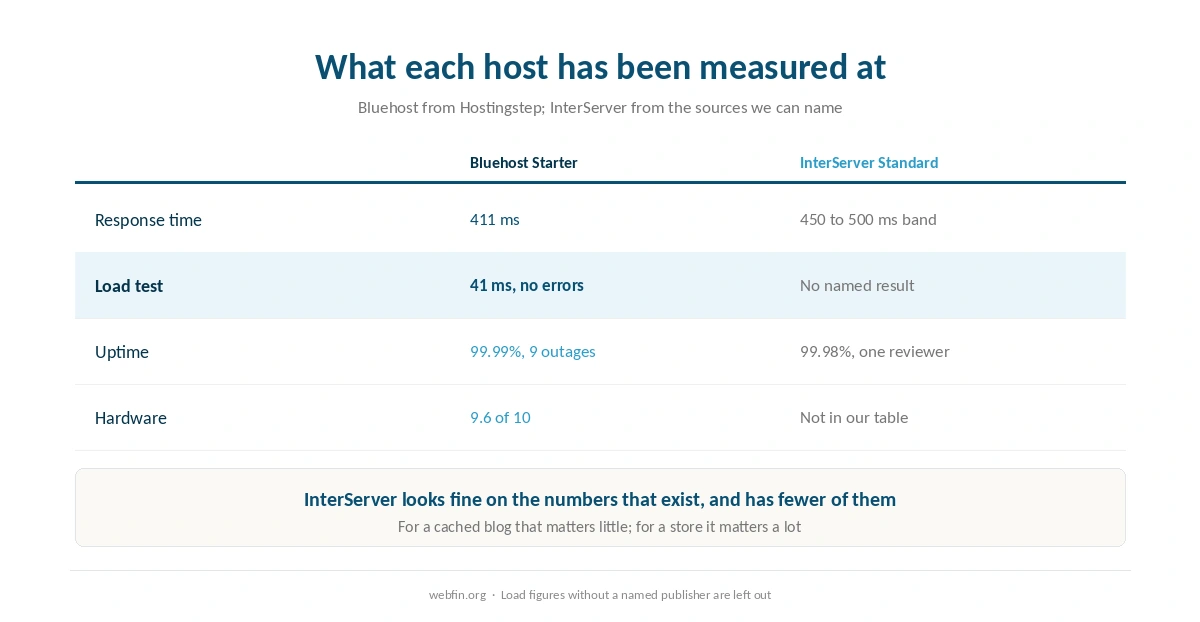
We run no tests, so these figures belong to Hostingstep. Bluehost records 411 ms response time and 99.99% uptime over 9 outages between November 2025 and August 2026. After its move to Oracle Cloud it passed the load test, which ramps to 100 concurrent visitors, at 41 ms without an error. Its hardware scores 9.6 of 10, at the top of that project’s shared results.
InterServer sits in the 450 to 500 ms band for response time in the same project, a reasonable result. Beyond that its record is thinner. Its uptime figure of 99.98% comes from one reviewer monitoring six production sites for eighteen months, and the load figures we hold for it come from sources we have not been able to name, so we leave them out.
⚠️ So InterServer looks fine on the numbers that exist and has fewer of them. For a brochure site that rarely sees a crowd, that matters little. For a store, it matters a lot. Our guide to reading an uptime report explains why a named monitor weighs more than a single reviewer.
Which Result Matters for Your Site
For a brochure site or a blog behind a page cache, most visitors receive a stored copy, and the server rarely meets a hundred people at once. On a site like that, the measured gap between these hosts is unlikely to be felt, and the price gap is felt every month.
For a store or a membership site, carts and logins bypass the cache, so the server works on every request. That is where a clean, named load result earns its keep, and where Bluehost’s higher price buys something concrete. Our roundup of hosting for high traffic ranks hosts by that result.
One Plan Against a Menu
InterServer sells one shared plan. Storage, bandwidth, email and the number of sites are all sold as unlimited, and there is no tier to be upgraded into later. Like every plan sold that way it runs under an acceptable use policy, which our piece on what unlimited hosting means explains.
Bluehost sells tiers and a menu of extras from its dashboard: a premium certificate at $89.88 that most sites do not need, SiteLock, Yoast SEO Premium and domain privacy at $15.00 a year. Newfold Digital owns both Bluehost and Yoast. Starter also caps each mailbox at 100 MB, which a small business outgrows quickly.
For a buyer who runs several small sites, or a business that wants a mailbox per person, the single InterServer plan removes most of the decisions Bluehost asks you to make. Our guide to setting up email on your domain covers the records either way.
What the Lock Covers, and What It Does Not
The lock applies to the hosting plan. The domain renews on its own schedule at its own price. Any extra service you add is billed separately. So a buyer comparing the two should compare the plans first, then the domain terms, rather than assume the $2.50 covers everything.
InterServer applies the same approach to its reseller plan, locked at $19.95, which suits someone who hosts sites for clients and needs to quote a price that holds. Bluehost publishes no price lock for its shared plans. Each rate we have recorded for it is a promotion with a renewal behind it. Our roundup of reseller hosting covers the client-work case.
Support and Refunds
InterServer answers phone, chat and tickets around the clock. Bluehost answers phone and chat around the clock. Neither publishes a measured response time, and no controlled test of hosting support exists in the sources we found, so on this line the two are close to level.
Both refund within 30 days and exclude domains, and Bluehost keeps $15.99 for a free domain if you cancel early. Our guide to canceling hosting and getting a refund covers the order that keeps the domain safe.
Panels and Everyday Use
Both hosts run cPanel, so accounts export in a standard format and every tutorial matches the screen. Bluehost wraps it in a WordPress-focused dashboard that handles installs and updates and also carries its add-on menu. InterServer stays closer to plain cPanel, which suits anyone who already knows it.
Our guide to understanding cPanel shows where each plan’s real limits appear, which is worth checking on an unlimited plan in particular.
Who Owns Them
Bluehost has belonged to Newfold Digital since 2021, alongside HostGator and Yoast SEO, and who owns Bluehost traces the group. InterServer states that it has been independent since 1999 and owns its data centers, which is rare at this price.
For a price lock, that history is the guarantee. A company that has kept the same owner for more than two decades is a better guarantor of a lock than one that could be sold, and a sale is how renewal policies usually change.
Where Each One Is Weakest
InterServer is weakest on evidence. Its measured record is thinner than Bluehost’s, there is no named load result, and there is no white-label or staging layer built in. None of that is a sign of poor service; it is a reason to watch a busy site closely.
Bluehost is weakest on price and after checkout. It costs more at every stage, its renewal depends on the term, and its dashboard sells extras. Those costs are visible in advance, and our page on hidden hosting fees collects them.
Winners by Category
Price at every stage: InterServer, at $2.50 locked. Three years: InterServer, at $90.00 against $143.64. Sites and email: InterServer, unlimited on one plan. Measured record: Bluehost, complete and named. Load handling: Bluehost, at 41 ms without errors. Support channels: InterServer, with tickets as well as phone and chat. Ownership stability: InterServer, independent since 1999.
When to Choose Bluehost Instead
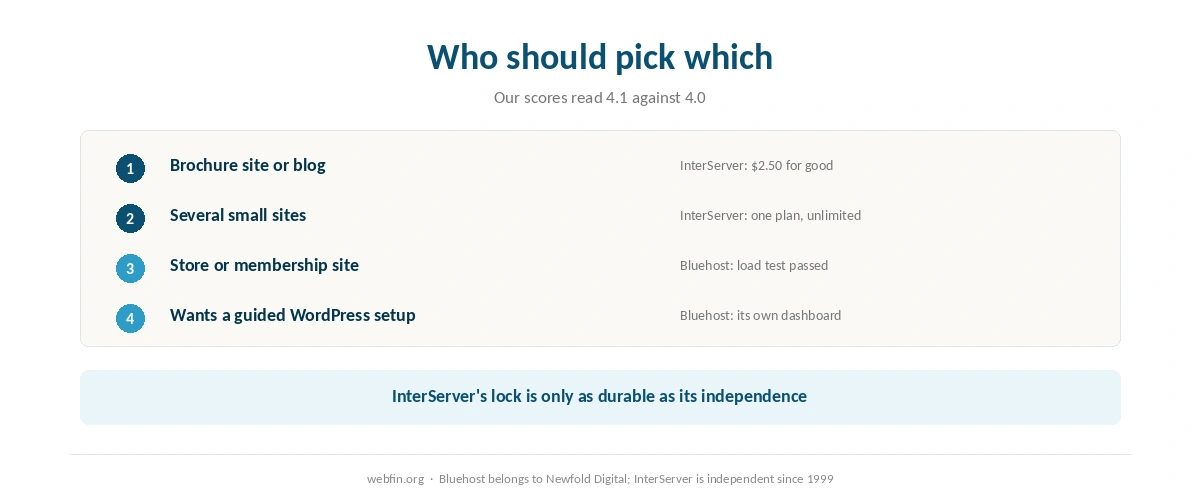
Take Bluehost for a store, a membership site or anything that expects bursts of visitors, because its behavior under load is measured and clean. Take it too if you want a WordPress dashboard that guides you through setup. Our list of hosting for ecommerce covers the store case.
Take InterServer for almost everything else: brochure sites, blogs, several small sites on one account, and anyone who wants to set a price once and never revisit it. Our comparison of SiteGround against InterServer weighs the same lock against another rival.
How We Research
We run no tests. Bluehost figures and the InterServer response band come from Hostingstep with their windows. The InterServer uptime figure comes from a reviewer who monitored six production sites, and we name it as that. Figures we could not attribute to a named publication are left out. Prices come from the providers’ own pages, read on 20 September 2026.
The criteria behind our scores are on our about page, and the full workings are in our InterServer review.
Bluehost vs InterServer FAQ
InterServer, at every stage. It costs $2.50 a month with the price locked, so three years come to $90.00 against $143.64 at Bluehost on its best term. Bluehost then renews at $9.99, so the gap widens every month after that.
A commitment that the monthly rate stays the same for as long as the account exists. Standard costs $2.50 and keeps costing $2.50. It is a policy rather than a contract clause, which is why the company’s long independent ownership matters.
Bluehost has the measured record: a load test at 41 ms without errors, hardware at 9.6 of 10 and 99.99% uptime over counted outages. InterServer sits in the 450 to 500 ms band for response time and has no named load result.
Bluehost, because checkout cannot be cached and its load result is measured and clean. InterServer may handle a store well, but nothing we can name shows how it behaves with a hundred buyers at once.
Bluehost belongs to Newfold Digital, which also owns HostGator and Yoast SEO. InterServer states that it has been independent since 1999 and owns its data centers.
The Verdict
InterServer takes this, and our scores agree at 4.1 against 4.0. It is cheaper at every stage, it never renews upward, and one plan covers what Bluehost splits across tiers and add-ons. Across five years it costs well under half as much.
Bluehost is the better host to verify, and that matters most for stores and busy sites. For a site that takes payments or expects crowds, its load result is worth the difference. Otherwise the price lock is the stronger argument. Should you move later, our guide to migrating web hosting covers the order.