
Disclosure: WebFin is reader-supported. If you buy hosting through links on this page, we may earn a commission at no extra cost to you. Commissions vary between providers and our ratings do not — here’s our full disclosure.
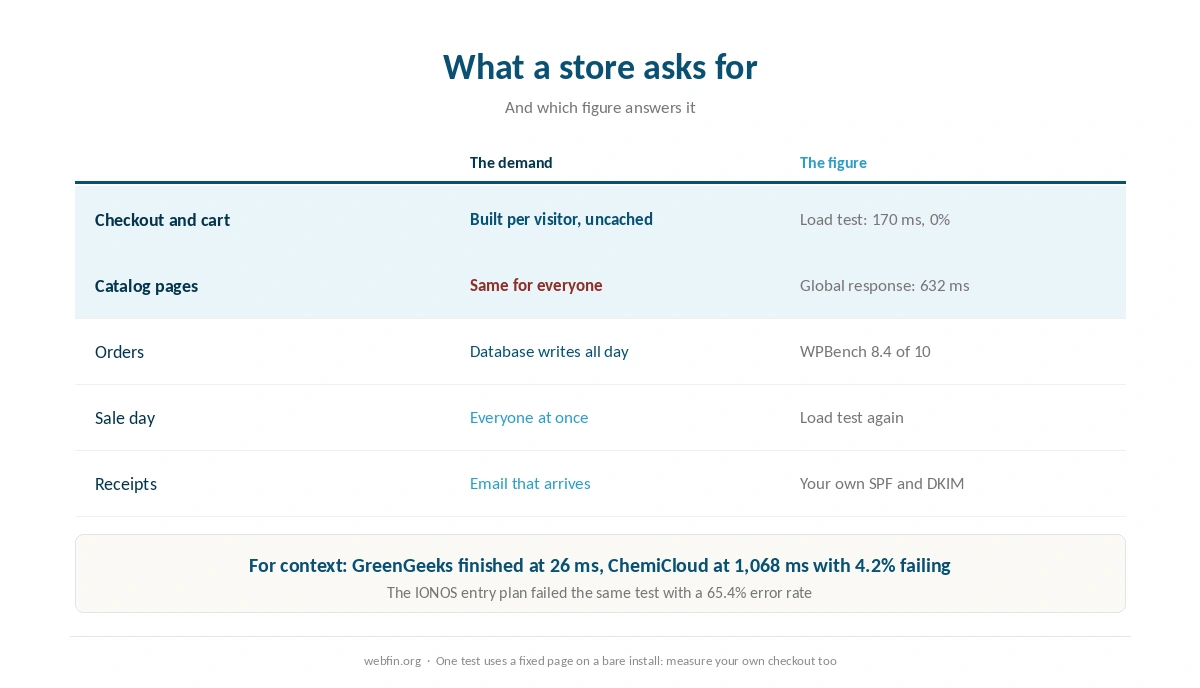
For a store, the measurement that matters is the load test, because a checkout is never cached. SiteGround has one: its shared plan finished the 2026 test at 170 ms with a 0% error rate, and scores 8.4 of 10 on that project’s WordPress benchmark. That is the figure our page on Hostinger for WooCommerce could not supply, because no load result exists for that host. Here it does, and it is good.
Is SiteGround Right for WooCommerce? The Short Answer
Yes for a small or mid-sized store, on the 24-month term, with GrowBig rather than StartUp if you want staging. The load result covers the pages a store depends on, daily backups are included and there is a phone line. Watch three things: a 632 ms global response, 44 outages across 2025, and a renewal that depends on the term you signed.
What a Store Needs, Briefly
Uncached pages on every click. Cart, checkout and account pages are built per visitor, so the server answers each time. That is what a load test measures.
Database writes. Every order writes rows, and stock changes touch products while customers read them, which our guide to fixing a slow database covers over a year of trading.
Concurrency on the worst day. A sale sends everyone to the checkout at once, which our guide to handling a traffic spike covers.
Receipts that arrive. Order confirmations are part of the product, and our guide to setting up email on your domain covers the records.
| Host | Measurement | Source and date |
|---|---|---|
| WP Engine | Global TTFB 65 ms, 1st of 34 hosts | Hostingstep, 2025 ranking, 40 locations |
| WP Engine | US TTFB 365 ms across 22 locations | Hostingstep, 2025 ranking |
| WP Engine | TTFB 355 ms, 349,920 checks | Hostingstep, Oct 2025 – May 2026 |
| WP Engine | Uptime 99.976%, 10th of 14 managed hosts | Study of 14 managed hosts, 2026 |
| WP Engine | Load 27 ms at 0% errors | Hostingstep, 2026 benchmarks |
| Rocket.net | Cached TTFB 85 ms globally | 12-month test, Mar 2025 – Mar 2026 |
| Rocket.net | Origin TTFB 310 ms; checkout bypasses cache | Same 12-month test |
| Rocket.net | Uptime 99.97%, seven outages in the window | Hostingstep, Oct 2025 – May 2026 |
| Rocket.net | Hardware score fell 8.5 → 7.5; not recommended | Hostingstep, 2026, tracked since Oct 2020 |
| Hostinger Business | Global TTFB 223 ms, 5th of 34 hosts | Hostingstep, 2026 |
| Hostinger Premium | Global TTFB 495 ms, 28th of 34; no CDN | Hostingstep, 2026 |
| Hostinger | TTFB 707 ms; server response 246 ms | Cybernews, June 2026 |
| Hostinger | Uptime 99.99%, 33 min down in 2025 | Hostingstep, continuous since 2021 |
| Hostinger | Uptime 99.93%, 6-month window | HostPro Reviews, 2026 |
| Hostinger | LCP 0.607 s, 2nd of 15 hosts | TechRadar, 10-week window, 2026 |
| Bluehost | Hardware score 9.6 of 10 | Hostingstep, 2026 |
| Bluehost | Load 41 ms at 0% errors after the Oracle move | Hostingstep changelog, 9 Jul 2026 |
| Bluehost | Response 411 ms; uptime 99.99% across 9 outages | Hostingstep, Nov 2025 – Aug 2026 |
| Bluehost | Global TTFB 224 ms across 40 locations, cached | Hostingstep Bluehost review, Jul 2026 |
| HostGator | Global TTFB 1.23 s; uptime 99.68%; 762 ms at 500 users | Hostingstep HostGator review, 2026 |
| HostGator | Hardware joint-highest in the field after the Oracle move | Hostingstep, 1 Sep 2026 update |
| ChemiCloud | US TTFB 531 ms; global 460 ms | Hostingstep, Oct 2025 – May 2026 |
| ChemiCloud | Load 1,068 ms at a 4.2% error rate | Hostingstep, same window |
| ChemiCloud | Uptime 99.76%; overall 6.1 of 10, degrading | Hostingstep, tracked since 2021 |
| GoDaddy shared | TTFB 751 ms; load test did not complete | Hostingstep, Nov 2025 – Jun 2026 |
| GoDaddy shared | Uptime 99.76% | Hostingstep, Nov 2025 – Jun 2026 |
| GoDaddy Managed WordPress | TTFB 344 ms; hardware 3.8 of 10 | Hostingstep, 2026 |
| GreenGeeks | TTFB 395 ms North America, 447 ms Europe | Long-term independent testing, 2026 |
| GreenGeeks | TTFB 580–610 ms Asia and Australia | Same testing window |
| GreenGeeks | Load 26 ms at 0% errors; WPBench 5.0 of 10 | Hostingstep, 2026 |
| GreenGeeks | 25 outages in the window; no integrated CDN found | Hostingstep, 2026 |
| Kinsta | Origin TTFB 525 ms; edge figures differ | Hostingstep, 2026 |
| Kinsta | Load 40 ms at 0% errors; WPBench 8.8 of 10 | Hostingstep, 2026 reviews |
| DreamHost | TTFB 450–500 ms band | Hostingstep, 2026 benchmarks |
| Scala Hosting | Uptime 99.97% across twelve months | Live site, 40,000 monthly visitors, UptimeRobot |
| Scala Hosting | 29 ms at the 95th percentile, 50 users | k6 load test, 2026 |
| InterServer | Uptime 99.98% across eighteen months | Six production sites, UptimeRobot |
| InterServer | Load under 700 ms; under 1.5 s by another source | Two 2026 reviews |
| A2 Hosting | TTFB 150–198 ms | 2026 studies; LiteSpeed on Turbo tiers |
| IONOS | Global TTFB 480 ms; WPBench 7.2 of 10 | Hostingstep, 2026 benchmarks |
| IONOS | Uptime 99.99%; load test failed at 65.4% errors | Hostingstep, 2026 benchmarks |
| Namecheap | TTFB 461 ms; global 448 ms; WPBench 5.0 | Hostingstep, Q4 2025; monitoring paused 30 Jun 2026 |
| InMotion | TTFB 300–500 ms shared | Published measurement, 2026 |
| InMotion | Uptime 99.97–99.99%; one account near 99.5% | Several 2026 sources |
| Hostwinds | No independent measurement found | 99.9999% is the company's own claim |
| Liquid Web | Not covered by the benchmarks we cite | VPS and dedicated are outside their scope |
| SiteGround | TTFB 632 ms; 22nd of 34 hosts | Hostingstep, 2026 benchmarks |
| SiteGround | Uptime 99.96% in 2025; 193 min over 44 outages | Hostingstep, full year 2025 |
| SiteGround | WPBench 8.4 of 10; load 170 ms at 0% errors | Hostingstep, Oct 2025 – May 2026 |
| Scala Hosting | TTFB 465 ms; global 501 ms | Hostingstep, 2026 benchmarks |
| Scala Hosting | WPBench 8.8 of 10; load 48 ms at 0% errors | Hostingstep, 2026 benchmarks |
| Scala Hosting | Uptime 99.98% across the year | Hostingstep, 2026 benchmarks |
| Cloudways | Vultr HF: load 288 ms at 1.7% errors; WPBench 7.6 | Hostingstep Cloudways review, 2026 |
| Cloudways | Uptime 99.996% to 99.999% across five plans | Hostingstep, Oct 2025 – May 2026 |
Why the Load Result Matters Here
The benchmark ramps to 100 concurrent visitors over 60 seconds. SiteGround answered at 170 ms without dropping a request, in the October 2025 to May 2026 window.
For context from the same project: GreenGeeks finished at 26 ms and Kinsta at 40 ms, both clean. ChemiCloud answered at 1,068 ms with 4.2% of requests failing, and the IONOS entry plan failed the test with a 65.4% error rate. SiteGround sits comfortably in the group that completed it.
⚠️ One test is not a guarantee. It uses a fixed page on a bare install, so measure your own checkout once the store is live, as our guide to testing your site speed properly describes.
The Three Things to Watch
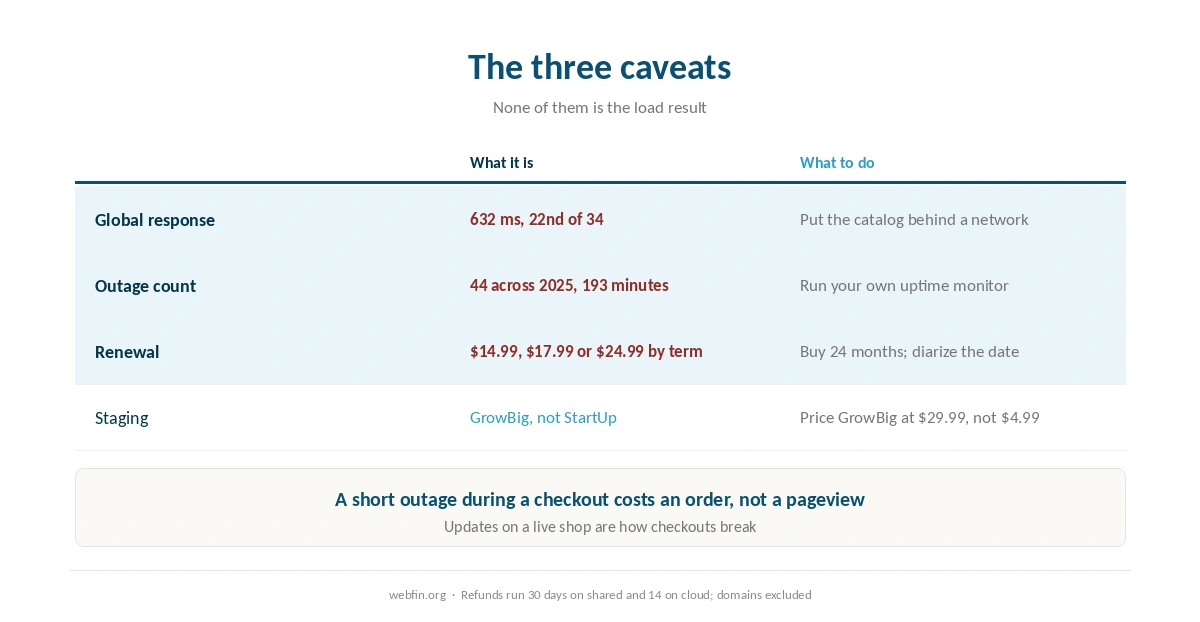
632 ms globally, 22nd of 34 hosts. Product pages cache well, so a content network fixes this for customers abroad, which our guide to setting up a CDN covers. The checkout stays uncached either way.
Forty-four outages across 2025. Total downtime was 193 minutes, which is small, but a short outage during a checkout is a lost order rather than a lost pageview. Run your own uptime monitor.
The renewal depends on the term. StartUp renews at $14.99 on a 24-month term, $17.99 on 12 months and $24.99 month to month. GrowBig opens at $4.99 and renews at $29.99, which our page on SiteGround for WordPress works through in three-year totals.
StartUp or GrowBig for a Store
StartUp runs a store, and the load result belongs to a shared plan of that kind. What it lacks is staging, which GrowBig adds.
For a store, staging is not a luxury. Plugin and theme updates on a live shop are how checkouts break, and a copy to test on costs less than one lost afternoon of orders. Our guide to setting up a staging site covers the workflow.
⚠️ Price GrowBig at its renewal rather than its intro rate. At $29.99 a month it is a different decision from $4.99, and the term you choose changes it again.
What Changes at GrowBig
Beyond staging, the higher tier is about room: more resources for the same uncached pages, which is what a growing store consumes. The load result belongs to the shared platform rather than to one tier, so the question is headroom rather than speed.
For a store crossing a few hundred orders a month, headroom is the reason to move up. up. Below that, StartUp with caching and a network in front of the catalog is enough, and our guide to reducing TTFB covers the layers that make the difference.
Which Stores Fit
A small store with steady orders. Comfortable, and the load result is the reason to trust it.
A store that runs occasional sales. Workable, with caching in place and the catalog behind a network. Buy capacity elsewhere if the sales are large.
A store with customers on several continents. Only with a content network in front, because 632 ms is the starting point without one.
A shop whose owner wants to phone someone. SiteGround publishes a line, which several hosts we price do not.
Which Should Look Elsewhere
A store on a tight budget that will forget the renewal. GreenGeeks finished the same load test at 26 ms without errors and opens at $2.95, renewing to $13.95, which our GreenGeeks review covers.
A store built around flash sales. Better served by a server billed by the hour, because you can size it for the day.
A store that needs guaranteed capacity. Shared hosting shares, whatever the benchmark says, and our list of hosting for ecommerce ranks the alternatives by the same test.
The First Month Checklist
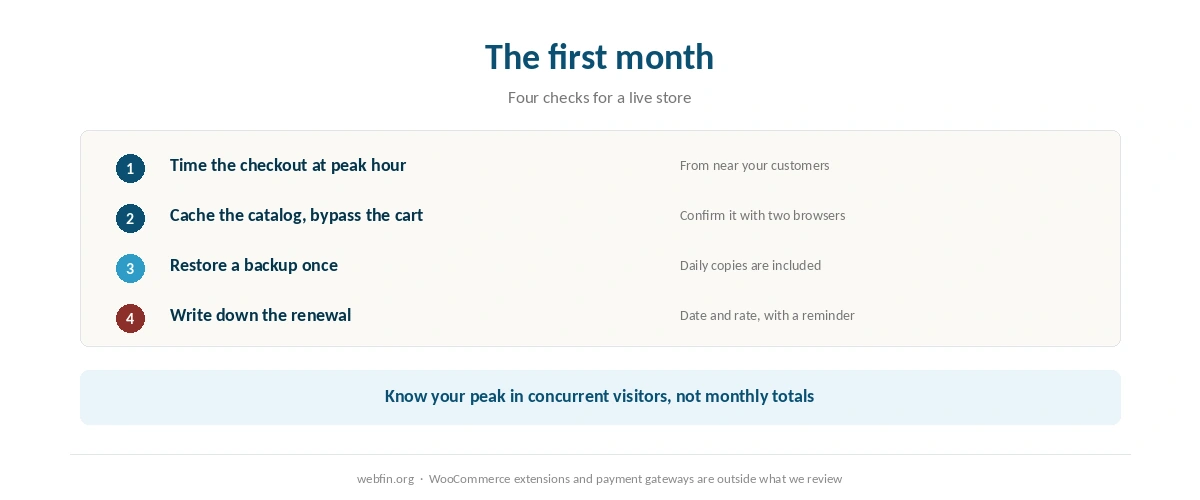
Time the checkout, not the home page. From a location near your customers, at your busiest hour.
Put the catalog behind a network. And confirm the cart and checkout bypass it, which our guide to configuring caching covers in detail.
Restore a backup once. Daily copies are included; an untested copy is a hypothesis, as our guide to setting up automatic backups explains.
Write down the renewal date and rate. With a reminder a month ahead, because the step is steep.
Two Numbers to Write Down Before Launch
The first is the concurrent visitors your busiest hour produced last year, or your best estimate if the store is new. The load test approximates a hundred at once, so if your peak is well under that, this plan has room.
Next, work out what one hour of downtime costs you in orders. Multiply it by the outage count rather than the uptime percentage. Forty-four short interruptions and one long one are different risks, as our guide to different risks, as our guide to reading an uptime report explains.
How We Research
We run no tests. The load result and WordPress benchmark come from Hostingstep’s October 2025 to May 2026 window. The uptime and outage count come from its full-year 2025 record, and the global response ranking from its 2026 benchmarks.
Figures quoted for other hosts come from the same project.
Prices, terms, refund rules and support channels come from SiteGround’s own pages and from reviews published this year, read on 20 September 2026. WooCommerce extensions and payment gateways are outside what we review. The criteria behind our scores are on our about page.
SiteGround for WooCommerce FAQ
For a small or mid-sized store, yes. Its shared plan finished the 2026 load test at 170 ms with a 0% error rate, which is the measurement a checkout depends on, and daily backups are included.
GrowBig if you want staging, and for a store that matters: updates on a live shop are how checkouts break. Price it at its $29.99 renewal rather than its $4.99 intro rate.
Global response time: 632 ms, 22nd of 34 hosts. Product pages cache, so a content network fixes it for distant customers. The checkout is uncached either way.
More than for a blog. Total downtime across 2025 was 193 minutes, which is small, but a short outage during a checkout costs an order rather than a pageview. Monitor uptime yourself.
GreenGeeks finished the same test at 26 ms without errors and opens at $2.95, renewing to $13.95. Kinsta answered every request at 40 ms on a managed platform at $35.00 a month flat.
The Verdict
This is the WooCommerce case where the evidence points the right way. A clean load result at 170 ms, a strong benchmark score, daily backups and a phone line make SiteGround a defensible home for a store, which is more than several cheaper plans can claim.
Buy the 24-month term, take GrowBig if you want staging, put a network in front of the catalog, and write down the renewal. The measurement that decides a sale day is the one this host actually has. Our page on what web hosting costs prices the alternatives across three years.