
Disclosure: WebFin is reader-supported. If you buy hosting through links on this page, we may earn a commission at no extra cost to you. Commissions vary between providers and our ratings do not — here’s our full disclosure.
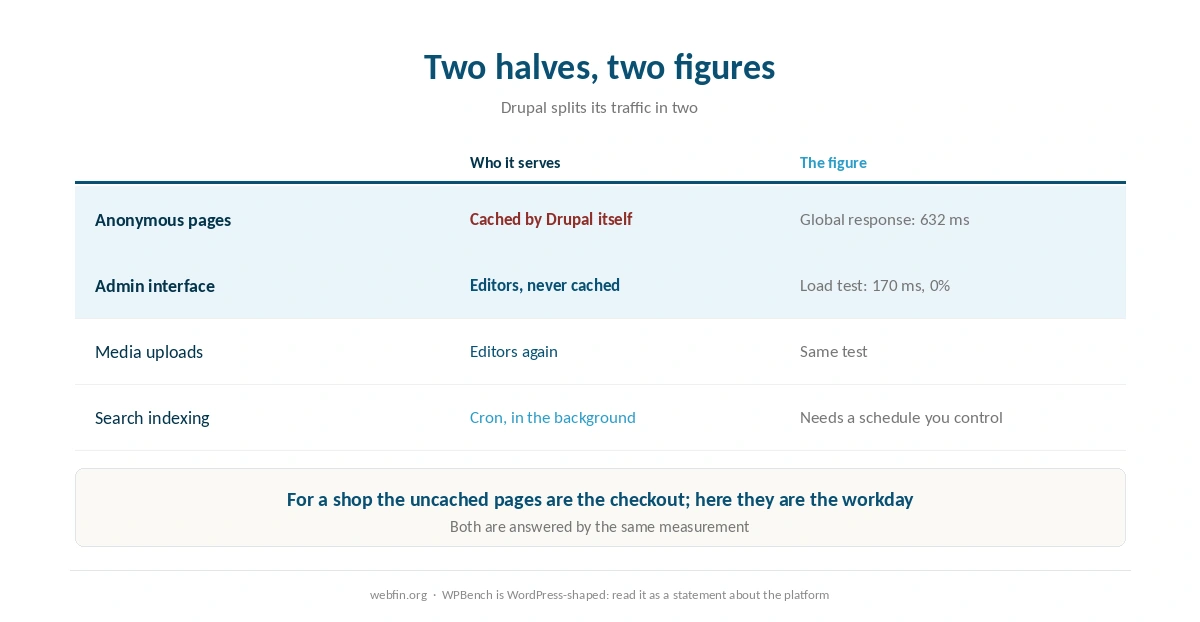
Drupal splits its traffic in two, and the split decides the host. Anonymous visitors get pages Drupal cached itself. Editors work in an administrative interface that no cache serves, and on a site with a real editorial team that is where the hosting is tested. SiteGround has the figure for it: a load test finished at 170 ms with a 0% error rate. Our page on Hostinger for Drupal could not offer that, because no load result exists for that host.
Is SiteGround Right for Drupal? The Short Answer
Yes for a brochure, institutional or editorial site, on the 24-month term, and on GrowBig if you want staging. Confirm SSH availability for your tier before buying, because Drupal manages modules through Composer. Three things to watch: a 632 ms global response, 44 outages across 2025, and a renewal that changes with the term you signed.
What Drupal Needs From a Host
Composer, which means a shell. Modules and core updates come through it. Our tables do not record SSH availability by tier at this host, so ask support in writing and keep the reply.
PHP memory in the hundreds of megabytes. Enough for installing modules, which is the step that fails on a stingy default.
Cron on a schedule you control. Search indexing, queue work and maintenance depend on it.
Room for its own caching. Drupal’s page cache and BigPipe handle anonymous visitors, and our guide to configuring caching covers the layers you add around them.
| Host | Measurement | Source and date |
|---|---|---|
| WP Engine | Global TTFB 65 ms, 1st of 34 hosts | Hostingstep, 2025 ranking, 40 locations |
| WP Engine | US TTFB 365 ms across 22 locations | Hostingstep, 2025 ranking |
| WP Engine | TTFB 355 ms, 349,920 checks | Hostingstep, Oct 2025 – May 2026 |
| WP Engine | Uptime 99.976%, 10th of 14 managed hosts | Study of 14 managed hosts, 2026 |
| WP Engine | Load 27 ms at 0% errors | Hostingstep, 2026 benchmarks |
| Rocket.net | Cached TTFB 85 ms globally | 12-month test, Mar 2025 – Mar 2026 |
| Rocket.net | Origin TTFB 310 ms; checkout bypasses cache | Same 12-month test |
| Rocket.net | Uptime 99.97%, seven outages in the window | Hostingstep, Oct 2025 – May 2026 |
| Rocket.net | Hardware score fell 8.5 → 7.5; not recommended | Hostingstep, 2026, tracked since Oct 2020 |
| Hostinger Business | Global TTFB 223 ms, 5th of 34 hosts | Hostingstep, 2026 |
| Hostinger Premium | Global TTFB 495 ms, 28th of 34; no CDN | Hostingstep, 2026 |
| Hostinger | TTFB 707 ms; server response 246 ms | Cybernews, June 2026 |
| Hostinger | Uptime 99.99%, 33 min down in 2025 | Hostingstep, continuous since 2021 |
| Hostinger | Uptime 99.93%, 6-month window | HostPro Reviews, 2026 |
| Hostinger | LCP 0.607 s, 2nd of 15 hosts | TechRadar, 10-week window, 2026 |
| Bluehost | Hardware score 9.6 of 10 | Hostingstep, 2026 |
| Bluehost | Load 41 ms at 0% errors after the Oracle move | Hostingstep changelog, 9 Jul 2026 |
| Bluehost | Response 411 ms; uptime 99.99% across 9 outages | Hostingstep, Nov 2025 – Aug 2026 |
| Bluehost | Global TTFB 224 ms across 40 locations, cached | Hostingstep Bluehost review, Jul 2026 |
| HostGator | Global TTFB 1.23 s; uptime 99.68%; 762 ms at 500 users | Hostingstep HostGator review, 2026 |
| HostGator | Hardware joint-highest in the field after the Oracle move | Hostingstep, 1 Sep 2026 update |
| ChemiCloud | US TTFB 531 ms; global 460 ms | Hostingstep, Oct 2025 – May 2026 |
| ChemiCloud | Load 1,068 ms at a 4.2% error rate | Hostingstep, same window |
| ChemiCloud | Uptime 99.76%; overall 6.1 of 10, degrading | Hostingstep, tracked since 2021 |
| GoDaddy shared | TTFB 751 ms; load test did not complete | Hostingstep, Nov 2025 – Jun 2026 |
| GoDaddy shared | Uptime 99.76% | Hostingstep, Nov 2025 – Jun 2026 |
| GoDaddy Managed WordPress | TTFB 344 ms; hardware 3.8 of 10 | Hostingstep, 2026 |
| GreenGeeks | TTFB 395 ms North America, 447 ms Europe | Long-term independent testing, 2026 |
| GreenGeeks | TTFB 580–610 ms Asia and Australia | Same testing window |
| GreenGeeks | Load 26 ms at 0% errors; WPBench 5.0 of 10 | Hostingstep, 2026 |
| GreenGeeks | 25 outages in the window; no integrated CDN found | Hostingstep, 2026 |
| Kinsta | Origin TTFB 525 ms; edge figures differ | Hostingstep, 2026 |
| Kinsta | Load 40 ms at 0% errors; WPBench 8.8 of 10 | Hostingstep, 2026 reviews |
| DreamHost | TTFB 450–500 ms band | Hostingstep, 2026 benchmarks |
| Scala Hosting | Uptime 99.97% across twelve months | Live site, 40,000 monthly visitors, UptimeRobot |
| Scala Hosting | 29 ms at the 95th percentile, 50 users | k6 load test, 2026 |
| InterServer | Uptime 99.98% across eighteen months | Six production sites, UptimeRobot |
| InterServer | Load under 700 ms; under 1.5 s by another source | Two 2026 reviews |
| A2 Hosting | TTFB 150–198 ms | 2026 studies; LiteSpeed on Turbo tiers |
| IONOS | Global TTFB 480 ms; WPBench 7.2 of 10 | Hostingstep, 2026 benchmarks |
| IONOS | Uptime 99.99%; load test failed at 65.4% errors | Hostingstep, 2026 benchmarks |
| Namecheap | TTFB 461 ms; global 448 ms; WPBench 5.0 | Hostingstep, Q4 2025; monitoring paused 30 Jun 2026 |
| InMotion | TTFB 300–500 ms shared | Published measurement, 2026 |
| InMotion | Uptime 99.97–99.99%; one account near 99.5% | Several 2026 sources |
| Hostwinds | No independent measurement found | 99.9999% is the company's own claim |
| Liquid Web | Not covered by the benchmarks we cite | VPS and dedicated are outside their scope |
| SiteGround | TTFB 632 ms; 22nd of 34 hosts | Hostingstep, 2026 benchmarks |
| SiteGround | Uptime 99.96% in 2025; 193 min over 44 outages | Hostingstep, full year 2025 |
| SiteGround | WPBench 8.4 of 10; load 170 ms at 0% errors | Hostingstep, Oct 2025 – May 2026 |
| Scala Hosting | TTFB 465 ms; global 501 ms | Hostingstep, 2026 benchmarks |
| Scala Hosting | WPBench 8.8 of 10; load 48 ms at 0% errors | Hostingstep, 2026 benchmarks |
| Scala Hosting | Uptime 99.98% across the year | Hostingstep, 2026 benchmarks |
| Cloudways | Vultr HF: load 288 ms at 1.7% errors; WPBench 7.6 | Hostingstep Cloudways review, 2026 |
| Cloudways | Uptime 99.996% to 99.999% across five plans | Hostingstep, Oct 2025 – May 2026 |
The Half That Decides It
For anonymous pages, almost any competent plan works, because Drupal serves stored copies. SiteGround’s weakness shows here instead: 632 ms globally, 22nd of 34 hosts, which a content network fixes, as our guide to setting up a CDN explains.
For the administrative side, nothing is cached. Every save, every preview and every media upload reaches the server, and several editors do it at once. The load test is the closest published proxy for that, and 170 ms with no dropped requests is a good result.
⚠️ This is the reverse of the store case. For a shop the uncached pages are the checkout; for an editorial Drupal site they are the workday. Both are answered by the same measurement.
What Else Comes With It
WPBench 8.4 of 10. The benchmark is WordPress-shaped, so read it as a statement about the underlying platform rather than about Drupal.
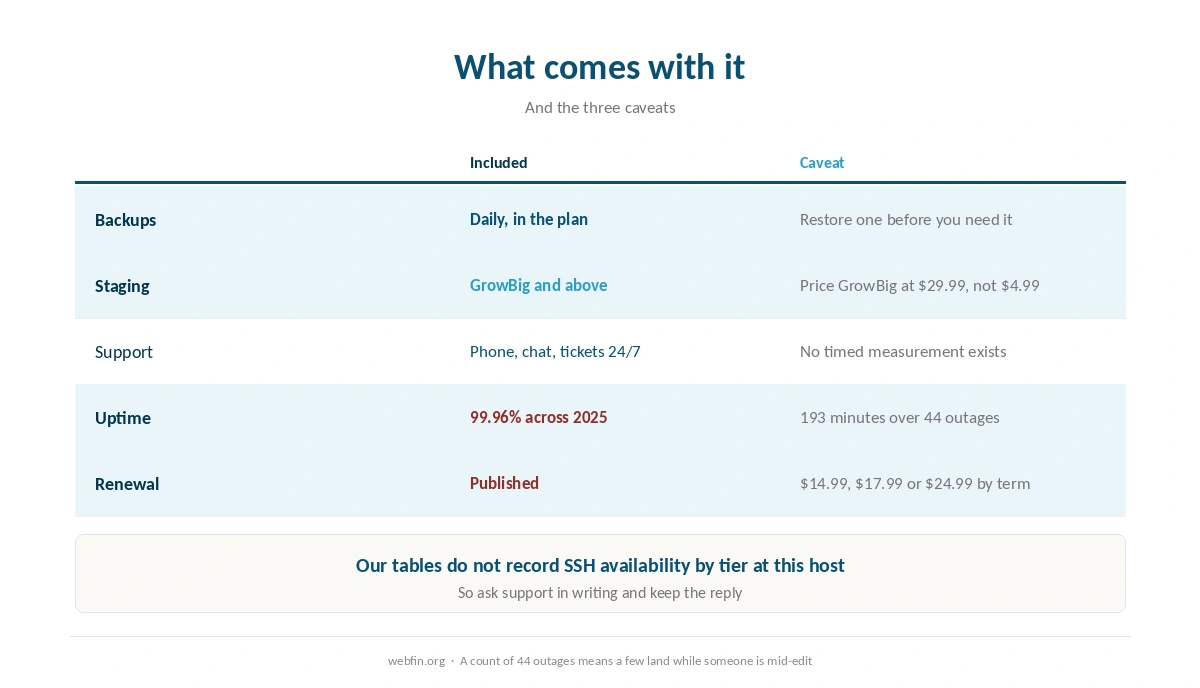
Daily backups. Included, which matters more on a site several people edit.
Staging on GrowBig and above. Composer updates belong on a copy first, and our guide to setting up a staging site covers the workflow.
Phone, chat and tickets around the clock. Rare among hosts we price, and useful for an organization where the site owner is not the developer.
The Three Caveats
The renewal depends on the term. StartUp renews at $14.99 on a 24-month term, $17.99 on 12 months and $24.99 month to month. GrowBig opens at $4.99 and renews at $29.99, which our page on SiteGround for WordPress works through in three-year totals.
Forty-four outages across 2025. Total downtime was 193 minutes, which is small. A count that high means a few land while someone is mid-edit, and our guide to reading an uptime report explains why both numbers matter.
632 ms globally. Fine for a national audience, worth a network for anyone else.
Where the Money Actually Goes
On a Drupal site the hosting bill is rarely the largest line. Module work, theme work and the person who applies security updates cost more, and a plan that makes those tasks slower costs more again in hours.
That is the argument for the tier with staging rather than the cheapest one. An update rehearsed on a copy takes twenty minutes; the same update on a live site can take an evening and an apology.
Which Drupal Sites Fit
A university department or an association. Anonymous readers, a handful of editors, and a phone line for the person who owns the budget.
A publication with a small newsroom. The uncached admin work is what the load result covers, and our list of hosting for news sites covers the rest of that case.
A multilingual brochure site. More database work per page, handled by Drupal’s caching for visitors.
A site that will be kept for years. Provided you buy the 24-month term and diarize the renewal.
When Drupal Needs a Server Instead
Drupal Commerce. A checkout is the uncached case at its most demanding, and our page on SiteGround for WooCommerce covers where a shared plan still holds.
Solr or OpenSearch. A search service runs beside the application, which means root.
A newsroom rather than a newsletter. Twenty people publishing at once is a hardware question, and our guide to moving from shared to VPS covers the sizing.
Multisite at scale. Dozens of sites in one install press on database table counts before they press on anything else.
Before You Buy
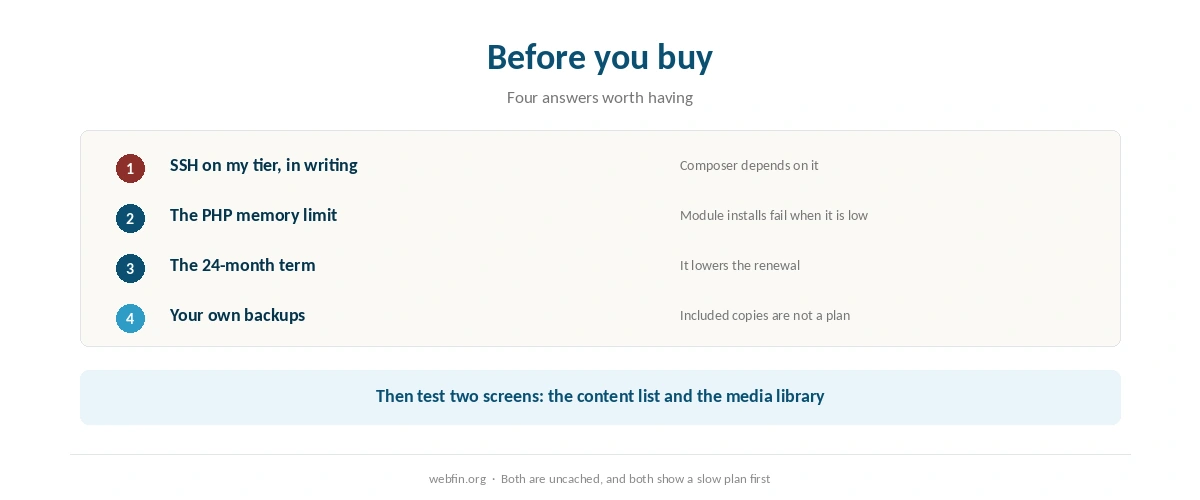
Confirm SSH for your tier, in writing. This is the one answer that decides whether Drupal is maintainable here.
Ask for the PHP memory limit. And whether you can raise it yourself.
Pick the 24-month term. It lowers the renewal and saves real money over three years.
Set up your own backups anyway. Daily copies are included; a copy nobody has restored is a hypothesis, which our guide to setting up automatic backups covers.
One Thing Drupal Teams Should Test First
Open the content list with a few hundred nodes in it, then open the media library. Those two screens are where a slow admin shows up first, and they are uncached by definition.
If either drags on a fresh install, the plan is the limit rather than your site, and our guide to checking whether your host is throttling you shows where the faults appear. Our list of hosting for developers records which hosts keep shell access and version control within reach.
How We Research
We run no tests. The load result and WordPress benchmark come from Hostingstep’s October 2025 to May 2026 window. The uptime and outage count come from its full-year 2025 record, and the global response ranking from its 2026 benchmarks.
Drupal’s requirements come from its own documentation for current releases, and module behavior is outside what we review. Our tables do not record SSH availability by tier at this host, and we say so rather than assume. Prices, terms and support channels come from SiteGround’s own pages, read on 20 September 2026. The criteria behind our scores are on our about page.
SiteGround for Drupal FAQ
Yes for a brochure, institutional or editorial site, provided your tier includes SSH so Composer works. Its load test finished at 170 ms with a 0% error rate, which is the figure that covers uncached admin work.
Because Drupal caches anonymous pages itself, so the hosting is tested by the administrative side, which is never cached. Every save, preview and upload reaches the server, and editors do it at once.
GrowBig if you want staging, and Composer updates belong on a copy first. Price it at its $29.99 renewal rather than its $4.99 intro rate, and remember the term changes the renewal again.
Global response time: 632 ms, 22nd of 34 hosts. Drupal’s cached pages are exactly what a content network copies well, so add one if readers are spread across countries.
For Drupal Commerce, for a search service such as Solr, for a newsroom with many editors publishing simultaneously, or for a multisite network holding dozens of sites.
The Verdict
For Drupal this host lines up better than the cheaper alternatives, and the reason is specific rather than general: the one measurement that covers an uncached admin interface exists here and is good. Daily backups, staging on GrowBig and a phone line suit organizations where the owner is not the developer.
Confirm SSH for your tier, buy the 24-month term, put a network in front of the anonymous pages, and write down the renewal date. Then the only reason to leave is a workload Drupal itself outgrows. Our page on what web hosting costs prices the alternatives across three years.