
Disclosure: WebFin is reader-supported. If you buy hosting through links on this page, we may earn a commission at no extra cost to you. Commissions vary between providers and our ratings do not — here’s our full disclosure.
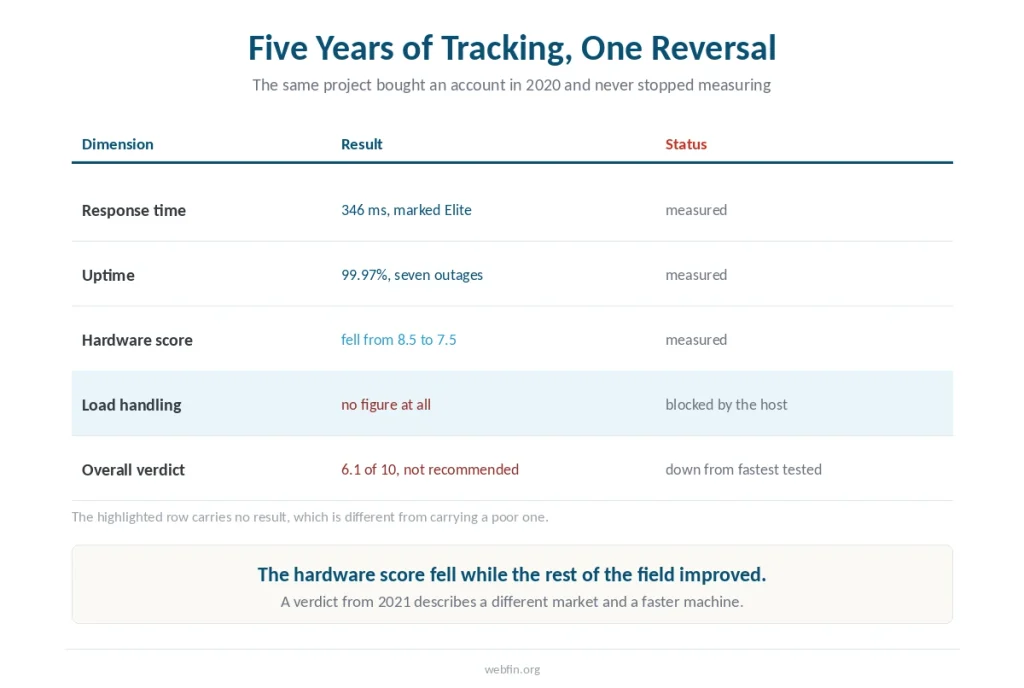
The benchmarking project we cite throughout these reviews has measured Rocket.net continuously since October 2020. It once described this host as the fastest response time among everything it tested.
Its current verdict is 6.1 out of 10 and the words not recommended. Two things moved at once: the rest of the field got faster, and its own hardware score fell from 8.5 to 7.5.
Is Rocket.net Good in 2026?
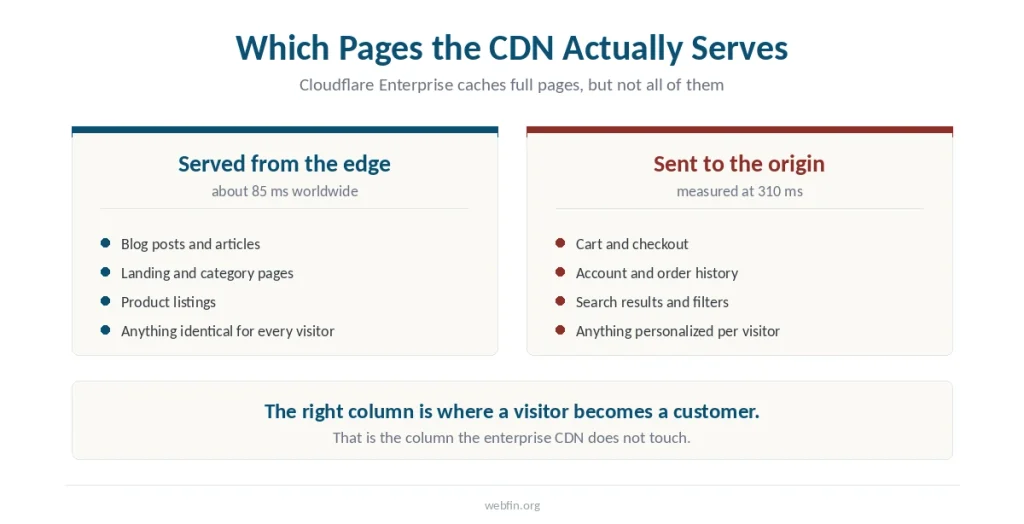
For cached pages, genuinely fast. Cloudflare Enterprise ships on every plan, and one twelve-month test recorded roughly 85 milliseconds globally for cached content.
For pages that cannot be cached, the picture changes completely. The same test measured 310 milliseconds at the origin, and WooCommerce checkout always reaches the origin because carts cannot be cached.
What the Enterprise CDN Does and Does Not Cover
In practice, Cloudflare Enterprise is the product. Standalone contracts for it are reported in the thousands per month, and Rocket.net includes it at entry pricing.
Moreover, the delivery model serves full WordPress pages from Cloudflare edge locations rather than caching static assets alone. A visitor in Sydney and a visitor in Chicago both reach a nearby point of presence, which is why global figures come in low. One measurement across more than forty locations recorded a 177 millisecond average.
⚠️ However, dynamic pages bypass the cache by design. Cart, checkout and account pages hit the origin server every time, and that origin measured 310 milliseconds in the twelve-month test. The same exclusion applies at every host.
So the CDN helps most on the pages a visitor reads and least on the pages where a visitor pays — the same origin-versus-edge distinction we drew elsewhere, with a sharper edge.
The Hardware Underneath
One published test names the processor as an Intel Xeon E5-2667 v2, released in 2013, ranked 433rd of 1,190 server CPUs in the benchmark it cites. It scored the platform 4.2 out of 10 on a WordPress hosting benchmark plugin.
The long-running project reports the same direction without naming the chip: its hardware score for Rocket.net dropped from 8.5 to 7.5, a fall of about 12 percent.
⚠️ We report the processor identification as that reviewer’s finding rather than ours. What both sources agree on is the trend.
Uptime, and a Test That Could Not Run
In short, uptime figures are strong on paper and worth reading with the detail attached.
The long-running project recorded 99.97 percent across its October 2025 to May 2026 window, with seven separate outages inside it. A separate twelve-month test recorded the same 99.97 percent, with 158 minutes of downtime across four incidents.
⚠️ More unusual is what that project could not measure. Rocket.net blocks its load test, so load handling carries no result at all rather than a poor one. We set Rocket.net against a managed cloud server in Cloudways vs Rocket.net.
That is the second host in these reviews where our usual benchmark cannot complete its methodology, and the first where the host itself prevents it.
Price and Renewal
Here the renewal barely moves at all, though one host holds it completely still.
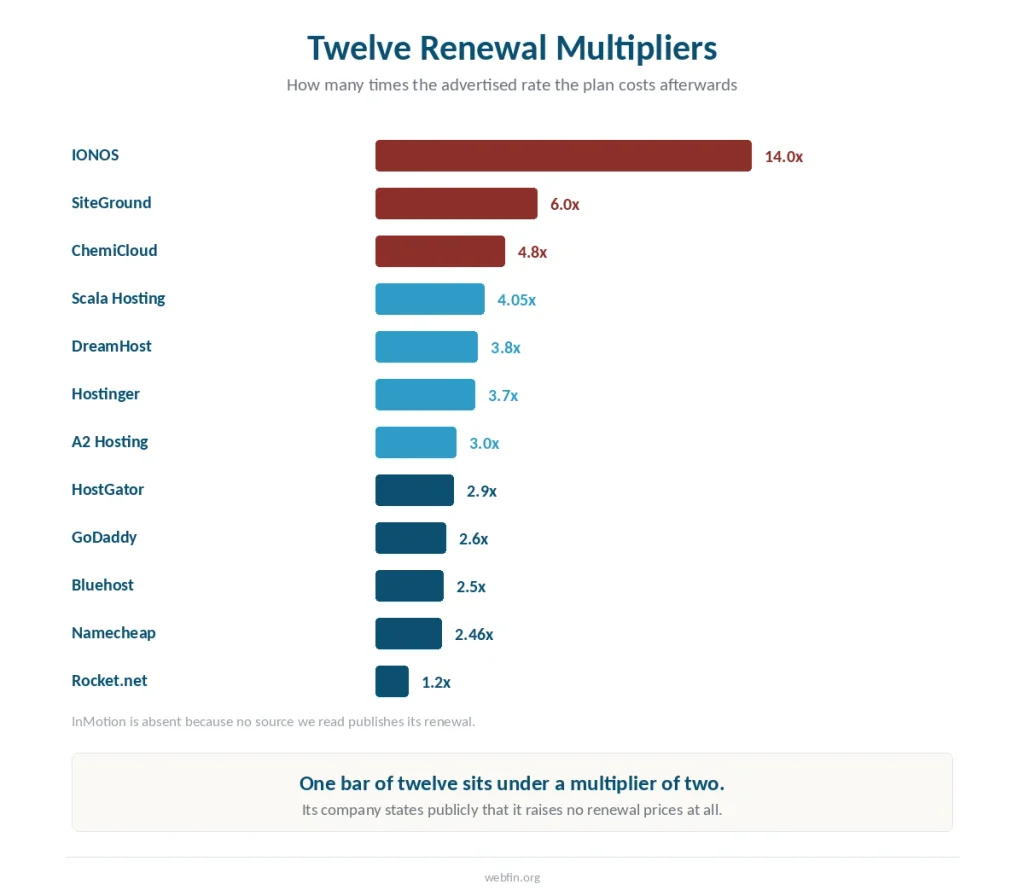
In practice, published figures put the Starter plan at $25 a month rising to $30, a multiplier of 1.2. Among the sixteen other hosts we have priced, the gentlest multiplier is 1.00 and the steepest is fourteen — the full field is here.
The company states publicly that it runs no hidden upsells and no renewal price increases. ⚠️ The gap between $25 and $30 most likely reflects annual against monthly billing rather than a promotional term ending, though we could not confirm that directly. We compare Rocket.net directly with SiteGround in SiteGround vs Rocket.net.
Therefore three years at the monthly rate comes to $1,080. That places it second among the five managed platforms we have priced, above Cloudways and below WP Engine.
What $30 buys is one site, 10 gigabytes of storage and 250,000 monthly visits. One review sets that directly against a competitor offering unlimited sites and full server access for the same money.
Support
Consistently the strongest thing reviewers say about it.
Live chat and email run around the clock on every plan, with phone support from the Business tier. Published accounts describe chat responses arriving in under a minute from people who understand WordPress rather than reading from a script.
Besides, migrations are free and unlimited on all plans, which removes the usual friction of switching — we set out the timing separately.
Who Owns It
Finally, Rocket.net was founded in 2020, and in August 2025 it joined hosting.com, part of World Host Group.
⚠️ Rocket.net called the deal a strategic partnership, while hosting.com lists it among the group’s acquisitions, and Rocket.net’s founder became the group’s chief product officer. The same group renamed A2 Hosting as hosting.com. Rocket.net continues to operate under its own name. We compare Rocket.net directly with Bluehost, a Newfold Digital brand, in Bluehost vs Rocket.net.
What We Don’t Love
Dynamic pages bypass the CDN that justifies the price, which matters most for stores.
The hardware trend runs downward in the source with the longest record on this host.
Ten gigabytes of storage on the entry plan is tight for anything media-heavy, and the per-site pricing model becomes expensive for agencies.
How We Research
Performance figures are attributed to named projects with their windows and test counts, and where one project cannot complete a measurement we say so rather than omitting the dimension. Pricing comes from published reviews stating what they read. Hardware identification comes from a single source and is reported as theirs.
We run no tests of any kind. Our five criteria are on our About page.
Frequently Asked Questions
For cached pages, yes. One twelve-month test recorded roughly 85 milliseconds globally, and another measured a 177 millisecond average across forty locations. Origin response measured 310 milliseconds, which applies to any page the cache cannot serve.
Less than its speed figures suggest. Cart, checkout and account pages bypass the CDN by design and reach the origin server every time, so the Cloudflare Enterprise advantage does not apply to the pages that complete a sale.
Published figures put the Starter plan at $25 rising to $30 a month, a multiplier of 1.2. That is the second gentlest increase across the sixteen hosts we have priced, and the company states it runs no renewal price increases.
Two independent measurements both recorded 99.97 percent. One counted seven outages across an eight-month window, the other 158 minutes of downtime across four incidents in twelve months.
Rocket.net joined hosting.com, part of World Host Group, in August 2025. The company called it a strategic partnership and still operates under its own name. It was founded in 2020.
Rocket.net
Summary
A renewal multiplier of 1.2, attached to a CDN that stops working where the money changes hands.
The Verdict
Rocket.net earns 3.9, and the score reflects a genuine split rather than a middling product.
Choose it if your site is content-heavy, your pages cache well, and global delivery matters more than storage or server access.
Skip it if you run WooCommerce, because the pages that decide whether a visitor becomes a customer are exactly the ones the CDN does not touch.