
Disclosure: WebFin is reader-supported. If you buy hosting through links on this page, we may earn a commission at no extra cost to you. Commissions vary between providers and our ratings do not — here’s our full disclosure.
SiteGround vs Rocket.net is a comparison of two opposite bets. Rocket.net puts every site behind an edge network and charges $25.00 a month, renewing at $30.00, which is 1.2× over 12 months. SiteGround charges $2.99 and renews at $14.99 on a 24-month term, which is 5.0× over 24 months. Across three years that is $1,020.00 against $251.64. The expensive host barely raises its price, and the cheap one raises it fivefold, and both score 3.9 in our reviews. The same Rocket.net figures against a Cloudways server are in our Cloudways and Rocket.net comparison.
SiteGround vs Rocket.net: The Short Answer
SiteGround, on our published tie-break rather than on a feature. The scores are level at 3.9, and the rule we publish breaks a tie by three-year cost, which is $251.64 against $1,020.00. Rocket.net is the faster host for cacheable pages, at 85 ms globally against 632 ms.
Head to Head
| Criterion | SiteGround StartUp | Rocket.net Starter |
|---|---|---|
| Intro rate | $2.99/mo | $25.00/mo |
| Renewal | $14.99 to $24.99 by term | $30.00/mo |
| Renewal step, by term | 5.0× over 24 months | 1.2× over 12 months |
| 36-month total | $251.64 | $1,020.00 |
| Cached time to first byte | 632 ms | 85 ms globally |
| Origin time to first byte | 632 ms | 310 ms |
| Uptime | 99.96%, 44 outages | 99.97%, seven outages |
| Server hardware score | 8.4 of 10 | 7.5, down from 8.5 |
| Plan limits | Storage and visit guidance | 25,000 visits, 1 site, 10 GB |
| Support | Phone, chat and tickets | Chat under a minute; phone above Starter |
| Our score | 3.9 | 3.9 |
The 85 ms Figure, and Where It Does Not Apply
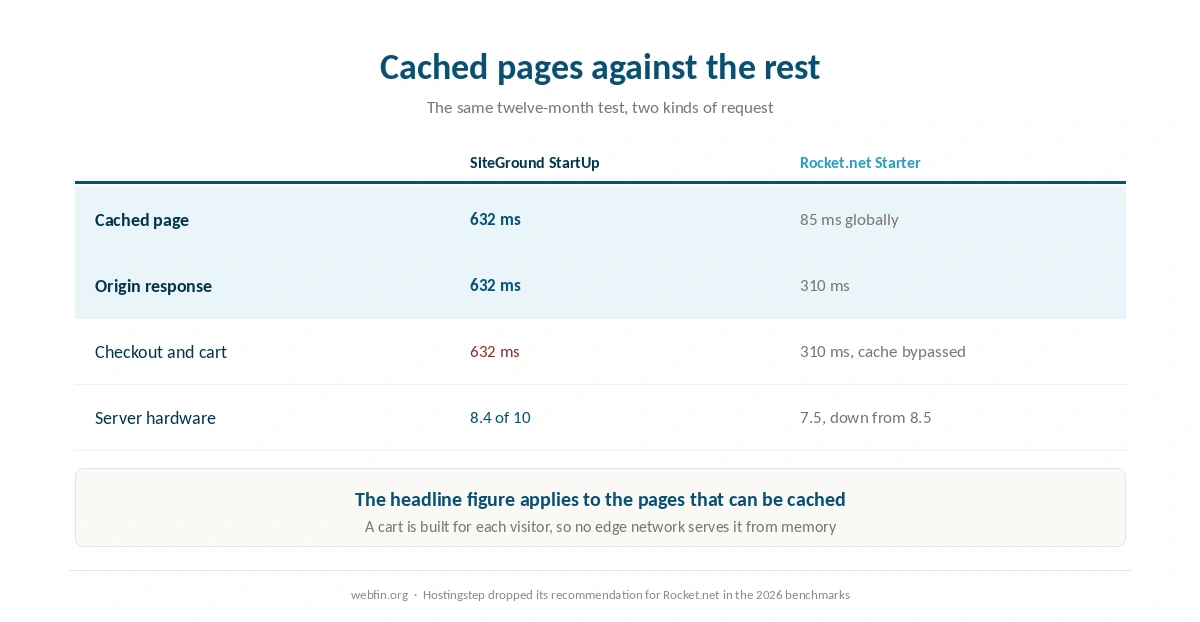
Rocket.net serves every site from an edge network, and a twelve-month test recorded a cached time to first byte of 85 ms globally. That is the number its marketing rests on, and for a blog or a brochure site it is real. SiteGround, without an edge layer on the entry plan, records 632 ms in the same period.
The same test recorded something the marketing does not. Origin responses, the ones the cache cannot serve, came back at 310 ms. Checkout bypasses the cache by design, because the server builds a cart for each visitor. So a store on Rocket.net gets 310 ms on the page where money changes hands, not 85 ms.
⚠️ This is the general case rather than a complaint about one host. Every edge number is a cached number, and every cart, search result and logged-in page is an origin one. Our guide to reducing TTFB separates the two, and it is the distinction that decides whether a fast host feels fast to your visitors.
A Tie in the Scores, Broken by a Published Rule
Both hosts score 3.9 in our reviews. That happens, and the rule for what to do about it is written on our about page rather than invented here: a tie goes to the lower cost of ownership over 36 months, and if that ties too, to the host that publishes its renewal price rather than showing it at checkout.
On the first test SiteGround wins and it is not close, at $251.64 against $1,020.00. So SiteGround takes the comparison, and the reason is a rule we published before we knew it would apply here. Rocket.net would win a tie-break weighted on speed, which is exactly why we do not weight one that way.
| Host and plan | How it builds | 36-month total |
|---|---|---|
| ChemiCloud Starter, 36-month term | 36 prepaid months at $2.49 | $89.64 |
| InterServer Standard | 36 months at $2.50, price locked | $90.00 |
| DreamHost Launch, 48-month term | 36 of 48 prepaid months at $2.89 | $104.04 |
| Namecheap Stellar, 24-month term | 24 at $1.98, then 12 at $4.88 | $106.08 |
| Hostinger Premium, 48-month term | 36 of 48 prepaid months at $2.99 | $107.64 |
| HostGator Hatchling, 36-month term | 36 months at $3.75, renewal not reached | $135.00 |
| HostGator Hatchling, with daily backups | 36 at $3.75, plus CodeGuard at $35.88 a year | $242.64 |
| Bluehost Starter, 36-month term | 36 months at $3.99, renewal not reached | $143.64 |
| GoDaddy Economy, 36-month term | 36 months at $5.99, renewal not reached | $215.64 |
| GoDaddy Economy, with SSL from year two | 36 at $5.99, plus $119.99 in years two and three | $455.62 |
| Hostwinds Basic, annual | 12 at $4.54, then 24 at $6.99 | $222.24 |
| SiteGround StartUp, 24-month term | 24 at $2.99, then 12 at $14.99 | $251.64 |
| DreamHost Launch, annual | 12 at $2.89, then 24 at $10.99 | $298.44 |
| Scala Hosting Mini, annual | 12 at $2.95, then 24 at $11.95 | $322.20 |
| Bluehost Starter, 12-month term | 12 at $3.99, then 24 at $11.99 | $335.64 |
| IONOS Plus, annual | 12 at $1.00, then 24 at $14.00 | $348.00 |
| GreenGeeks Lite, 36-month prepay | 36 months at $2.95 | $106.20 |
| GreenGeeks Lite, annual | 12 at $2.95, then 24 at $13.95 | $370.20 |
| SiteGround StartUp, 12-month term | 12 at $2.99, then 24 at $17.99 | $467.64 |
| Cloudways, from | 36 months at $14.00, flat | $504.00 |
| A2 Hosting Turbo Boost, annual | 12 at $6.99, then 24 at $20.99 | $587.64 |
| Rocket.net Starter, annual | 12 at $25.00, then 24 at $30.00 | $1,020.00 |
| WP Engine Startup, annual | 12 at $27.00, then 24 at $35.00 | $1,164.00 |
| Liquid Web managed VPS | 36 months at $33.00 | $1,188.00 |
| Kinsta Starter | 36 months at $35.00, flat | $1,260.00 |
| InMotion Core, 36-month term | 36 months at $3.19, renewal not reached | $114.84 |
| InMotion Launch, 36-month term | 36 months at $4.99, renewal not reached | $179.64 |
What Three Years Cost
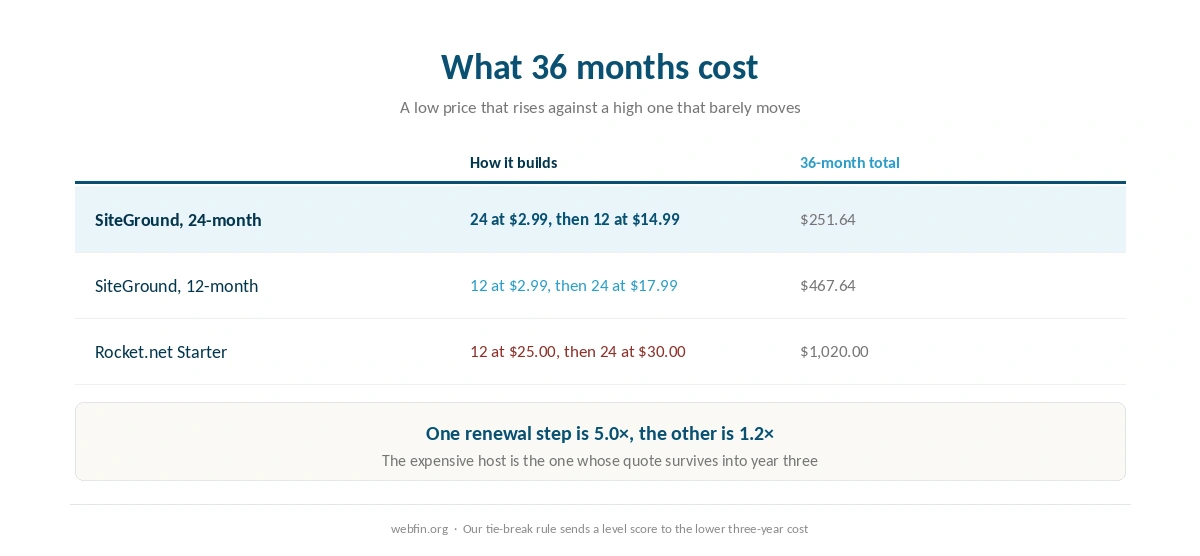
Rocket.net Starter bills 12 months at $25.00 and then 24 at $30.00, so three years come to $1,020.00. SiteGround StartUp bills 24 months at $2.99 and 12 at $14.99, which is $251.64. On annual SiteGround terms the figure is $467.64 instead, and even that stays well below Rocket.net.
The shapes are opposite in a way worth noticing. Rocket.net asks a high price and moves it by 1.2× over 12 months, so the quote you give yourself in year one survives to year three. SiteGround asks a low price and moves it by 5.0× over 24 months. Our page on hosting renewal prices collects both patterns across the field, and what web hosting costs runs them out to three years.
A Tester That Changed Its Mind
Hostingstep has monitored Rocket.net since October 2020. In its 2026 benchmarks the server hardware score falls from 8.5 to 7.5, and the project drops its recommendation. Uptime over its October 2025 to May 2026 window reads 99.97% with seven outages, which is a good result on its own.
Read that alongside the price. A managed host at $30.00 a month on renewal sells the promise that its infrastructure beats a shared plan, and the one project tracking it longest now scores its hardware below SiteGround at 8.4. That does not make it a bad host. It does mean the premium is buying the edge network rather than the machine.
⚠️ One tester is one tester. We cite this project throughout the site because it publishes its window, its method and its history, and a score that moves over six years is more informative than a score taken once. Still, a single source moving its opinion is not the same as a consensus.
Limits, Support and What You Actually Get
Rocket.net states its limits plainly: 25,000 monthly visits, one site and 10 GB of storage on Starter. Chat answers in under a minute according to published accounts, and a phone line appears above the entry tier. SiteGround publishes storage and visit guidance per tier, and it answers the phone at every tier.
Both refund within 30 days and exclude domains. Neither publishes a measured support response time, and no controlled test of hosting support exists in the sources we found, so the channel list is the whole comparison there.
The practical difference is what happens at the ceiling. Rocket.net sells more visits as a tier upgrade, and SiteGround moves you to GrowBig at $29.99 on renewal or GoGeek at $44.99, both over 12 months. At that point the two sit far closer than the entry plans suggest.
Who Owns Them
SiteGround Hosting Ltd has been private since it was founded in Sofia in 2004. Rocket.net joined hosting.com, part of World Host Group, in August 2025; the company called it a strategic partnership and still operates under its own name.
Ownership matters here mainly because of the renewal shape. A host that moves the price by 1.2× over 12 months is making a promise about year two, and its value depends on who is making it. The pattern we traced in who owns Bluehost is what changes renewal policy in this market. Bluehost belongs to Newfold Digital. SiteGround has not been through anything similar; Rocket.net now has, so its renewal is worth rechecking at each term. The same Rocket.net figures set against Newfold Digital’s Bluehost are in our Bluehost and Rocket.net comparison.
What the Premium Is Actually Buying
At $30.00 a month on renewal against $14.99, the gap over a year is real money for a small site. The honest way to describe what it buys is narrow: an edge network on every page that can be cached, a visit allowance stated on the plan page, and an outage record of seven in an eight-month window rather than 44 across a year.
What it does not buy, on the figures we have, is a better machine. The hardware score sits at 7.5 against 8.4, and it fell this year rather than rose. For a site whose pages are mostly dynamic, that is the wrong trade, because both hosts serve dynamic pages from the origin.
The case flips for a content site with readers spread across continents. There the edge network does the work a shared plan cannot do at any price, and the 85 ms figure is what most visitors actually meet. Our guide to speeding up a slow website covers what you can achieve without moving.
Winners by Category
Three-year price: SiteGround, at $251.64 against $1,020.00. Renewal step: Rocket.net, at 1.2× over 12 months of term. Cached speed: Rocket.net, at 85 ms globally. Origin speed: Rocket.net, at 310 ms against 632 ms. Server hardware: SiteGround, at 8.4 against 7.5. Uptime: Rocket.net, with seven outages against 44. Support channels: SiteGround, which answers the phone on the entry plan. Published limits: Rocket.net, which states visits, sites and storage.
When to Choose Rocket.net Instead
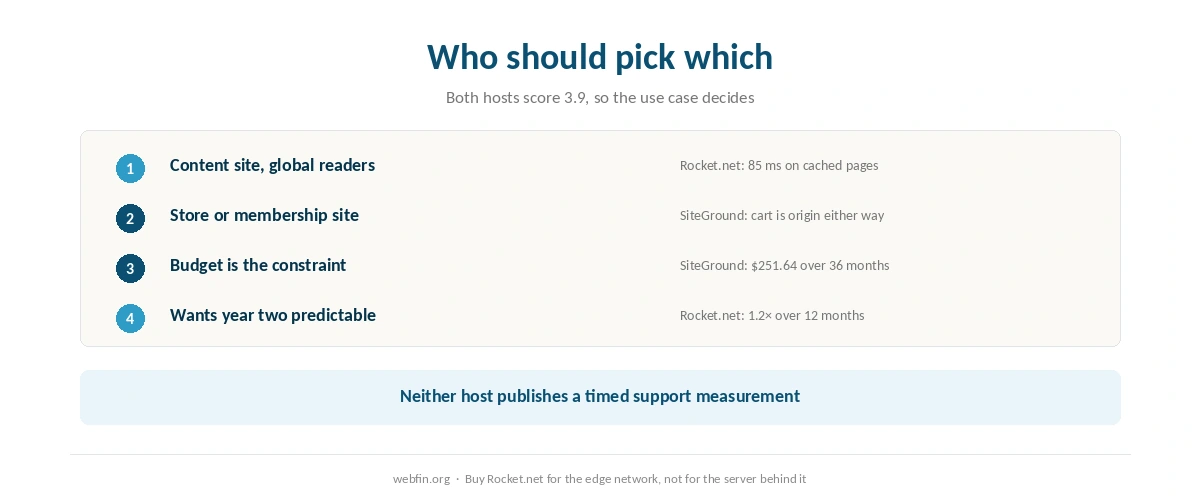
Take Rocket.net if your pages are cacheable and speed is the product. A content site, a documentation site or a brochure with global readers gets the 85 ms figure most of the time, and no amount of tuning gets a shared plan near it. Take it too if a predictable second year matters more than a low first one. A step of 1.2× over 12 months is the gentlest in our renewal table.
Take SiteGround if the budget is the constraint or the site is transactional. Three years at $251.64 against $1,020.00 is the kind of gap that pays for a developer, and the cart page is served from the origin on either host. Our roundup of the best WordPress hosting shows where each sits, and WooCommerce hosting covers the store case.
How We Research
We run no speed or uptime tests. The cached and origin figures come from a twelve-month test running from March 2025 to March 2026, and the hardware and uptime figures from Hostingstep, with the window each one covers. Prices come from the providers’ own pages, read on 20 September 2026.
Our scores tied here, and the tie-break is published rather than chosen after the fact. The criteria sit on our about page, and the full workings are in our SiteGround review. Our page on hidden hosting fees collects what arrives after the first term.
SiteGround vs Rocket.net FAQ
SiteGround, at $251.64 on a 24-month term against $1,020.00. Even on annual SiteGround terms the figure is $467.64, which stays well below Rocket.net. The gap is the product difference: one is shared hosting and the other is managed hosting behind an edge network.
For cached pages, yes, in a twelve-month test. Origin responses in the same test came back at 310 ms, and checkout bypasses the cache by design. So a content site sees the fast number most of the time and a store sees it rarely.
They win different criteria. Rocket.net takes speed and uptime, SiteGround takes hardware, support channels and price. Our published rule breaks a tie by three-year cost of ownership, which hands this comparison to SiteGround by a wide margin.
SiteGround, by a distance. StartUp moves 5.0× over 24 months, from $2.99 to $14.99, and further on shorter terms. Rocket.net Starter moves from $25.00 to $30.00, which is 1.2× over 12 months and the gentlest step in our renewal table.
Rocket.net states 25,000 monthly visits, one site and 10 GB of storage on Starter. SiteGround publishes storage and a visit guidance figure per tier. Both are clearer than the parts of this market that publish nothing at all.
The Verdict
SiteGround takes this, and the rule that decides it was published before the comparison existed. Two hosts at 3.9 go to the lower three-year cost, and $251.64 against $1,020.00 is not a close reading. The hardware score points the same way, at 8.4 against a figure that fell to 7.5 this year.
Rocket.net is still the faster host, and for a cacheable site with global readers the gap between 85 ms and 632 ms is worth paying for. Just buy it for the edge network rather than for the server behind it, and check that your busiest pages are the ones the cache can serve. If you are moving, our guide to migrating web hosting covers the order of operations.