
Disclosure: WebFin is reader-supported. If you buy hosting through links on this page, we may earn a commission at no extra cost to you. Commissions vary between providers and our ratings do not — here’s our full disclosure.
Bluehost vs Rocket.net asks whether an edge-first managed host is worth seven times the price of a shared plan. Rocket.net Starter costs $1,020.00 across 36 months and renews at $30.00, which is 1.2× over 12 months. Bluehost Starter costs $143.64 over the same stretch on its three-year term and renews at $9.99. On every figure a named benchmark project has published for both, the cheaper host comes out ahead: a load test Rocket.net blocks, a hardware score of 9.6 against 7.5, and uptime of 99.99% against 99.97%. The same Rocket.net figures against a Cloudways server are in our Cloudways and Rocket.net comparison.
Bluehost vs Rocket.net: The Short Answer
Bluehost, for almost every site. It costs a seventh as much across three years, measures ahead on the published record, and answers the phone on the entry plan. Rocket.net is for a site that needs managed WordPress behind an enterprise edge network on every page, and a renewal that barely moves.
Head to Head
| Criterion | Bluehost Starter | Rocket.net Starter |
|---|---|---|
| Product | Shared hosting | Managed WordPress, edge-first |
| Intro rate | $3.99/mo, 36-month term | $25.00/mo |
| Renewal | $9.99/mo | $30.00/mo |
| Renewal step | 2.5× over 36 months | 1.2× over 12 months |
| 36 months | $143.64 | $1,020.00 |
| Load test | 41 ms, no errors | Blocked; no result |
| Server hardware | 9.6 of 10 | 7.5, down from 8.5 |
| Uptime | 99.99%, 9 outages | 99.97%, 7 outages |
| Plan limits | 10 GB NVMe | 25,000 visits, 1 site, 10 GB |
| Support on the entry plan | Phone and chat | Chat; phone from Business |
| Owner | Newfold Digital, 2021 | hosting.com, World Host Group, 2025 |
| Our score | 4.0 | 3.9 |
Seven Times the Price
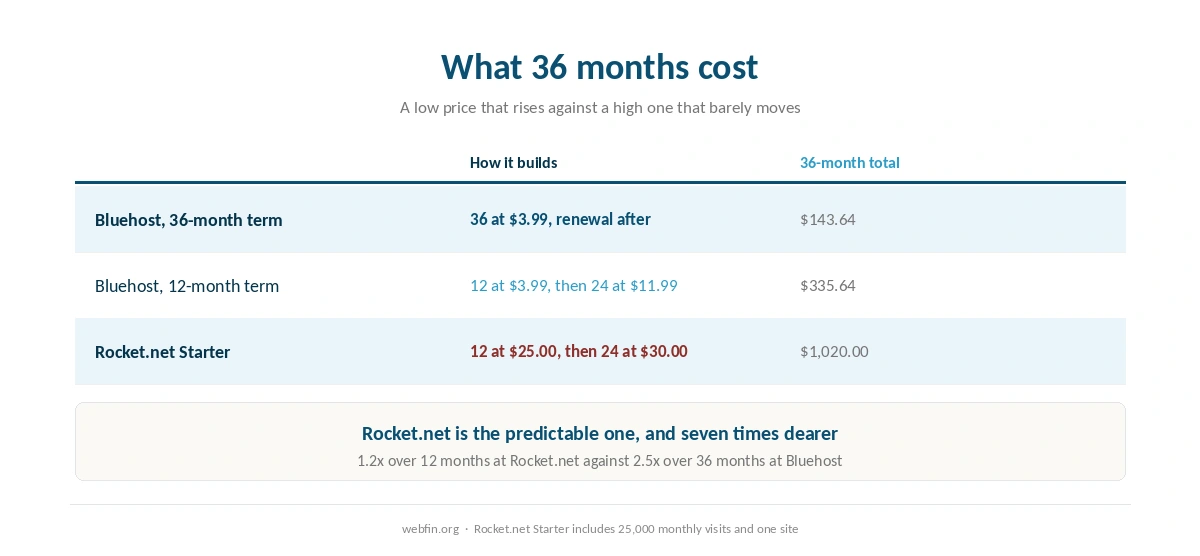
Bluehost Starter bills 36 months at $3.99, which is $143.64, and renews at $9.99. On a 12-month term it renews at $11.99 and the same three years reach $335.64. Rocket.net Starter bills twelve months at $25.00 and twenty-four at $30.00, which is $1,020.00, and that is 7.1 times the Bluehost figure over 36 months on its best term.
The renewal shapes run in opposite directions. Rocket.net moves only 1.2× over 12 months, so the quote in year one holds in year three. Bluehost moves 2.5× over 36 months, from a far lower starting point. The expensive host is the predictable one, and it stays far more expensive. Our page on what web hosting costs runs both shapes to three years.
⚠️ Bluehost pricing is disputed between sources: its help page gives $3.99 renewing at $9.99, while a July 2026 review quotes $1.99 renewing at $8.99. Either reading leaves the gap enormous. Our page on hosting renewal prices records both.
| Host and plan | How it builds | 36-month total |
|---|---|---|
| ChemiCloud Starter, 36-month term | 36 prepaid months at $2.49 | $89.64 |
| InterServer Standard | 36 months at $2.50, price locked | $90.00 |
| DreamHost Launch, 48-month term | 36 of 48 prepaid months at $2.89 | $104.04 |
| Namecheap Stellar, 24-month term | 24 at $1.98, then 12 at $4.88 | $106.08 |
| Hostinger Premium, 48-month term | 36 of 48 prepaid months at $2.99 | $107.64 |
| HostGator Hatchling, 36-month term | 36 months at $3.75, renewal not reached | $135.00 |
| HostGator Hatchling, with daily backups | 36 at $3.75, plus CodeGuard at $35.88 a year | $242.64 |
| Bluehost Starter, 36-month term | 36 months at $3.99, renewal not reached | $143.64 |
| GoDaddy Economy, 36-month term | 36 months at $5.99, renewal not reached | $215.64 |
| GoDaddy Economy, with SSL from year two | 36 at $5.99, plus $119.99 in years two and three | $455.62 |
| Hostwinds Basic, annual | 12 at $4.54, then 24 at $6.99 | $222.24 |
| SiteGround StartUp, 24-month term | 24 at $2.99, then 12 at $14.99 | $251.64 |
| DreamHost Launch, annual | 12 at $2.89, then 24 at $10.99 | $298.44 |
| Scala Hosting Mini, annual | 12 at $2.95, then 24 at $11.95 | $322.20 |
| Bluehost Starter, 12-month term | 12 at $3.99, then 24 at $11.99 | $335.64 |
| IONOS Plus, annual | 12 at $1.00, then 24 at $14.00 | $348.00 |
| GreenGeeks Lite, 36-month prepay | 36 months at $2.95 | $106.20 |
| GreenGeeks Lite, annual | 12 at $2.95, then 24 at $13.95 | $370.20 |
| SiteGround StartUp, 12-month term | 12 at $2.99, then 24 at $17.99 | $467.64 |
| Cloudways, from | 36 months at $14.00, flat | $504.00 |
| A2 Hosting Turbo Boost, annual | 12 at $6.99, then 24 at $20.99 | $587.64 |
| Rocket.net Starter, annual | 12 at $25.00, then 24 at $30.00 | $1,020.00 |
| WP Engine Startup, annual | 12 at $27.00, then 24 at $35.00 | $1,164.00 |
| Liquid Web managed VPS | 36 months at $33.00 | $1,188.00 |
| Kinsta Starter | 36 months at $35.00, flat | $1,260.00 |
| InMotion Core, 36-month term | 36 months at $3.19, renewal not reached | $114.84 |
| InMotion Launch, 36-month term | 36 months at $4.99, renewal not reached | $179.64 |
The Named Record Favors Bluehost
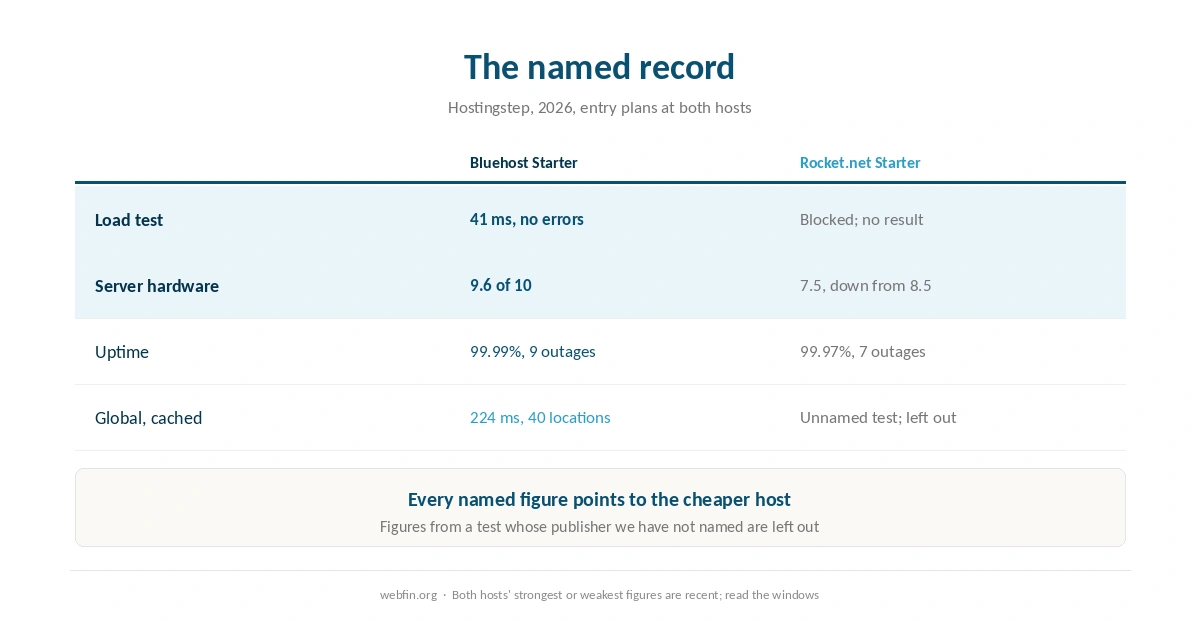
We run no tests, so these figures belong to Hostingstep. Bluehost records 411 ms response time and 99.99% uptime over 9 outages between November 2025 and August 2026. After its move to Oracle Cloud it passed the load test at 41 ms without an error, and its hardware scores 9.6 of 10, at the top of that project’s shared results.
Rocket.net records 99.97% uptime over seven outages between October 2025 and May 2026, a good result on its own. Its hardware score fell from 8.5 to 7.5 in the 2026 benchmarks, and the project dropped its recommendation. Rocket.net blocks the load test, so there is no concurrency result for it at all, rather than a poor one.
⚠️ Our review also cites cached and uncached response figures from a separate twelve-month test whose publisher we have not yet named in our tables, so we leave them out here. The named figures above are enough to see the direction. Our guide to reading an uptime report explains why an unnamed figure weighs less than a counted one.
A Year of Change at Rocket.net
Three things moved for Rocket.net within twelve months. It joined hosting.com in August 2025. Its hardware score in the benchmark project we cite fell from 8.5 to 7.5. And that project, which has tracked it since October 2020, dropped its recommendation.
We draw no line between those facts, because nothing we read connects them. What they do mean for a buyer is that older reviews describe a different situation, and the case for Rocket.net now rests more on its edge network and predictable renewal than on its servers. A buyer weighing a three-year stay should read the most recent figures rather than the reputation.
Bluehost moved too, in the other direction: its load result improved after the move to Oracle Cloud, from a weaker reading under the project’s previous method to 41 ms without an error. Its strongest figures are therefore recent as well, which is worth keeping in mind on both sides.
What the Premium Buys
Rocket.net puts Cloudflare’s enterprise edge network in front of every site on every plan, and it is built for WordPress only. Pages that can be cached are served from a location near the reader, and the platform handles the caching rules rather than leaving them to plugins. For a content site with readers on several continents, that is the product.
What it does not buy, on the named figures, is a stronger server or proof under load. Pages that cannot be cached, such as carts, checkouts and logged-in areas, are served from the origin at both hosts. Our guide to reducing TTFB explains why an edge network changes one kind of request and not the other.
Limits, Support and Leaving
Rocket.net Starter states its limits plainly: 25,000 monthly visits, one site and 10 GB of storage. Bluehost Starter lists 10 GB of NVMe storage and sells shared hosting without a visit cap, while its own help pages describe inode ceilings three different ways, which our piece on what unlimited hosting means covers.
Bluehost answers phone and chat around the clock on the entry plan. Rocket.net answers chat quickly according to published accounts and adds a phone line from its Business tier. Both refund within 30 days and exclude domains, and Bluehost keeps $15.99 for a free domain if you leave early.
Two Hosting Groups
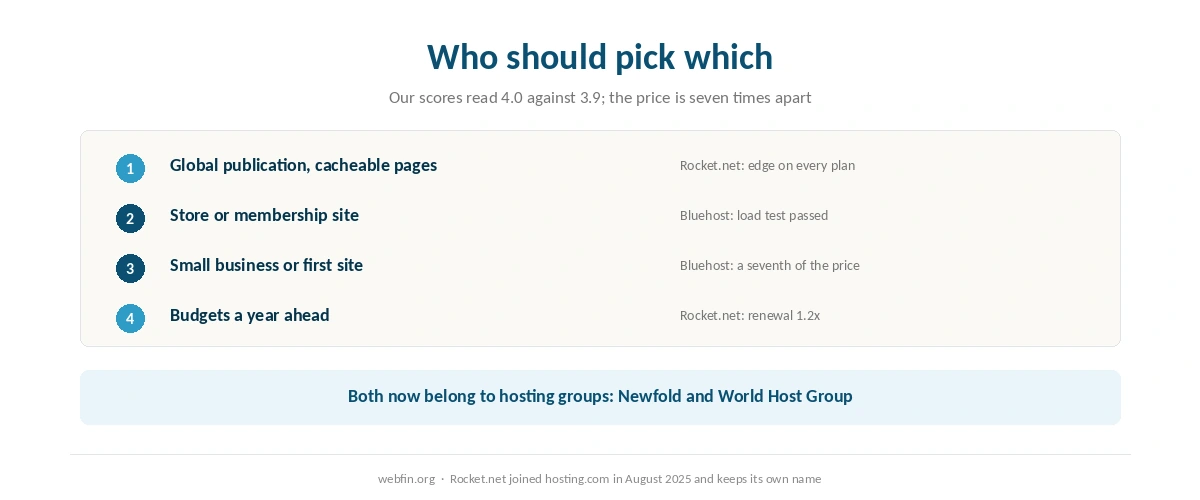
Bluehost has belonged to Newfold Digital since 2021, alongside HostGator and Yoast SEO, and who owns Bluehost traces the group. Rocket.net joined hosting.com, part of World Host Group, in August 2025. The company called it a strategic partnership and still operates under its own name, and the same group renamed A2 Hosting as hosting.com.
So this is no longer a comparison between a corporate brand and an independent specialist. Both answer to groups that own several hosting brands, which matters for how renewal policy is set. Our comparison of Bluehost against A2 Hosting covers the World Host Group side in more depth.
Which Sites Rocket.net Actually Suits
A monetized content site with readers spread across countries is the clearest case. Nearly every page can be cached, so the edge network does most of the work, and the renewal step of 1.2× over 12 months makes the budget easy to hold. Our list of hosting for bloggers makes that case for blogs that earn.
A store is the weakest case. Checkout bypasses the cache on any host, so the edge network helps least on the pages that make money, and the hardware score is lower than Bluehost’s. For a store, compare managed WordPress options that publish a load result, as our roundup of hosting for high traffic does.
Before Paying for an Edge Network
Where are your readers? An edge network earns its keep when visitors are spread across continents. For an audience in one country, a shared host near that country does most of what the edge does. Bluehost’s cached global figure is 224 ms across 40 locations in the same benchmark project, which is already quick.
How much of the site can be cached? A blog is almost entirely cacheable. A store, a forum or a membership site is not, and the uncached share is served from the origin whichever host you choose.
Does your current host already include one? Several shared plans put a content network in front of the site at some tier. Paying for a second one is common, because the plan page and the dashboard rarely use the same word for it.
Will the renewal matter? Rocket.net’s 1.2× step over 12 months is a genuine advantage for a business that budgets a year ahead. At $30.00 a month it is still three times Bluehost’s renewal, so predictability is what you are buying, not economy.
Where Each One Is Weakest
Rocket.net is weakest on price and on evidence. It costs seven times as much, it blocks the one test that shows behavior under load, and its hardware score fell this year. None of that makes it a poor host; it makes the premium harder to justify from published numbers.
Bluehost is weakest after checkout and on commitment. Its dashboard sells add-ons most sites never need, its best rate needs three years in advance, and the renewal step is the steeper of the two. Our page on hidden hosting fees lists the extras.
Winners by Category
Price: Bluehost, at $143.64 against $1,020.00 over 36 months. Renewal step: Rocket.net, at 1.2× over 12 months. Load handling: Bluehost, which passed a test Rocket.net blocks. Hardware: Bluehost, at 9.6 against 7.5. Uptime: Bluehost, narrowly. Edge network: Rocket.net, on every plan. Phone support on the entry plan: Bluehost.
When to Choose Rocket.net Instead
Take Rocket.net if the site earns from global readers, its pages are overwhelmingly cacheable, and you want managed WordPress with an enterprise edge network and a price that barely moves at renewal. Compare its managed rivals too, since our comparison of Bluehost against WP Engine covers one that publishes a load result.
Take Bluehost for everything else. It costs a seventh as much, measures ahead on the named record, and answers the phone.
How We Research
We run no tests. Hardware, uptime and load figures come from Hostingstep’s 2026 benchmarks, reviews and changelog, each with its window. Figures from a test whose publisher we have not named in our tables are left out rather than quoted. Prices come from the providers’ own pages, read on 20 September 2026.
Ownership comes from the companies’ own announcements of August 2025. The criteria behind our scores are on our about page, and the full workings are in our Rocket.net review.
Bluehost vs Rocket.net FAQ
For most sites, no. Across 36 months it costs $1,020.00 against $143.64, and on the named record Bluehost measures ahead on hardware, uptime and load. It can be worth it for a monetized content site with global readers and cacheable pages.
On the named figures, Bluehost: a load test at 41 ms without errors and hardware at 9.6 of 10. Rocket.net blocks that load test and its hardware score fell to 7.5. Its edge network speeds up cached pages, which our review covers separately.
Rocket.net, at 1.2× over 12 months, from $25.00 to $30.00. Bluehost moves 2.5× over 36 months, from $3.99 to $9.99. Rocket.net is the predictable one, and it stays far more expensive at every stage.
Rocket.net joined hosting.com, part of World Host Group, in August 2025, and continues to operate under its own name. Bluehost belongs to Newfold Digital, which also owns HostGator and Yoast SEO.
From its Business tier. Starter relies on chat, which published accounts describe as answered quickly. Bluehost answers phone and chat around the clock on its entry plan. Neither publishes a measured response time.
The Verdict
Bluehost takes this clearly. It costs a seventh as much across three years, and every named figure we hold for both hosts points its way: load, hardware and uptime. Our scores read 4.0 against 3.9, closer than the price and the record suggest, because Rocket.net’s edge network and predictable renewal are real strengths.
Rocket.net makes sense for one kind of site: a WordPress publication that earns from readers around the world and serves them cached pages. For that site the edge network is the product. For a store, a small business or a first site, it is an expensive way to buy less proof. If you move later, our guide to migrating web hosting covers the order.