
Disclosure: WebFin is reader-supported. If you buy hosting through links on this page, we may earn a commission at no extra cost to you. Commissions vary between providers and our ratings do not — here’s our full disclosure.
Cloudways vs Rocket.net sets two managed platforms with opposite philosophies against each other. Rocket.net puts Cloudflare’s enterprise edge in front of every site and prices by monthly visits: $25.00 rising to $30.00, or $1,020.00 across 36 months. Cloudways sells a server on the cloud you choose, with no visit cap, at $14.00 flat, or $504.00 over the same stretch. That is exactly twice the price for the edge-first route. And only one of the two has a load result at all, because Rocket.net blocks the test.
Cloudways vs Rocket.net: The Short Answer
Cloudways, at 4.1 against 3.9 in our reviews. It costs half as much, has the stronger named uptime, imposes no visit cap and bills by the hour. Rocket.net is the better choice for a WordPress publication with readers on several continents and pages that can all be cached, and for a buyer who wants a renewal that barely moves.
Head to Head
| Criterion | Cloudways | Rocket.net Starter |
|---|---|---|
| Approach | Server on the cloud you choose | Edge-first managed WordPress |
| Price | $14.00/mo flat | $25.00/mo, then $30.00 |
| 36 months | $504.00 | $1,020.00 |
| Renewal step | None | 1.2× over 12 months |
| Visit allowance | None; sized by server | 25,000 monthly visits |
| Uptime | 99.996% to 99.999% | 99.97%, seven outages |
| Load test | 288 ms at 1.7% errors | Blocked; no result |
| Server hardware | 7.6, Vultr HF | 7.5, down from 8.5 |
| Edge network | Add-on | Cloudflare Enterprise on every plan |
| Applications | Any PHP application | WordPress only |
| Owner | DigitalOcean, 2022 | hosting.com, World Host Group, 2025 |
| Our score | 4.1 | 3.9 |
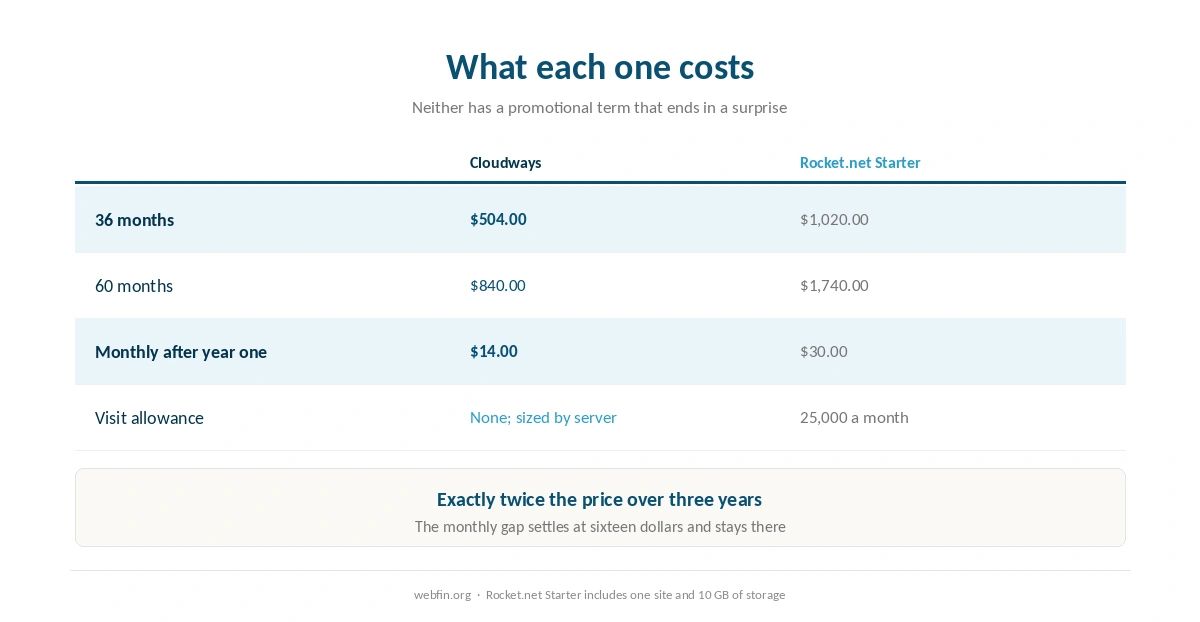
Exactly Twice the Price
Rocket.net Starter bills twelve months at $25.00 and then $30.00, which is 1.2× over 12 months and $1,020.00 across 36 months. Cloudways bills $14.00 from the first month with no promotional term, which is $504.00. The ratio is 2.02 to one.
Rocket.net has the gentler shape and the higher price. Its renewal moves by a fifth, so the quote in year one nearly holds in year three, while Cloudways never changes at all. Over five years Rocket.net costs more than twice the Cloudways total. Our page on hosting renewal prices puts both beside the field.
⚠️ The visit allowance is the other price. Rocket.net Starter includes 25,000 monthly visits, one site and 10 GB of storage. A publication that grows past that moves up a tier. Cloudways has no visit cap; its limit is the size of the server, which you can change by the hour.
| Host and plan | How it builds | 36-month total |
|---|---|---|
| ChemiCloud Starter, 36-month term | 36 prepaid months at $2.49 | $89.64 |
| InterServer Standard | 36 months at $2.50, price locked | $90.00 |
| DreamHost Launch, 48-month term | 36 of 48 prepaid months at $2.89 | $104.04 |
| Namecheap Stellar, 24-month term | 24 at $1.98, then 12 at $4.88 | $106.08 |
| Hostinger Premium, 48-month term | 36 of 48 prepaid months at $2.99 | $107.64 |
| HostGator Hatchling, 36-month term | 36 months at $3.75, renewal not reached | $135.00 |
| HostGator Hatchling, with daily backups | 36 at $3.75, plus CodeGuard at $35.88 a year | $242.64 |
| Bluehost Starter, 36-month term | 36 months at $3.99, renewal not reached | $143.64 |
| GoDaddy Economy, 36-month term | 36 months at $5.99, renewal not reached | $215.64 |
| GoDaddy Economy, with SSL from year two | 36 at $5.99, plus $119.99 in years two and three | $455.62 |
| Hostwinds Basic, annual | 12 at $4.54, then 24 at $6.99 | $222.24 |
| SiteGround StartUp, 24-month term | 24 at $2.99, then 12 at $14.99 | $251.64 |
| DreamHost Launch, annual | 12 at $2.89, then 24 at $10.99 | $298.44 |
| Scala Hosting Mini, annual | 12 at $2.95, then 24 at $11.95 | $322.20 |
| Bluehost Starter, 12-month term | 12 at $3.99, then 24 at $11.99 | $335.64 |
| IONOS Plus, annual | 12 at $1.00, then 24 at $14.00 | $348.00 |
| GreenGeeks Lite, 36-month prepay | 36 months at $2.95 | $106.20 |
| GreenGeeks Lite, annual | 12 at $2.95, then 24 at $13.95 | $370.20 |
| SiteGround StartUp, 12-month term | 12 at $2.99, then 24 at $17.99 | $467.64 |
| Cloudways, from | 36 months at $14.00, flat | $504.00 |
| A2 Hosting Turbo Boost, annual | 12 at $6.99, then 24 at $20.99 | $587.64 |
| Rocket.net Starter, annual | 12 at $25.00, then 24 at $30.00 | $1,020.00 |
| WP Engine Startup, annual | 12 at $27.00, then 24 at $35.00 | $1,164.00 |
| Liquid Web managed VPS | 36 months at $33.00 | $1,188.00 |
| Kinsta Starter | 36 months at $35.00, flat | $1,260.00 |
| InMotion Core, 36-month term | 36 months at $3.19, renewal not reached | $114.84 |
| InMotion Launch, 36-month term | 36 months at $4.99, renewal not reached | $179.64 |
One Has a Load Result, the Other Does Not
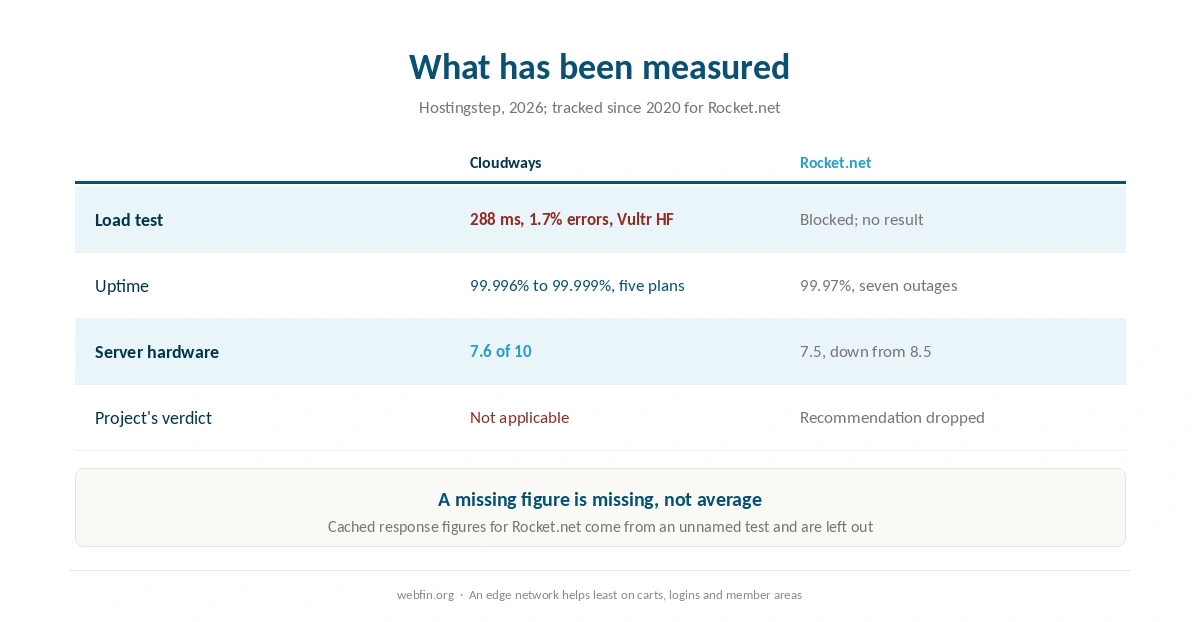
We run no tests, so these figures belong to Hostingstep. Its load test ramps to 100 concurrent visitors. Cloudways on its Vultr High Frequency plan finished at 288 ms with a 1.7% error rate, which is its weakest published result and still a completed test. Rocket.net blocks the test, so there is no concurrency figure for it at all.
On uptime, Cloudways held between 99.996% and 99.999% across five plans from October 2025 to May 2026. Rocket.net recorded 99.97% over seven outages between October 2025 and May 2026, a good result on its own. Hardware is nearly level, at 7.6 against 7.5, though Rocket.net’s score fell from 8.5 during the year and the project dropped its recommendation.
⚠️ A blocked test is not a poor result, and it is not a good one either. It means a buyer cannot compare the platform on the measure that matters for uncached pages. Our guide to reading an uptime report explains why we treat a missing figure as missing rather than average.
Edge-First Against Server-First
Rocket.net puts Cloudflare Enterprise in front of every site on every plan, and the platform manages the caching rules. Pages that can be cached are served from a location near the reader, which is the product. For a content site with readers across countries, that is the cleanest version of this idea we cover.
Cloudways puts you on a server and lets you choose its cloud and size. Caching, if you want an edge network, is an add-on. What you get instead is capacity you control: resize for a launch, shrink afterward, and pay for the hours used. Our guide to setting up a CDN covers adding one yourself.
⚠️ The split matters most on pages that cannot be cached. Carts, logins and member areas are served from the origin on both platforms, so an edge network helps least on exactly those pages. Our list of hosting for membership sites covers that case.
What Each One Leaves Out
Neither hosts email. Rocket.net is WordPress only; Cloudways runs any PHP application. Cloudways sells mailboxes through Rackspace at about a dollar each per month, and phone support as an add-on. Our guide to setting up email on your domain covers the records either way.
Support differs in shape. Rocket.net answers chat quickly according to published accounts and adds a phone line from its Business tier. Cloudways answers chat and tickets around the clock. Neither publishes a measured response time, and no controlled test of hosting support exists in the sources we found.
Two Corporate Owners
DigitalOcean acquired Cloudways in 2022 and sells the cloud underneath many of its servers. Rocket.net joined hosting.com, part of World Host Group, in August 2025; the company called it a strategic partnership, hosting.com lists it among the group’s acquisitions, and Rocket.net continues to operate under its own name.
So both platforms here answer to larger companies, which is worth knowing for renewal policy. Rocket.net’s ownership is the more recent change, and its hardware score fell in the same year. Our comparison of Cloudways against A2 Hosting covers the rest of the World Host Group side.
What a Dropped Recommendation Means
The benchmark project we cite has tracked Rocket.net since October 2020. During the past year its hardware score fell from 8.5 to 7.5 and the project stopped recommending it. That is one project’s judgement rather than a verdict, and it is the most recent signal we have.
For a buyer, the practical effect is that older praise describes a stronger platform than the current figures do. Read the most recent numbers, not the reputation, and weigh the edge network on its own merits rather than on a general impression of speed.
Moving Between Them
Both platforms host WordPress, so the move is routine in either direction. Cloudways provides a migration plugin, and Rocket.net offers migrations as part of onboarding according to published accounts. The domain can stay at its registrar and point at whichever platform runs the site, as our guide to pointing a domain to a new host explains.
Time a move away from Rocket.net for the end of a paid month rather than the middle, since it bills monthly. Moving off Cloudways costs nothing in unused time, because it bills by the hour. Email lives outside both platforms, so it moves separately or not at all.
Which Site Belongs Where
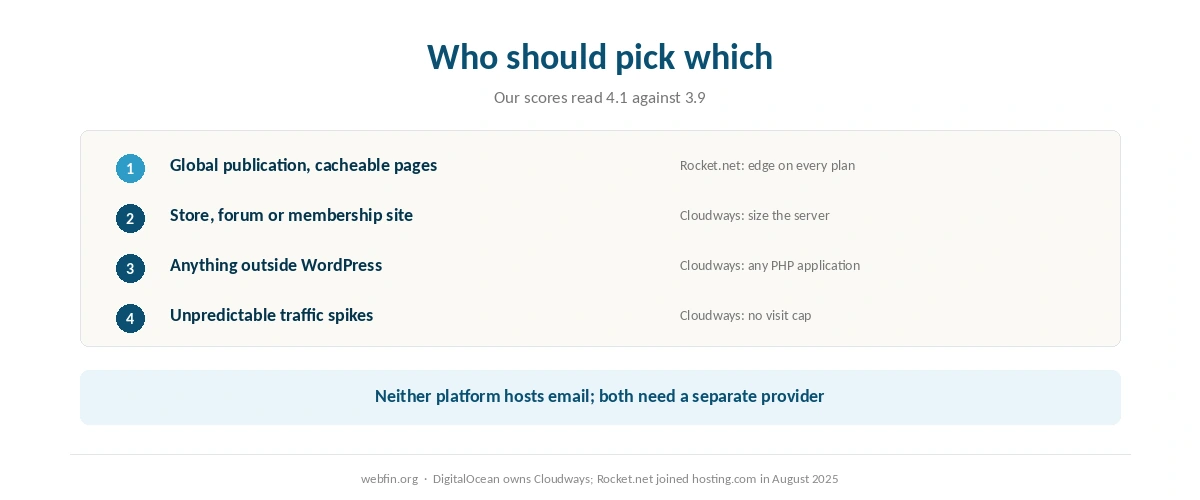
A monetized publication with global readers. Rocket.net, where nearly every page can be cached and the edge does the work. Our list of hosting for bloggers makes that case.
A store, a forum or a membership site. Cloudways, because the pages that matter bypass the cache and you can size the server for them.
A portfolio of projects, or anything not WordPress. Cloudways, which runs any PHP application. Our list of hosting for developers covers the tooling.
A business that budgets a year ahead. Either one: Cloudways never changes its price, and Rocket.net moves only by a fifth, from a much higher base.
The Visit Cap in Practice
A visit allowance is easy to budget and awkward when a post does well. Rocket.net Starter covers 25,000 monthly visits, and a piece that spreads on social media can use a month’s allowance in a day. The tier above exists for that, and the cost rises with it.
Cloudways prices by server size instead, so a spike is limited by what the server can serve rather than by an allowance. That is better for unpredictable traffic and worse for anyone who wants a fixed bill. Our roundup of hosting for high traffic covers both approaches.
The Five-Year View
Neither platform has a promotional term that ends in a surprise. Cloudways stays at $14.00, and Rocket.net at $30.00 after its first year. So the monthly gap settles at sixteen dollars and stays there, and over five years Rocket.net costs more than twice the Cloudways total. Whether that is worth paying depends entirely on how much of your site can be cached.
Where Each One Is Weakest
Rocket.net is weakest on price and on evidence. It costs twice as much over three years, it blocks the load test, its hardware score fell this year, and the benchmark project dropped its recommendation. The edge network cannot help on uncached pages.
Cloudways is weakest on its own load result and on what it leaves out. A 1.7% error rate on one cloud is not clean, there is no email, and an edge network costs extra. Our Cloudways review covers each cloud.
Winners by Category
Price: Cloudways, at $504.00 against $1,020.00 over 36 months. Renewal shape: Rocket.net, at 1.2× over 12 months. Named uptime: Cloudways. Load evidence: Cloudways, which completed the test. Edge network: Rocket.net, on every plan. Visit caps: Cloudways, which has none. Applications: Cloudways, beyond WordPress.
How We Research
We run no tests. Uptime, hardware and load figures come from Hostingstep’s 2026 benchmarks, reviews and changelog, each with its window, and we mark the load test Rocket.net blocks as missing rather than estimating it. Our tables also hold cached response figures for Rocket.net from a test whose publisher we have not named, and we leave those out here.
Prices, visit allowances and ownership come from the providers’ own pages and announcements, read on 20 September 2026. The criteria behind our scores are on our about page, and the full workings are in our Rocket.net review.
Cloudways vs Rocket.net FAQ
Cloudways, at exactly half the price over three years: $504.00 against $1,020.00. Cloudways charges $14.00 flat, while Rocket.net Starter opens at $25.00 and renews at $30.00.
Neither can be compared on load, because Rocket.net blocks that test. Cloudways’ weakest cloud completed it at 288 ms with 1.7% errors. Rocket.net’s edge network speeds up cached pages, which our review covers separately.
Starter includes 25,000 monthly visits, one site and 10 GB of storage, and higher tiers raise the allowance. Cloudways has no visit cap; its limit is the size of the server, which you can change by the hour.
On the named figures, Cloudways: 99.996% to 99.999% across five plans, against 99.97% over seven outages at Rocket.net. Both are strong, and Rocket.net’s hardware score fell from 8.5 to 7.5 during the year.
DigitalOcean has owned Cloudways since 2022. Rocket.net joined hosting.com, part of World Host Group, in August 2025 and keeps its own name.
The Verdict
Cloudways takes this, at 4.1 against 3.9. It costs half as much, holds the stronger named uptime, completed the load test Rocket.net blocks, and imposes no visit cap. For a store, a community or a portfolio, that is the better purchase by a clear margin. Our page on Cloudways for Magento covers the first yes in that series, with conditions.
Rocket.net earns its price in one case: a WordPress publication whose pages are almost all cacheable and whose readers are spread around the world. There the edge network is the product and the gentle renewal makes the budget easy to hold. For a store, a community or anything outside WordPress, the server is the better buy. Our page on what web hosting costs runs both totals further.