
Disclosure: WebFin is reader-supported. If you buy hosting through links on this page, we may earn a commission at no extra cost to you. Commissions vary between providers and our ratings do not — here’s our full disclosure.
Bluehost vs Scala Hosting is a tie in our reviews, at 4.0 each, and the rule that breaks it was published before this page existed. A tie goes to the lower cost of ownership across 36 months. On each host’s best published term, that is Bluehost, at $143.64 against $322.20. On annual terms at both, it is Scala, at $322.20 against $335.64. The measurements are nearly as close: both passed the load test without an error, 41 ms against 48 ms. So this page is less about a winner than about which of two very similar hosts fits the way you buy. The same Scala Hosting figures against Kinsta are in our Kinsta and Scala Hosting comparison.
Bluehost vs Scala Hosting: The Short Answer
Bluehost, by our published tie-break, if you will prepay three years. It then costs $143.64 across 36 months, measures slightly ahead and answers the phone. Scala Hosting is the better buy on annual terms, includes daily backups and a malware monitor, and offers a VPS priced by the unit when you outgrow shared.
Head to Head
| Criterion | Bluehost Starter | Scala Hosting Mini |
|---|---|---|
| Intro rate | $3.99/mo | $2.95/mo |
| Renewal, annual term | $11.99/mo | $11.95/mo |
| Renewal, longest term | $9.99 on 36 months | Not in our table |
| 36 months, longest term | $143.64 | $322.20 |
| 36 months, annual terms | $335.64 | $322.20 |
| Load test | 41 ms, no errors | 48 ms, no errors |
| Server hardware | 9.6 of 10 | 8.8 of 10 |
| Uptime | 99.99% | 99.98% |
| Backups | Weekly on Starter | Daily, in the panel |
| Support | Phone and chat, 24/7 | Chat and tickets, no phone |
| Our score | 4.0 | 4.0 |
A Tie, and the Rule That Breaks It
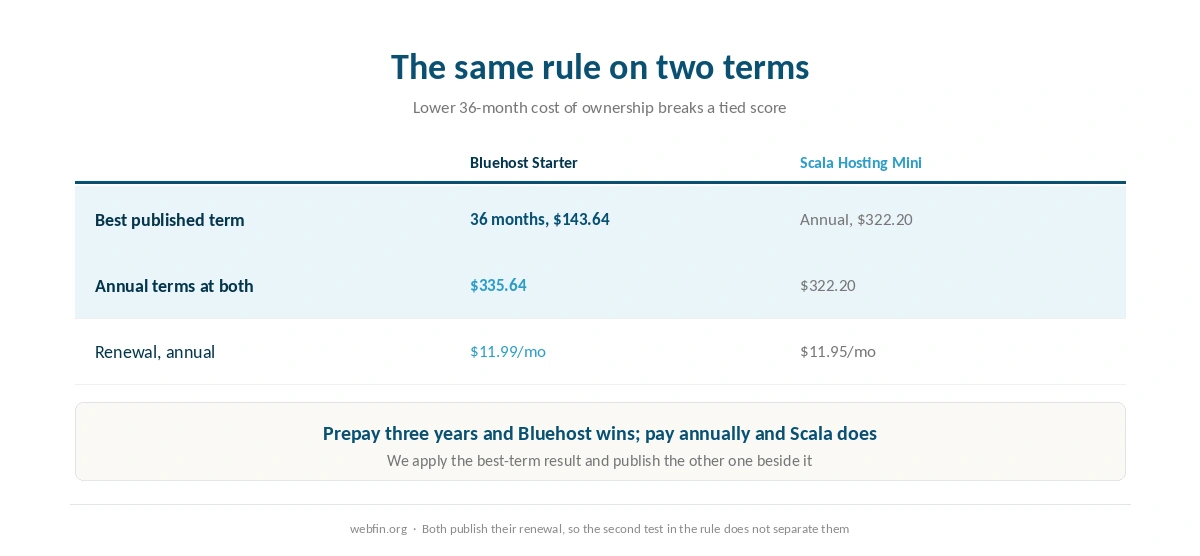
Our scoring put both hosts at 4.0. What happens next is written on our about page rather than decided here: a tie goes to the lower cost of ownership over 36 months. If that ties too, it goes to the host that publishes its renewal price rather than showing it at checkout.
The first test needs a term, and each host rewards a different one. Bluehost’s best rate needs a 36-month prepayment and costs $143.64 across it. Scala’s best published rate in our table is on an annual term, $2.95 then $11.95, which comes to $322.20. On those terms Bluehost wins the tie-break clearly, and that is the result we apply.
⚠️ It would be dishonest to stop there. On annual terms at both, Scala is cheaper, at $322.20 against $335.64, and its intro and renewal are both lower. So if you will not prepay three years, the rule that makes Bluehost the winner points the other way for you. We publish both results rather than only the one that decides the verdict.
The second test in the rule would not help either way. Both hosts publish their renewal prices on their own pages, Bluehost through its help pages and Scala on its plan cards. Neither hides the second term at checkout. That leaves the term you sign as the deciding fact, which is a useful thing for a buyer to know before looking at anything else.
| Host and plan | How it builds | 36-month total |
|---|---|---|
| ChemiCloud Starter, 36-month term | 36 prepaid months at $2.49 | $89.64 |
| InterServer Standard | 36 months at $2.50, price locked | $90.00 |
| DreamHost Launch, 48-month term | 36 of 48 prepaid months at $2.89 | $104.04 |
| Namecheap Stellar, 24-month term | 24 at $1.98, then 12 at $4.88 | $106.08 |
| Hostinger Premium, 48-month term | 36 of 48 prepaid months at $2.99 | $107.64 |
| HostGator Hatchling, 36-month term | 36 months at $3.75, renewal not reached | $135.00 |
| HostGator Hatchling, with daily backups | 36 at $3.75, plus CodeGuard at $35.88 a year | $242.64 |
| Bluehost Starter, 36-month term | 36 months at $3.99, renewal not reached | $143.64 |
| GoDaddy Economy, 36-month term | 36 months at $5.99, renewal not reached | $215.64 |
| GoDaddy Economy, with SSL from year two | 36 at $5.99, plus $119.99 in years two and three | $455.62 |
| Hostwinds Basic, annual | 12 at $4.54, then 24 at $6.99 | $222.24 |
| SiteGround StartUp, 24-month term | 24 at $2.99, then 12 at $14.99 | $251.64 |
| DreamHost Launch, annual | 12 at $2.89, then 24 at $10.99 | $298.44 |
| Scala Hosting Mini, annual | 12 at $2.95, then 24 at $11.95 | $322.20 |
| Bluehost Starter, 12-month term | 12 at $3.99, then 24 at $11.99 | $335.64 |
| IONOS Plus, annual | 12 at $1.00, then 24 at $14.00 | $348.00 |
| GreenGeeks Lite, 36-month prepay | 36 months at $2.95 | $106.20 |
| GreenGeeks Lite, annual | 12 at $2.95, then 24 at $13.95 | $370.20 |
| SiteGround StartUp, 12-month term | 12 at $2.99, then 24 at $17.99 | $467.64 |
| Cloudways, from | 36 months at $14.00, flat | $504.00 |
| A2 Hosting Turbo Boost, annual | 12 at $6.99, then 24 at $20.99 | $587.64 |
| Rocket.net Starter, annual | 12 at $25.00, then 24 at $30.00 | $1,020.00 |
| WP Engine Startup, annual | 12 at $27.00, then 24 at $35.00 | $1,164.00 |
| Liquid Web managed VPS | 36 months at $33.00 | $1,188.00 |
| Kinsta Starter | 36 months at $35.00, flat | $1,260.00 |
| InMotion Core, 36-month term | 36 months at $3.19, renewal not reached | $114.84 |
| InMotion Launch, 36-month term | 36 months at $4.99, renewal not reached | $179.64 |
The Measurements Are Close
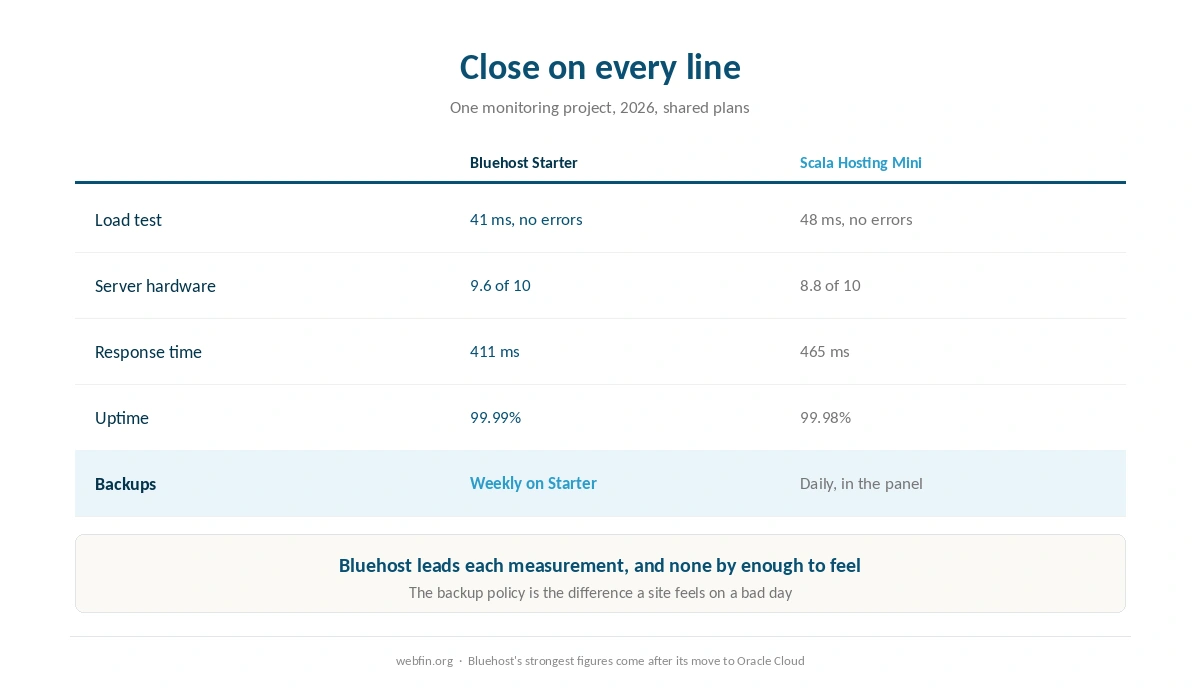
We run no tests, so these figures belong to Hostingstep. Both hosts passed the load test, which ramps to 100 concurrent visitors, with no errors. Bluehost answered at 41 ms after its move to Oracle Cloud, and Scala at 48 ms. Bluehost scores 9.6 of 10 on hardware and Scala 8.8, and that project names Scala’s result the strongest among shared hosts apart from Bluehost.
Response and uptime follow the same pattern. Bluehost records 411 ms and 99.99% over 9 outages between November 2025 and August 2026. Scala records 465 ms and 99.98%. Bluehost is ahead on every line, and on none of them by enough that a visitor would notice.
⚠️ Bluehost’s strongest figures are recent, taken on new infrastructure, while Scala’s describe a setup that has not changed. A buyer who values a stable record over a strong new one could weigh this section differently. Our guide to reading an uptime report explains why.
What Scala Includes That Bluehost Sells
Scala’s own panel, SPanel, includes daily backups, WordPress staging and cloning, and a real-time malware monitor. Bluehost Starter keeps weekly backups according to the benchmark project, and it sells security separately: SiteLock Essentials renews at $95.88 a year. Its dashboard also offers a premium certificate at $89.88 that most sites do not need.
So the two plans cost different amounts before and after a bad day. On Scala, a restore from yesterday is part of the plan. On Bluehost Starter, it depends on a weekly copy or a paid add-on. Our guide to recovering a hacked website shows why that matters, and hidden hosting fees lists the add-ons.
Growing Past Shared Hosting
Scala has the clearer path up. Its VPS prices a processor core at $36.00 a year and a gigabyte of memory at $12.00, and both can be added or removed as traffic changes. A site that outgrows Mini moves to resources it can size precisely, inside the same company and the same panel.
Bluehost’s path runs through its Business tier first, which opens at $6.99 and renews at $13.99 on a 36-month term. Given its load result, a Bluehost site stays comfortable on shared hosting for longer than most, which delays the question. Our guide to moving from shared to VPS covers the signals that it is time.
Panels, Portability and Support
Bluehost runs cPanel behind a WordPress dashboard, so accounts export in a standard format and every tutorial matches the screen. Scala runs SPanel, which it built to avoid per-account cPanel licenses. SPanel is capable and proprietary, so leaving Scala means moving the site rather than exporting the account.
Bluehost answers phone and chat around the clock. Scala answers chat and tickets with no phone line. Neither publishes a measured response time. On refunds, both give 30 days; Bluehost keeps $15.99 for a free domain, and Scala then pro-rates the unused part of the term, which is unusual.
Which Difference Matters for Your Site
For a quiet brochure site or a cached blog, the measured gaps here will not be felt. A few milliseconds of load handling and a small hardware difference disappear behind a page cache. What such a site will feel is the backup policy on the day something goes wrong, and the renewal on the day the promotion ends.
For a store or a plugin-heavy site, the hardware and load results matter more, and Bluehost’s slight lead is worth something. So is Scala’s VPS path, because busy sites are the ones that outgrow shared hosting first. The honest summary is that the two hosts trade small advantages, and the site you run decides which ones count.
Who Owns Them
Bluehost has belonged to Newfold Digital since 2021, alongside HostGator and Yoast SEO, and who owns Bluehost traces the group. Scala describes itself as a Dallas-based company in business since about 2008, and its ownership is not documented in anything we read.
That gap is a gap, not an implication. It matters mostly for renewal policy, which tends to follow the owner. For a buyer prepaying several years, it is worth knowing which kind of company holds the other end of the contract.
Client Work and Reselling
Scala sells white-label reseller hosting, where client-facing pages carry your brand rather than the host’s. Its VPS also lets you give a seasonal client more capacity without moving everyone else. For a freelancer who hosts sites for clients, that is a real product rather than an afterthought. Our roundup of reseller hosting covers it in more depth.
Bluehost is built around one owner and their own sites, with the dashboard, the extras and the support aimed at that person. It serves client work adequately through its higher tiers, and it is not where its strengths lie.
Where Each One Is Weakest
Scala is weakest on portability and on the phone. SPanel is proprietary, so skills and scripts do not carry to other hosts, and there is no telephone line at any tier. Its ownership is also undocumented, which matters more to a buyer prepaying several years than to one paying annually.
Bluehost is weakest on what the entry plan leaves out. Weekly backups, a 100 MB cap per mailbox and a dashboard that sells security separately all push costs to later. And its best price needs a three-year prepayment, which is the commitment the tie-break rewards and the one a cautious buyer may not want to make.
Winners by Category
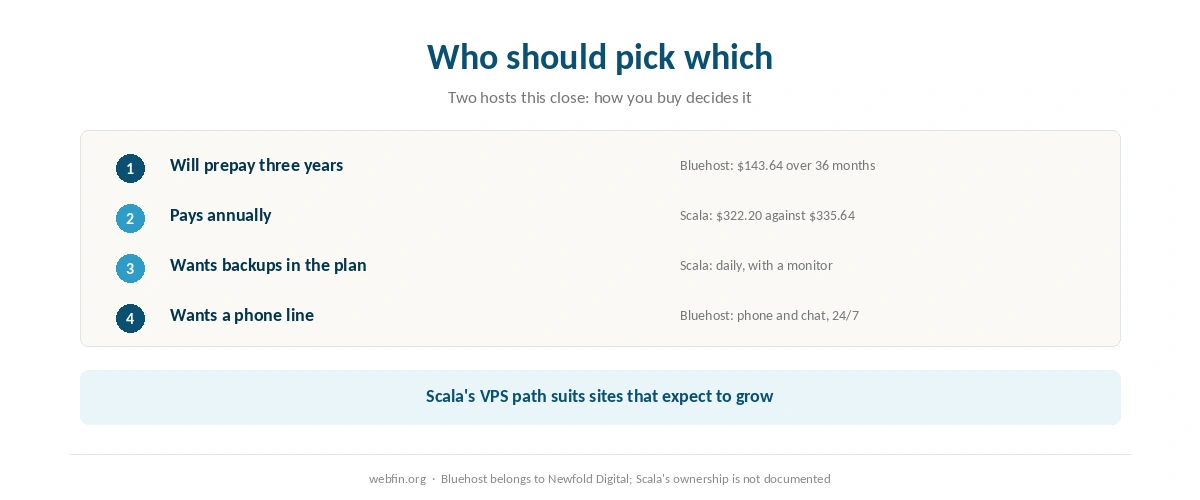
Tie-break, longest terms: Bluehost, at $143.64 against $322.20. Annual terms: Scala, at $322.20 against $335.64. Load and hardware: Bluehost, narrowly, at 41 ms and 9.6. Backups and malware monitoring: Scala, included. Growth path: Scala, with a VPS priced by the unit. Support channels: Bluehost, with a phone line. Portability: Bluehost, on standard cPanel. Refunds: Scala, which pro-rates after 30 days.
When to Choose Scala Hosting Instead
Take Scala if you buy annually or expect to grow into a VPS. Take it too if backups and malware monitoring should be in the plan rather than on the menu. It is cheaper on annual terms, includes more, and its upgrade path is the most precise on this page. Our comparison of SiteGround against Scala covers it against another rival.
Take Bluehost if you will prepay three years, want a phone line, or value standard cPanel and the slightly stronger measurements. Our comparison of Bluehost against Namecheap weighs it against a cheaper renewal.
How We Research
We run no tests. Load, hardware, response and uptime figures come from Hostingstep’s 2026 benchmarks with their windows. Prices, inclusions and refund terms come from the providers’ own pages, read on 20 September 2026, and features are those documented in our reviews.
When two hosts tie on score, we apply the tie-break published on our about page and show where it would point on other terms. The full workings are in our Bluehost review.
Bluehost vs Scala Hosting FAQ
It depends on the term. On Bluehost’s 36-month prepayment, three years cost $143.64, well below Scala’s $322.20 on annual terms. On annual terms at both, Scala is cheaper, at $322.20 against $335.64, with a lower intro and renewal.
They win different criteria and land level. Our published tie-break gives a tie to the lower 36-month cost of ownership, which on each host’s best term is Bluehost. On annual terms the same rule would favor Scala.
Bluehost, narrowly. It passed the load test at 41 ms against 48 ms, scores 9.6 on hardware against 8.8, and records 411 ms against 465 ms. Both passed the load test without a single error, so the difference is small.
Yes. SPanel includes daily backups, staging and cloning, and a real-time malware monitor. Bluehost Starter keeps weekly backups and sells security separately, with SiteLock Essentials renewing at $95.88 a year.
Bluehost belongs to Newfold Digital, which also owns HostGator and Yoast SEO. Scala describes itself as a Dallas-based company in business since about 2008, and its ownership is not documented in anything we read.
The Verdict
Bluehost takes this on our published tie-break, because on each host’s best term it costs $143.64 across three years against $322.20. It also measures a little ahead and answers the phone. Those are real advantages, and the tie-break exists so that a level score is settled by a rule rather than by preference.
Scala is the better buy for anyone who pays annually, and it includes the backups and malware monitoring that Bluehost sells. Two hosts this close deserve a verdict that depends on how you buy, and this one does. If you move later, our guide to migrating web hosting covers the order.