
Disclosure: WebFin is reader-supported. If you buy hosting through links on this page, we may earn a commission at no extra cost to you. Commissions vary between providers and our ratings do not — here’s our full disclosure.
Cloudways sells the thing this site keeps asking for. There is no introductory rate, no renewal increase, no contract and no cancellation penalty. You pay by the hour for a server, and the price in year three is the price in month one. Our comparison of Cloudways against GoDaddy prices the same server beside a cheaper plan.
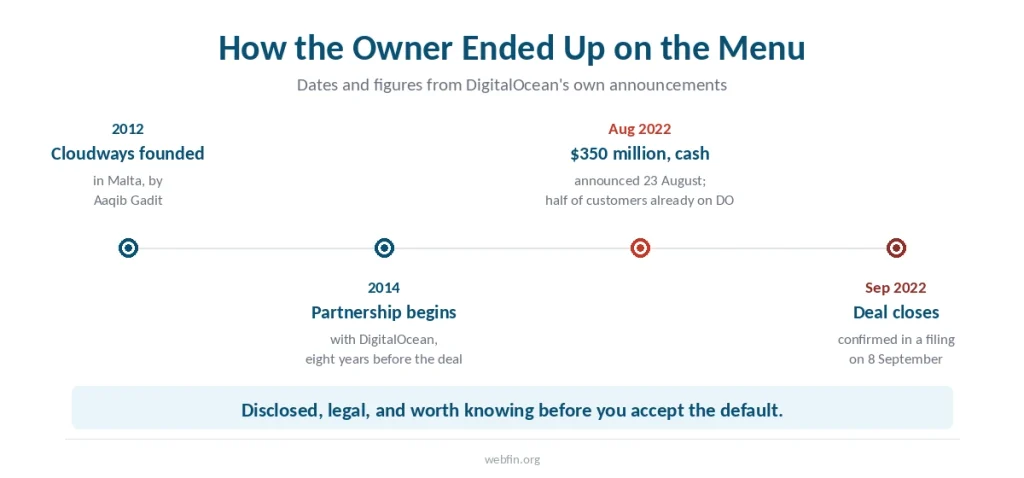
It also asks you to choose between five cloud providers, and it is owned by one of them. DigitalOcean bought Cloudways in 2022 for $350 million, and said in its own announcement that Cloudways already ran more than half its customers on DigitalOcean infrastructure. For more developer-focused picks, see the best hosting for developers.
Is Cloudways Worth It in 2026?
For anyone past their first site, probably. Independent monitoring across five configurations records uptime between 99.996% and 99.999% and TTFB in a tight 419–447 ms band, with entry pricing from $11 to $16 a month and no increase later. The trade is that you manage a server, and email is not included. Our comparison of Cloudways against ChemiCloud prices the same server beside it.
At a Glance
What works
- No promotional pricing, so no renewal cliff to plan around
- Uptime between 99.996% and 99.999% across every configuration monitored
- Hourly billing, cancel any time, no contract
- Staging, SSH, WP-CLI and Git included at every tier
- Server-level caching rather than a plugin doing the work
What does not
- No email hosting; Rackspace mailboxes cost extra
- No phone support at any tier
- You are responsible for a server, not a hosting account
- The owner sells one of the five clouds you are choosing between
Speed
Every figure below comes from a named project with its window stated. We run no tests of our own.
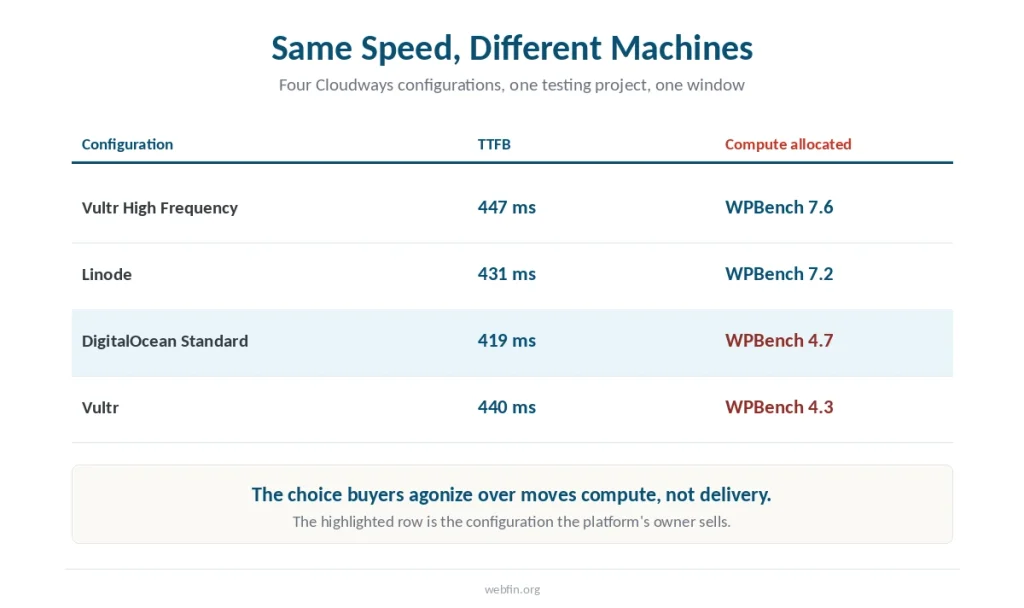
Hostingstep has monitored Cloudways since 2020 across five cloud provider configurations, running more than 12.2 million individual tests. Its window from October 2025 to May 2026 records TTFB between 419 ms and 447 ms, with every configuration scoring 8 to 8.5 out of 10 on response time. Our comparison of Cloudways against Rocket.net prices the same server beside it.
The band is the finding. Whichever cloud you pick, the delivery speed lands within 28 milliseconds of the others. The choice that buyers agonize over turns out not to move the number they think it moves.
Where the configurations differ is compute. WPBench hardware scores run 7.6 for Vultr High Frequency, 7.2 for Linode, 4.7 for DigitalOcean Standard and 4.3 for Vultr — a difference of nearly two to one for money that looks similar on the pricing page.
⚠️ Published figures outside that dataset run much lower, down to 72–180 ms, usually measured on Vultr High Frequency with caching and a CDN active. Those are real numbers on optimized setups rather than out-of-the-box results, and we give both rather than blending them.
Uptime
Between 99.996% and 99.999%, and unusually the short and long windows agree.
Hostingstep’s eight-month window records 99.996% to 99.999% across all five configurations. Quarterly figures from other projects put Cloudways at 99.99% for Q4 2025, and a twelve-month independent record gives 99.981%.
The explanation is structural rather than operational. A Cloudways server is a virtual machine on DigitalOcean, Vultr, AWS, Google Cloud or Linode infrastructure, which means it inherits enterprise redundancy that shared hosting on a single machine cannot match. Our comparison of Cloudways against HostGator prices the same server beside a cheaper plan.
Support
Chat and tickets, around the clock, with no phone line at any tier.
The harder point is what support covers. On shared hosting the host owns the whole stack; on Cloudways the boundary sits at the platform, and problems inside your application are yours. That is normal for managed cloud and it surprises people arriving from shared hosting.
⚠️ Nobody publishes controlled measurement of support response times for any host, so this criterion rests on consistent description rather than data. We treat it as the softest of the five throughout this site.
Price and Renewal
There is nothing to explain here, which is the point. At equal specifications, though, cheaper servers exist.
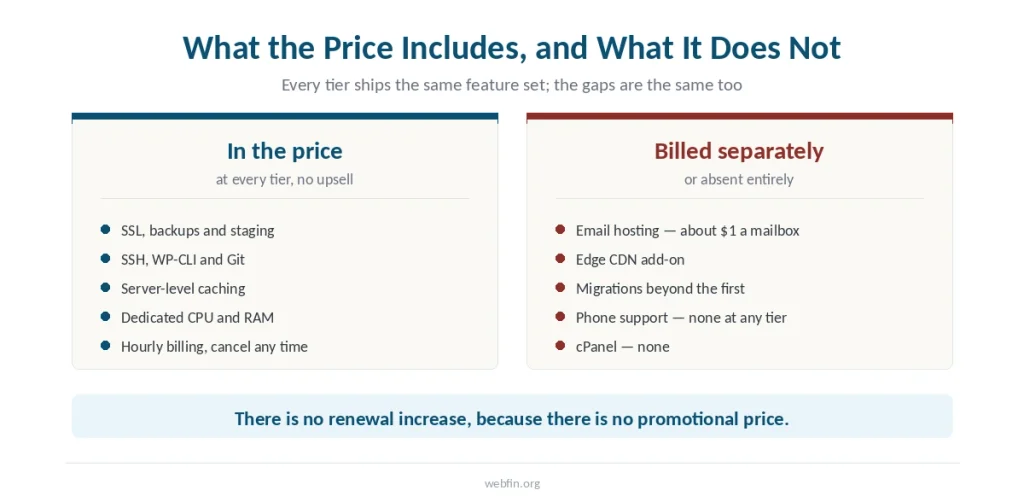
Hostingstep records entry pricing from $11 to $16 a month across the five configurations, with the same figure at renewal. Cloudways’ own pricing page gives $14 as its starting point. Billing is hourly, there is no contract, and closing the account costs nothing — set against the field, that is unusual.
Over three years a $14 server costs $504.00. That is more than any shared plan we have calculated, and about a dollar a month more than SiteGround’s entry plan bought annually — the full arithmetic is here.
What is genuinely absent is the resource ceiling. You are not sharing CPU seconds or inodes with strangers; you have a machine with stated RAM and cores. The ceilings we spent a whole article on do not exist in this model, and if you have ever hit one, that alone may justify the price.
What is genuinely extra: email is not included, with Rackspace mailboxes billed separately at about a dollar each. The Edge CDN is an add-on. Migrations beyond the free one are chargeable.
Ease of Use
For a developer or an agency, this is the best tooling in our set. Staging, SSH, WP-CLI, Git deployment and PHP version selection ship at every tier, and launching a server takes minutes. For a portfolio of client sites, see the best hosting for agencies.
For a first website, it is the hardest. There is no cPanel, no email in the box, and the mental model is a server rather than a hosting account. Nothing here is difficult; it is simply not designed for someone who has never seen a control panel.
Who Owns It
Cloudways is owned by DigitalOcean, which is one of the five cloud providers it offers you.
The company was founded in 2012 by Aaqib Gadit, headquartered in Malta with substantial operations in Pakistan, and ran independently until 2022. DigitalOcean announced the acquisition on 23 August 2022 and completed it on 8 September, paying $350 million in cash, with a significant portion spread over 30 months. The filing is public.
Two details from DigitalOcean’s own announcement are worth quoting plainly. The companies had partnered since 2014. And at the time of the deal, Cloudways already relied on DigitalOcean infrastructure to power approximately half its customers.
⚠️ So the neutral menu is offered by a party on the menu. We are not suggesting anyone is steered: Cloudways still supports Vultr, AWS, Google Cloud and Linode, and continues to operate as a distinct product. But the independent benchmark above gives the owner’s own configuration the lowest hardware allocation of the five, and a buyer picking the default deserves to know who benefits from that default.
It is the same structural question we asked about a hosting company that also owns the SEO plugin it sells you, arriving from a different direction.
What We Don’t Love
No email. For a small business this is a real gap, and the workaround costs money and adds a vendor.
The owner is on the menu. Disclosed, legal, and worth knowing before you accept the default.
Not a first host. The pricing is honest and the tooling is excellent, but someone launching their first blog will find shared hosting friendlier and cheaper.
How We Research
Ownership and deal terms come from DigitalOcean’s investor announcements and its filing, read on 1 September 2026. Performance figures are attributed to named testing projects with their windows and test counts. Where optimised results differ from out-of-the-box results, both appear.
We run no tests of any kind. Our five criteria are on our About page.
Frequently Asked Questions
If you have outgrown shared hosting, yes. Independent monitoring records uptime between 99.996% and 99.999% and no renewal increase at any point. A $14 server costs $504 over three years, more than any shared plan but with dedicated resources and no ceiling to hit.
DigitalOcean, which acquired it for $350 million in cash in 2022. Cloudways was founded in 2012 by Aaqib Gadit and is headquartered in Malta. DigitalOcean is also one of the five cloud providers Cloudways offers.
No renewal markup and no contract, which is unusual. Email hosting is not included and costs about a dollar per mailbox monthly through Rackspace. The Edge CDN and additional migrations are separate charges.
Independent testing found delivery speed almost identical across all five, between 419 ms and 447 ms. Hardware allocation differs more: Vultr High Frequency scored 7.6 and Linode 7.2, against 4.7 for DigitalOcean Standard.
Less than shared hosting. There is no cPanel, no email in the box, and you manage a server rather than an account. The tooling is excellent for developers and agencies, and unfamiliar for a first website.
Cloudways
Summary
Flat pricing, uptime above 99.99% in every window measured, and no email in the box.
The Verdict
Cloudways earns 4.1, held up by uptime and pricing honesty and held down by what it does not include.
Choose it if you have outgrown shared hosting, you want a price that never changes, and email lives elsewhere already. Our page on Cloudways for Joomla covers why a managed server is more than most Joomla sites need.
Skip it if this is your first site, you need mailboxes included, or you want a phone number. We put it against Hostinger, where the steady-state gap is $3.01 a month.
Consider instead: Hostinger for a third of the three-year cost if your traffic is modest, or Kinsta if you want the same flat model with a faster edge network.