
Disclosure: WebFin is reader-supported. If you buy hosting through links on this page, we may earn a commission at no extra cost to you. Commissions vary between providers and our ratings do not — here’s our full disclosure.
For a store this comes out as the right shape at the wrong size. Cloudways gives you hourly billing, no visit caps and staging on every tier, which is exactly what a sale-driven shop wants. But the benchmark figure for its entry Vultr High Frequency configuration is 288 ms under load with a 1.7% error rate. That is roughly one request in sixty failing. On a checkout, that is the failure you cannot absorb.
Is Cloudways Right for WooCommerce? The Short Answer
Yes for a store with sales, campaigns or growth, and no at the cheapest configuration. Size the server above the entry tier, pick the cloud deliberately, and test the checkout under load on staging. A steady small store is better served by a shared plan with a clean load result, and those figures are lower and cleaner.
What a Checkout Asks For
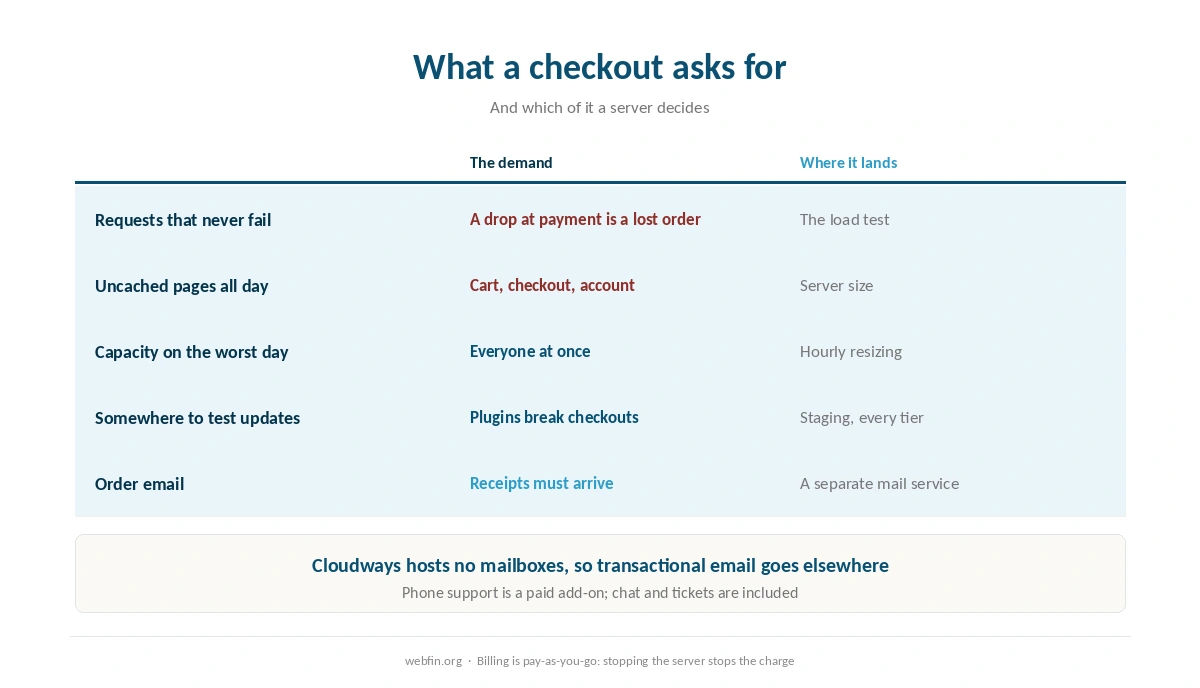
Requests that never fail. A dropped request on a product page is an annoyance. A dropped request at payment is a lost order and often a lost customer.
Uncached pages all day. Cart, checkout and account pages are built per visitor, which is what a load test measures and a cache cannot help with.
Capacity on the worst day. A campaign sends everyone to the checkout at once, which our guide to handling a traffic spike covers.
Somewhere to test updates. Plugin updates on a live shop are how checkouts break, and our guide to setting up a staging site covers the alternative.
The Entry Figure, in Context
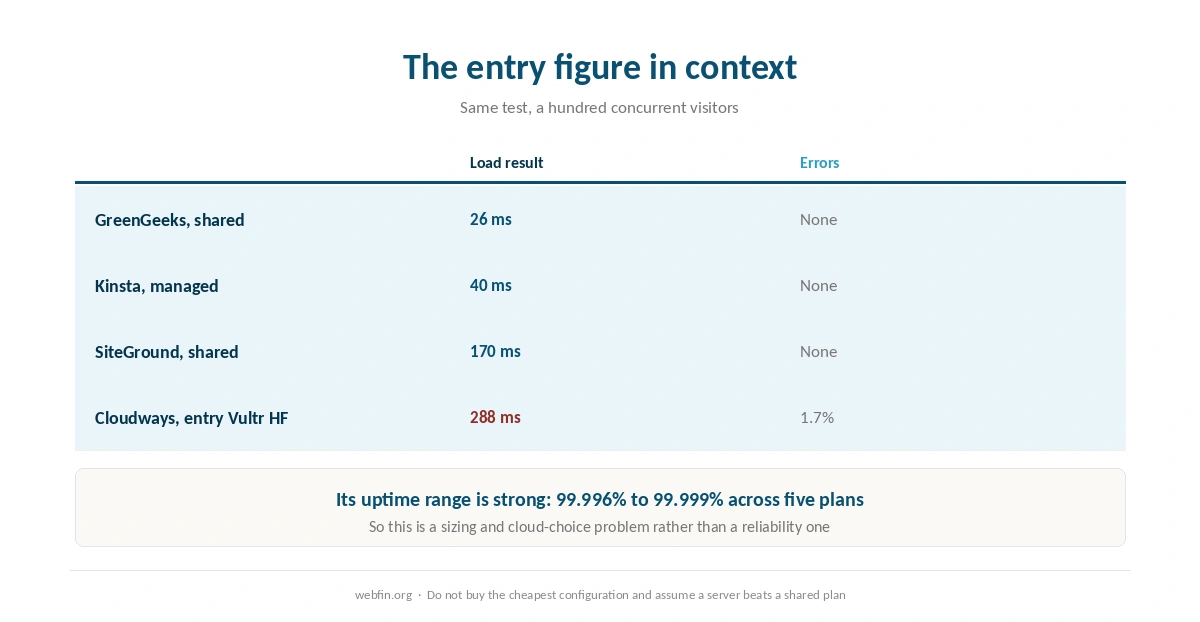
The 2026 load test ramps to a hundred concurrent visitors. GreenGeeks finished at 26 ms and Kinsta at 40 ms, both without dropping a request. SiteGround managed 170 ms, and Bluehost, a Newfold Digital brand, 41 ms.
The entry Cloudways configuration on Vultr High Frequency recorded 288 ms with a 1.7% error rate, and a WordPress score of 7.6 of 10.
Its uptime range is strong: 99.996% to 99.999% across five plans in the same window. So this is a sizing and cloud-selection problem rather than a reliability one.
⚠️ The practical reading for a store: do not buy the cheapest configuration and assume a server beats a shared plan. It does not, at that size, on the measurement a checkout depends on. Our list of hosting for ecommerce ranks hosts by that test.
| Host | Measurement | Source and date |
|---|---|---|
| WP Engine | Global TTFB 65 ms, 1st of 34 hosts | Hostingstep, 2025 ranking, 40 locations |
| WP Engine | US TTFB 365 ms across 22 locations | Hostingstep, 2025 ranking |
| WP Engine | TTFB 355 ms, 349,920 checks | Hostingstep, Oct 2025 – May 2026 |
| WP Engine | Uptime 99.976%, 10th of 14 managed hosts | Study of 14 managed hosts, 2026 |
| WP Engine | Load 27 ms at 0% errors | Hostingstep, 2026 benchmarks |
| Rocket.net | Cached TTFB 85 ms globally | 12-month test, Mar 2025 – Mar 2026 |
| Rocket.net | Origin TTFB 310 ms; checkout bypasses cache | Same 12-month test |
| Rocket.net | Uptime 99.97%, seven outages in the window | Hostingstep, Oct 2025 – May 2026 |
| Rocket.net | Hardware score fell 8.5 → 7.5; not recommended | Hostingstep, 2026, tracked since Oct 2020 |
| Hostinger Business | Global TTFB 223 ms, 5th of 34 hosts | Hostingstep, 2026 |
| Hostinger Premium | Global TTFB 495 ms, 28th of 34; no CDN | Hostingstep, 2026 |
| Hostinger | TTFB 707 ms; server response 246 ms | Cybernews, June 2026 |
| Hostinger | Uptime 99.99%, 33 min down in 2025 | Hostingstep, continuous since 2021 |
| Hostinger | Uptime 99.93%, 6-month window | HostPro Reviews, 2026 |
| Hostinger | LCP 0.607 s, 2nd of 15 hosts | TechRadar, 10-week window, 2026 |
| Bluehost | Hardware score 9.6 of 10 | Hostingstep, 2026 |
| Bluehost | Load 41 ms at 0% errors after the Oracle move | Hostingstep changelog, 9 Jul 2026 |
| Bluehost | Response 411 ms; uptime 99.99% across 9 outages | Hostingstep, Nov 2025 – Aug 2026 |
| Bluehost | Global TTFB 224 ms across 40 locations, cached | Hostingstep Bluehost review, Jul 2026 |
| HostGator | Global TTFB 1.23 s; uptime 99.68%; 762 ms at 500 users | Hostingstep HostGator review, 2026 |
| HostGator | Hardware joint-highest in the field after the Oracle move | Hostingstep, 1 Sep 2026 update |
| ChemiCloud | US TTFB 531 ms; global 460 ms | Hostingstep, Oct 2025 – May 2026 |
| ChemiCloud | Load 1,068 ms at a 4.2% error rate | Hostingstep, same window |
| ChemiCloud | Uptime 99.76%; overall 6.1 of 10, degrading | Hostingstep, tracked since 2021 |
| GoDaddy shared | TTFB 751 ms; load test did not complete | Hostingstep, Nov 2025 – Jun 2026 |
| GoDaddy shared | Uptime 99.76% | Hostingstep, Nov 2025 – Jun 2026 |
| GoDaddy Managed WordPress | TTFB 344 ms; hardware 3.8 of 10 | Hostingstep, 2026 |
| GreenGeeks | TTFB 395 ms North America, 447 ms Europe | Long-term independent testing, 2026 |
| GreenGeeks | TTFB 580–610 ms Asia and Australia | Same testing window |
| GreenGeeks | Load 26 ms at 0% errors; WPBench 5.0 of 10 | Hostingstep, 2026 |
| GreenGeeks | 25 outages in the window; no integrated CDN found | Hostingstep, 2026 |
| Kinsta | Origin TTFB 525 ms; edge figures differ | Hostingstep, 2026 |
| Kinsta | Load 40 ms at 0% errors; WPBench 8.8 of 10 | Hostingstep, 2026 reviews |
| DreamHost | TTFB 450–500 ms band | Hostingstep, 2026 benchmarks |
| Scala Hosting | Uptime 99.97% across twelve months | Live site, 40,000 monthly visitors, UptimeRobot |
| Scala Hosting | 29 ms at the 95th percentile, 50 users | k6 load test, 2026 |
| InterServer | Uptime 99.98% across eighteen months | Six production sites, UptimeRobot |
| InterServer | Load under 700 ms; under 1.5 s by another source | Two 2026 reviews |
| A2 Hosting | TTFB 150–198 ms | 2026 studies; LiteSpeed on Turbo tiers |
| IONOS | Global TTFB 480 ms; WPBench 7.2 of 10 | Hostingstep, 2026 benchmarks |
| IONOS | Uptime 99.99%; load test failed at 65.4% errors | Hostingstep, 2026 benchmarks |
| Namecheap | TTFB 461 ms; global 448 ms; WPBench 5.0 | Hostingstep, Q4 2025; monitoring paused 30 Jun 2026 |
| InMotion | TTFB 300–500 ms shared | Published measurement, 2026 |
| InMotion | Uptime 99.97–99.99%; one account near 99.5% | Several 2026 sources |
| Hostwinds | No independent measurement found | 99.9999% is the company's own claim |
| Liquid Web | Not covered by the benchmarks we cite | VPS and dedicated are outside their scope |
| SiteGround | TTFB 632 ms; 22nd of 34 hosts | Hostingstep, 2026 benchmarks |
| SiteGround | Uptime 99.96% in 2025; 193 min over 44 outages | Hostingstep, full year 2025 |
| SiteGround | WPBench 8.4 of 10; load 170 ms at 0% errors | Hostingstep, Oct 2025 – May 2026 |
| Scala Hosting | TTFB 465 ms; global 501 ms | Hostingstep, 2026 benchmarks |
| Scala Hosting | WPBench 8.8 of 10; load 48 ms at 0% errors | Hostingstep, 2026 benchmarks |
| Scala Hosting | Uptime 99.98% across the year | Hostingstep, 2026 benchmarks |
| Cloudways | Vultr HF: load 288 ms at 1.7% errors; WPBench 7.6 | Hostingstep Cloudways review, 2026 |
| Cloudways | Uptime 99.996% to 99.999% across five plans | Hostingstep, Oct 2025 – May 2026 |
For a store that sells steadily rather than in bursts, that comparison is the whole decision, and our roundup of hosting for high traffic ranks hosts by the same test. Our page on Cloudways for WordPress covers the non-store version of this trade.
Where Cloudways Wins for a Store
Sale days cost hours. Resize before a campaign, shrink afterward, pay for what ran. No other billing shape in our tables does that.
No visit allowance. A store that suddenly triples its traffic does not hit a tier ceiling, which platforms priced by visits do impose.
Staging on every tier. For a shop, this is not a developer luxury: it is how you avoid breaking payment with a plugin update.
Several stores on one server. No per-site pricing, which suits an operator running a few shops, as our list of hosting for multiple sites covers.
What to Get Right Before Launch
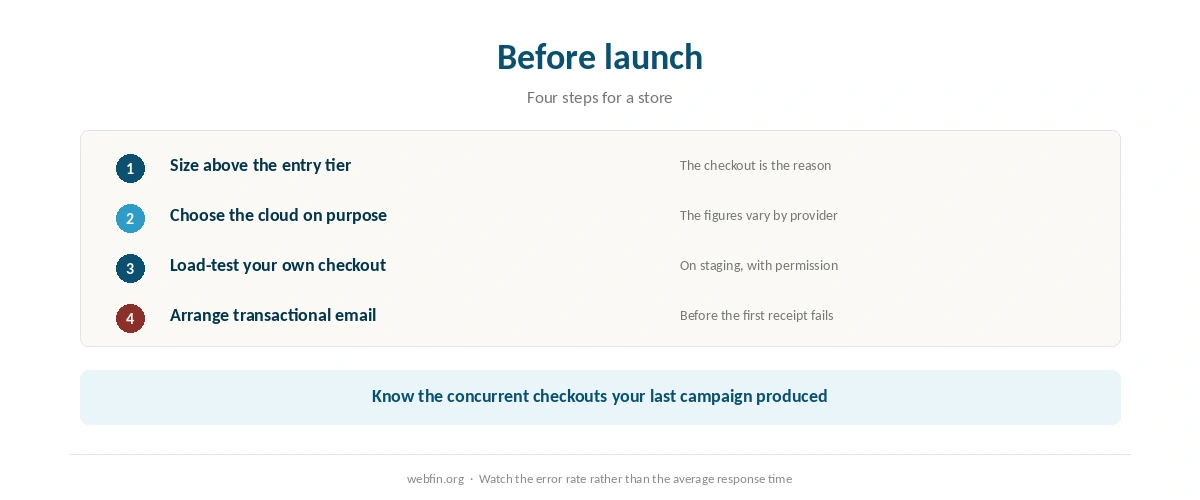
Size above the entry tier. The checkout is the reason, and the hourly billing means you can try two sizes in a week.
Choose the cloud on purpose. The load figure in our tables belongs to one specific cloud and size, so treat the choice as a decision rather than a default.
Load-test your own checkout on staging. With the host’s permission and with your real plugins, as our guide to testing your site speed properly describes.
Arrange transactional email elsewhere. Cloudways hosts no mailboxes, so order confirmations need a mail service, and our guide to setting up email on your domain covers the records.
Against the Alternatives
Against shared hosting with a clean load result. GreenGeeks at 26 ms and SiteGround at 170 ms both finished without dropping a request, and both cost a fraction of a sized server. For a store with steady orders that is the better buy.
Against managed WordPress. Kinsta answered every request at 40 ms for $35.00 a month flat, with 25,000 monthly visits included. You trade the visit ceiling for someone else deciding capacity.
Against a plain VPS. Scala prices resources per unit at $36.00 a year per processor core, with root access. That is cheaper for a known load, and more work.
Which Stores Fit
A store built around campaigns. Hourly resizing is the whole argument.
A store growing out of shared hosting. Faults at peak are the signal, which our page on shared against VPS hosting covers.
An operator with several shops. One server, no per-site tiers.
A store with a developer. Staging, Git and SSH from the first plan make deployment routine.
Which Should Look Elsewhere
A small store with steady orders. Cheaper hosts have cleaner load figures.
An owner who will not size a server. Nothing in the panel says the plan is too small for a checkout.
A business that needs mailboxes with the hosting. There are none here.
Anyone expecting phone support. Chat and tickets are included; a phone line is a paid add-on.
One Number for the Sale Day
Work out the concurrent checkouts your last campaign produced, or your best estimate for the next one. That figure is what to size the server against, and the load test approximates a hundred at once.
Then rehearse it: put the staging copy behind the same plugins, run the test with permission, and watch the error rate rather than the average. Our guide to configuring caching covers keeping the catalog cached while the cart stays out.
And our guide to setting up automatic backups covers the copies that make a bad release survivable.
How We Research
We run no tests. The load result, WordPress score and uptime range come from Hostingstep. The load and score are from its Cloudways review of 2026, and the uptime range from its October 2025 to May 2026 window. Figures quoted for other hosts come from the same project.
Prices, billing terms, inclusions and support channels come from Cloudways’ own pages, read on 20 September 2026, and sit in our tables. Ownership moved to DigitalOcean in 2022 by acquisition reporting. Individual cloud providers are not rated separately here. Our tables record Cloudways rather than the clouds underneath, and the criteria are on our about page. The full workings are in our Cloudways review.
Cloudways for WooCommerce FAQ
For campaign-driven or growing stores, yes: hourly resizing, no visit caps and staging on every tier. Not at the cheapest configuration, where the benchmark recorded a 1.7% error rate under load.
Roughly one request in sixty failing during the test. On product pages that is an annoyance; at payment it is a lost order, which is why sizing above the entry tier matters here.
Only if it is sized properly. In the same 2026 test GreenGeeks finished at 26 ms and Kinsta at 40 ms. Bluehost managed 41 ms and SiteGround 170 ms, all without dropping a request.
It hosts no mailboxes, so transactional email needs a separate mail service. Set that up before launch rather than after the first confirmation fails to arrive.
Hourly billing. Resize the server before a campaign and shrink it afterward, paying for the hours it ran, with no visit allowance to exceed.
The Verdict
Cloudways is the right shape for a store whose traffic arrives in campaigns, and its uptime range across five plans is strong. The catch is specific and checkable. At the entry configuration the load test recorded a 1.7% error rate, and a checkout is where dropped requests turn into lost money.
So buy it deliberately. Size above the entry tier, choose the cloud on purpose, test the checkout on staging, and arrange transactional email elsewhere. If your orders are steady rather than spiky, a shared plan with a clean load result is cheaper and better measured. Our page on what web hosting costs prices both across three years.