
Disclosure: WebFin is reader-supported. If you buy hosting through links on this page, we may earn a commission at no extra cost to you. Commissions vary between providers and our ratings do not — here’s our full disclosure.
This is a shopping page that mostly tells you not to shop. A free automated certificate does the same cryptographic job as a paid one, and browsers treat them identically. Our own table of add-on charges records $89.88 a year for a premium single-domain certificate at Bluehost, a Newfold Digital brand. GoDaddy Economy charges $119.99 a year from year two, and Hostwinds $75.00, each beside a free automated option. There are three cases where paying makes sense, and they are narrow.
Best SSL Certificates: The Short Answer
Use the free automated certificate your host issues, which almost every plan we price includes. Pay only in three cases: a procurement process that demands organization or extended validation, a wildcard your host will not automate, or a certificate your host cannot issue at all. Before buying anything, check whether your plan already covers it: sell what they also give away.
What a Certificate Actually Does
It encrypts the connection. That part is identical whether the certificate cost nothing or three figures. The encryption comes from the protocol, not from the price.
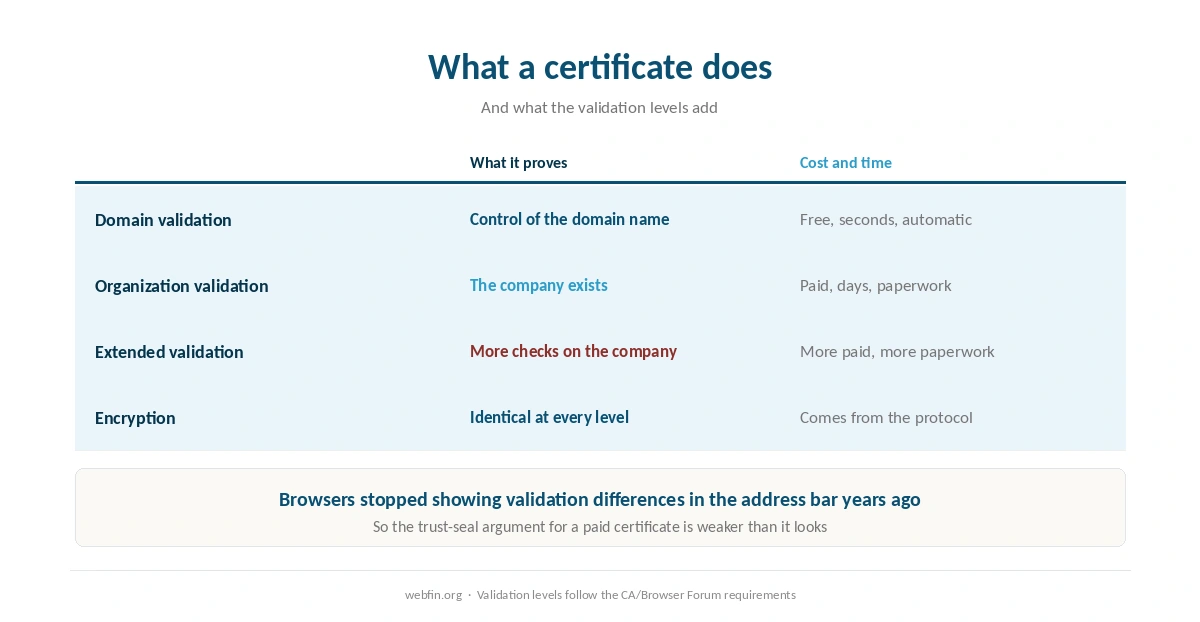
It proves control of the domain. Domain validation checks that whoever asked for the certificate controls the name, which is what an automated issuer verifies in seconds.
It does not vouch for the business. Organization and extended validation add checks on the company, and browsers stopped showing those differences in the address bar years ago.
⚠️ So the “trust seal” argument for a paid certificate is weaker than it looks. A visitor sees the same padlock either way.
| Host | Charge | Cost per year |
|---|---|---|
| Bluehost | Premium SSL, single domain | $89.88 (optional; Let's Encrypt is free) |
| Bluehost | Domain privacy | $15.00 (free year one on Business and up) |
| Bluehost | SiteLock Essentials | $95.88 |
| Bluehost | SiteLock Prevent | $239.88 |
| Bluehost | Yoast SEO Premium | $99.99 |
| Bluehost | Early cancellation, free domain | $15.99 one-off, deducted from refund |
| GoDaddy | SSL on Economy after year one | $119.99; other tiers include it for the plan's life |
| GoDaddy | Pre-checked extras at checkout | $345.39 counted by one review, unverified |
| HostGator | CodeGuard daily backups | $35.88 (weekly copies are a courtesy, not guaranteed) |
| HostGator | SiteLock, pre-selected at checkout | $23.88 |
| HostGator | Dedicated IP | $59.40 |
| HostGator | Professional migration | $149.99 one-off |
| Hostwinds | Standard SSL | $75.00 (free AutoSSL on shared via cPanel) |
| Hostwinds | Wildcard SSL | $150.00 |
| Scala Hosting | Processor core, added or removed anytime | $36.00 per core |
| Scala Hosting | Memory, added or removed anytime | $12.00 per gigabyte |
| Hostinger | WHOIS privacy | Included |
| Hostinger | Domain renewal, .com | $15–$20, no first-party figure published |
| DreamHost | WHOIS privacy | Included for the life of the domain |
| Namecheap | Domain privacy | Included for the life of the domain |
| InterServer | Everything on the one plan | Included; no tiers to upgrade to |
The Three Validation Levels
Domain validation. Automatic, free on most plans we price, issued in seconds and renewed without you noticing. Right for essentially every site, including stores.
Organization validation. The issuer checks the company exists, which takes days and paperwork. Occasionally required by a partner or a procurement checklist.
Extended validation. More paperwork, more money, and no visible difference in a modern browser. Bought almost exclusively because a policy document names it.
Where the Money Actually Goes at Hosts
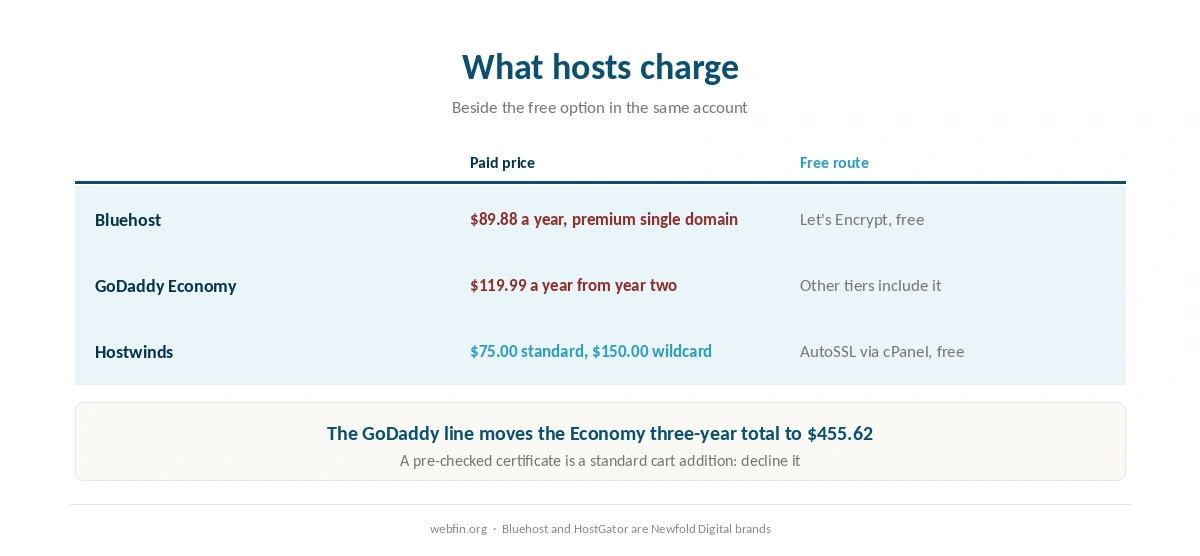
Our table of add-on charges records the pattern rather than the marketing. Bluehost sells a premium single-domain certificate at $89.88 a year and notes that Let’s Encrypt is free. Hostwinds prices a standard certificate at $75.00 and a wildcard at $150.00, with free AutoSSL available on shared plans through cPanel.
GoDaddy is the sharpest case: on Economy the certificate costs $119.99 a year from year two, while other tiers include it for the life of the plan. That single line moves the three-year total for Economy to $455.62 in our pricing table, which our page on hidden hosting fees covers alongside the rest.
⚠️ Read those rows as a warning about carts rather than about cryptography. A pre-checked certificate is a standard cart addition. Our guide to avoiding checkout upsells covers declining it.
When Paying Is the Right Call
A procurement requirement. If a client, a partner or an insurer names organization or extended validation, buy what the document says and move on.
A wildcard your host will not automate. Free authorities issue wildcards, but automation varies, and a subdomain network needs one. Our guide to setting up WordPress Multisite covers that case.
A certificate your host cannot issue. Rare on shared hosting, more common on a server you configure yourself.
A warranty that somebody insists on. Paid certificates carry warranties, which procurement departments care about and few site owners ever use.
What to Do Instead, Step by Step
Check the panel first. Look for a free or automated certificate section before looking at a price list, which our guide to understanding cPanel helps with on cPanel hosts.
Confirm renewal is automatic. Free certificates are short-lived by design, so the automation is the feature. A certificate that expires quietly is worse than none.
Force HTTPS everywhere. Redirect plain connections, and fix mixed content so the padlock stays clean, as our guide to configuring caching touches on for cached pages.
Then check the expiry date once a quarter. Automation fails silently more often than it fails loudly.
Certificates on a Server You Run Yourself
On a VPS or a cloud server the free automated route still applies, but you configure it yourself: an ACME client, a renewal timer and a reload hook for the web server. Managed hosts do all three silently.
That is one more line in the maintenance column when pricing a server. Our list of hosting for SaaS startups covers. Our guide to moving from shared to VPS covers the step before it.
The Failure Mode Nobody Plans For
A certificate that stopped renewing. Visitors get a full-page browser warning, which costs more traffic than any slow page ever will, and search engines notice.
It follows a DNS change, a host move or a domain transfer, when the validation path breaks and nobody is watching. Our guide to pointing a domain to a new host covers the order that avoids it. Our guide to fixing a website that is down covers the morning it happens anyway.
Which Sites Need What
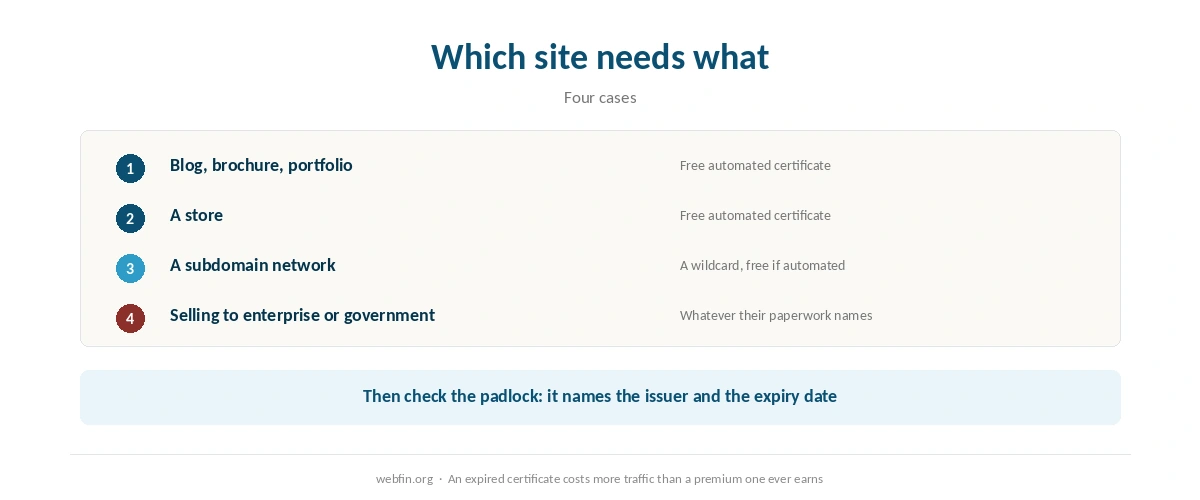
A blog, brochure site or portfolio. Free automated certificate. Nothing else.
A store. Free automated certificate. Payment processors require HTTPS, not a particular price, and our list of hosting for ecommerce covers what actually matters for a checkout.
Subdomain networks. These need a wildcard, free if your host automates it and paid if not.
A site selling to enterprises or government. Whatever their paperwork names, which our guide to reading a hosting agreement is the right frame of mind for.
One Thing Worth Doing Today
Open your site in a browser and click the padlock. It names the issuer and the expiry date, and those two facts tell you whether the automation is working and who to ask if it is not.
If the certificate came from your host’s automated issuer and expires in weeks rather than months, that is normal and healthy. If it expires in a year and you do not remember buying it, check the invoice. A certificate is not the only line that renews quietly, as our page on hosting renewal prices shows.
How We Research
We run no tests and we issue no certificates. The add-on prices here come from the providers’ own pages and from our reviews, read on 20 September 2026. They sit in our table of recurring charges. The GoDaddy three-year total that includes the certificate comes from the same pricing work.
We do not rank certificate authorities, because the cryptography is standardized and the differences that remain are commercial rather than technical. Validation levels and browser behavior follow the CA/Browser Forum requirements and current browser releases. The criteria behind our scores are on our about page.
SSL Certificate FAQ
Almost certainly not. A free automated certificate encrypts identically and browsers show the same padlock. Our table records hosts charging $75.00 to $119.99 a year for certificates they also issue free.
No. The encryption comes from the protocol rather than the price. What money buys is a different validation level, a warranty and support, none of which changes what a visitor’s browser does.
When a procurement document names organization or extended validation. When you need a wildcard your host will not automate. Or when your host cannot issue one at all.
On Economy, $119.99 a year for the certificate from year two, while other tiers include it for the life of the plan. That pushes the Economy three-year total to $455.62 in our pricing table.
Renewal. Free certificates are short-lived by design, so a broken validation path after a DNS change or a host move leaves visitors facing a browser warning. Check the expiry date once a quarter.
The Verdict
For nearly every site the best certificate is the free one your host already issues. The money saved is not small either: $89.88 at Bluehost, $119.99 a year on GoDaddy Economy, $75.00 at Hostwinds. Every year, for something sitting one click away at no charge.
Pay when paperwork demands a validation level or when you need a wildcard nobody will automate for you. Otherwise spend the attention on renewal instead of purchase, because an expired certificate costs more traffic than a premium one ever earns. Our page on what web hosting costs prices the plans underneath.