
Disclosure: WebFin is reader-supported. If you buy hosting through links on this page, we may earn a commission at no extra cost to you. Commissions vary between providers and our ratings do not — here’s our full disclosure.
A news site breaks the usual advice about caching, because it keeps invalidating its own cache. Every publish, every correction and every new comment clears pages that a blog would serve from storage for weeks. Then add editors working in an admin area that is never cached, and an archive of tens of thousands of posts pressing on database limits. Traffic arrives without warning too. The shortlist ends up different from every other kind of site we cover.
Best Hosting for News Sites: The Short Answer
Cloudways when stories break: you can resize the server for a day and shrink it afterward, billed by the hour, from $14.00 a month. Scala Hosting for a local or trade title on a budget: it served the load test at 48 ms without an error and includes daily backups. Kinsta when several editors work at once and you need to see which query is slow.
Why a News Site Is the Hard Case
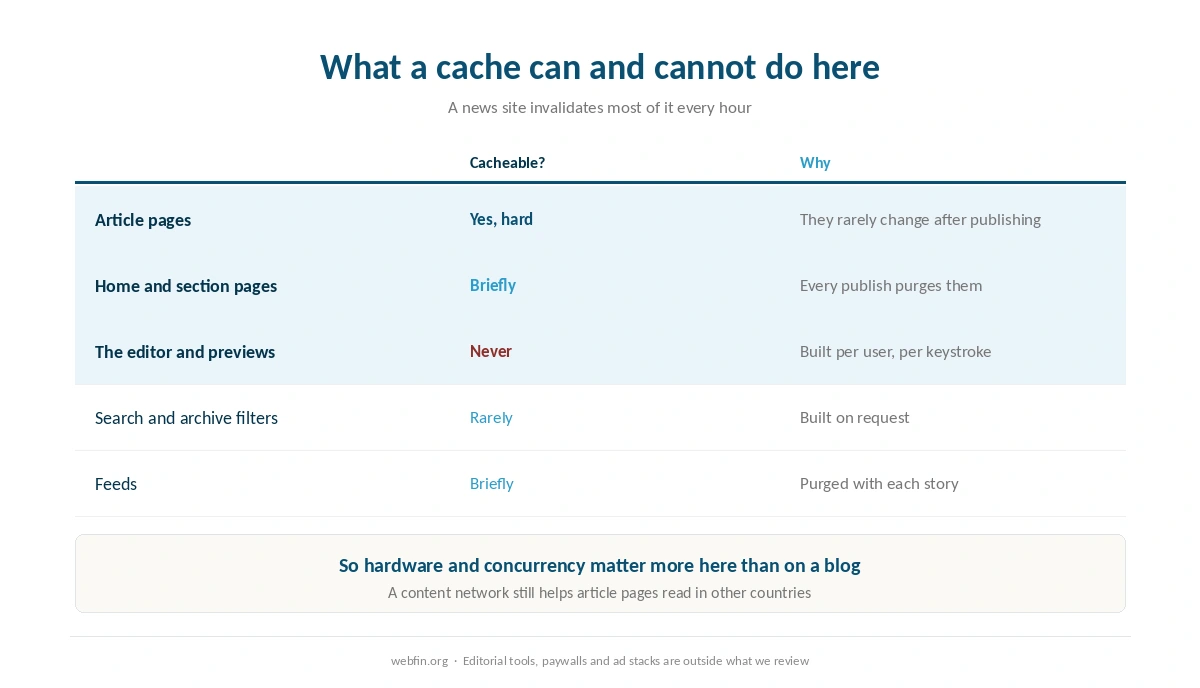
The cache never settles. Publishing a story purges the home page, the section page, the feed and the archive. On a site that publishes twenty times a day, a page cache spends much of its life being rebuilt rather than serving.
The admin area is uncached by definition. Editors writing, uploading and previewing hit the database on every action, and they do it at the same time as readers.
The archive grows into the limits. Bluehost publishes the figures most hosts hide: 5 GB for a single database, and 5,000 tables or 10 GB across all of them. A long-running title with plugins reaches numbers like those.
Traffic arrives without notice. A story picked up elsewhere brings more visitors in an hour than a normal week, which is the case our guide to handling a traffic spike covers.
| Host and plan | Limit | Where it's stated |
|---|---|---|
| Bluehost shared | 50,000 inodes — soft limit | Hosting Inode Limit article |
| Bluehost shared | 200,000 inodes — AUP threshold | Server Resource Limitations |
| Bluehost shared | 1,000,000 inodes — TOS violation | Hosting Inode Limit article |
| Bluehost shared | 5,000 tables or 10 GB, all databases | Server Resource Limitations |
| Bluehost shared | 5 GB per single database | Server Resource Limitations |
| Bluehost Starter | 100 MB per mailbox | Shared hosting prices page |
| WP Engine Startup | 25,000 monthly visits, then overage handling | Plan pages |
| WP Engine, by tier | 25,000 to 400,000 monthly visits | Plan pages |
| Rocket.net Starter | 25,000 monthly visits, 1 site, 10 GB storage | Plan pages |
| Namecheap EasyWP | 50,000 / 200,000 / 500,000 monthly visits by tier | Plan pages |
| Kinsta Starter | 25,000 monthly visits | Plan pages |
| Scala Hosting VPS | Priced per unit: $3 per core, $1 per gigabyte | Plan pages; adjustable anytime |
| HostGator shared | Weekly backups described as a courtesy, not guaranteed | Hosting terms |
| Liquid Web | Dedicated resources at every tier; no shared plan | Plan pages |
| InterServer Standard | Unlimited storage, bandwidth, email and websites | One plan, no tiers |
| GreenGeeks Lite | One website only | Plan pages |
| IONOS Plus | One email account bundled per plan | Plan pages |
| Hostinger, all plans | Not published | Hostinger support article, 28 Aug 2026 |
| Bluehost Starter | 10 GB NVMe storage | Plan pages, as listed in a 2026 audit |
| InMotion Core | One site, 10 email accounts, SSD storage; NVMe from Launch | TechRadar and a 2026 review |
| SiteGround shared | Shell access by tier — not recorded | Not stated on the plan pages we read, 20 Sep 2026 |
| Bluehost shared | Shell access by tier — not recorded | Not stated on the plan pages we read, 20 Sep 2026 |
| Hostinger, all plans | Shell access by tier — not recorded | Not stated on the plan pages we read, 20 Sep 2026 |
| Cloudways servers | Search service (OpenSearch, Elasticsearch) — not recorded | Not stated on the plan pages we read, 20 Sep 2026 |
Cloudways: Capacity That Follows the News
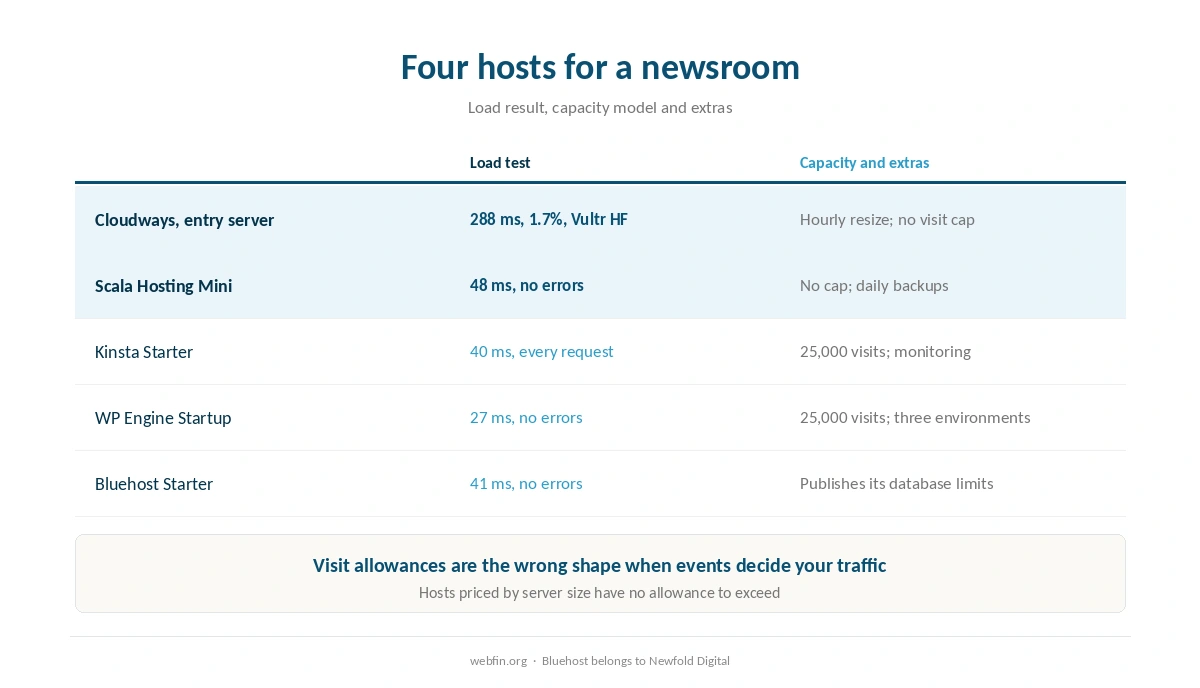
Cloudways runs a managed server on the cloud you choose, from $14.00 a month with no promotional term, billed by the hour. For a newsroom that is the useful shape: move to a larger server when a story is running and shrink it the next day. It held uptime between 99.996% and 99.999% across five plans in the benchmark project we cite, and it imposes no visit cap.
Strengths. Hourly billing and no visit allowance. Staging, SSH and Git on every tier. Uptime measured across five plans.
Weaknesses. Its weakest published load result, on the Vultr High Frequency plan, was 288 ms with a 1.7% error rate, so choose the cloud and size deliberately. No email, and phone support is a paid add-on.
Choose it if your traffic is unpredictable. Skip it if nobody on the team wants to manage a server. Our Cloudways review covers each cloud.
Scala Hosting: The Budget Title
Scala’s shared plan served the load test at 48 ms with no errors and scores 8.8 of 10 on hardware. That is the combination an uncached site needs. Its own panel includes daily backups, staging and a malware monitor, and Mini opens at $2.95 renewing to $11.95. Its VPS prices a processor core at $36.00 a year and a gigabyte of memory at $12.00.
Strengths. Strong uncached performance for a shared price. Daily backups of the archive included. A VPS path priced by the unit as the title grows.
Weaknesses. No phone line. SPanel is proprietary, so leaving means moving the site. Its ownership is not documented in anything we read.
Choose it if the newsroom is small and the budget fixed. Skip it if you need a phone number at three in the morning. Our Scala Hosting review covers the VPS line.
Kinsta: For a Newsroom With Several Editors
Kinsta runs each site in its own container and served the load test at 40 ms with every request answered. Its plan includes application performance monitoring, which on a news site is the fastest way to find the plugin or query that makes the editor screen crawl. Starter is $35.00 a month flat and includes 25,000 monthly visits.
Strengths. Built-in monitoring. Isolation between sites. Cloudflare Enterprise on every plan, which suits cached article pages read abroad.
Weaknesses. The visit allowance is the problem for news: a single story can spend a month’s worth. WordPress only, no email, no phone line.
Choose it if the team is bigger than the traffic. Skip it if one story a month could blow the allowance. Our Kinsta review prices the tiers.
Visit Caps Are the Wrong Shape for News
Kinsta Starter and WP Engine Startup each include 25,000 monthly visits, and WP Engine’s tiers run to 400,000. Those are comfortable numbers for a steady site and awkward for one whose traffic is decided by events.
WP Engine has the strongest load result we cite, 27 ms with no errors, and gives every site three environments, which suits a newsroom that changes templates often. Price the tier against your worst month rather than your average one. Our WP Engine review prices each tier.
⚠️ Hosts that price by server size, such as Cloudways and Scala’s VPS, have no allowance to exceed. That is the argument for them on a news site even when a managed platform looks faster on paper.
What to Cache, and What Cannot Be
Article pages can be cached hard, and a content network in front of them is worth having for readers in other countries. Section pages and the home page need short cache lifetimes, because they change every time you publish.
The admin area, the preview, the editor and any personalised element cannot be cached at all. So our guide to setting up a CDN matters less here than our guide to reducing TTFB. That one covers the server side a newsroom leans on all day.
Bluehost: When the Archive Is the Constraint
Bluehost Starter costs $3.99 a month for 36 months and renews at $9.99. It passed the load test at 41 ms without errors, scores 9.6 of 10 on hardware and recorded 99.99% uptime. It is also the host that publishes its database limits, which is what a long archive eventually meets. Bluehost belongs to Newfold Digital.
Read those numbers as planning tools rather than warnings. Knowing that a single database may not pass 5 GB tells you when to archive old content or move up, instead of discovering the ceiling during an election night. Our Bluehost review lists every limit it states.
Four Titles, Four Answers
A local paper publishing daily. Scala Hosting, for a clean load result and daily backups at a shared price.
A national title with unpredictable spikes. Cloudways, because capacity follows the story and nothing counts visits.
A trade publication with a large team. Kinsta, for monitoring and isolation, as long as the traffic fits the allowance.
A title with a decade of archives. A host that publishes its database limits, so you can plan the move before you need it.
Habits That Keep a Newsroom Online
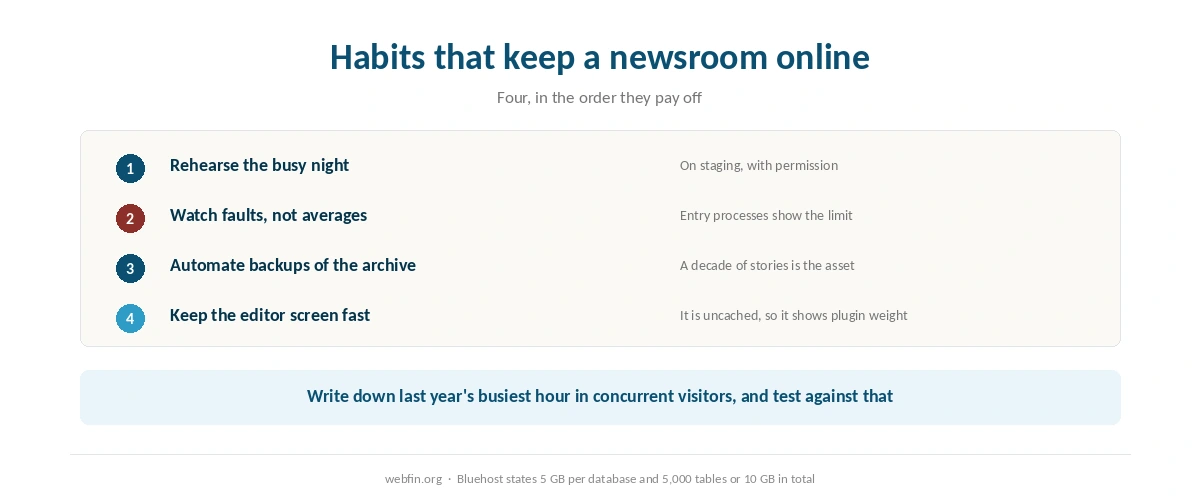
Rehearse the busy night. Test at the concurrency you expect on a staging copy, with the host’s permission, as our guide to testing your site speed properly describes.
Watch the faults, not the averages. Entry process faults show a limit being reached, and our guide to checking whether your host is throttling you shows where they appear.
Automate backups of the archive. A decade of stories is the asset, and our guide to setting up automatic backups covers the rotation.
Keep the editor screen fast. It is uncached, so it shows plugin weight first, and a slow editor costs the newsroom time every day.
One Number Worth Knowing Before a Big Night
Find your busiest hour from last year and write down the concurrent visitors it produced. That single figure is what a plan has to survive, and it is the number to test against rather than a monthly total.
Then check what your plan does at that level. In the 2026 benchmarks the load test ramps to a hundred concurrent visitors, and several plans could not serve it. The IONOS entry plan failed with a 65.4% error rate, and ChemiCloud lost 4.2% of requests. For a newsroom, that hour is the whole product.
How We Research
We run no tests. Load, hardware and uptime figures come from Hostingstep’s 2026 benchmarks and reviews, each with its window. Database and visit limits, prices and backup terms come from the providers’ own pages, read on 20 September 2026, and sit in our tables.
Editorial tools, paywalls and ad stacks are outside what we review; this guide covers the hosting under them. The criteria behind our scores are on our about page, and our roundup of hosting for high traffic ranks hosts by the load test a busy night imitates.
News Hosting FAQ
Because the site keeps invalidating its own cache. Publishing a story purges the home page, the section page, the feed and the archive, so a page cache spends much of its life being rebuilt. The admin area is never cached at all.
Cloudways, because it bills by the hour and imposes no visit cap: enlarge the server while a story runs and shrink it afterward. Scala’s VPS prices resources by the unit for the same reason.
They can be. Kinsta Starter and WP Engine Startup each include 25,000 monthly visits, and a single story can spend that. Price the tier against your worst month rather than your average one.
Database size and table count before storage. Bluehost publishes 5 GB for a single database and 5,000 tables or 10 GB across all of them, which is the kind of ceiling a decade of posts and plugins approaches.
Yes, more than the public pages do. The admin area cannot be cached, so it reflects hardware and plugin weight directly, and a slow editor costs the newsroom time every day.
The Verdict
Choose a news host on how it behaves when the cache cannot help: uncached pages, a busy admin area and traffic you did not schedule. Cloudways fits a title whose traffic is decided by events, because capacity follows the story and nothing counts visits. Scala Hosting fits a smaller newsroom, with a clean load result and daily backups included.
Kinsta fits a team that needs to see which query is slow, provided the visit allowance covers your worst month. And whichever you pick, learn your database limits before an archive of ten years finds them for you. Our page on what web hosting costs prices each option across three years.