Disclosure: WebFin is reader-supported. If you buy hosting through links on this page, we may earn a commission at no extra cost to you. Commissions vary between providers and our ratings do not — here’s our full disclosure.
To set up automatic backups, pick where the automation runs, give the database and the files separate schedules, send the copies somewhere your hosting account cannot reach, and turn on an alert for failures. The setup takes half an hour. Keeping it working is the real job, because automated backups fail quietly: a timeout on a large site, an expired key at the storage provider, a scheduler that never fires. Our guide to backing up a WordPress site covers what to copy and why; this page covers making it happen without you.
How to Set Up Automatic Backups: The Short Answer
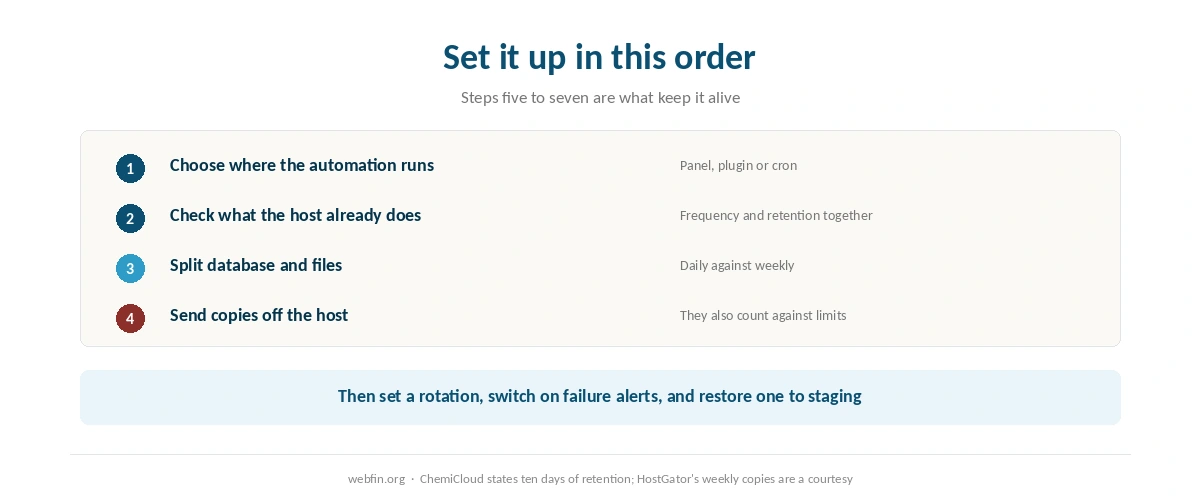
Choose one place for the automation: your host’s panel, a plugin, or a real cron job. Back up the database daily or more often and the files weekly. Send both to storage outside the hosting account. Keep a rotation of daily, weekly and monthly copies, switch on failure emails, and restore one copy every few months to prove the chain works.
Step 1: Choose Where the Automation Lives
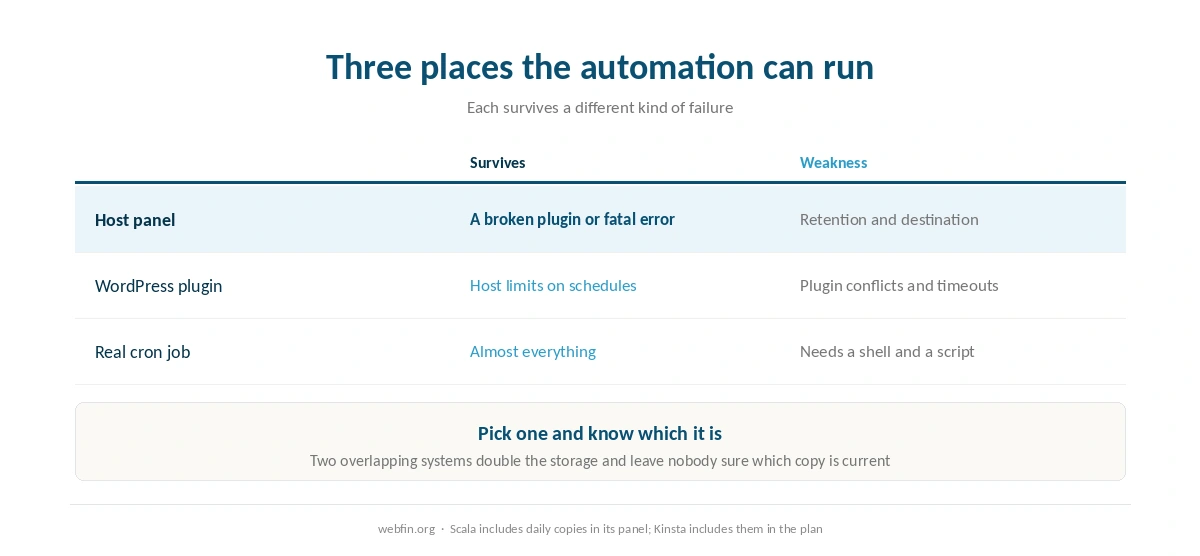
The host’s panel. Backups run outside WordPress, so a broken plugin cannot stop them, and the panel handles the restore for you. Scala Hosting includes daily copies in its own panel, and Kinsta includes them in its plan. The limits are retention and destination: copies often live on the same platform.
A WordPress plugin. Flexible schedules, a choice of remote destinations, and restores you can run yourself. The catch is that it runs inside the site: a plugin conflict, a fatal error or a PHP timeout can stop the job.
A real cron job. On a host with SSH you can script a database dump and a file archive and send them off-site. It is the most reliable and the least friendly, and it suits anyone already comfortable with a shell. Our list of hosting for developers covers hosts that provide one.
⚠️ Pick one and know which it is. Two overlapping systems double the storage, double the load and still leave nobody sure which copy is current.
Step 2: Check What the Host Already Automates
Read the frequency and the retention together, because one without the other is useless. ChemiCloud states ten days of backups on its entry plan. Bluehost Starter keeps weekly copies according to the benchmark project we cite, and HostGator describes its weekly copies as a courtesy while selling daily CodeGuard backups at $35.88 a year. Bluehost and HostGator both belong to Newfold Digital.
Retention decides how far back you can go, and frequency decides how much you lose. Ten days of daily copies is plenty for a site you watch and useless for a problem that started last month. Our page on hidden hosting fees lists what hosts charge to improve either.
| Host and plan | Limit | Where it's stated |
|---|---|---|
| Bluehost shared | 50,000 inodes — soft limit | Hosting Inode Limit article |
| Bluehost shared | 200,000 inodes — AUP threshold | Server Resource Limitations |
| Bluehost shared | 1,000,000 inodes — TOS violation | Hosting Inode Limit article |
| Bluehost shared | 5,000 tables or 10 GB, all databases | Server Resource Limitations |
| Bluehost shared | 5 GB per single database | Server Resource Limitations |
| Bluehost Starter | 100 MB per mailbox | Shared hosting prices page |
| WP Engine Startup | 25,000 monthly visits, then overage handling | Plan pages |
| WP Engine, by tier | 25,000 to 400,000 monthly visits | Plan pages |
| Rocket.net Starter | 25,000 monthly visits, 1 site, 10 GB storage | Plan pages |
| Namecheap EasyWP | 50,000 / 200,000 / 500,000 monthly visits by tier | Plan pages |
| Kinsta Starter | 25,000 monthly visits | Plan pages |
| Scala Hosting VPS | Priced per unit: $3 per core, $1 per gigabyte | Plan pages; adjustable anytime |
| HostGator shared | Weekly backups described as a courtesy, not guaranteed | Hosting terms |
| Liquid Web | Dedicated resources at every tier; no shared plan | Plan pages |
| InterServer Standard | Unlimited storage, bandwidth, email and websites | One plan, no tiers |
| GreenGeeks Lite | One website only | Plan pages |
| IONOS Plus | One email account bundled per plan | Plan pages |
| Hostinger, all plans | Not published | Hostinger support article, 28 Aug 2026 |
| Bluehost Starter | 10 GB NVMe storage | Plan pages, as listed in a 2026 audit |
| InMotion Core | One site, 10 email accounts, SSD storage; NVMe from Launch | TechRadar and a 2026 review |
| SiteGround shared | Shell access by tier — not recorded | Not stated on the plan pages we read, 20 Sep 2026 |
| Bluehost shared | Shell access by tier — not recorded | Not stated on the plan pages we read, 20 Sep 2026 |
| Hostinger, all plans | Shell access by tier — not recorded | Not stated on the plan pages we read, 20 Sep 2026 |
| Cloudways servers | Search service (OpenSearch, Elasticsearch) — not recorded | Not stated on the plan pages we read, 20 Sep 2026 |
| Azure | B1S virtual machine free for 12 months for new customers | agentdeals 2026 |
| Bluehost cPanel | Included on shared plans: Hosting tab → Quick Links → cPanel, or Websites → Overview; also domain/cpanel or :2083; no separate login; Bluehost Cloud does not include cPanel; Softaculous in cPanel | Bluehost knowledge base (official) |
| Bluehost email | Free cPanel mailboxes with every hosting plan; 30-day Professional Email trial with new hosting | HostAdvice guide, 2026 |
| Bluehost migration | Free for qualifying WordPress sites within 30 days of signup via the Bluehost Site Migrator plugin; one site per hosting purchase; malware-free; reviewed by experts; otherwise paid professional migration; about 2–3 days; WordPress.org sites on new shared accounts | Bluehost knowledge base and migration page (official); TechRadar |
| Bluehost SSL | Free SSL listed among standard hosting features; Premium SSL optional at $89.88 | Truehost 2026; our tables |
| Bluehost status | Official status page at pulse.bluehost.com/status: operational, degraded, partial and major outage levels; uptime statistics and incident history; uptime guarantee varies by product | Bluehost (official) |
| Cloudflare Pages (free) | Unmetered bandwidth for static assets; 500 builds a month, one at a time; up to 100 custom domains per project; 20,000 files per site; Workers recommended for new SSR projects | GuptaDeepak, Puter, bootstrap.build 2026 |
| Cloudflare Registrar | At-cost registration and renewal, no upsells, free WHOIS privacy and DNSSEC, 400+ TLDs; Cloudflare nameservers required; 60-day transfer lock; minimal support on free accounts | domains.cloudflare.com (official); StartupOwl, Mystrika 2026 |
| Contabo | Throttles port speed after 10 days over the traffic allowance instead of charging overage | LearnWithHasan, 2026 |
| DigitalOcean | Powered-off Droplets still bill; 99.99% SLA published | CostBench, LinuxTeck, 2026 |
| DigitalOcean App Platform | Three free static sites, 1 GiB outbound transfer each a month | agentdeals 2026 |
| DreamHost Email | 3-month free trial with every web hosting plan; unlimited on DreamPress, VPS and Dedicated | DreamHost email page, Oct 2026 |
| DreamHost status | Help article 'Current Status Notifications' points to the official status page; contact technical support if your site has issues while systems show operational; incident history on StatusGator | DreamHost help center (official); StatusGator |
| DreamHost VPS | Managed; unmetered bandwidth; daily backups; 30-day refund; no four-year term | FitGap; Website Builder Expert |
| Dynadot | Free WHOIS privacy on every domain | DomainOffer, 2026 |
| FatCow | One shared plan; 30-day money-back; no free migration | WebsiteSetup review |
| GitHub Pages | Free for public repositories; about 100 GB bandwidth a month (soft); 1 GB site size; about 10 builds an hour | Puter, bootstrap.build 2026 |
| GoDaddy Website Builder | Free plan with GoDaddy branding; SEO tools from Premium; free domain on annual plans | TechRadar and Website Builder Expert, 2026 |
| GoDaddy Windows Hosting | Plesk; supports latest .NET Framework 3.5 and 4.8, .NET Core 8 and 9; end-of-life .NET versions removed from Q2 2025 | GoDaddy help center (official) |
| Google Cloud | $300 credit for new customers (90 days); always-free tier incl. 1 e2-micro VM a month (us-west1, us-east1, us-central1), 30 GB HDD, 5 GB Cloud Storage; 1 GB free egress a month from North America | Google Cloud free page (official); FreeTier.co and NicheeLab guides, 2026 |
| Heroku / Fly.io free tiers | Heroku free tier removed 2022; Fly.io no free tier for new accounts since Oct 2024 | agentdeals 2026 |
| Hetzner | Four pricing actions in 2026: setup fees (Feb), +30–37% (1 Apr), dedicated setup fees (29 Apr), and cloud rises of +33% to +169% by line (15 Jun) | PrivateDevOps, Jun 2026; Hetzner price page |
| HostGator status | Official status page at hostgator.com/status: component indicators, uptime statistics, incident history, maintenance labelled separately; if operational but site down, clear cache, try another network, check DNS, then contact chat or phone | HostGator (official) |
| HostGator VPS | Self-managed and managed lines; discount on the first invoice only; cPanel priced separately; free migration from third-party hosts; 30-day refund window | HostGator VPS pages and price chart (official) |
| Hostinger Cloud limits | Startup 4 GB / 4 cores; Professional 6 GB / 5 cores; Enterprise 12 GB / 6 cores; Enterprise Plus 15 GB / 8 cores | Hostinger support (official) |
| Hostinger migration | Free website migration via a Migration Request Form; Hostinger handles it; unlimited for all customers; usually under 48 hours | Hostinger compare page (official, Jul 2026); WebsitePlanet; CrazyEgg |
| Hostinger Premium | Up to 100 mailboxes as a free Business Email trial, usually for the first year; then they renew as paid Business Starter ($1.59 a mailbox a month) | DEV guide, Aug 2026; Hostinger support (official); TechRadar |
| Hostinger status | Official status page with components: datacenters (US, UK, NL, DE, FR, LT, SG, IN, BR and more), hPanel, Mail, DNS, CDN, VPS API; tracked by StatusGator, IncidentHub and OpenStatus | StatusGator; IncidentHub; OpenStatus, Oct 2026 |
| Hostinger Website Builder | No free plan; 14-day trial; Business needed for full AI tools and ecommerce | Startups.co.uk and Website Builder Expert, 2026 |
| Hover | Founded 2008 by Tucows (Canada); free WHOIS privacy; no pre-checked add-ons; ICANN-accredited (IANA ID 69) | ProfileTree; DomainOffer, 2026 |
| InMotion Hosting Plus | Python, Node.js, Ruby and Git on shared plans | InMotion pricing page (official) |
| InMotion VPS | Launch Assist free server setup on all VPS; management options self, core and full | CB Insights 2026 |
| InterServer VPS | Price lock; 30-day refund; US-only locations; older hardware per a competitor | whtop; Expanse (competitor), Aug 2026 |
| IONOS dedicated | Configurable hardware, choice of data center, RAID options, unlimited bandwidth on listed plans | Geekchamp; Cybernews |
| IONOS domains | Free WHOIS privacy; Wildcard SSL for the initial domain contract | DomainOffer; Thewearify citing IONOS's .com page |
| IONOS MyWebsite Now | Free domain year one, SSL, email inbox (2 GB Starter, 12 GB+ higher); one site per subscription; 24/7 phone support; store versions cost more | ExpertMarket; TechRadar; ionos.ca |
| IONOS status | Official IONOS US status page with components including Control Panel, DNS, VPS, Webmail, SSL and Customer Hotline, tracked by StatusGator | StatusGator |
| iPage | One main shared plan; free SSL; free domain year one; 30-day money-back | DiggityMarketing, LarryLudwig 2026 |
| Kinsta infrastructure | Google Cloud C2 VMs and Premium Tier network for all sites; C3D in some data centers ('Boosted'), 20–50% faster response than C2 in Kinsta's tests; 37 locations on its 2026 page (older pages list 27 to 36) | Kinsta (official) |
| Linode (Akamai Cloud) | Owned by Akamai since 2022; linode.com redirects to akamai.com; Linux-only KVM; 24/7 phone reported | LearnWithHasan, 2026 |
| Liquid Web dedicated | 100% network uptime SLA; backups included on all plans; managed and self-managed options | Bluehost blog; Cybernews; Geekchamp |
| Magento 2.4.x requirements | 8 GB RAM recommended (4 GB works with performance issues); PHP 8.3; OpenSearch; current releases need OpenSearch 3; Magento 2.4.6 regular support ended 11 Aug 2026; MySQL 8.0 support ended 30 Apr 2026; Elasticsearch 7.17 ended 15 Jan 2026 | Cloudways support doc; Findstack citing Adobe's requirements page (18 Aug 2026); EveryHost 2026 |
| Magento hosts | Cloudways: one-click Magento install; Liquid Web: Magento among its managed applications; hosting.com: Magento among supported applications (stack unverified) | Cloudways support; Findstack, Aug 2026 |
| Microsoft Azure | $200 credit for 30 days (unused credit lost); 12 months of free services for new customers; always free App Service: 10 apps, 1 GB, 1 hour of compute a day | Azure free-services page and Microsoft Learn (official); agentdeals 2026 |
| Namecheap Private Email | 60-day free trial; storage 5 / 10 / 15 GB a mailbox; plans renamed Launch / Expand / Scale from 2 June 2026 | Namecheap email page and KB |
| Namecheap Reseller limits | Nebula: 30 email accounts in total, 50 messages an hour per domain; Galaxy: 200 an hour, unlimited mailboxes; WHMCS license prices rose Jan 8, 2026 | Namecheap knowledge base and blog (official) |
| Namecheap status | Knowledge base article points to Namecheap's status page for maintenance and hosting server notices | Namecheap (official) |
| Namecheap Stellar | Backups about twice a week, not guaranteed; Plus and Business get daily AutoBackup | Namecheap shared hosting page, Oct 2026 |
| Netlify (free) | Credit-based since 2026: 300 credits a month, hard cap; site pauses when credits run out | bootstrap.build, agentdeals 2026 |
| Oracle Cloud | Always Free: Ampere A1 4 OCPU/24 GB per Oracle docs as read; cut to 2 OCPU/12 GB for free-only accounts per InfoQ (Jul 2026); 2 AMD micro VMs; 200 GB block storage; $300 credit for 30 days; idle reclamation; frequent out-of-capacity errors | Oracle docs; InfoQ; TerminalBytes; Oracle community, 2026 |
| OVHcloud VPS | Anti-DDoS, daily backup, unlimited traffic in EU/NA; APAC quotas (VPS-1: 500 GB); self-managed; 99.9% SLA advertised | iTechGuides, Aug 2026; OVHcloud US announcement, Sep 2025 |
| PHP versions | Each branch: 2 years active + 2 years security. 8.1 end of life 31 Dec 2025; 8.2 security until 31 Dec 2026; 8.3 security until 31 Dec 2027; 8.4 active until 31 Dec 2026, security until 31 Dec 2028; 8.5 active, security until 2029 | php.net supported-versions (official); Remi's repository blog, Jan 2026 |
| Porkbun | Free WHOIS privacy, free Let's Encrypt SSL (incl. wildcard), up to 20 email forwards, URL forwarding, DNS on Cloudflare; email hosting $2 an inbox a month, annual | AffNinja and Hostinger's registrar guide, 2026 |
| Pressable | WP Cloud (WordPress.com infrastructure); CDN, daily and hourly backups, staging, Jetpack Security, WAF, free migrations; 24/7 WordPress support; no email hosting; WordPress only | CloudTweaks; whtop; Blogrecode 2026 |
| PythonAnywhere | Free Beginner: 1 web app on a pythonanywhere.com subdomain, 100 CPU-seconds a day, 512 MB disk, outbound access limited to allowed sites; Developer $10 a month | Fly.io comparison (Sep 2026, a competitor); agentdeals 2026 |
| Railway | $5 one-time trial credit for 30 days, then per-second billing | agentdeals 2026 |
| Render (free web service) | Spins down after 15 minutes idle, about a minute to wake; 750 free instance hours a month; free Postgres expires after 30 days; 512 MB RAM | Fly.io comparison (Sep 2026); agentdeals 2026 |
| SiteGround | No VPS or dedicated servers; cloud hosting with auto-scaling instead | CyberInsider; Bitcatcha; FitGap 2026 |
| SiteGround email | Unlimited email accounts on shared plans; no email-only plans | Tooltester; Bitcatcha; CyberInsider 2026 |
| SiteGround migration | Free professional migration on select plans only (plans not specified in source) | CrazyEgg |
| SiteGround status | status.siteground.com, per a third-party guide; confirm through SiteGround's help center | GMapsWidget (third-party) |
| Vercel Hobby | Free for personal, non-commercial use; 100 GB bandwidth; site pauses above limits | Puter, bootstrap.build 2026 |
| Vultr | 33 regions; hourly billing capped at 672 hours a month; no free tier or trial | FrontDesk Review, CostBench, 2026 |
| Windows hosting market | AccuWeb ended Windows personal hosting Sep 2025; Reg.ru ended Windows shared plans Feb 2026; Windows costs more due to Microsoft licenses | whtop; TechRadar |
| WP Engine status | Official status page with components: North America, Europe, Asia/Pacific, CDN, SSL, Mail, Backups, User Portal, SFTP, chat, phone and ticket support; no published maintenance feed; 8+ years of history on StatusGator | StatusGator |
| GitHub Student Developer Pack: DigitalOcean | Ended: the $200 credit closed after 31 Jul 2026; redeemed credits expired 1 Aug 2026 | Capital & Compute citing the pack changelog, Sep 2026 |
| GitHub Student Developer Pack: Namecheap | Free .me domain for one year with an SSL certificate; verification lasts two years | GitHub Education pack page, 2026 |
Step 3: Give the Database and the Files Separate Schedules
The database changes constantly: every order, comment, member action and setting. The files barely change between updates. One schedule for both means either wasting storage on identical file copies or losing a day of data to save space.
So run the database daily at a minimum, and more often for a store or a community. Run the files weekly, plus once by hand before any update or release. That pairing keeps the copies small and the recovery window short. Our list of hosting for ecommerce explains why a store needs the tighter setting.
Step 4: Send the Copies Off the Host
A backup inside the hosting account protects you from your own mistakes and from nothing else. If the account is suspended, hacked or lost, the copies go with it. Point the automation at storage you control: object storage, a cloud drive, or a computer that is not the server.
⚠️ Copies kept in the account also count against its limits. Files count toward the inode limit, and archives fill the disk. Bluehost publishes 50,000 inodes as a soft limit, and a few retained archives plus their extracted contents can move that number quickly. Our piece on what unlimited hosting means covers the ceilings, and understanding cPanel shows where to watch them.
Step 5: Set a Rotation Rather Than a Number
A single retention figure forces a choice between depth and history. A rotation gives both: keep the last fourteen daily copies, eight weekly ones and six monthly ones. That covers a mistake you notice today, a problem that started last month, and a slow corruption you find in the spring.
Storage cost follows the database size rather than the file size, because the files repeat. Backup tools that offer a rotation handle it for you once you set the numbers. So this is a five-minute decision that decides how far back you can reach.
Step 6: Turn On Failure Alerts
An automated backup that stops is worse than no backup, because you believe you have one. Switch on email notifications for failures, and make sure they go to an address you read. If your tool can also confirm successes weekly, take that too.
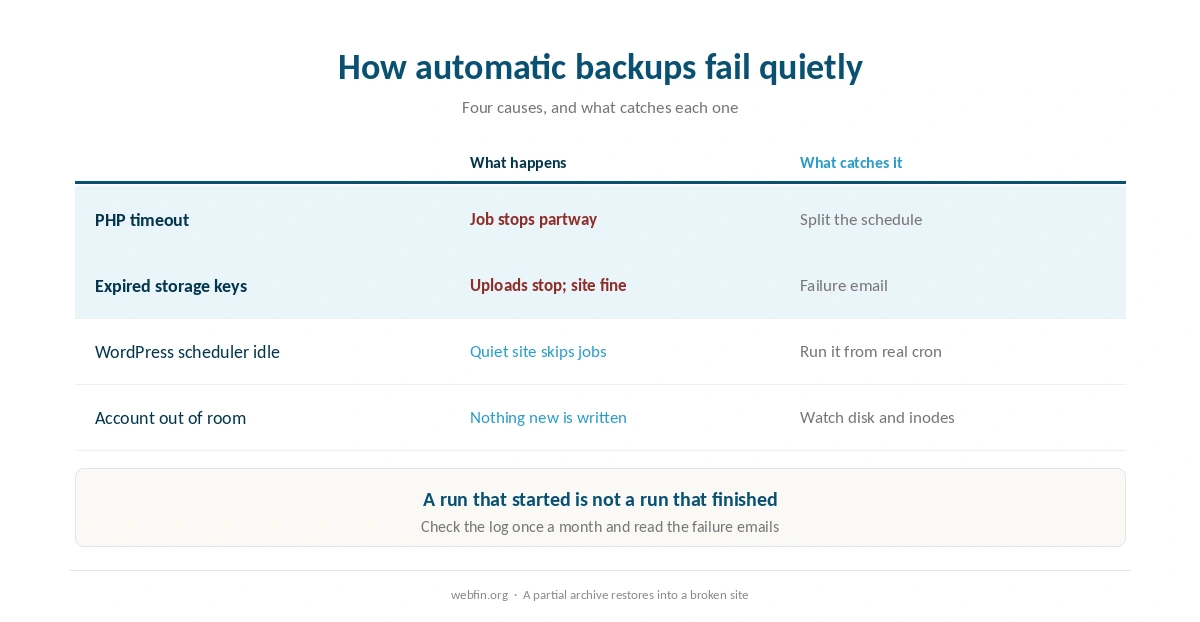
Check the log once a month. What you are looking for is a run that finished, not a run that started: a job that times out halfway leaves a partial archive that restores into a broken site.
Step 7: Restore One, on Purpose
A backup nobody has restored is a plan rather than a backup. Every few months, restore the most recent copy to a staging site and click through the front page, a product or post, and the login. Then delete the staging copy.
Restoring to staging rather than production is the whole point: you learn the process without risking the live site. Our guide to setting up a staging site covers the copy, and pushing a staging database over a live one is exactly what to avoid while testing.
What Breaks Automatic Backups
A PHP timeout on a large site. The job stops partway. Split the schedule: database separately from files, and exclude caches and other archives from the file job.
Expired credentials at the destination. Cloud storage keys and tokens expire. This one is easy to miss, and the failure email is what catches it.
WordPress’s own scheduler not firing. It runs on visits, so a quiet site may skip jobs. On a host with cron, run the plugin’s job from a real cron entry instead.
The account running out of room. Retained archives fill the disk or the inode allowance, and then nothing new is written. Our guide to checking whether your host is throttling you shows where those limits appear.
A Setting for Each Kind of Site
A blog or brochure site. Database daily, files weekly, copies off the host, fourteen days of daily retention.
A store. Database every few hours if the tool allows, files weekly, and a manual copy before every plugin update. Orders arrive at all hours.
A membership site. Database daily at least, and test restores more often, because member records are the product. Our list of hosting for membership sites covers the rest.
A portfolio with a large image library. Files weekly, but keep the originals on your own drive so the host holds only display copies. Our list of hosting for portfolio sites covers the storage side.
How We Research
This guide describes procedures rather than measurements, and it runs no tests. Backup frequencies, retention figures and add-on prices come from the hosts’ own pages and from the benchmark project we cite, as recorded in our reviews and read on 20 September 2026.
Tool names change often, so the steps describe what to look for rather than one plugin’s menus. The criteria behind our scores are on our about page. Two hosts that include daily copies are covered in our Scala Hosting review, and our Kinsta review describes the second.
Automatic Backups FAQ
Match the database to how often the site changes and the files to how often you update them. Daily database copies fit a site that changes daily, a store benefits from more, and weekly file copies plus one before each update cover the files.
It depends on frequency, retention and where the copy lives. ChemiCloud states ten days on its entry plan, Bluehost Starter keeps weekly copies, and HostGator calls its weekly copies a courtesy. Keep your own copies off the host regardless.
Outside the hosting account: object storage, a cloud drive or your own computer. Copies kept in the account share its fate if it is suspended or compromised, and they count against its disk and inode limits.
Four causes to check: a PHP timeout on a large job, expired credentials at the storage destination, WordPress’s scheduler not firing on a quiet site, and the account running out of room. Failure emails catch all four.
Restore one to a staging site every few months and click through the front page, a product or post, and the login. A backup nobody has restored is a plan rather than a backup.
The Verdict
Automatic backups are a half-hour setup and a monthly glance. Choose one place for the automation, split the database and files into separate schedules, send both off the host, keep a rotation rather than a single retention figure, and switch on failure alerts.
Then restore one on purpose, to a staging copy, before you ever need to in a hurry. That single habit is what separates a backup from an intention, and it is also the fastest way to find out that the chain has been broken for weeks. Our guide to recovering a hacked website covers the day you are glad you checked.