
Disclosure: WebFin is reader-supported. If you buy hosting through links on this page, we may earn a commission at no extra cost to you. Commissions vary between providers and our ratings do not — here’s our full disclosure.
WebFin runs on Hostinger, which appears below. We pay for the plan ourselves and have received no discount or other consideration, and that does not change how it scores.
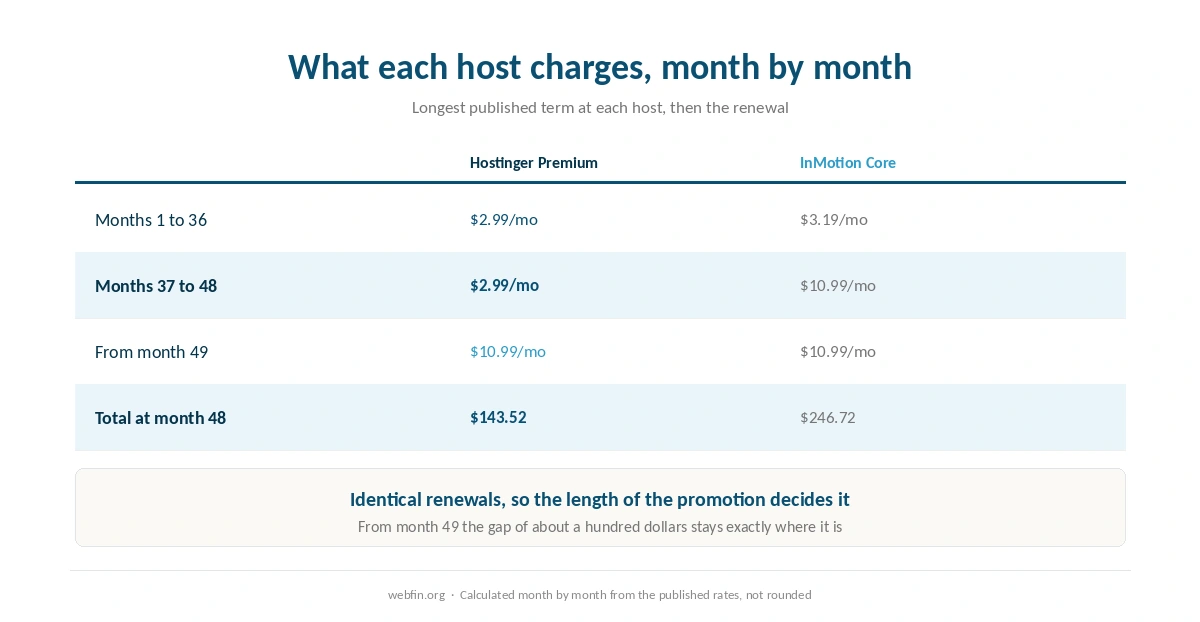
Hostinger vs InMotion comes down to a clock rather than a price. Both renew their entry plans at $10.99 a month. The difference is when that happens: InMotion Core renews after 36 months at $3.19, and Hostinger Premium holds $2.99 for 48 months first. So Hostinger is cheaper in every month of the first four years, and the year it gains is never clawed back. InMotion answers with a phone line staffed in the United States, a 90-day refund window and an owner that has never changed. The same InMotion figures against a Cloudways server are in our Cloudways and InMotion comparison.
Hostinger vs InMotion: The Short Answer
Hostinger, at 4.2 against 3.8 in our reviews. It costs $107.64 across 36 months against $114.84, keeps its opening rate for a year longer, and has the stronger measured record. InMotion is the better choice if you want to talk to a person on the phone or need three months to decide.
Head to Head
| Criterion | Hostinger Premium | InMotion Core |
|---|---|---|
| Intro rate | $2.99/mo for 48 months | $3.19/mo for 36 months |
| Renewal | $10.99/mo | $10.99/mo |
| Renewal step | 3.7× over 48 months | 3.4× over 36 months |
| 36 months | $107.64 | $114.84 |
| Measured uptime | 99.99%, 33 minutes in 2025 | No named measurement |
| Support | Chat and email; AI assistant first | Phone, chat and tickets, US staff |
| Refund window | 30 days | 90 days on 6-month terms |
| Monthly billing | Available | Not on shared plans |
| Owner | Private, Vilnius; about 30% PE-held | Independent since 2001 |
| Our score | 4.2 | 3.8 |
Why This Page Was Rewritten
An earlier version of this comparison had to work around a missing number. InMotion described its renewal only as an increase, so we calculated what it would need to be for InMotion to draw level and showed that no realistic figure got there. The verdict held, and the reasoning was an estimate.
InMotion now shows intro and renewal figures on its plan cards, and TechRadar lists Core at $3.19 renewing to $10.99 on a three-year term. So this page uses the real rate. The verdict is the same; the reason for it is now a published price rather than a bound. Our comparison of SiteGround against InMotion was rewritten for the same reason.
Same Renewal, Different Clock
For the first 36 months, Hostinger charges $2.99 and InMotion $3.19, so Hostinger is cheaper every month and reaches $107.64 against $114.84. Then InMotion renews at $10.99 while Hostinger stays at $2.99 for another year. By the end of month 48, the gap has grown to roughly a hundred dollars.
From month 49 both charge $10.99, so the gap stops growing and simply stays. Neither host ever becomes the cheaper one again, because the renewal is identical. That makes this one of the rare comparisons where the length of the promotion decides everything. Our page on hosting renewal prices lists both.
⚠️ Both prices assume the longest term. Hostinger’s best rate needs 48 months paid up front, and InMotion’s needs 36. On shorter terms InMotion Core renews higher, up to $14.49, so a buyer on an annual term pays more there than the table suggests. The same InMotion figures against Kinsta are in our Kinsta and InMotion comparison.
| Host and plan | How it builds | 36-month total |
|---|---|---|
| ChemiCloud Starter, 36-month term | 36 prepaid months at $2.49 | $89.64 |
| InterServer Standard | 36 months at $2.50, price locked | $90.00 |
| DreamHost Launch, 48-month term | 36 of 48 prepaid months at $2.89 | $104.04 |
| Namecheap Stellar, 24-month term | 24 at $1.98, then 12 at $4.88 | $106.08 |
| Hostinger Premium, 48-month term | 36 of 48 prepaid months at $2.99 | $107.64 |
| HostGator Hatchling, 36-month term | 36 months at $3.75, renewal not reached | $135.00 |
| HostGator Hatchling, with daily backups | 36 at $3.75, plus CodeGuard at $35.88 a year | $242.64 |
| Bluehost Starter, 36-month term | 36 months at $3.99, renewal not reached | $143.64 |
| GoDaddy Economy, 36-month term | 36 months at $5.99, renewal not reached | $215.64 |
| GoDaddy Economy, with SSL from year two | 36 at $5.99, plus $119.99 in years two and three | $455.62 |
| Hostwinds Basic, annual | 12 at $4.54, then 24 at $6.99 | $222.24 |
| SiteGround StartUp, 24-month term | 24 at $2.99, then 12 at $14.99 | $251.64 |
| DreamHost Launch, annual | 12 at $2.89, then 24 at $10.99 | $298.44 |
| Scala Hosting Mini, annual | 12 at $2.95, then 24 at $11.95 | $322.20 |
| Bluehost Starter, 12-month term | 12 at $3.99, then 24 at $11.99 | $335.64 |
| IONOS Plus, annual | 12 at $1.00, then 24 at $14.00 | $348.00 |
| GreenGeeks Lite, 36-month prepay | 36 months at $2.95 | $106.20 |
| GreenGeeks Lite, annual | 12 at $2.95, then 24 at $13.95 | $370.20 |
| SiteGround StartUp, 12-month term | 12 at $2.99, then 24 at $17.99 | $467.64 |
| Cloudways, from | 36 months at $14.00, flat | $504.00 |
| A2 Hosting Turbo Boost, annual | 12 at $6.99, then 24 at $20.99 | $587.64 |
| Rocket.net Starter, annual | 12 at $25.00, then 24 at $30.00 | $1,020.00 |
| WP Engine Startup, annual | 12 at $27.00, then 24 at $35.00 | $1,164.00 |
| Liquid Web managed VPS | 36 months at $33.00 | $1,188.00 |
| Kinsta Starter | 36 months at $35.00, flat | $1,260.00 |
| InMotion Core, 36-month term | 36 months at $3.19, renewal not reached | $114.84 |
| InMotion Launch, 36-month term | 36 months at $4.99, renewal not reached | $179.64 |
What the Longer Promotion Is Worth
A year at $2.99 instead of $10.99 sounds like a small thing on a pricing page. Across twelve months it is eight dollars a month, which accounts for almost all of the difference between the two hosts over a five-year stay. The twenty cents a month in the first three years adds the rest, and nothing else in their pricing moves the total as much.
The catch is the commitment behind it. Hostinger asks for 48 months in advance to give that year, and InMotion asks for 36. If the site might close in year two, the extra prepaid year is money spent on nothing, and the comparison looks different. For a site meant to last, our list of hosting for bloggers explains why the longest promotion usually wins.
The Measured Record
Hostinger has a long record from a named project. Hostingstep has monitored it continuously since 2021 and records 99.99% uptime across 2025, or 33 minutes offline. Its Business tier answers globally in 223 ms with a content network, and Premium in 495 ms without one. A shorter six-month window from HostPro Reviews put uptime at 99.93%.
InMotion has no equivalent from a named project in our tables. The response and uptime ranges we hold come from sources we could not attribute to a single publication, so we set them aside. That gap in evidence is part of the scoring difference, alongside price. Our guide to reading an uptime report explains how to weigh windows like these.
Where InMotion Is Genuinely Ahead
Support is the clearest case. InMotion answers phone, chat and tickets around the clock from staff in the United States, and reviews name it as the reason to choose the company. Hostinger has no phone line at any tier, and its support starts with an AI assistant before chat and email.
The refund window is the second. InMotion refunds for 90 days on shared and WordPress plans bought for six months or longer, three times Hostinger’s 30. For a buyer migrating an existing site, three months is enough to live with the new host properly before committing. Our guide to canceling hosting and getting a refund covers both.
Ownership is the third. InMotion has been independent since 2001 and never acquired. Hostinger is privately held from Vilnius with about 30% held by private equity. Both are reasonable; one simply has a longer unbroken record.
It is worth being precise about what a phone line is worth. Hosting problems tend to arrive at bad moments: a site down during a launch, an email that stopped overnight. A person on the phone can talk a non-technical owner through the fix in one call. A chat thread is often better for someone who wants a written record to follow later. Neither host publishes a measured response time, so the choice is about which kind of help suits you rather than which is faster.
The Refund Window Has a Condition
The 90 days apply to terms of six months or longer. InMotion shared plans have no monthly billing, so the long window and a short commitment cannot both apply to you. Hostinger offers monthly billing, which is a different kind of flexibility: a small commitment rather than a long refund.
Which one matters depends on how you buy. Someone testing an idea wants the short commitment. Someone moving a real site wants the long window. Our list of hosting for beginners weighs the same choice.
Plans, Limits and Everyday Use
InMotion Core allows one site and ten email accounts on SSD storage, and Launch lifts both limits with NVMe at $4.99 renewing to $13.99. Hostinger does not publish resource limits for its plans, which our table records as not published rather than guessing.
InMotion runs standard cPanel, so every tutorial matches the screen and accounts export cleanly. Hostinger runs its own panel, built for people who have never used cPanel. Both include a free certificate. Our guide to setting up email on your domain matters more at InMotion Core, given its mailbox cap.
Which Plans to Compare
Premium and Core are the entry plans, and each has a catch. Hostinger Premium has no content network, which is why it answers globally in 495 ms while Business, with the network, answers in 223 ms. InMotion Core has one site, ten mailboxes and SSD storage, which Launch fixes at $4.99 renewing to $13.99.
So a buyer who cares about speed abroad should look at Hostinger Business, and one who needs several mailboxes should look at InMotion Launch. At that level the price order stays the same, because Launch renews higher than Core while Hostinger keeps its longer promotion. Our guide to reducing TTFB explains what the content network changes, and our guide to choosing a hosting plan covers when an upgrade pays for itself.
Where Each One Is Weakest
Hostinger is weakest on contact and on disclosure. There is no phone line, the first reply comes from an AI assistant, and resource limits are not published at all. Its best rate also means paying four years in advance, which is the longest prepayment in this comparison.
InMotion is weakest on evidence and on flexibility. No named project measures it in our tables, its entry plan is narrow, and shared plans cannot be bought monthly. Its renewal also rises sharply on shorter terms, so the headline figure assumes a three-year commitment. Our page on hidden hosting fees collects what follows the first term at both.
Winners by Category
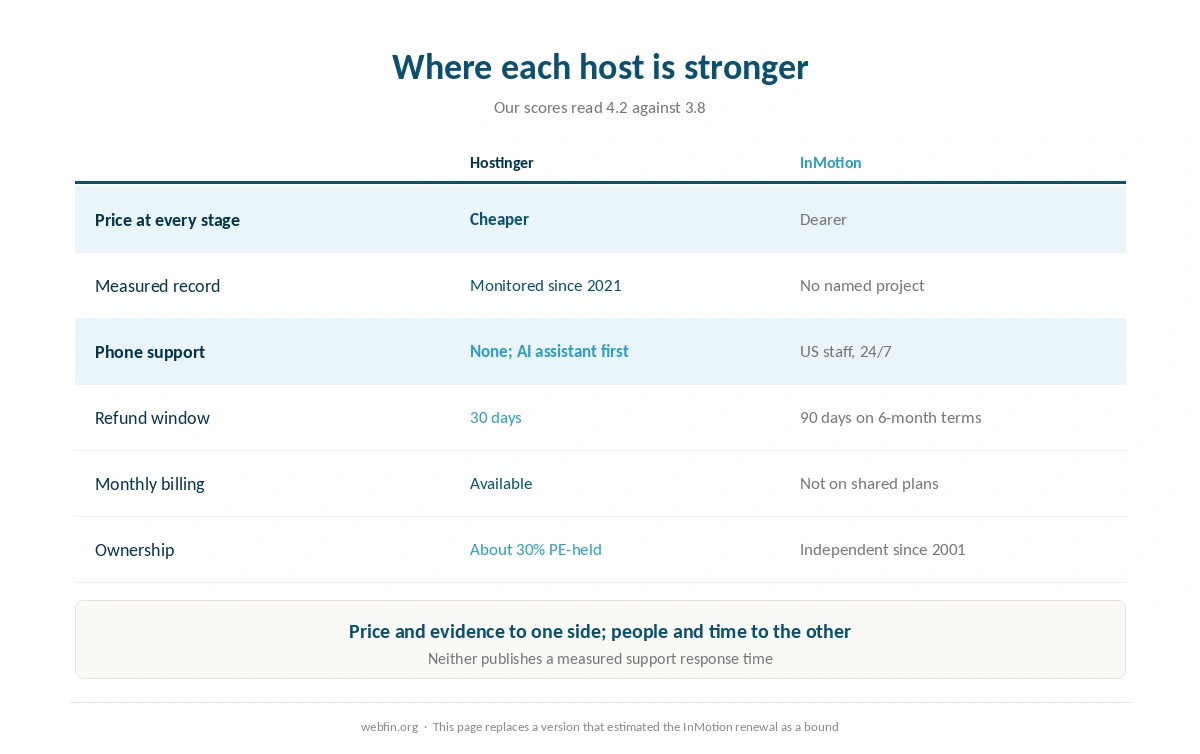
Price at every stage: Hostinger, cheaper in each of the first 48 months. Renewal: a tie, at $10.99. Length of promotion: Hostinger, at 48 months against 36. Measured record: Hostinger, monitored since 2021. Phone support: InMotion. Refund window: InMotion, at 90 days. Monthly billing: Hostinger. Ownership continuity: InMotion.
When to Choose InMotion Instead
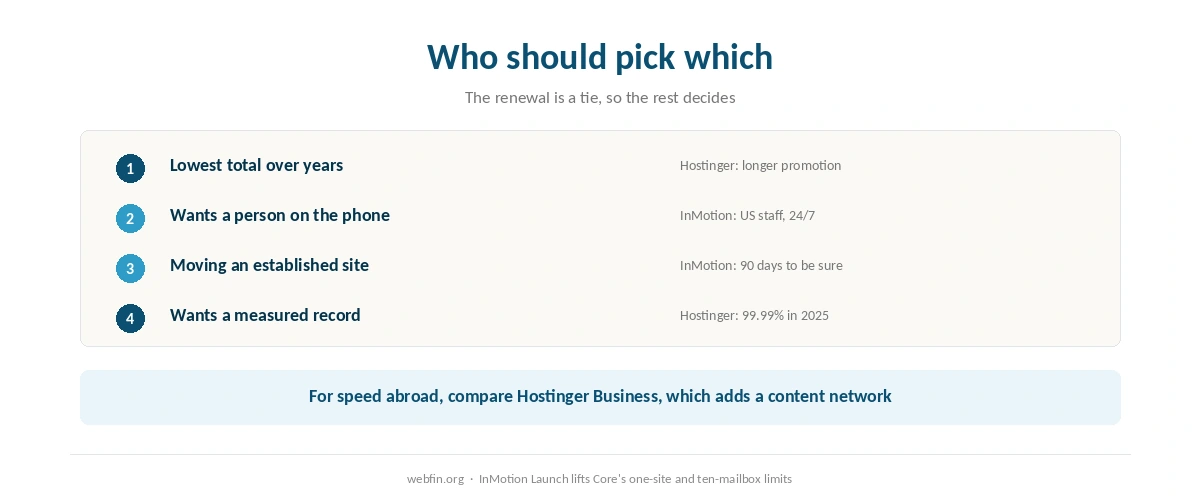
Take InMotion if you want to speak to a person when something breaks, or if you are moving an established site and want three months to be sure. Its renewal is identical to Hostinger’s, so the cost of that choice is the extra year of promotion you give up. Our comparison of Bluehost against InMotion, a Newfold Digital brand, sets it against another phone-first host.
Take Hostinger for price and evidence. It is cheaper at every point, its opening rate lasts longer, and its record is measured. Our roundup of cheap web hosting puts it in context.
How We Research
We run no tests. Hostinger uptime and response figures come from Hostingstep and HostPro Reviews with their windows. InMotion renewals come from TechRadar and the plan cards described in reviews this year, read on 20 September 2026. Figures we could not attribute to a named publication are set aside.
This page replaces an earlier version that estimated the InMotion renewal as a bound. The criteria behind our scores are on our about page, and the full workings are in our Hostinger review.
Hostinger vs InMotion FAQ
Hostinger, in every month of the first four years. It costs $107.64 across 36 months against $114.84 at InMotion Core, and it stays at $2.99 for a year after InMotion renews. Both then charge $10.99, so the gap simply remains.
Core renews at $10.99 on a three-year term, the same as Hostinger Premium, and Launch at $13.99. On shorter terms Core renews higher, up to $14.49. Earlier this year the figure was hard to find, which older reviews still reflect.
InMotion, from US staff around the clock alongside chat and tickets. Hostinger has no phone line; support starts with an AI assistant, then chat and email. Neither publishes a measured response time.
Hostinger gives 30 days. InMotion gives 90 on shared and WordPress plans bought for six months or longer, and 30 on monthly, VPS and reseller plans. InMotion shared plans have no monthly billing option.
Hostinger has the named record: 99.99% uptime across 2025 in monitoring that has run since 2021. InMotion has no measurement from a named project in our tables, so a fair comparison on reliability is not possible yet.
The Verdict
Hostinger takes this, at 4.2 against 3.8, and now on a published price rather than an estimate. The two renew identically, so the extra year of Hostinger’s promotion decides the money, and its measured record decides the rest.
InMotion is the better company to call. A US-staffed phone line, three months to change your mind and an owner unchanged since 2001 are real advantages, and none of them is about cost. Choose on which of those matters to you. If you move later, our guide to migrating web hosting covers the order.