
Disclosure: WebFin is reader-supported. If you buy hosting through links on this page, we may earn a commission at no extra cost to you. Commissions vary between providers and our ratings do not — here’s our full disclosure.
WebFin runs on Hostinger. We pay for the plan ourselves and have received no discount or other consideration, and that does not change how it scores. This page is a use-case answer rather than a review; the full workings are in our Hostinger review.
This is a short answer with a long explanation. Magento does not belong on a shared hosting plan, at Hostinger or anywhere else. Magento 2 expects a separate search service, memory measured in gigabytes for a single compile, command-line access for Composer and a real cron schedule. A shared account gives none of those. The plans we price at Hostinger are shared plans, so the honest answer here is no, and the useful part is what to buy instead.
Is Hostinger Right for Magento? The Short Answer
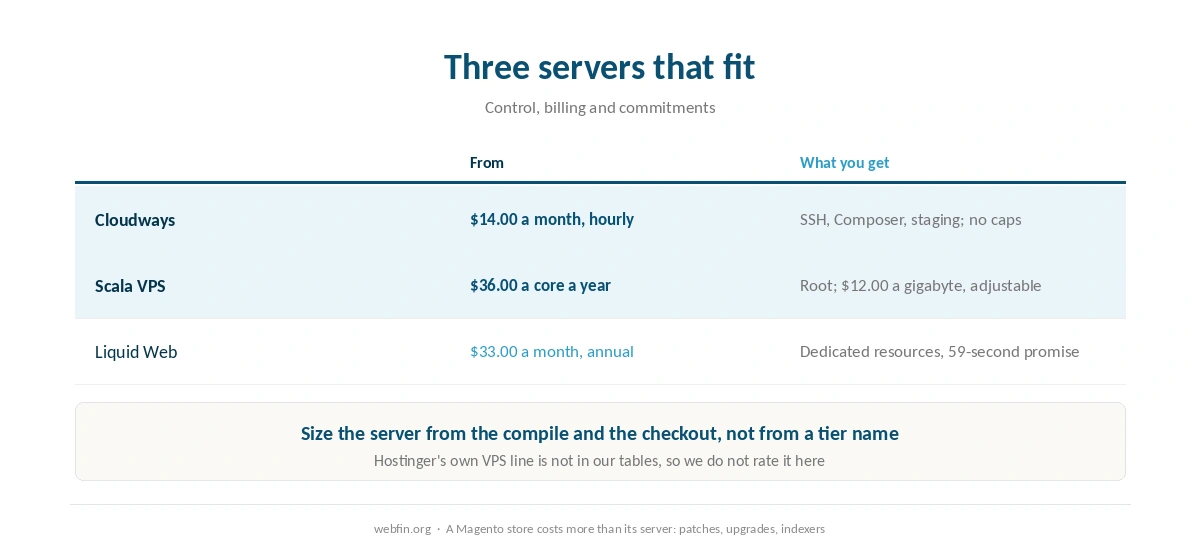
No, for its shared plans, and our tables only cover those. Magento needs a server: memory you own, a search service running beside the store, Composer on the command line and cron you control. Cloudways from $14.00 a month, Scala’s VPS at $36.00 a year per processor core, or Liquid Web from $33.00 a month are the shapes that fit. If the store is small, WooCommerce on shared hosting is a more sensible plan than Magento on a server you cannot afford.
What Magento Actually Requires
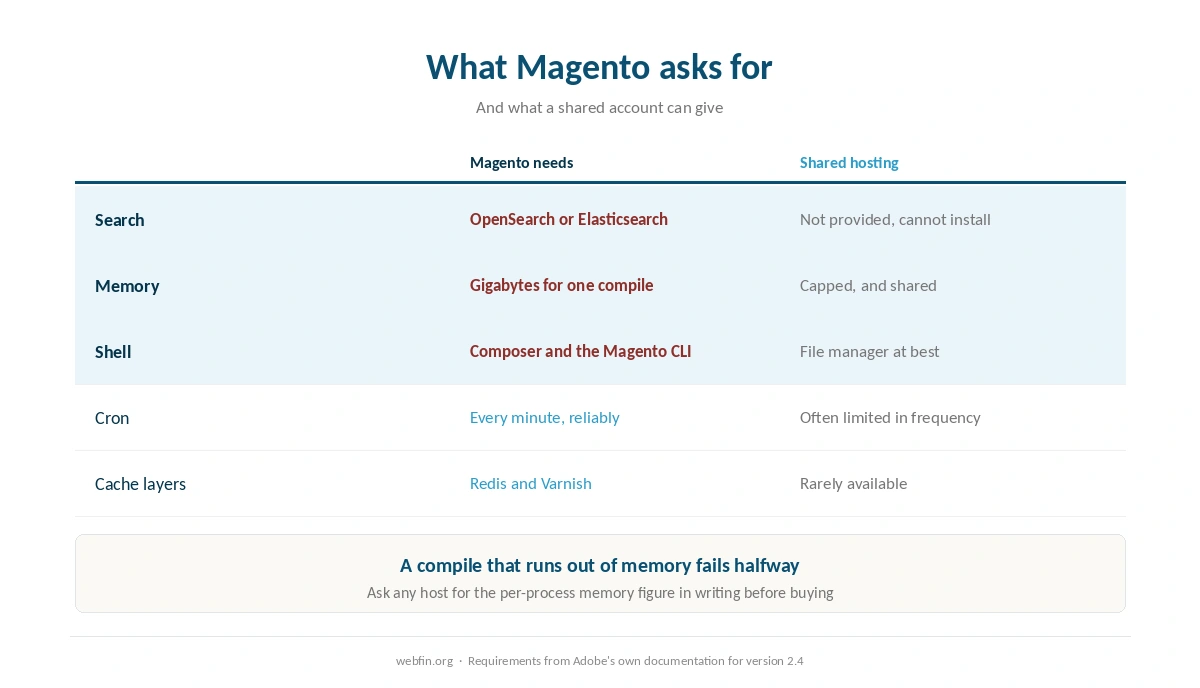
A search service. Magento 2.4 requires OpenSearch or Elasticsearch, which is a separate service with its own memory. Shared hosting does not run it for you, and you cannot install it without root.
Memory in gigabytes. Compiling and deploying static content is memory-hungry, and Adobe’s own guidance is measured in gigabytes rather than megabytes for that step alone.
The command line. Composer, the Magento CLI, cache flushes and reindexing all run from a shell. A file manager cannot do any of it.
Real cron. Indexers, emails and scheduled imports depend on cron running every minute. A shared panel often limits the frequency.
| Host and plan | Limit | Where it's stated |
|---|---|---|
| Bluehost shared | 50,000 inodes — soft limit | Hosting Inode Limit article |
| Bluehost shared | 200,000 inodes — AUP threshold | Server Resource Limitations |
| Bluehost shared | 1,000,000 inodes — TOS violation | Hosting Inode Limit article |
| Bluehost shared | 5,000 tables or 10 GB, all databases | Server Resource Limitations |
| Bluehost shared | 5 GB per single database | Server Resource Limitations |
| Bluehost Starter | 100 MB per mailbox | Shared hosting prices page |
| WP Engine Startup | 25,000 monthly visits, then overage handling | Plan pages |
| WP Engine, by tier | 25,000 to 400,000 monthly visits | Plan pages |
| Rocket.net Starter | 25,000 monthly visits, 1 site, 10 GB storage | Plan pages |
| Namecheap EasyWP | 50,000 / 200,000 / 500,000 monthly visits by tier | Plan pages |
| Kinsta Starter | 25,000 monthly visits | Plan pages |
| Scala Hosting VPS | Priced per unit: $3 per core, $1 per gigabyte | Plan pages; adjustable anytime |
| HostGator shared | Weekly backups described as a courtesy, not guaranteed | Hosting terms |
| Liquid Web | Dedicated resources at every tier; no shared plan | Plan pages |
| InterServer Standard | Unlimited storage, bandwidth, email and websites | One plan, no tiers |
| GreenGeeks Lite | One website only | Plan pages |
| IONOS Plus | One email account bundled per plan | Plan pages |
| Hostinger, all plans | Not published | Hostinger support article, 28 Aug 2026 |
| Bluehost Starter | 10 GB NVMe storage | Plan pages, as listed in a 2026 audit |
| InMotion Core | One site, 10 email accounts, SSD storage; NVMe from Launch | TechRadar and a 2026 review |
| SiteGround shared | Shell access by tier — not recorded | Not stated on the plan pages we read, 20 Sep 2026 |
| Bluehost shared | Shell access by tier — not recorded | Not stated on the plan pages we read, 20 Sep 2026 |
| Hostinger, all plans | Shell access by tier — not recorded | Not stated on the plan pages we read, 20 Sep 2026 |
| Cloudways servers | Search service (OpenSearch, Elasticsearch) — not recorded | Not stated on the plan pages we read, 20 Sep 2026 |
Why the Hostinger Figures Do Not Answer This
Hostinger is well measured for what it is. Uptime came in at 99.99% across 2025, from continuous monitoring since 2021. Cached global delivery is 223 ms on Business against 495 ms on Premium, and a front-end paint figure of 0.607 seconds.
Every one of those describes a cached page on a shared plan. Magento’s hard parts are uncached: the checkout, the customer account, the admin panel and the indexers. There is also no load test result for Hostinger in our tables, and its resource limits are not published, which a support article dated 28 August 2026 confirms.
⚠️ So the figures are not bad news for Magento. They are simply about a different question. Our list of hosting for ecommerce ranks hosts by the load test rather than by cached delivery.
What to Buy Instead
Cloudways. A managed server from $14.00 a month, billed by the hour. SSH, Composer and staging are on every tier, and there are no visit caps. Size it for Magento rather than accepting a tier, and remember its weakest published load result was 288 ms with a 1.7% error rate on one cloud. Our Cloudways review covers each cloud.
Scala Hosting’s VPS. Priced per unit, with root: $36.00 a year for a processor core and $12.00 for a gigabyte of memory, adjustable at any time. That is the clearest way to buy the memory a compile needs. Our Scala Hosting review covers the line.
Liquid Web. Managed VPS from $33.00 a month on annual billing. Dedicated resources on every managed tier, root access, a 59-second support commitment and 100% network uptime backed by credits. Our Liquid Web review covers the disputes around those promises.
Our list of hosting for SaaS startups covers the same three hosts from the application side.
Consider Whether You Need Magento
Magento is built for catalogs with thousands of products, complex pricing rules and several storefronts. If your store has fifty products and one currency, the platform costs more to host than the features are worth.
WooCommerce runs on shared hosting. Our page on Hostinger for WooCommerce covers what that plan does and does not cover. That is not a lesser answer; for most small stores it is the right one.
The Cost Nobody Mentions
A Magento store on a server costs more than the server. Somebody has to apply security patches, run upgrades on a copy first, and watch the indexers. That work does not exist on a shared plan, because the platform does not run there.
So price the time as well as the plan. If nobody on the team wants to maintain a server, simpler software on a host with a clean load result is the better outcome.
And read what a managed provider actually promises to do for you, which our guide to reading a hosting agreement covers.
How to Judge Any Host for Magento
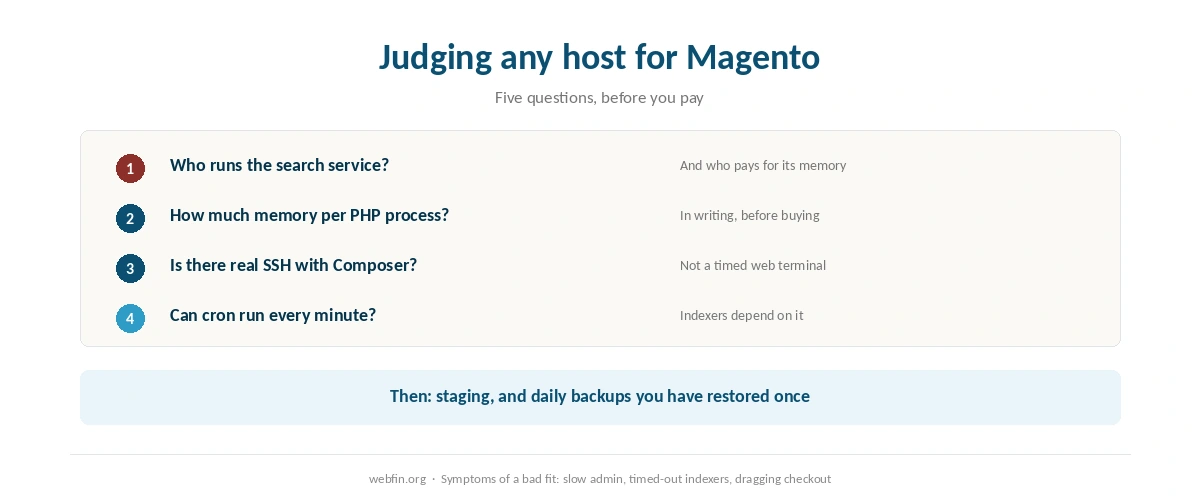
Does it run OpenSearch or Elasticsearch, and who pays for the memory? Either the host provides the service or you run it on your own server.
How much memory per PHP process? Ask for the figure in writing before you buy, because a compile that runs out of memory fails halfway.
Is there real SSH with Composer? Not a web terminal with a timeout.
Can cron run every minute? Indexers depend on it, and shared panels often cap frequency.
Is there staging, and are backups daily? A Magento upgrade is not something to try on the live store, as our guide to setting up a staging site explains.
If You Are Already on Shared Hosting
A Magento store that half-works on a shared plan shows three symptoms. The admin panel is slow, indexers time out, and the checkout drags under any load. None of those is a bug in Magento.
Move rather than optimize. Size the server from the memory a compile needs and the concurrency your checkout sees, which our guide to moving from shared to VPS covers.
Check the resource faults on the old plan first, so you know what you are replacing. Our guide to checking whether your host is throttling you shows where they appear.
How We Research
We run no tests. Hostinger’s figures come from Hostingstep, continuous since 2021, with global first-byte rankings from its 2026 benchmarks, and from a ten-week TechRadar window. There is no load test result for Hostinger in our tables, and we say so rather than borrow one.
Magento’s requirements come from Adobe’s own documentation for version 2.4. Hostinger’s VPS line is not in our tables, so we do not rate it here; the plans we price are its shared plans. We host this site on Hostinger and pay for the plan, as disclosed above. The criteria are on our about page.
Hostinger for Magento FAQ
Not usefully. Magento 2.4 requires OpenSearch or Elasticsearch as a separate service. It also needs gigabytes of memory for a compile, Composer on the command line and cron every minute. A shared account provides none of those.
They are not in our tables, so we do not rate them here. The principle holds either way. Magento needs memory you own, a search service beside the store and root access, and those are server features.
A server. Cloudways from $14.00 a month billed by the hour, or Scala’s VPS at $36.00 a year per core and $12.00 per gigabyte. Liquid Web starts at $33.00 a month with dedicated resources and root.
Enough that Adobe’s own guidance is measured in gigabytes for the compile and deploy step alone. Ask any host for the per-process memory figure in writing before buying, because a compile that runs out of memory fails halfway.
For a small store, often yes. Magento is built for large catalogs, complex pricing and multiple storefronts. With fifty products and one currency, WooCommerce on shared hosting costs far less to run.
The Verdict
Hostinger is a good shared host, and Magento is not a shared-hosting application. So this page ends in a recommendation against rather than for. Nothing in Hostinger’s measured record argues the other way, because none of it describes the uncached, memory-hungry work Magento does.
Buy a server sized to the compile and the checkout. That means Cloudways by the hour, Scala’s VPS by the unit, or Liquid Web with dedicated resources. And ask honestly whether the store needs Magento at all, because WooCommerce on a cheap plan beats Magento on a server you cannot maintain. Our page on what web hosting costs prices the alternatives across three years.