
Disclosure: WebFin is reader-supported. If you buy hosting through links on this page, we may earn a commission at no extra cost to you. Commissions vary between providers and our ratings do not — here’s our full disclosure.
Bluehost vs DreamHost sets the most measured host in shared hosting against one of the cheapest to keep. DreamHost Launch opens at $2.89 and holds that rate for 48 months on its longest term, then renews at $7.99. Bluehost Starter opens at $3.99 for 36 months and renews at $9.99. So DreamHost is cheaper at every stage we can price. Bluehost answers with the evidence: a complete record in the benchmarks, a load test passed at 41 ms, and a phone line that DreamHost does not offer. The same DreamHost figures against Kinsta are in our Kinsta and DreamHost comparison.
Bluehost vs DreamHost: The Short Answer
DreamHost, for most small sites. Three years cost $104.04 against $143.64, it is still at its opening rate in year four, and it is independent of the large hosting groups. Bluehost scores higher in our reviews, at 4.0 against 3.7, on measured performance and support.
Head to Head
| Criterion | Bluehost Starter | DreamHost Launch |
|---|---|---|
| Intro rate | $3.99/mo for 36 months | $2.89/mo for 48 months |
| Renewal on the longest term | $9.99/mo | $7.99/mo |
| Renewal on annual terms | $11.99/mo | $10.99/mo |
| 36 months, longest term | $143.64 | $104.04 |
| 36 months, annual terms | $335.64 | $298.44 |
| Response time | 411 ms, 99.99% uptime | 450 to 500 ms band |
| Load test | 41 ms, no errors | Not in our table for shared |
| Support | Phone and chat, 24/7 | Chat, email and tickets; no phone |
| Refund window | 30 days, $15.99 kept for the domain | 97 days, disputed |
| Domain privacy | Sold separately | Included for life |
| Owner | Newfold Digital, 2021 | Independent, employee-owned |
| Our score | 4.0 | 3.7 |
Cheaper at Every Stage
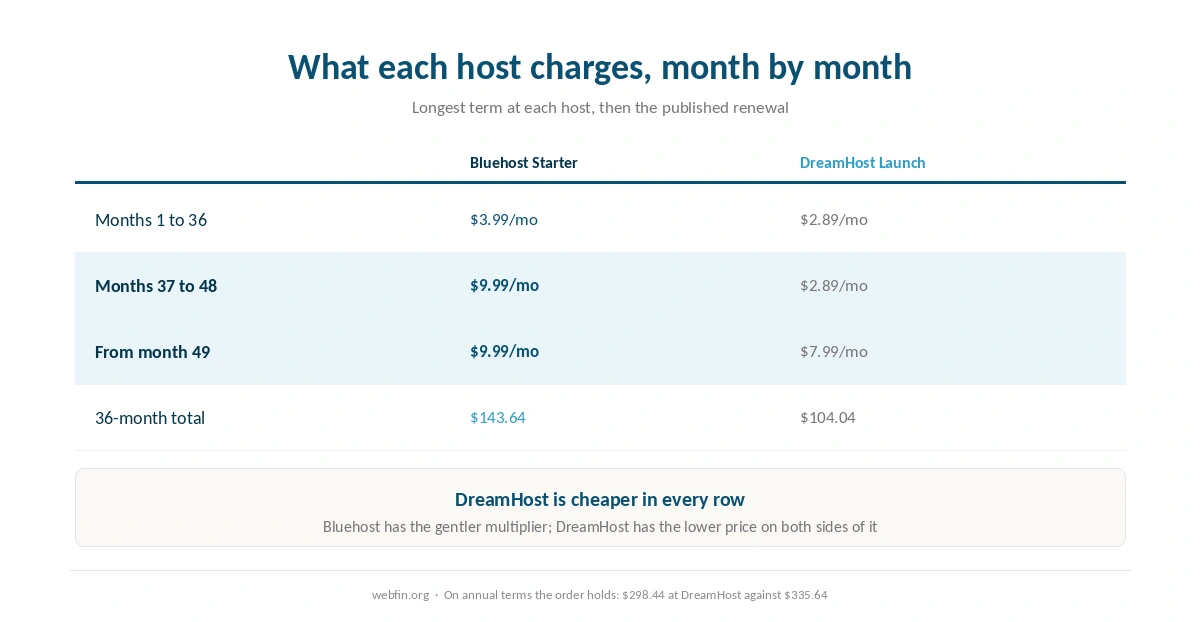
DreamHost Launch holds $2.89 for 48 months on its four-year term and renews at $7.99, which is 2.8× over 48 months. Bluehost Starter holds $3.99 for 36 months and renews at $9.99, which is 2.5× over 36 months. Bluehost has the gentler multiplier, and DreamHost has the lower price on both sides of it.
On those terms, three years cost $104.04 at DreamHost and $143.64 at Bluehost. Month 37 is where the gap opens properly: Bluehost starts billing $9.99 while DreamHost is still at $2.89 for another year. From month 49 DreamHost renews at $7.99, still two dollars a month below Bluehost. Our page on hosting renewal prices puts both beside the field.
Annual terms keep the order. DreamHost renews at $10.99 on a 12-month term, which is 3.8× over 12 months, and Bluehost at $11.99. Three years come to $298.44 against $335.64. The four-year prepayment is the catch at DreamHost, since the lowest rate means paying for 48 months up front.
| Host and plan | Intro → Renewal | Multiplier |
|---|---|---|
| IONOS Plus | $1.00 → $14.00 | 14.0× over 12 months |
| SiteGround StartUp | $2.99 → $17.99 | 6.0× over 12 months |
| SiteGround GrowBig | $4.99 → $29.99 | 6.0× over 12 months |
| SiteGround GoGeek | $7.99 → $44.99 | 5.6× over 12 months |
| ChemiCloud Starter | $2.49 → not published | Renewal shown at checkout only |
| Scala Hosting Mini | $2.95 → $11.95 | 4.1× over 12 months |
| DreamHost Launch, annual | $2.89 → $10.99 | 3.8× over 12 months |
| Hostinger Premium | $2.99 → $10.99 | 3.7× over 48 months |
| Bluehost Starter | $3.99 → $11.99 | 3.0× over 12 months |
| A2 Hosting Turbo Boost | $6.99 → $20.99 | 3.0× over 12 months |
| HostGator Hatchling | $3.75 → $10.99 | 2.9× over 36 months |
| GoDaddy Economy | $5.99 → $15.32 | 2.6× over 36 months |
| Bluehost Starter | $3.99 → $9.99 | 2.5× over 36 months |
| Namecheap Stellar | $1.98 → $4.88 | 2.5× over 12 or 24 months |
| Namecheap Stellar Plus | $2.98 → $6.88 | 2.3× over 12 or 24 months |
| Namecheap Stellar Business | $4.98 → $9.88 | 2.0× over 12 or 24 months |
| DreamHost Launch, 4-year | $2.89 → $7.99 | 2.8× over 48 months |
| DreamHost, eligible US nonprofits | One shared plan free for the account's life | 501(c)(3) or (c)(19); help article, checked 10 Jun 2026 by a nonprofit directory |
| Bluehost Business | $6.99 → $13.99 | 2.0× over 36 months |
| Bluehost Starter, second reading | $1.99 → $8.99 | Hostingstep, July 2026; conflicts with Bluehost's help page |
| Hostwinds Basic | $4.54 → $6.99 | 1.5× over 12 months |
| WP Engine Startup | $27.00 → $35.00 | 1.3× over 12 months |
| Rocket.net Starter | $25.00 → $30.00 | 1.2× over 12 months |
| InterServer Standard | $2.50 flat | 1.0×, price lock |
| Cloudways, from | $14.00 flat | no promotional term |
| Kinsta Starter | $35.00 flat | no promotional term |
| Liquid Web managed VPS, annual billing | $33.00, no promotional term | No increase described on annual billing |
| Liquid Web managed VPS, monthly billing | $36.00 → $72.00 reported | 2.0× over one month; one pricing guide, disputed |
| GreenGeeks Lite | $2.95 → $13.95 | 4.7× after one term; renewal was $12.95 before 2026 |
| ChemiCloud Starter, third-party figures | $9.95, $11.95 or $12.95 quoted | Sources disagree; 4.0× to 5.2× over 36 months |
| SiteGround StartUp, by term | $2.99 → $14.99, $17.99 or $24.99 | 5.0× over 24 months, 6.0× over 12, 8.4× month to month |
| ChemiCloud Kickstart, reseller | $8.99 → $29.95 | Term not stated in the source we read |
| InterServer reseller | $19.95, price locked | No increase described in sources |
| GreenGeeks reseller | $19.95 with WHMCS included | Promotional rate; renewal not published |
| Hostwinds white-label reseller | $10.00 with WHMCS included | Plain reseller plan excludes WHMCS |
| InMotion Core, 36-month term | $3.19 → $10.99 | 3.4× over 36 months; TechRadar, 2026 |
| InMotion Launch, 36-month term | $4.99 → $13.99 | 2.8× over 36 months; TechRadar and plan cards, 2026 |
| InMotion Core, by term | Renews at $10.99, $11.99 or $14.49 | Longest term lowest; one review, May 2026 |
The Evidence Favors Bluehost
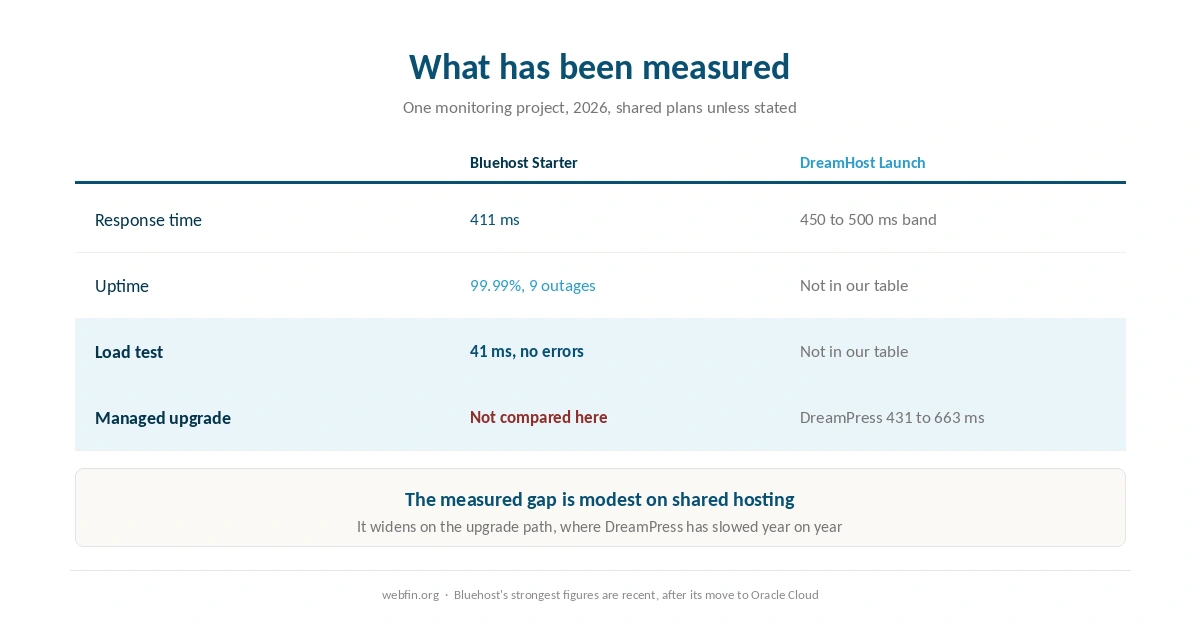
We run no tests, so these figures belong to Hostingstep. Bluehost records 411 ms response time and 99.99% uptime over 9 outages between November 2025 and August 2026. After its move to Oracle Cloud it passed the load test at 41 ms with no errors, and its hardware scores 9.6 of 10, at the top of that project’s shared results.
DreamHost sits in the 450 to 500 ms band in the same project, alongside several budget hosts, which is a reasonable result and a thinner record. We have no shared-plan load figure for it in our table. Its managed WordPress line tells a weaker story: DreamPress regressed from 431 ms to 663 ms between years and posted the slowest load score of any managed host in that project, at 221 ms.
⚠️ So the measured gap is modest on shared hosting and clearer on the upgrade path. If you expect to move from shared to managed WordPress later, that DreamPress trend is worth reading first. Our guide to reading an uptime report explains why a thin record weighs less than a long one.
One more point of fairness. The strongest Bluehost figures are recent: the load result comes from a July 2026 rerun after the move to Oracle Cloud, replacing a weaker reading under the project’s older method. They describe new infrastructure with a short history. DreamHost’s middling figures, by contrast, describe a setup that has not changed much, which makes them less impressive and more predictable. A buyer who values a stable track record over a strong recent one could reasonably read this section the other way.
Refunds, and a Window Nobody Agrees On
DreamHost is quoted at 97 days by four sources and 30 days by another, and we have not resolved it. Bluehost refunds for 30 days and keeps $15.99 for the free domain if you leave early. Even at the lower reading, DreamHost matches Bluehost, and at the higher one it runs more than three times as long.
Confirm the DreamHost window at checkout and keep the page. It matters more than usual here, because the cheapest rate needs a 48-month prepayment. Our guide to canceling hosting and getting a refund covers the order that keeps the site and domain safe.
Support: The One Clear Bluehost Advantage
Bluehost answers the phone and chat around the clock. DreamHost offers chat, email and tickets, and no telephone line at all. Neither publishes a measured response time, and no controlled test of hosting support exists in the sources we found.
For a buyer who solves problems by calling someone, that difference can outweigh the price. For one who prefers writing things down, a ticket system is often better, because it leaves a record. Which kind of buyer you are is worth deciding before the price does it for you.
What Is Included, and What Is Sold
DreamHost includes WHOIS privacy for the life of the domain, which several hosts bill every year. Bluehost sells the extras from its dashboard: a premium certificate at $89.88 that most sites do not need, SiteLock from $95.88, and Yoast SEO Premium at $99.99. Newfold Digital owns Yoast as well as Bluehost.
None of the Bluehost extras are required, and all of them are easy to decline. They still show the difference in how the two companies earn. Our page on hidden hosting fees collects these charges across the field.
Panels and Everyday Use
DreamHost runs its own control panel rather than cPanel, and it has done so for years. It is clean and complete, and the skills do not transfer to other hosts. Bluehost puts a WordPress dashboard in front of cPanel, which is the more familiar tool for anyone who has rented hosting before.
Portability follows from that. A cPanel account exports in a standard format, so leaving Bluehost later is routine. Leaving DreamHost means moving the site rather than the account, which our guide to migrating web hosting covers step by step.
What the Four-Year Term Asks of You
DreamHost’s lowest rate is the reward for paying four years in advance. That is the longest commitment in this comparison, and it moves the risk onto the buyer: if the site closes in year two, the remaining months are spent. The refund window covers the start of the term, not the middle.
Bluehost asks for three years to reach its best rate, which is a shorter bet on the same kind of promise. Neither arrangement is unusual, because the discount exists precisely to buy the long commitment. Ask yourself one question before either: will this site exist at the end of the term? If the honest answer is maybe, the annual rates above are the fairer comparison, and DreamHost still wins it.
Where Each One Is Weakest
DreamHost is weakest on evidence and on the upgrade path. Its shared record in the benchmarks is thinner than Bluehost’s, it has no load figure in our table, and its managed line has slowed year on year. The refund window is also disputed, which is an odd thing to be uncertain about at a company this established.
Bluehost is weakest on price and on everything after checkout. It costs more at every term, its dashboard sells add-ons most sites do not need, and it keeps $15.99 of your refund for the free domain. None of that affects how fast the site loads. All of it affects what you pay across the years you keep it.
Who Owns Them
Bluehost has belonged to Newfold Digital since 2021, alongside HostGator and Yoast SEO, and who owns Bluehost traces the group. DreamHost describes itself as independent and employee-owned, and no outside group appears in its ownership in anything we read.
Ownership shapes renewal policy more than anything else in this market. A company that answers to its staff rather than to a portfolio has fewer reasons to raise a renewal after an acquisition, because there has been none. That is not a guarantee, and it is a better starting point than most.
Winners by Category
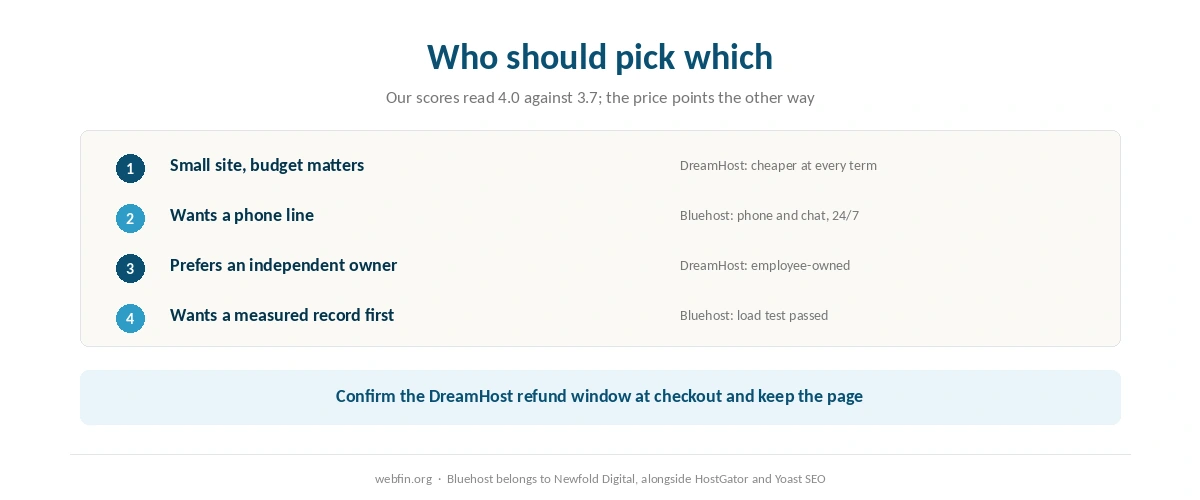
Three-year price: DreamHost, at $104.04 against $143.64. Year four: DreamHost, still at $2.89 while Bluehost charges $9.99. Renewal multiplier: Bluehost, at 2.5× over 36 months. Measured record: Bluehost, complete and current. Load handling: Bluehost, at 41 ms with no errors. Support channels: Bluehost, with a phone line. Refund window: DreamHost, at 97 days by most sources. Ownership: DreamHost, independent.
When to Choose Bluehost Instead
Take Bluehost if you want the measured record before paying, or a phone line when something breaks. Its load result and hardware score are the strongest numbers on this page, and its 36-month term needs a shorter prepayment than DreamHost’s 48. Our comparison of Bluehost against HostGator covers the other brand in its group.
Take DreamHost if the site is small, the budget matters and you prefer an independent company. It costs less at every term we can price and includes domain privacy permanently. Our roundup of cheap web hosting shows where both sit at the bottom of the market.
How We Research
We run no tests. Measurements come from Hostingstep’s 2026 benchmarks and reviews with their windows, and we say where a figure is missing rather than borrowing one from an unnamed study. Prices, terms and inclusions come from the providers’ own pages, read on 20 September 2026.
Where sources disagree, as they do on the DreamHost refund window, we print both readings. The criteria behind our scores are on our about page, and the full workings are in our DreamHost review.
Bluehost vs DreamHost FAQ
DreamHost at every term we can price. On the longest terms, three years cost $104.04 against $143.64, and DreamHost is still at $2.89 in year four. On annual terms it is $298.44 against $335.64. The catch is a 48-month prepayment for its lowest rate.
Bluehost, on the published record: 411 ms response, 99.99% uptime and a load test at 41 ms with no errors. DreamHost shared sits in the 450 to 500 ms band with a thinner record, and its managed DreamPress line has slowed.
No. It offers chat, email and tickets. Bluehost answers phone and chat around the clock. Neither publishes a measured response time, so the difference is the channel rather than a proven speed of reply.
Four sources say 97 days and one says 30, and we have not resolved it. Even the lower figure matches Bluehost, which refunds for 30 days and keeps $15.99 for the free domain. Confirm the DreamHost window at checkout.
Bluehost belongs to Newfold Digital, which also owns HostGator and Yoast SEO. DreamHost describes itself as independent and employee-owned. That matters mainly for renewal policy, which tends to follow the owner.
The Verdict
DreamHost is the better buy for most small sites, and it is not close on price: cheaper at every term, still at its opening rate in year four, with domain privacy included and an independent owner. Our scores read 4.0 against 3.7 in Bluehost’s favor, because measured performance and a phone line count, and those two facts sit together without contradiction.
Bluehost is the better host to verify. Its record is complete, its load result is excellent, and its prepayment is shorter. Buy DreamHost for the price and the owner, or Bluehost for the evidence and the phone. If you are moving later, our guide to what web hosting costs runs both out to three years.